
American Peppers With U.S. Breeding History or a Regional Food Identity
United States pepper culture includes New Mexican chile breeding, Mid-Atlantic and immigrant heirlooms, Florida Datil, and South Carolina superhots.

Notable Varieties
All American Peppers
Every variety in this collection, sorted by maximum Scoville heat rating. Click any card for the full profile with flavor notes, anatomy details, growing tips, and substitutes.
 Super-Hot
Apollo Pepper
 Super-Hot
Pepper X
 Super-Hot
Carolina Reaper
 Super-Hot
Chocolate Bhutlah
 Super-Hot
7 Pot Brain Strain
 Extra-Hot
Nagabon
 Extra-Hot
Red Savina Habanero
 Extra-Hot
Datil Pepper
 Extra-Hot
Charleston Hot
 Hot
Hot
Sugar Rush Stripey
 Hot
Hot
Prairie Fire
 Hot
Hot
Buena Mulata
 Hot
Hot
NuMex Twilight
 Hot
Hot
Fish Pepper
 Hot
Hot
Black Pearl Pepper
 Hot
Hot
Hinkelhatz Pepper
 Hot
Hot
Peter Pepper
 Hot
Hot
Fresno Pepper
 Hot
Hot
Lumbre Pepper
View profile → Medium
NuMex Heritage Big Jim
View profile → Medium
New Mexico Chile
 Medium
Hatch Chile
 Medium
Pretty in Purple Pepper
 Medium
Sandia Pepper
 Medium
Chimayo Pepper
 Medium
Sangria Pepper
 Medium
Cowhorn Pepper
 Medium
NuMex Centennial Pepper
View profile → Medium
Cajun Belle
 Medium
NuMex Big Jim
 Medium
Numex Easter
 Medium
Anaheim Pepper
 Medium
NuMex Heritage 6-4
 Medium
Medusa Pepper
 Medium
Chilly Chili Pepper
View profile → Mild
Mild
NuMex Joe E. Parker
View profile → Mild
Mild
NuMex Suave Orange
 Mild
Mild
Santa Fe Grande
 Mild
Mild
Cherry Pepper
 Mild
Mild
Lipstick Pepper
 Mild
Mild
Carmen Pepper
 Mild
Mild
Tangerine Dream Pepper
View profile → Mild
Mild
Habanada
Species Breakdown
The United States peppers span multiple Capsicum species. Each species has distinct characteristics, which the profiles below explain in detail.
What Counts as an American Pepper?
American peppers in this collection have either a documented United States breeding history or a durable identity in a U.S. regional food tradition. A pepper does not enter this group merely because a domestic nursery sells it or an American gardener grows it.
That boundary keeps geography clear. The New Mexico State University Chile Pepper Institute explains that domesticated Capsicum peppers originated in the Americas, but Mexican, Caribbean, and South American cultivars still belong in their own regional collections.
Public releases such as NuMex cultivars and Cornell's Habanada qualify through named breeding programs. Fish pepper, Datil, Jimmy Nardello, Hinkelhatz, and Beaver Dam qualify through community seed keeping and documented local use.
A named American university, public program, or breeder documents the selection history.
A community, place, and food tradition preserve the pepper's identity across generations.
New Mexico Chile Has Three Different Identities
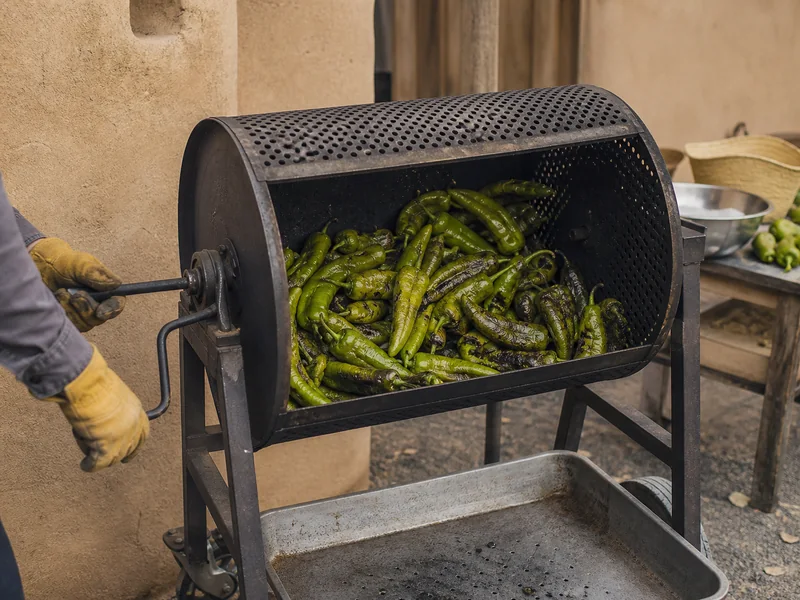
Hatch names a growing region, not one cultivar. The NMSU Chile Pepper Institute notes that Hatch-grown pods may be NuMex Big Jim, Sandia, Anaheim, Española Improved, New Mexico 6-4, or another named New Mexican type.
The pod type has its own breeding history. NMSU credits Fabián García with developing New Mexico No. 9 in the early twentieth century, establishing a long green chile line that influenced later New Mexican cultivars.
That distinction changes how you shop and cook. The regional label tells you where a crop was grown, while the cultivar name better predicts heat, pod size, wall thickness, and whether the pepper suits roasting, chile rellenos, red sauce, or drying.
Four U.S. Traditions Lead to Different Peppers
The Fish pepper belongs to Mid-Atlantic food history. The Smithsonian National Museum of American History traces its preservation through African American gardeners and cooks, who used pale immature pods to season seafood and cream sauces without turning them red.
Florida's Datil has a different role. UF/IFAS links this Capsicum chinense pepper to St. Augustine and documents it in hot sauce, chowder, jams, jellies, and other local preparations.
Family seed stories add another branch. Slow Food USA records Jimmy Nardello as a Connecticut sweet frying pepper and Beaver Dam as a Wisconsin heirloom brought by Hungarian immigrant Joe Hussli, while Hinkelhatz remains tied to Pennsylvania Dutch cooking.
New Mexican long green and red chiles for roasting, drying, sauces, and chile rellenos.
Fish pepper and Hinkelhatz connect pod color or shape to specific community cooking.
Datil brings very hot Capsicum chinense character to St. Augustine sauces and preserves.
Jimmy Nardello and Beaver Dam preserve family seed histories in Connecticut and Wisconsin.
American Breeding Covers Flavor, Form, and Extreme Heat
U.S. breeding programs have selected for more than pungency. Cornell University describes Habanada as a heatless Capsicum chinense pepper with fruity, habanero-like aroma, and lists about 75 days to green fruit and 100 days to orange fruit.
NMSU releases cover long green roasting pods, reduced-heat NuMex Suave peppers, ornamental plants such as NuMex Twilight, and controlled heat levels. These programs show why origin alone cannot predict a pepper's kitchen job or garden behavior.
At the opposite endpoint, South Carolina breeder Ed Currie developed Carolina Reaper and Pepper X. Guinness World Records reported an average of 2,693,000 Scoville Heat Units for Pepper X in 2023, based on Winthrop University testing.
Choose an American Pepper by Kitchen Job
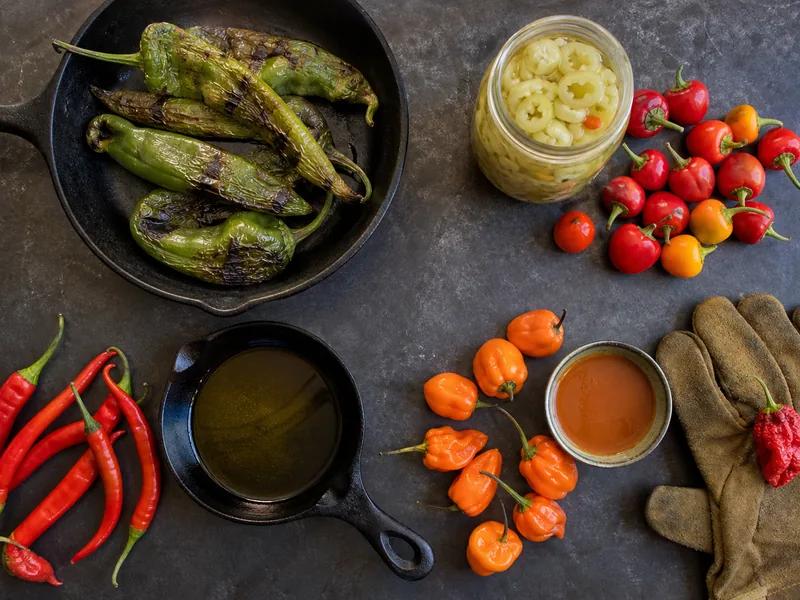
For roasting, start with a named New Mexican cultivar whose long pod gives broad contact with flame or a hot surface. For quick frying, Jimmy Nardello's thin walls and sweet flavor make more sense than a thick roasting pod or a very hot pickling pepper.
Fish pepper earns its place in pale seafood sauces because immature pods add heat without a red color. Datil fits St. Augustine-style sauces and preserves, while Habanada supplies Capsicum chinense aroma when the dish needs fruitiness without burn.
A Carolina Reaper or Pepper X is a concentrated ingredient, not a one-for-one Datil replacement. UF/IFAS warns that capsaicin can irritate skin and eyes, so gloves, clean tools, and careful portioning become more important as heat rises.
| Kitchen job | Shortlist | Decision clue |
|---|---|---|
| Roast or stuff | Named New Mexican cultivar | Long pod, broad roasting surface |
| Quick fry | Jimmy Nardello | Sweet flavor and thin walls |
| Pale seafood sauce | Fish pepper | Light immature pods preserve sauce color |
| Florida sauce or preserve | Datil | Regional character with very high heat |
| Fruity aroma without burn | Habanada | Capsicum chinense flavor at 0 SHU |
Match the Cultivar to the Season, Then Browse
NMSU Extension treats chile peppers as frost-sensitive warm-season crops, so planting begins after soil and air warm beyond the last spring frost. Gardeners with short summers also need to compare days to maturity and decide whether they need green pods or fully ripe color.
Habanada shows why harvest target matters. Cornell's estimate of about 75 days green and 100 days orange means a gardener seeking mature fruit character needs more season than someone harvesting a green New Mexican chile.
Use the filters below to narrow by heat and species, then open the individual profile for pod dimensions, mature color, exact SHU range, and growing habit. The Capsicum annuum contains most New Mexican and frying types here, while Capsicum chinense includes Habanada, Datil, and many superhots.
Before choosing seed
- Check days to the harvest color you actually want.
- Compare mature pod size and wall thickness with the intended dish.
- Use local extension guidance for frost timing, irrigation, and disease pressure.
- Open the cultivar profile before relying on a broad regional label.
Heat Level Distribution
How american peppers distribute across the Scoville scale. Click any tier to browse all peppers at that heat level.
Heat Range Comparison
Visual breakdown of where each variety falls on the Scoville scale. Wider bars show a larger documented SHU spread between individual pods.
The causes of pepper heat variation explain why pods from one cultivar do not always measure alike.
Related Comparisons
Side-by-side breakdowns of heat, flavor, and cooking uses. Each comparison covers Scoville ratings, pod anatomy, and substitution options.
Apollo vs Carolina Reaper: Claim vs Record
Apollo's reported 2.5M-3M SHU range sits above Carolina Reaper's practical 1.4M-2.2M range. Carolina Reaper's measured record history… 2.2M SHU
vs
2.7M SHU
2.2M SHU
vs
2.7M SHU
Carolina Reaper vs Pepper X: Dethroned by a Cousin
Pepper X is hotter than the Carolina Reaper, but the practical gap is smaller than many headlines imply. Guinness lists Pepper X at… 2.5M SHU
vs
2.7M SHU
2.5M SHU
vs
2.7M SHU
Dragon's Breath vs Pepper X: Claim vs Record
Pepper X is the documented winner because Guinness records its 2,693,000 SHU average. Dragon's Breath is tied to an unofficial 2.48… 2.2M SHU
vs
350K SHU
2.2M SHU
vs
350K SHU
Carolina Reaper vs Habanero: A 10x Heat Leap
The Carolina Reaper and habanero share the same species and a fruity flavor base, but they sit in completely different heat… 2.2M SHU
vs
1M SHU
2.2M SHU
vs
1M SHU
Carolina Reaper vs Ghost: Twice the Burn
The Carolina Reaper tops the Scoville scale at 1,400,000-2,200,000 SHU, making it one of the most intense peppers ever measured. The… 2.2M SHU
vs
2M SHU
2.2M SHU
vs
2M SHU
Carolina Reaper vs Moruga Scorpion: Heat and Use
If you only want the hotter published ceiling, Carolina Reaper still edges Trinidad Moruga Scorpion in the common SHU ranges used on…Browse all comparisons in our comparison hub, or use the pepper tools for calculators and finders.
Related Guides
Reference guides and recipes tied to the same pepper family, region, or use-case.


Explore Other Origins
Peppers evolved in the Americas and spread worldwide through the Columbian Exchange. Each region developed distinct varieties shaped by local cuisine and climate.
Frequently Asked Questions
Sources & References
- NMSU Chile Pepper Institute - Then and Now
- NMSU Chile Pepper Institute - NMSU Cultivars
- NMSU Extension - Growing Chile Peppers in New Mexico
- Smithsonian National Museum of American History - Fish Pepper
- UF IFAS Gardening Solutions - Datil Peppers
- Slow Food USA - Jimmy Nardello Sweet Italian Frying Pepper
- Slow Food USA - Beaver Dam Pepper
- Cornell Center for Technology Licensing - Habanada
- Guinness World Records - Pepper X
Keep Reading
Jump into the wider database, heat tiers, comparisons, and substitute references without another card wall.