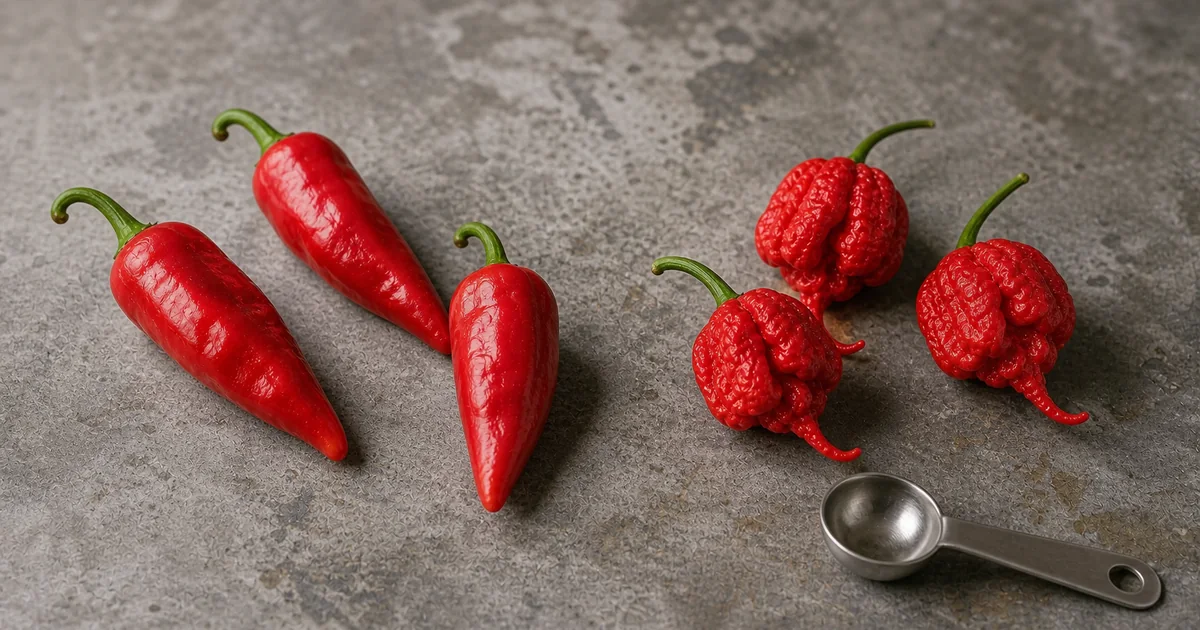
If you only want the hotter published ceiling, Carolina Reaper still edges Trinidad Moruga Scorpion in the common SHU ranges used on KTP. For cooking, the better split is different: Reaper is easier to source and measure, while Moruga often gives a broader Trinidad-style burn that can take over a sauce faster.
Comparison Contributor·Updated Jun 30, 2026·
Reviewed by
Karen Liu
Quick Comparison
Carolina Reaper measures 1.4M–2.2M SHU while Trinidad Moruga Scorpion registers 1.2M–2M SHU. Their upper SHU ranges are close enough to treat as the same heat bracket. Carolina Reaper is known for its fruity and sweet flavor (C. chinense), while Trinidad Moruga Scorpion offers fruity and floral notes (C. chinense).
Carolina Reaper
1.4M–2.2M SHU
Super-Hot · fruity and sweet
Trinidad Moruga Scorpion
1.2M–2M SHU
Super-Hot · fruity and floral
Species: Both are C. chinense
Best for: Carolina Reaper excels in hot sauces and extreme dishes, Trinidad Moruga Scorpion in hot sauces and spicy dishes
Carolina Reaper vs Trinidad Moruga Scorpion Comparison
Attribute
Carolina Reaper
Trinidad Moruga Scorpion
Scoville (SHU)
1.4M–2.2M
1.2M–2M
Heat Tier
Super-Hot
Super-Hot
vs Jalapeño
275x hotter
251x hotter
Flavor
fruity and sweet
fruity and floral
Species
C. chinense
C. chinense
Origin
USA
Trinidad
Carolina Reaper vs Trinidad Moruga Scorpion Heat Levels
Position on the Scoville Scale
Carolina
Trinidad
0 SHU3.2M SHU
Carolina Reaper is
in the same practical heat bracket.
Carolina Reaper spans 1.4M–2.2M SHU, roughly 275× a jalapeño at the upper end.
Trinidad Moruga Scorpion spans 1.2M–2M SHU, about 251× a jalapeño at the upper end.
Use the ranges to decide whether the recipe needs a measured dose, a mild overlap, or a hard substitution limit.
Tools: Scoville chart and SHU calculator.
The Carolina Reaper is a super-hot Capsicum chinense pepper bred by Ed Currie of PuckerButt Pepper Company in South Carolina. For practical kitchen use, treat it as a 1,400,000 to 2,200,000 SHU pepper, with one important record caveat: Guinness confirmed the Reaper as the hottest chilli pepper in 2013 at 1,569,300 SHU, and Guinness later reported Pepper X as the current record holder in 2023.
The pod is small, wrinkled, usually red at full maturity, and often ends in a pointed tail. That shape matters for identification because many ordinary red C. chinense peppers are sold with aggressive names, while a true Reaper normally shows a rough surface, broad shoulder, and narrow stinger-like end.
Trinidad Moruga Scorpion
fruityfloralC. chinense
Few peppers command the same respect as the Trinidad Moruga Scorpion. Its super-hot intensity range sits between 1.
The pod itself is distinctive: roughly golf-ball sized, deeply wrinkled, and capped with that characteristic scorpion tail. Colors run from bright red to chocolate brown depending on the variety.
Both peppers belong to C. chinense, so they share some underlying flavor chemistry. However, Carolina Reaper’s fruity and sweet notes contrast with Trinidad Moruga Scorpion’s fruity and floral character.
Carolina Reaper brings fruity and sweet notes, so it fits recipes where that flavor should remain visible.
Trinidad Moruga Scorpion leans fruity and floral, which can change the sauce, filling, marinade, or garnish even when the heat range looks close.
Culinary Uses for Carolina Reaper and Trinidad Moruga Scorpion
Carolina Reaper
The Carolina Reaper's culinary value is concentrated heat with a short fruity-sweet note, not pod-sized eating. In a sauce, start around one quarter of a fresh pod per 2 cups of base, blend completely, wait a full minute, and then taste a tiny amount.
Fruit, vinegar, tomato, carrot, and roasted garlic can make the pepper's aroma easier to perceive, but they do not neutralize the heat. A mango or pineapple sauce may taste balanced at first and still become punishing after the capsaicin catches up.
Scorpion pepper hot sauce is the most practical entry point. The fruity, floral notes survive fermentation well, and diluting the mash with vinegar and fruit - mango, pineapple, tamarind - produces something genuinely complex rather than just painful.
Dried and powdered, the Moruga Scorpion works as a finishing spice on grilled meats, eggs, or chocolate desserts - anywhere a tiny hit of tropical fire makes sense. A quarter teaspoon can heat an entire pot of chili intended for heat-tolerant guests.
For those exploring the culinary range of extreme super-hots, this pepper pairs particularly well with fatty proteins. The capsaicin binds to fat molecules, which is why butter-based sauces or coconut milk curries temper the burn better than water-based preparations.
Replacing Trinidad Moruga Scorpion with Carolina Reaper
Use slightly less by weight. Start below the recipe amount and adjust after tasting.
Milder replacement
Replacing Carolina Reaper with Trinidad Moruga Scorpion
Increase gradually, but expect the flavor balance to change before the heat matches exactly.
Growing Carolina Reaper vs Trinidad Moruga Scorpion
Growing notes
Carolina Reaper
Carolina Reaper plants need a long, warm season and consistent care. Start seed indoors early, use warm germination conditions, harden plants off after frost risk, and give mature plants full sun with well-drained soil.
Harvest with gloves. The same capsaicin that makes the pepper useful in sauce can transfer from pods to fingers, tools, towels, and cutting boards.
Growing notes
Trinidad Moruga Scorpion
The Moruga Scorpion is a long-season grower. From seed to first ripe pod typically runs 150 to 180 days, which means starting indoors 10 to 12 weeks before your last frost date is non-negotiable in most climates.
Germination requires consistent soil temps of 80-85°F. A heat mat under the seed tray isn't optional - it's the difference between 70% germination and 20%.
Once seedlings reach 4-6 inches, pot up gradually rather than jumping straight to a large container. The Moruga Scorpion responds well to slightly root-bound conditions early on - it triggers more aggressive flowering.
Where They Come From
Origin & background
Carolina Reaper
USA · C. chinense
Guinness World Records confirmed Smokin' Ed's Carolina Reaper as the hottest chilli pepper in 2013. Guinness reported an average of 1,569,300 SHU for that certification and described the pepper as a cross connected to Ed Currie's South Carolina breeding work.
That distinction fixes the main factual risk on older Reaper articles. A page can say the Reaper was the Guinness record holder.
Origin & background
Trinidad Moruga Scorpion
Trinidad · C. chinense
The Moruga Scorpion originates from the Moruga region in south-central Trinidad, where it grew semi-wild for generations before attracting international attention. Local communities used it in traditional cooking and folk medicine, but it remained largely unknown outside the Caribbean until the early 2000s when the super-hot pepper community began cataloging extreme varieties.
New Mexico State University's Chile Pepper Institute conducted the definitive study in 2012, testing multiple plants across multiple harvests. Their mean SHU of 1,207,764 and peak reading of 2,009,231 put the Moruga Scorpion on the world map.
Buying & Storage
Whether you’re shopping for Carolina Reaper or Trinidad Moruga Scorpion, the same quality indicators apply. Fresh peppers should feel firm and heavy for their size, with taut, glossy skin and no soft or wet spots. Minor stem cracks known as “corking” are perfectly normal and often indicate a mature, flavorful pod.
Selection
What to look for
Firm pods with taut skin and consistent color
Should feel heavy relative to size
Minor stem cracks (“corking”) are normal
Avoid anything soft, shriveled, or with dark wet spots
Storage
How to store them
Fresh: Paper bag, crisper drawer, 1 to 2 weeks
Frozen: Wash, dry, freeze on sheet pan, 6+ months
Dried: Airtight and away from light, up to 1 year
Mistakes to avoid
Common misses
Carolina Reaper
Skipping gloves. Capsaicin absorbs through skin.
Using too much. Start with a quarter pod.
Drinking water for the burn. Use dairy instead.
Common misses
Trinidad Moruga Scorpion
Skipping gloves. Capsaicin absorbs through skin.
Using too much. Start with a quarter pod.
Drinking water for the burn. Use dairy instead.
Final call
Carolina Reaper vs Trinidad Moruga Scorpion
Carolina Reaper and Trinidad Moruga Scorpion
sit in the same heat tier but serve different roles. Carolina Reaper delivers its distinctive fruity and sweet character.
Trinidad Moruga Scorpion, with its fruity and floral profile, excels in everyday cooking.
Heat gap same bracketCarolina Reaper fruity and sweetTrinidad Moruga Scorpion fruity and floral
On paper, Carolina Reaper usually runs about 1,400,000 to 2,200,000 SHU. Trinidad Moruga Scorpion usually runs about 1,200,000 to 2,009,231 SHU. Reaper has the slightly higher published ceiling, but this is not a gulf. It is a near-tie at a level where both peppers are far beyond ordinary kitchen heat.
That small spread matters less than people think because pod-to-pod variation is huge in superhots. Growing conditions, ripeness, seed line, and whether you use fresh pod, mash, or powder all change how the heat lands in real food.
So the useful reading is not "Reaper wins." The useful reading is that both peppers require the same respect: gloves, tiny doses, and a recipe large enough to absorb them. Once you are in this range, one careless extra piece can matter more than the paper gap between two SHU charts.
Record History Vs Kitchen Behavior
Moruga became famous after New Mexico State testing in 2012 showed pods above two million SHU. Reaper then took the Guinness record in 2013. That record status is now historical, not current, but it still shapes how cooks recognize the pepper and how sellers label it.
That history gives Reaper a cleaner market identity. More powders, sauces, seed packs, and fresh pods are sold under the Reaper name, so it is easier to find a product that matches the label.
Moruga can feel less standardized in the market. Some jars say scorpion, some say Trinidad Moruga, and some blur together several scorpion-type superhots. If the recipe depends on a specific fruit note or heat expectation, that looser labeling matters.
It also changes how people read risk. A cook who knows the super-hot tier may still treat Moruga like a generic scorpion blend and miss how close it runs to the Reaper class. With superhots, vague naming is not a small detail.
So this section is not trivia. It changes shopping confidence. Reaper is usually the easier pepper to buy on purpose. Moruga rewards the cook who already trusts the grower or supplier.
Burn Timing Changes The Recipe
Many cooks read Carolina Reaper as a more pointed burn. It hits hard, climbs fast, and stays around. Moruga often feels broader once it lands, with heat that spreads through the mouth and lingers even after the bite is gone. Either way, tasting too early is a mistake.
The safest workflow is tiny measured doses and a waiting period. In a blender sauce or fermented mash, start with much less than one whole pod per quart unless the recipe is built around true superhot heat. Blend, wait at least a minute, then taste a very small amount.
Powder tightens the margin even more because it spreads instantly. A quarter teaspoon can be too much when the base is small. Fresh pod gives you a little more control, but only if you mince it carefully and account for the placenta and seeds.
This is also where capsaicin handling becomes a cooking issue, not just a skin issue. The main danger in recipe work is impatience.
Fruit Notes Are Real But Small
Both peppers are Capsicum chinense, so both carry real fruit under the heat. Reaper usually reads sweet and red-fruit forward for a brief moment before the heat takes over. Moruga often reads a little more floral and tropical, especially in vinegar sauces and fermented mashes.
Those flavor notes matter only when the recipe gives them room. Fruit, vinegar, garlic, carrot, tomato, mango, and tamarind can all help the pepper say something besides pain. Heavy smoke, too much sugar, or too much extract-like sauce can flatten the difference.
That is why Moruga often feels like the better pepper for a Trinidad-style hot sauce, while Reaper is easier to use as a named superhot in powders, wing sauces, and controlled micro-dosed recipes. The heat is still the headline. The flavor only matters if you build the sauce to hear it.
Swap Only In Tiny Measured Steps
A whole-pod swap is the wrong unit. If a sauce was tuned around Reaper and you only have Moruga, start with about 25 percent less by weight, then taste after the sauce settles. Moruga can spread wider than expected even when the SHU charts look close.
Going from Moruga to Reaper is simpler, but it still is not automatic. Start near equal weight only when the form matches, then pause before adding more. Reaper powder and fresh Reaper do not behave like the same ingredient.
Read labels closely. "Scorpion powder" is not always Trinidad Moruga Scorpion, and unnamed superhot mash can hide several cultivars behind one heat claim. Carolina Reaper products are usually easier to verify because the market uses the name more consistently.
Fresh pods need the same caution. A wrinkled red superhot can look convincing even when the strain is off, and mixed-seed hobby lines can produce peppers that do not match the exact label. If recipe identity matters, named growers and stable seed history matter more than dramatic pod shape.
Store either pepper like a safety item, not like paprika. Keep powders airtight, dark, and clearly labeled. Buy seed from growers who show stable pods and parent lines. At this heat level, identity problems are not small quality issues. They change the whole recipe.
Fact-Checked & Expert Reviewed
Editorial Standards: Head-to-head comparisons include blind tasting when applicable. Heat levels cross-referenced with multiple sources. All substitution ratios tested side-by-side.
Review Process:
Written by
James Thompson
(Lead Comparison Reviewer)
, reviewed by
Karen Liu
(Lead Fact-Checker & Science Editor)
. Last updated June 30, 2026.
Carolina Reaper vs Trinidad Moruga Scorpion FAQ
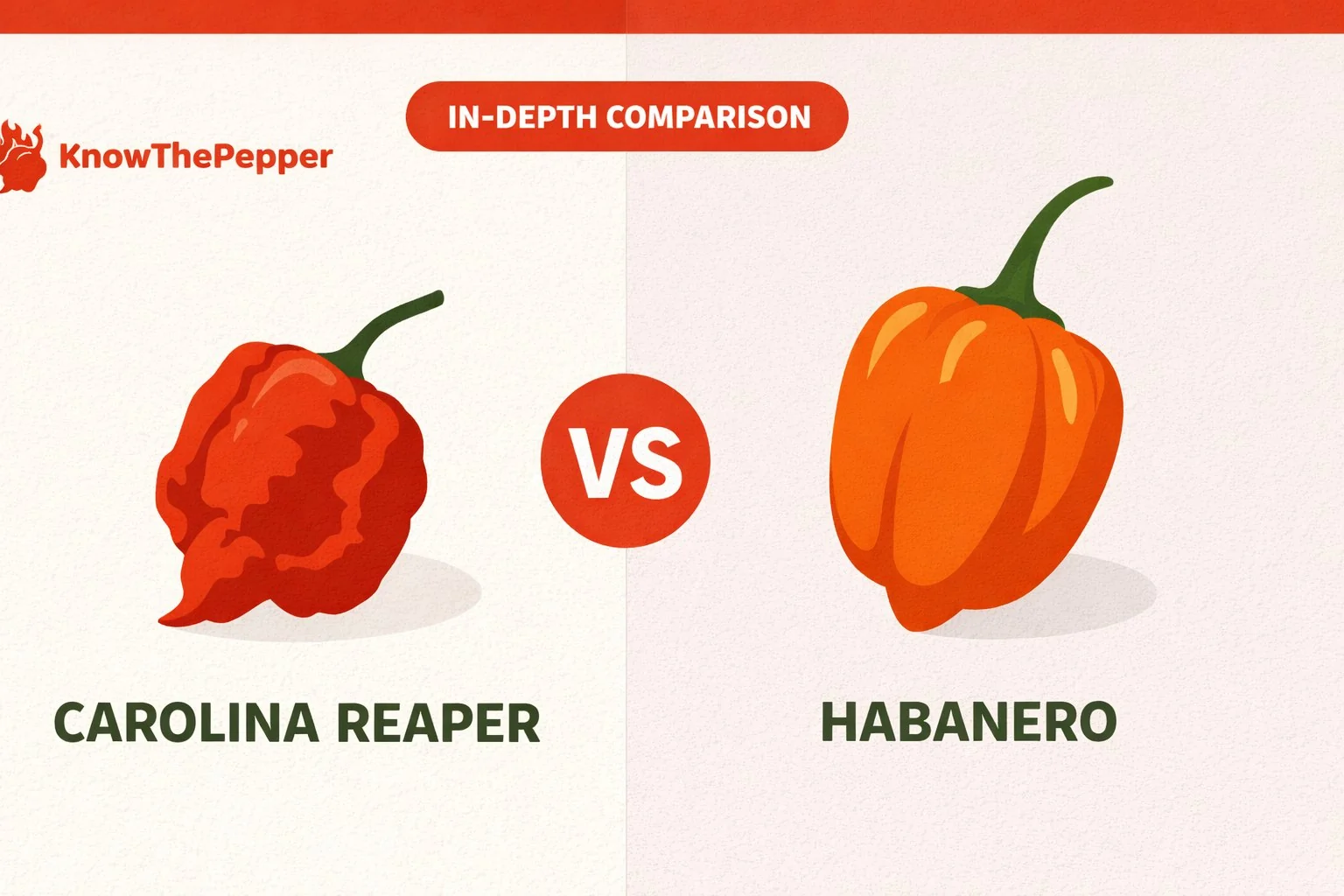
Carolina Reaper usually carries the slightly higher published ceiling, but the gap is small compared with the risk of either pepper. In real cooking, both need micro-dosing and careful tasting.
Moruga often fits fruit-forward Trinidad-style sauces very well because the pepper can taste floral and tropical under the heat. Reaper is easier to source and measure, so it is often the simpler choice for consistent batches.
Not safely by whole pod. Match the form first, then start with less Moruga if it replaces Reaper, or near-equal weight with caution if Reaper replaces Moruga. Taste only after the sauce settles.
Powder spreads instantly and removes the visual warning of pod size, so it can overwhelm a batch faster. Fresh pods give more prep steps and slightly more control, but they still need gloves and tiny amounts.