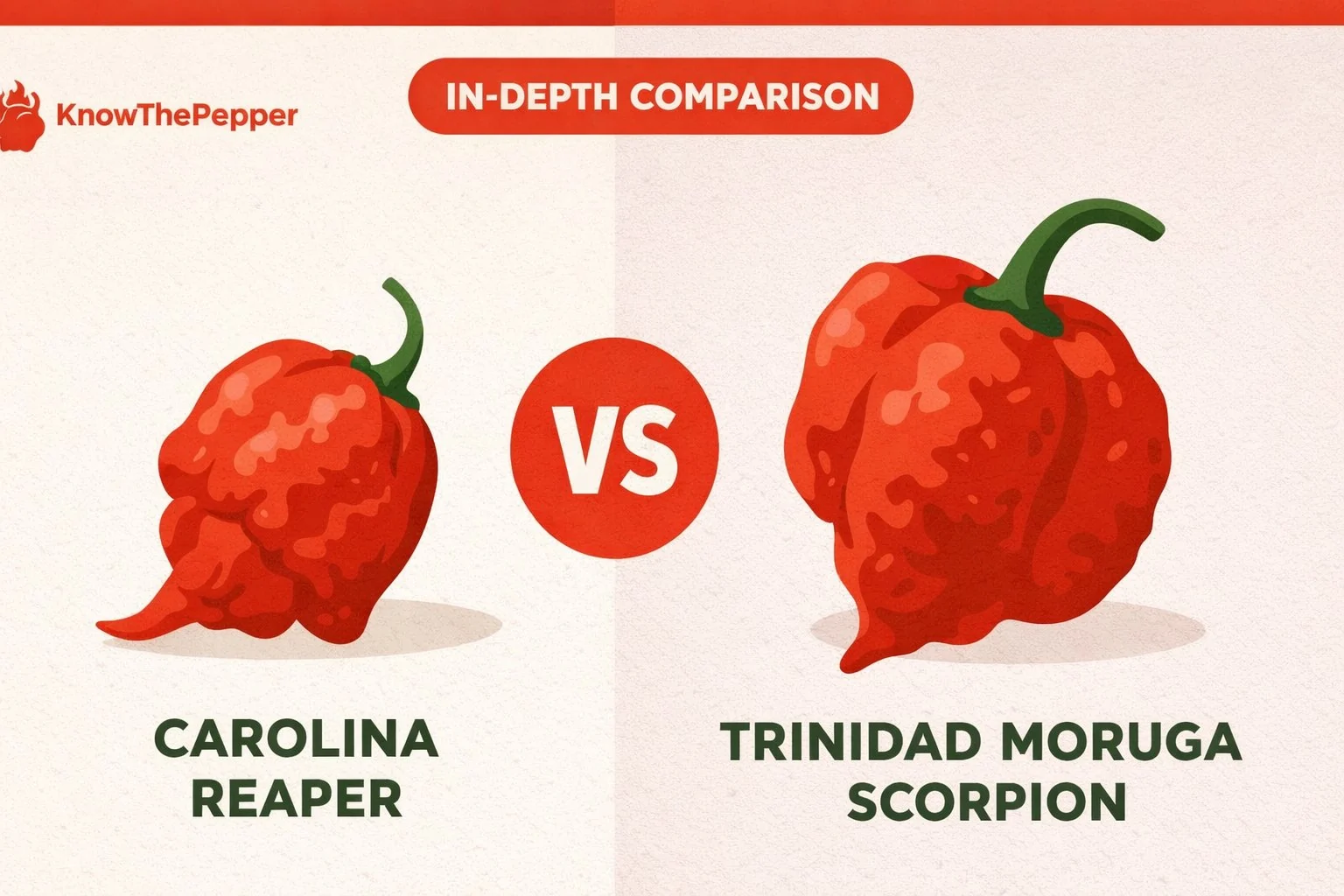
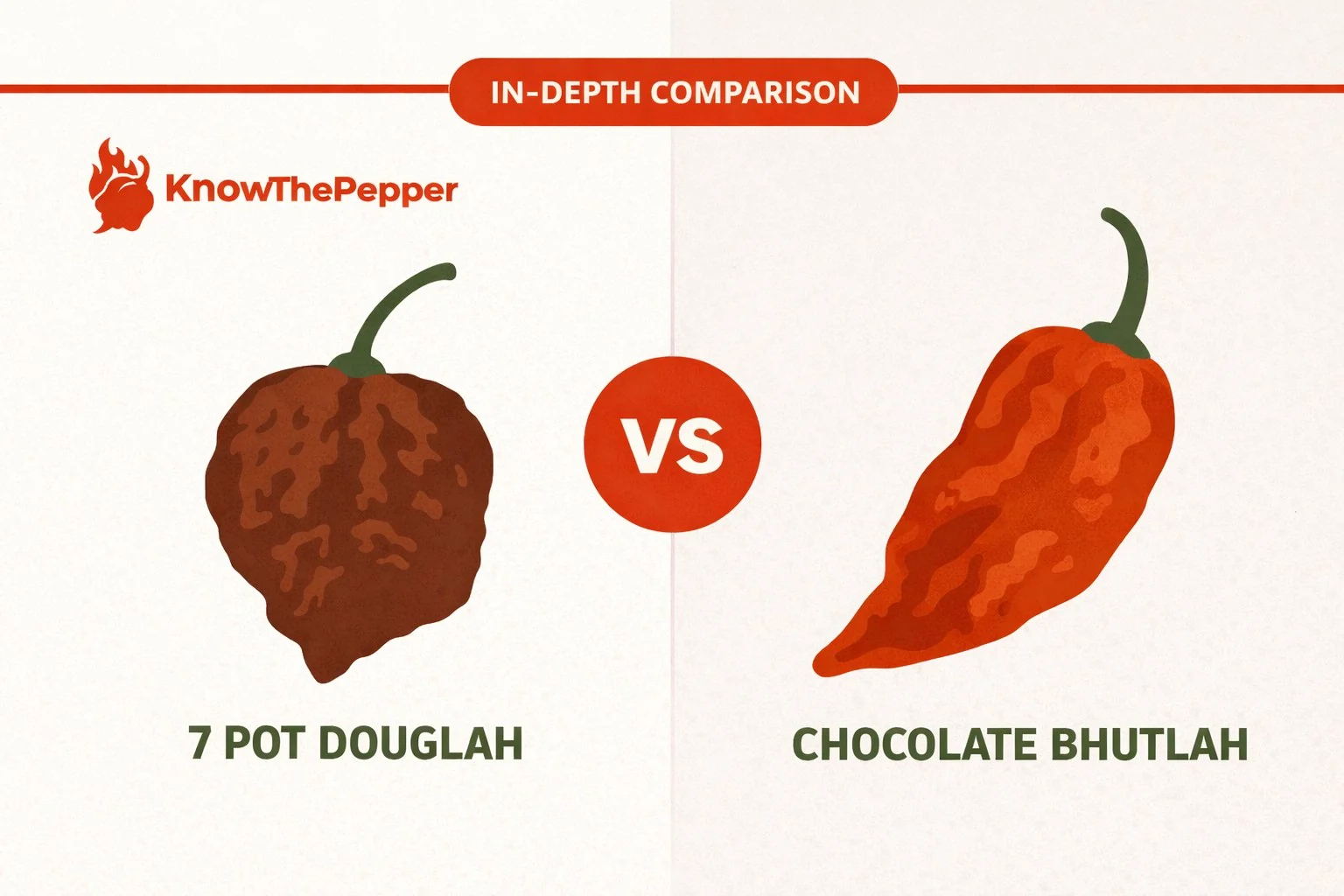
7 Pot Douglah vs Reaper: Dark Sauce or Red Record?

Choose 7 Pot Douglah when the recipe wants a dark, earthy superhot that can push a sauce deeper in color and tone. Choose Carolina Reaper when you want the better-known red superhot with a fruitier profile and easier market recognition. Both are extreme. The real split is sauce identity, not survival.

7 Pot Douglah and Carolina Reaper side by side for a heat and flavor comparison
Quick Comparison

7 Pot Douglah measures 923K–1.9M SHU while Carolina Reaper registers 1.4M–2.2M SHU. That makes Carolina Reaper about 1.2x hotter by upper SHU range. 7 Pot Douglah is known for its earthy, nutty C. chinense fruit with extreme heat flavor (C. chinense), while Carolina Reaper offers fruity and sweet notes (C. chinense).

7 Pot Douglah
923K–1.9M SHU
Super-Hot · earthy, nutty C. chinense fruit with extreme heat
Carolina Reaper
1.4M–2.2M SHU
Super-Hot · fruity and sweet
  • Heat difference: Carolina Reaper is about 1.2× hotter by upper SHU range
  • Species: Both are C. chinense
  • Best for: 7 Pot Douglah excels in hot sauces and extreme dishes, Carolina Reaper in hot sauces and spicy dishes

7 Pot Douglah vs Carolina Reaper Comparison

Attribute 7 Pot Douglah Carolina Reaper
Scoville (SHU) 923K–1.9M 1.4M–2.2M
Heat Tier Super-Hot Super-Hot
vs Jalapeño 232x hotter 275x hotter
Flavor earthy, nutty C. chinense fruit with extreme heat fruity and sweet
Species C. chinense C. chinense
Origin Trinidad and Tobago USA

7 Pot Douglah vs Carolina Reaper Heat Levels

Position on the Scoville Scale
7
Carolina
0 SHU3.2M SHU

Carolina Reaper is about 1.2× hotter than 7 Pot Douglah.

7 Pot Douglah spans 923K–1.9M SHU, roughly 232× a jalapeño at the upper end. Carolina Reaper spans 1.4M–2.2M SHU, about 275× a jalapeño at the upper end. Use the ranges to decide whether the recipe needs a measured dose, a mild overlap, or a hard substitution limit. Tools: Scoville chart and SHU calculator.

Flavor Profile Comparison

7 Pot Douglah
earthy nutty C. chinense fruit with extreme heat C. chinense

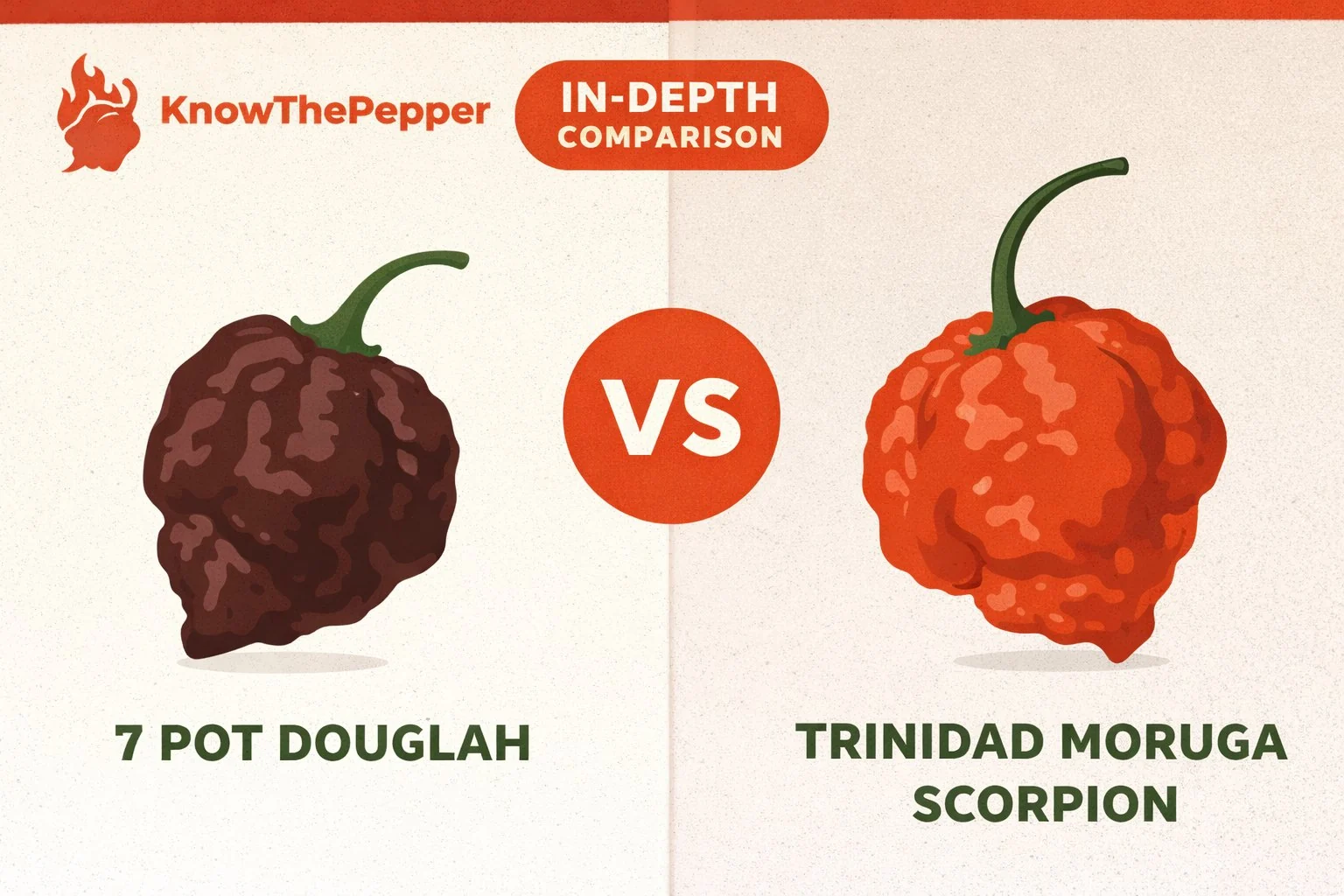
7 Pot Douglah is a dark, bumpy C. chinense superhot species group pepper from the Caribbean pepper tradition. It is part of the 7 Pot family, but the ripe color makes it stand apart: green pods mature to chocolate brown or deep purple-brown instead of a clean red.

The heat should be read as a reported range. Pepper Joe's lists 7 Pot Douglah at 923,000-1,853,396 SHU, while SuperHotChiles says a 2011 Chile Pepper Institute reading peaked just over 1.

Carolina Reaper
fruity sweet C. chinense

The Carolina Reaper is a super-hot Capsicum chinense pepper bred by Ed Currie of PuckerButt Pepper Company in South Carolina. For practical kitchen use, treat it as a 1,400,000 to 2,200,000 SHU pepper, with one important record caveat: Guinness confirmed the Reaper as the hottest chilli pepper in 2013 at 1,569,300 SHU, and Guinness later reported Pepper X as the current record holder in 2023.

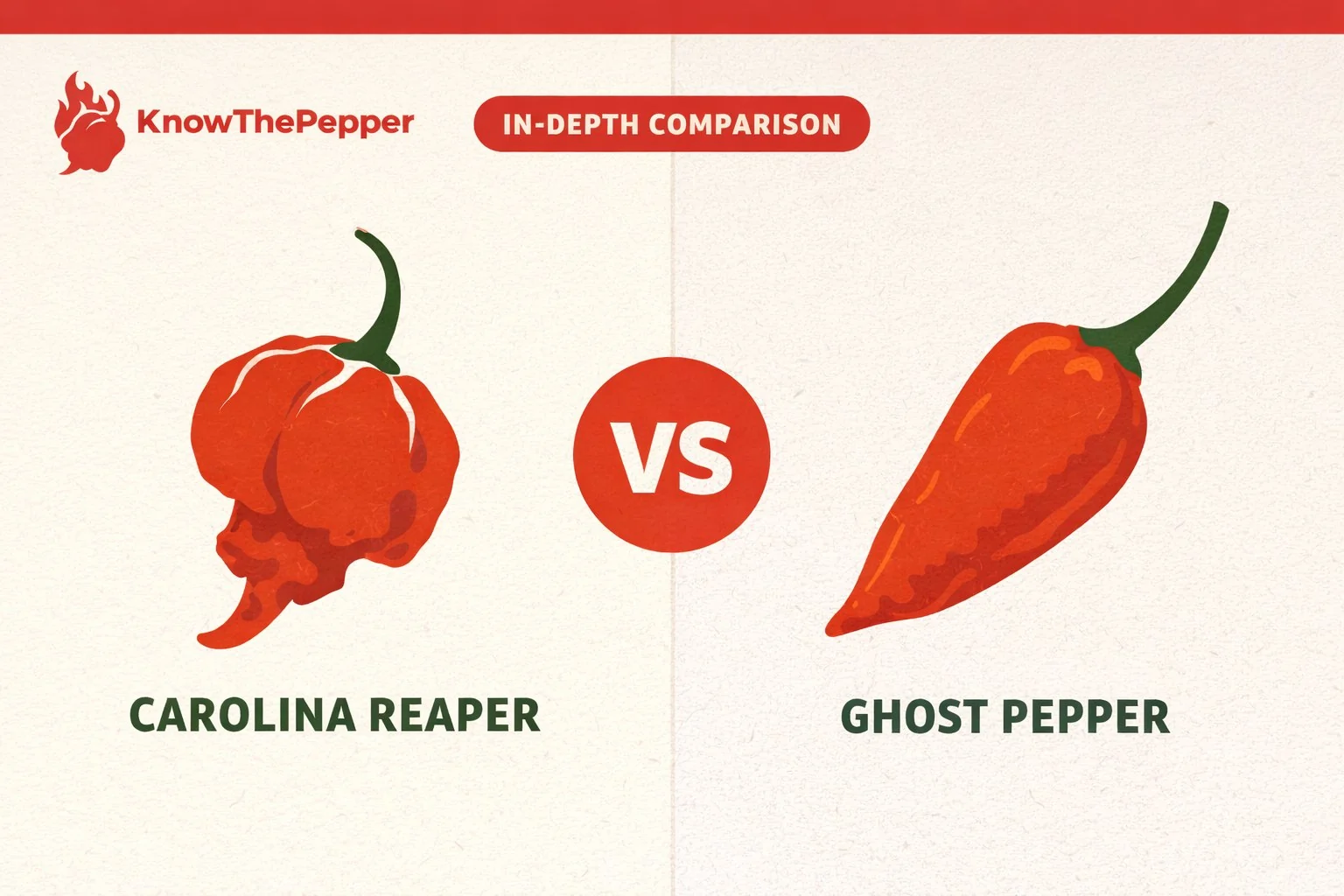
The pod is small, wrinkled, usually red at full maturity, and often ends in a pointed tail. That shape matters for identification because many ordinary red C. chinense peppers are sold with aggressive names, while a true Reaper normally shows a rough surface, broad shoulder, and narrow stinger-like end.

Both peppers belong to C. chinense, so they share some underlying flavor chemistry. However, 7 Pot Douglah’s earthy, nutty C. chinense fruit with extreme heat notes contrast with Carolina Reaper’s fruity and sweet character.

7 Pot Douglah brings earthy, nutty C. chinense fruit with extreme heat notes, so it fits recipes where that flavor should remain visible. Carolina Reaper leans fruity and sweet, which can change the sauce, filling, marinade, or garnish even when the heat range looks close.

7 Pot Douglah and Carolina Reaper comparison

Culinary Uses for 7 Pot Douglah and Carolina Reaper

7 Pot Douglah

Use 7 Pot Douglah as a seasoning concentrate, not as a chopped vegetable. A scrape of fresh flesh, a thin sliver, or a pinch of powder can heat a full pot.

The earthy, nutty flavor makes it better for savory work than for bright fresh salsa. Try it in fermented hot sauce, vinegar sauce, beef chili, black beans, mole-style sauces, dry rubs, and roasted-root sauces where dark flavor has somewhere to land.

For fermented sauce, start with a small amount of Douglah and build the rest of the mash with milder red chiles, garlic, carrot, onion, or fruit. The goal is to let the dark C. chinense flavor show up without making the sauce unusable.

Carolina Reaper

The Carolina Reaper's culinary value is concentrated heat with a short fruity-sweet note, not pod-sized eating. In a sauce, start around one quarter of a fresh pod per 2 cups of base, blend completely, wait a full minute, and then taste a tiny amount.

Fruit, vinegar, tomato, carrot, and roasted garlic can make the pepper's aroma easier to perceive, but they do not neutralize the heat. A mango or pineapple sauce may taste balanced at first and still become punishing after the capsaicin catches up.

If a recipe only asks for extreme heat, the Carolina Reaper substitute guide is the better page because it can give ratio logic. If the question is whether a habanero can stand in, use the habanero comparison route.

Which Should You Choose?

Best fit

Choose 7 Pot Douglah if…

You want milder heat
You prefer earthy, nutty C. chinense fruit with extreme heat flavors
You need a C. chinense variety

Best fit

Choose Carolina Reaper if…

You want maximum heat
You prefer fruity and sweet flavors
You need a C. chinense variety

Can You Substitute One for the Other?

Hotter replacement

Replacing 7 Pot Douglah with Carolina Reaper

Use slightly less by weight. Start below the recipe amount and adjust after tasting.

Milder replacement

Replacing Carolina Reaper with 7 Pot Douglah

Increase gradually, but expect the flavor balance to change before the heat matches exactly.

Growing 7 Pot Douglah vs Carolina Reaper

Growing notes

7 Pot Douglah

Grow 7 Pot Douglah like a long-season C. chinense superhot. Pepper Joe's lists plants around 3 ft tall with 2-inch pods, while SuperHotChiles describes plants up to about 4 ft.

UMN Extension's general pepper guidance is a reliable baseline: start pepper seeds indoors before outdoor planting, keep germination warm, and transplant only after conditions are settled. For Douglah, an early indoor start is especially important because pods need time to move from green to full dark brown.

Use the pepper seed-starting guide for trays and germination, then map transplant timing with the pepper growing calendar. Warmth, full sun, steady moisture, and patience matter more than forcing the plant with heavy feeding.

Growing notes

Carolina Reaper

Carolina Reaper plants need a long, warm season and consistent care. Start seed indoors early, use warm germination conditions, harden plants off after frost risk, and give mature plants full sun with well-drained soil.

For spacing and calendar detail, use the full Carolina Reaper growing guide. For seed-start timing and transplant sequencing, use the Carolina Reaper planting guide.

Harvest with gloves. The same capsaicin that makes the pepper useful in sauce can transfer from pods to fingers, tools, towels, and cutting boards.

Where They Come From

Origin & background

7 Pot Douglah

Trinidad and Tobago · C. chinense

The 7 Pot Douglah is best documented through seed-source and superhot-community records rather than a formal university cultivar release. SuperHotChiles frames it as a Trinidad-origin 7 Pot type and reports a 2011 Chile Pepper Institute peak just over 1.

Pepper Joe's lists the origin as Trinidad and Tobago, the species as Chinense, and the dark form as a Chocolate 7 Pot variation. That is the practical identity stack KTP uses: Trinidad 7 Pot family, C. chinense species, dark mature pods, and reported superhot heat.

Origin & background

Carolina Reaper

USA · C. chinense

Guinness World Records confirmed Smokin' Ed's Carolina Reaper as the hottest chilli pepper in 2013. Guinness reported an average of 1,569,300 SHU for that certification and described the pepper as a cross connected to Ed Currie's South Carolina breeding work.

That distinction fixes the main factual risk on older Reaper articles. A page can say the Reaper was the Guinness record holder.

Buying & Storage

Whether you’re shopping for 7 Pot Douglah or Carolina Reaper, the same quality indicators apply. Fresh peppers should feel firm and heavy for their size, with taut, glossy skin and no soft or wet spots. Minor stem cracks known as “corking” are perfectly normal and often indicate a mature, flavorful pod.

Selection

What to look for

  • Firm pods with taut skin and consistent color
  • Should feel heavy relative to size
  • Minor stem cracks (“corking”) are normal
  • Avoid anything soft, shriveled, or with dark wet spots

Storage

How to store them

  • Fresh: Paper bag, crisper drawer, 1 to 2 weeks
  • Frozen: Wash, dry, freeze on sheet pan, 6+ months
  • Dried: Airtight and away from light, up to 1 year

Mistakes to avoid

Common misses

7 Pot Douglah

  • Skipping gloves. Capsaicin absorbs through skin.
  • Using too much. Start with a quarter pod.
  • Drinking water for the burn. Use dairy instead.

Common misses

Carolina Reaper

  • Skipping gloves. Capsaicin absorbs through skin.
  • Using too much. Start with a quarter pod.
  • Drinking water for the burn. Use dairy instead.
Final call

7 Pot Douglah vs Carolina Reaper

7 Pot Douglah and Carolina Reaper sit in the same heat tier but serve different roles. Carolina Reaper delivers about 1.2× more upper-range heat with its distinctive fruity and sweet character. 7 Pot Douglah, with its earthy, nutty C. chinense fruit with extreme heat profile, excels in everyday cooking.

Heat gap about 1.2× by upper range 7 Pot Douglah earthy, nutty C. chinense fruit with extreme heat Carolina Reaper fruity and sweet
Additional 7 Pot Douglah and Carolina Reaper comparison view

Dark Sauce Or Red Record

If the sauce needs a dark savory superhot, 7 Pot Douglah is the clearer fit. If it needs a famous red superhot with fruit and a cleaner buying trail, Carolina Reaper is the clearer fit.

That answer matters more than trying to crown one winner. Douglah and Reaper both sit high enough in the super-hot tier that most cooks will use either one in tiny fractions, not as a full chopped pepper.

So this page is not about which pepper is simply hotter. It is about what kind of superhot presence the sauce is trying to become.

Brown Color Tells You Something

Douglah's dark brown color is not just cosmetic. It often comes with an earthy, nutty, almost raisin-like depth that makes sense in beefy sauces, darker ferments, smoky rubs, and savory projects where the pepper should disappear into the base.

Reaper stays in a red-fruit profile. Even under brutal heat, many cooks still read a brief sweet fruity note before the capsaicin takes over. That makes it easier to pair with carrot, fruit, vinegar, tomato, and brighter hot sauce builds.

Color becomes a practical clue in the bottle too. Douglah can pull a sauce darker and moodier. Reaper keeps a sauce closer to the bright red superhot identity people expect.

That is why these peppers separate earlier than the SHU table suggests. One changes the color and tone of the batch. The other changes the heat story without pulling it as far into brown-sauce territory.

Heat Ceilings Do Not Save You

Douglah is often listed around 923,889 to 1,853,986 SHU. Carolina Reaper is often listed around 1,400,000 to 2,200,000 SHU. Reaper usually holds the higher ceiling, but that number does not make it the automatically better cooking pepper.

At this level, both peppers require the same habits: gloves, tiny measured additions, clear labels, and waiting before you taste again. A little extra Reaper on paper and a little extra Douglah in the spoon can both destroy a small batch just as easily.

So treat the numbers as a boundary, not a recipe. The kitchen choice still comes back to flavor direction and form.

Where Each Superhot Fits

Douglah is especially good in darker ferments, savory powders, chili pastes, beefy rubs, and sauces where a little earthy bitterness can actually help the final profile feel deeper.

Reaper is often easier to use in bright hot sauces, fruit-forward blends, and challenge-style bottles where the pepper name itself carries part of the appeal. It is also easier to find already milled or dried in clearly labeled forms.

Fresh pod, powder, and mash each change the balance. Douglah powder can make a sauce feel dark and dense very quickly. Reaper powder can spike a sauce with brutal heat before the fruit has a chance to register. Neither pepper should be treated like a casual table shake.

A nearby comparison like 7 Pot Douglah vs Ghost Pepper also lives in the earthy superhot world. Reaper matters here because it brings the most famous red superhot identity into the choice.

Fame Changes Buying Risk

Reaper is easier to verify in the market because the name is used more consistently. More seed packs, sauces, powders, and fresh-pod listings explain exactly what they are selling.

Douglah needs a sharper eye. The pepper may be sold as 7 Pot Douglah, Chocolate 7 Pot, or a seller-specific variation, and the pod color alone does not prove stable lineage. That matters when a recipe depends on the pepper's darker flavor, not just its heat.

Buying from a named grower or established superhot seller helps both peppers, but the trust gap is usually bigger with Douglah.

Swap In Fractions Not Pods

A full-pod swap is the wrong unit. If a recipe was tuned around Reaper and you only have Douglah, start with less by weight and check whether the sauce is already getting darker and denser before adding more.

If a recipe was tuned around Douglah and you only have Reaper, start small and ask whether the brighter fruit note still fits the sauce. More Reaper does not recreate Douglah's darker character. It only pushes the heat.

The best swap rule is to match the role first. Douglah is the dark superhot. Reaper is the red familiar superhot. Once you lose that distinction, the sauce can hit the same heat level and still feel like the wrong bottle.

Fact-Checked & Expert Reviewed
Editorial Standards: Head-to-head comparisons include blind tasting when applicable. Heat levels cross-referenced with multiple sources. All substitution ratios tested side-by-side.
Review Process: Written by James Thompson (Lead Comparison Reviewer) , reviewed by Karen Liu (Lead Fact-Checker & Science Editor) . Last updated June 30, 2026.

7 Pot Douglah vs Carolina Reaper FAQ
Carolina Reaper usually carries the higher published ceiling, but both peppers are extreme enough that tiny measured doses matter more than the paper gap.

Its brown color and earthy, nutty flavor can deepen savory sauces in a way that a brighter red Reaper usually does not.

Only in very small measured steps. You can match some heat, but Reaper will not recreate Douglah's darker flavor direction.

Usually yes. Reaper has stronger market recognition and more clearly labeled powders, sauces, seeds, and dried pods.

Sources & References
KL
Fact-checked by Karen Liu
Research Contributor
SHU Verified
Sources Cited
Expert Reviewed
All Comparisons Browse Peppers Scoville Scale