7 Pot Douglah is the darker, earthier superhot for savory sauces, powders, and fermented mashes. Trinidad Moruga Scorpion reaches the higher documented ceiling and brings a brighter red-fruit spike to superhot sauce.
Comparison Contributor·Updated Jun 29, 2026·
Reviewed by
Karen Liu
Quick Comparison
7 Pot Douglah measures 923K–1.9M SHU while Trinidad Moruga Scorpion registers 1.2M–2M SHU. Their upper SHU ranges are close enough to treat as the same heat bracket. 7 Pot Douglah is known for its earthy, nutty C. chinense fruit with extreme heat flavor (C. chinense), while Trinidad Moruga Scorpion offers fruity and floral notes (C. chinense).
7 Pot Douglah
923K–1.9M SHU
Super-Hot · earthy, nutty C. chinense fruit with extreme heat
Trinidad Moruga Scorpion
1.2M–2M SHU
Super-Hot · fruity and floral
Species: Both are C. chinense
Best for: 7 Pot Douglah excels in hot sauces and extreme dishes, Trinidad Moruga Scorpion in hot sauces and spicy dishes
7 Pot Douglah vs Trinidad Moruga Scorpion Comparison
Attribute
7 Pot Douglah
Trinidad Moruga Scorpion
Scoville (SHU)
923K–1.9M
1.2M–2M
Heat Tier
Super-Hot
Super-Hot
vs Jalapeño
232x hotter
251x hotter
Flavor
earthy, nutty C. chinense fruit with extreme heat
fruity and floral
Species
C. chinense
C. chinense
Origin
Trinidad and Tobago
Trinidad
7 Pot Douglah vs Trinidad Moruga Scorpion Heat Levels
Position on the Scoville Scale
7
Trinidad
0 SHU3.2M SHU
Trinidad Moruga Scorpion is
in the same practical heat bracket.
7 Pot Douglah spans 923K–1.9M SHU, roughly 232× a jalapeño at the upper end.
Trinidad Moruga Scorpion spans 1.2M–2M SHU, about 251× a jalapeño at the upper end.
Use the ranges to decide whether the recipe needs a measured dose, a mild overlap, or a hard substitution limit.
Tools: Scoville chart and SHU calculator.
earthynutty C. chinense fruit with extreme heatC. chinense
7 Pot Douglah is a dark, bumpy C. chinense superhot species group pepper from the Caribbean pepper tradition. It is part of the 7 Pot family, but the ripe color makes it stand apart: green pods mature to chocolate brown or deep purple-brown instead of a clean red.
The heat should be read as a reported range. Pepper Joe's lists 7 Pot Douglah at 923,000-1,853,396 SHU, while SuperHotChiles says a 2011 Chile Pepper Institute reading peaked just over 1.
Trinidad Moruga Scorpion
fruityfloralC. chinense
Few peppers command the same respect as the Trinidad Moruga Scorpion. Its super-hot intensity range sits between 1.
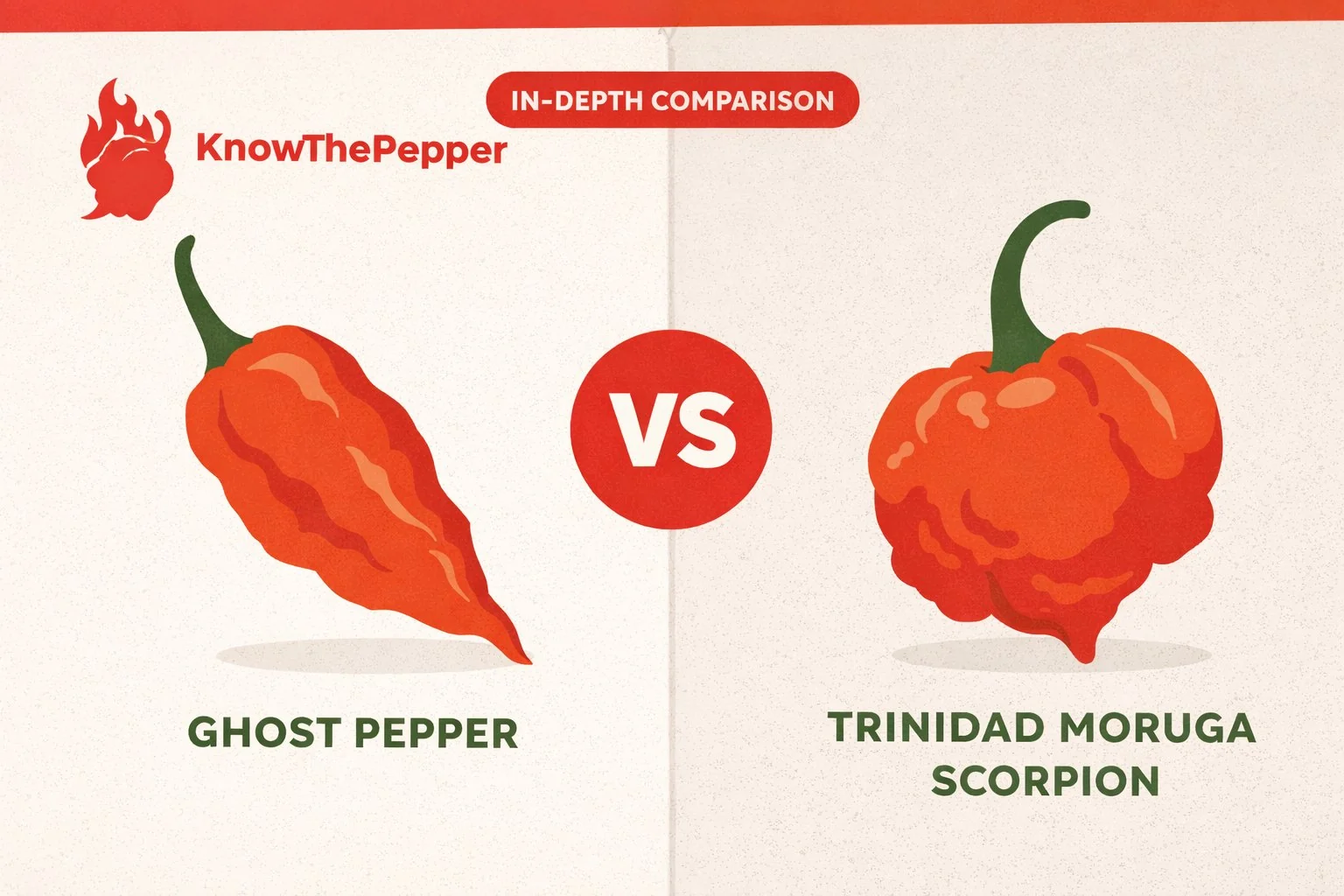
The pod itself is distinctive: roughly golf-ball sized, deeply wrinkled, and capped with that characteristic scorpion tail. Colors run from bright red to chocolate brown depending on the variety.
Both peppers belong to C. chinense, so they share some underlying flavor chemistry. However, 7 Pot Douglah’s earthy, nutty C. chinense fruit with extreme heat notes contrast with Trinidad Moruga Scorpion’s fruity and floral character.
7 Pot Douglah brings earthy, nutty C. chinense fruit with extreme heat notes, so it fits recipes where that flavor should remain visible.
Trinidad Moruga Scorpion leans fruity and floral, which can change the sauce, filling, marinade, or garnish even when the heat range looks close.
Culinary Uses for 7 Pot Douglah and Trinidad Moruga Scorpion
7 Pot Douglah
Use 7 Pot Douglah as a seasoning concentrate, not as a chopped vegetable. A scrape of fresh flesh, a thin sliver, or a pinch of powder can heat a full pot.
The earthy, nutty flavor makes it better for savory work than for bright fresh salsa. Try it in fermented hot sauce, vinegar sauce, beef chili, black beans, mole-style sauces, dry rubs, and roasted-root sauces where dark flavor has somewhere to land.
For fermented sauce, start with a small amount of Douglah and build the rest of the mash with milder red chiles, garlic, carrot, onion, or fruit. The goal is to let the dark C. chinense flavor show up without making the sauce unusable.
Trinidad Moruga Scorpion
Scorpion pepper hot sauce is the most practical entry point. The fruity, floral notes survive fermentation well, and diluting the mash with vinegar and fruit - mango, pineapple, tamarind - produces something genuinely complex rather than just painful.
Dried and powdered, the Moruga Scorpion works as a finishing spice on grilled meats, eggs, or chocolate desserts - anywhere a tiny hit of tropical fire makes sense. A quarter teaspoon can heat an entire pot of chili intended for heat-tolerant guests.
For those exploring the culinary range of extreme super-hots, this pepper pairs particularly well with fatty proteins. The capsaicin binds to fat molecules, which is why butter-based sauces or coconut milk curries temper the burn better than water-based preparations.
You prefer earthy, nutty C. chinense fruit with extreme heat flavors
You need a C. chinense variety
Best fit
Choose Trinidad Moruga Scorpion if…
You want maximum heat
You prefer fruity and floral flavors
You need a C. chinense variety
Can You Substitute One for the Other?
Hotter replacement
Replacing 7 Pot Douglah with Trinidad Moruga Scorpion
Use slightly less by weight. Start below the recipe amount and adjust after tasting.
Milder replacement
Replacing Trinidad Moruga Scorpion with 7 Pot Douglah
Increase gradually, but expect the flavor balance to change before the heat matches exactly.
Growing 7 Pot Douglah vs Trinidad Moruga Scorpion
Growing notes
7 Pot Douglah
Grow 7 Pot Douglah like a long-season C. chinense superhot. Pepper Joe's lists plants around 3 ft tall with 2-inch pods, while SuperHotChiles describes plants up to about 4 ft.
UMN Extension's general pepper guidance is a reliable baseline: start pepper seeds indoors before outdoor planting, keep germination warm, and transplant only after conditions are settled. For Douglah, an early indoor start is especially important because pods need time to move from green to full dark brown.
Use the pepper seed-starting guide for trays and germination, then map transplant timing with the pepper growing calendar. Warmth, full sun, steady moisture, and patience matter more than forcing the plant with heavy feeding.
Growing notes
Trinidad Moruga Scorpion
The Moruga Scorpion is a long-season grower. From seed to first ripe pod typically runs 150 to 180 days, which means starting indoors 10 to 12 weeks before your last frost date is non-negotiable in most climates.
Germination requires consistent soil temps of 80-85°F. A heat mat under the seed tray isn't optional - it's the difference between 70% germination and 20%.
Once seedlings reach 4-6 inches, pot up gradually rather than jumping straight to a large container. The Moruga Scorpion responds well to slightly root-bound conditions early on - it triggers more aggressive flowering.
Where They Come From
Origin & background
7 Pot Douglah
Trinidad and Tobago · C. chinense
The 7 Pot Douglah is best documented through seed-source and superhot-community records rather than a formal university cultivar release. SuperHotChiles frames it as a Trinidad-origin 7 Pot type and reports a 2011 Chile Pepper Institute peak just over 1.
Pepper Joe's lists the origin as Trinidad and Tobago, the species as Chinense, and the dark form as a Chocolate 7 Pot variation. That is the practical identity stack KTP uses: Trinidad 7 Pot family, C. chinense species, dark mature pods, and reported superhot heat.
Origin & background
Trinidad Moruga Scorpion
Trinidad · C. chinense
The Moruga Scorpion originates from the Moruga region in south-central Trinidad, where it grew semi-wild for generations before attracting international attention. Local communities used it in traditional cooking and folk medicine, but it remained largely unknown outside the Caribbean until the early 2000s when the super-hot pepper community began cataloging extreme varieties.
New Mexico State University's Chile Pepper Institute conducted the definitive study in 2012, testing multiple plants across multiple harvests. Their mean SHU of 1,207,764 and peak reading of 2,009,231 put the Moruga Scorpion on the world map.
Buying & Storage
Whether you’re shopping for 7 Pot Douglah or Trinidad Moruga Scorpion, the same quality indicators apply. Fresh peppers should feel firm and heavy for their size, with taut, glossy skin and no soft or wet spots. Minor stem cracks known as “corking” are perfectly normal and often indicate a mature, flavorful pod.
Selection
What to look for
Firm pods with taut skin and consistent color
Should feel heavy relative to size
Minor stem cracks (“corking”) are normal
Avoid anything soft, shriveled, or with dark wet spots
Storage
How to store them
Fresh: Paper bag, crisper drawer, 1 to 2 weeks
Frozen: Wash, dry, freeze on sheet pan, 6+ months
Dried: Airtight and away from light, up to 1 year
Mistakes to avoid
Common misses
7 Pot Douglah
Skipping gloves. Capsaicin absorbs through skin.
Using too much. Start with a quarter pod.
Drinking water for the burn. Use dairy instead.
Common misses
Trinidad Moruga Scorpion
Skipping gloves. Capsaicin absorbs through skin.
Using too much. Start with a quarter pod.
Drinking water for the burn. Use dairy instead.
Final call
7 Pot Douglah vs Trinidad Moruga Scorpion
7 Pot Douglah and Trinidad Moruga Scorpion
sit in the same heat tier but serve different roles. Trinidad Moruga Scorpion delivers its distinctive fruity and floral character.
7 Pot Douglah, with its earthy, nutty C. chinense fruit with extreme heat profile, excels in everyday cooking.
Heat gap same bracket7 Pot Douglah earthy, nutty C. chinense fruit with extreme heatTrinidad Moruga Scorpion fruity and floral
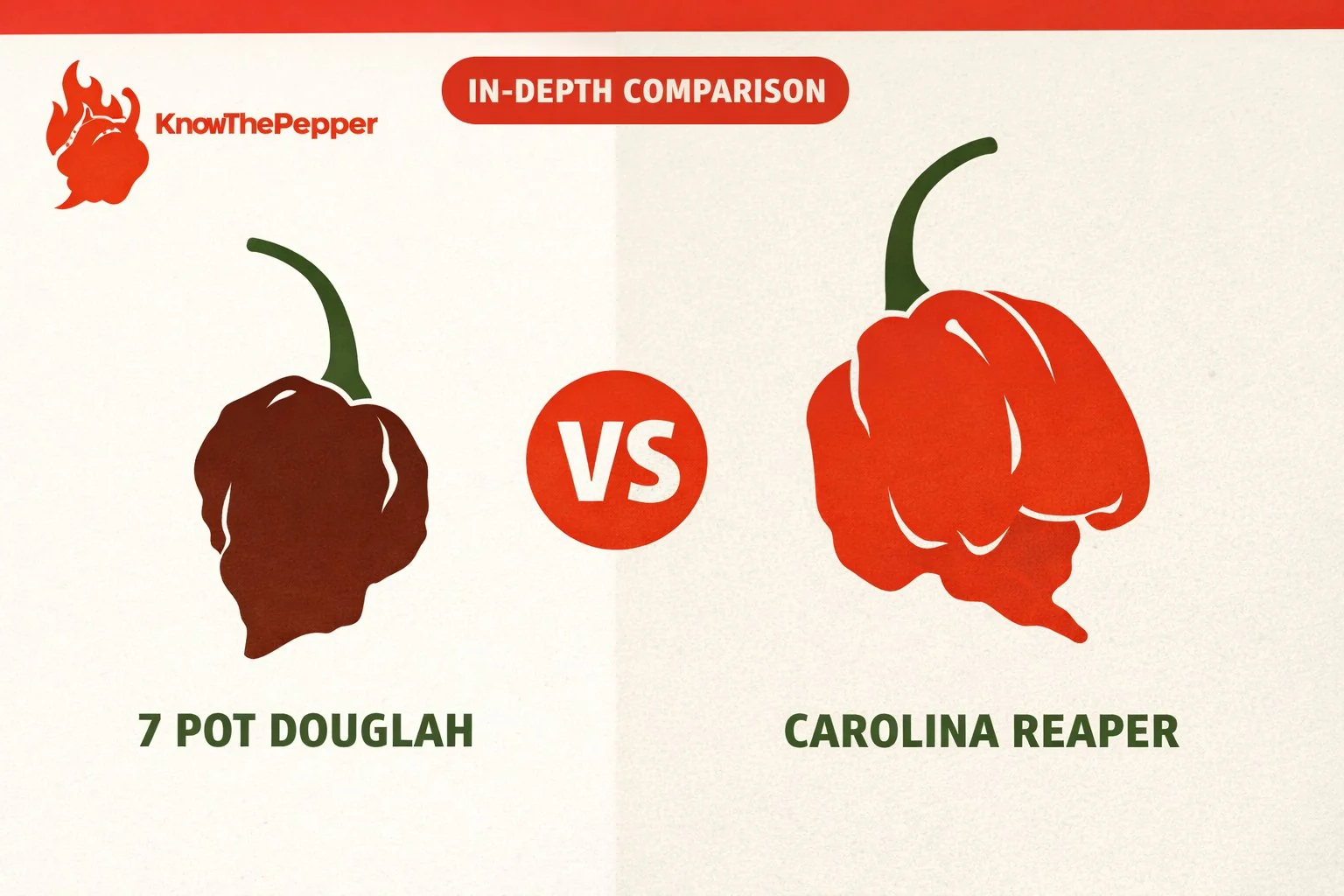
Color is not decoration in this comparison. The Douglah's dark brown skin usually points to a heavier savory profile, while Moruga Scorpion's red pod reads brighter before the heat takes over.
That matters in a sauce base. Black beans, roasted roots, beef chili, and dark fermented mash can carry Douglah's earthy edge; mango, carrot, citrus, and vinegar bases usually make more sense with Moruga.
Buying by color alone is still risky. Chocolate superhots look alike, so vendor naming, pod shape, and source history matter more than a photo of a brown pod.
Ceiling Trap
The Moruga Scorpion owns the higher published peak at 2,009,231 SHU, while the Douglah commonly appears around 923,000 to 1,853,396 SHU in seed-source and CPI-linked reporting.
That difference is real on paper and nearly useless for casual dosing. At this level, both peppers should be treated as measured seasoning concentrates, not as vegetables.
Ferment Split
Fermentation exposes their personalities better than raw tasting. Douglah pushes a mash toward dark, savory, almost cocoa-like depth, especially with garlic, onion, carrot, and a little sweetness for balance.
Moruga Scorpion keeps more of a red-fruit lift when the base includes carrot, mango, pineapple, or bright vinegar. Its burn can feel sharper early, so acidity has to be adjusted after the mash settles.
A mixed-superhot ferment can use both, but the role should be deliberate: Douglah for bass notes, Moruga for top-end fire and fruit.
The weak version is adding both only because they are famous. That turns the sauce into a heat stunt and hides the flavor reason to choose either pepper.
Powder Choice
For powder, choose Douglah when the food is dark and savory; choose Moruga when the food needs a red superhot accent. A tiny pinch is enough for beans, chili, rubs, or a vinegar sauce.
Seed Source
Seeds are the hidden quality issue. Both cultivars move through hobbyist and specialty seed channels, and cross-pollination can blur pod shape, color, and heat.
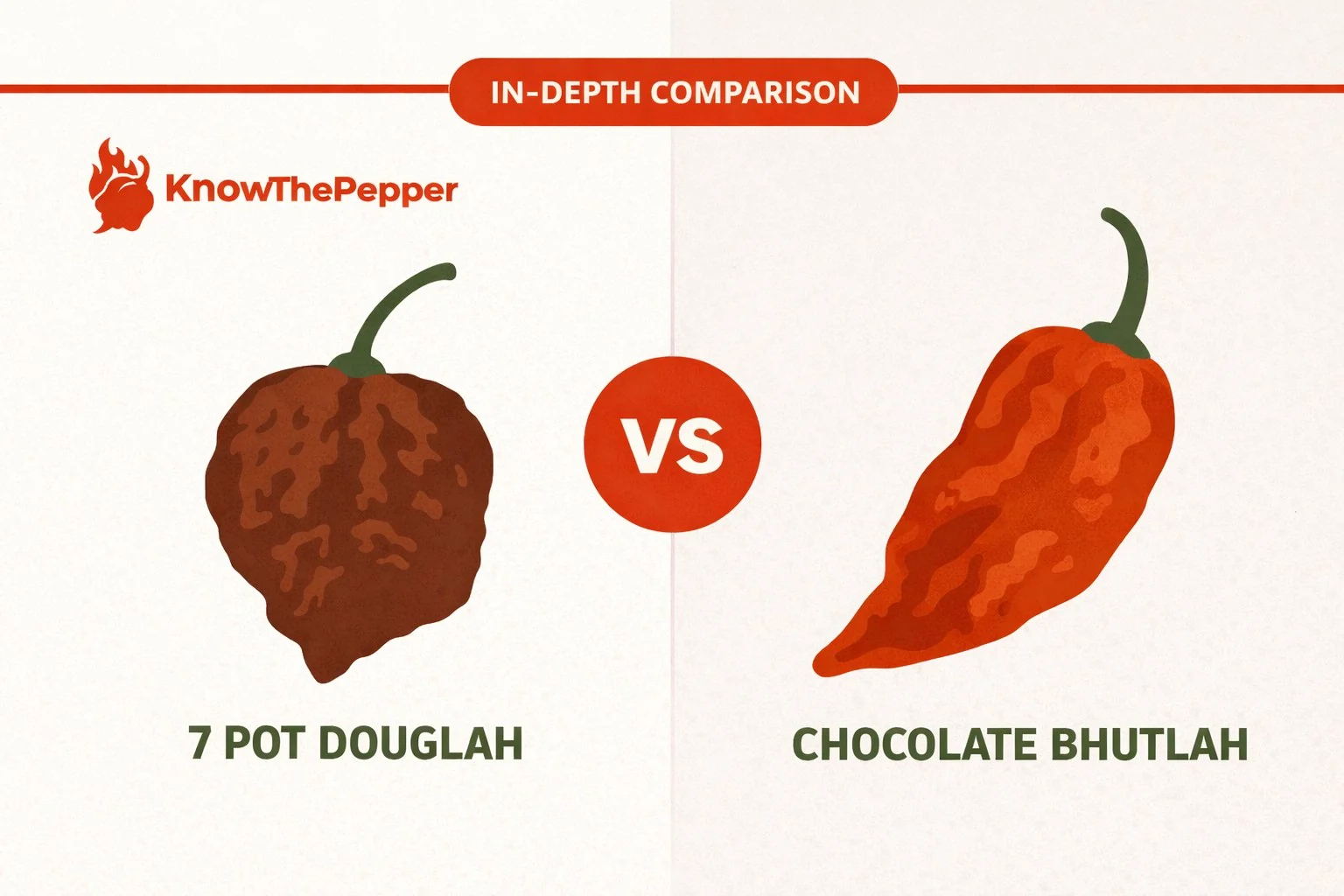
A reliable listing should name the cultivar, species, origin story, pod color, and expected SHU range. For related dark-superhot context, Douglah versus Chocolate Bhutlah is a better sibling check than a generic superhot list.
If you are growing for sauce production, isolate plants or buy from a source that explains its seed-saving practice. Otherwise the harvest may still be hot, but it may not behave like the comparison you planned around.
Fact-Checked & Expert Reviewed
Editorial Standards: Head-to-head comparisons include blind tasting when applicable. Heat levels cross-referenced with multiple sources. All substitution ratios tested side-by-side.
Review Process:
Written by
James Thompson
(Lead Comparison Reviewer)
, reviewed by
Karen Liu
(Lead Fact-Checker & Science Editor)
. Last updated June 29, 2026.
7 Pot Douglah vs Trinidad Moruga Scorpion FAQ
Trinidad Moruga Scorpion has the higher documented peak at just over 2 million SHU. 7 Pot Douglah is still a true superhot, so the practical difference is flavor and dose control more than normal eating heat.
Use 7 Pot Douglah for darker savory ferments with garlic, onion, carrot, or roasted flavors. Use Trinidad Moruga Scorpion for a brighter red superhot sauce with fruit, vinegar, or citrus.
Yes, but the sauce will turn brighter and less earthy. Start with the same tiny dose, then adjust the base because Moruga can make fruit and vinegar notes feel sharper.
The mature pods ripen to dark brown or purple-brown, which is why it is often grouped with chocolate superhots. The color also signals a heavier savory profile compared with many red superhots.