
7 Pot Douglah vs Chocolate Bhutlah: Which Is Hotter?
Chocolate Bhutlah has the higher listed ceiling at about 2,000,000 SHU, but 7 Pot Douglah overlaps it at a reported 923,000 to 1,853,396 SHU and the figures are not one head-to-head test. Choose Douglah for the smaller Trinidad 7 Pot identity and Bhutlah for the longer reported ghost-and-Douglah cross, then verify either through a named seed line.

7 Pot Douglah
Super-HotChocolate Bhutlah
Super-HotQuick Comparison
| Attribute | 7 Pot Douglah | Chocolate Bhutlah |
|---|---|---|
| Scoville evidence | 923K-1.9M SHU | 1M-2M SHU |
| Heat Tier | Super-Hot | Super-Hot |
| vs Jalapeño | 232x hotter | 250x hotter |
| Flavor | earthy, nutty C. chinense fruit with extreme heat | Refining Fire Chiles describes Chocolate Bhutlah CS as smoky-fruity; ripe brown color does not prove chocolate flavor. |
| Species | C. chinense | C. chinense |
| Origin | Trinidad and Tobago | USA |
Does Chocolate Bhutlah Run Hotter Than 7 Pot Douglah?
By the published ceilings used for these profiles, Chocolate Bhutlah has the higher listed maximum. Secondary Bhutlah references commonly report about 1,500,000 to 2,000,000 SHU, while 7 Pot Douglah seed sources report 923,000 to 1,853,396 SHU.
The 146,604-SHU gap between those maximums is only about 8 percent, and the ranges overlap broadly. The figures also come from different source types rather than one controlled head-to-head test, so they support a higher Bhutlah claim rather than a guarantee about every pod.
The peppers are related as well as similar. Sonoran Spice and PepperScale describe Chocolate Bhutlah as a Bhut Jolokia and 7 Pot Douglah cross, although PepperScale notes that some public lineage accounts leave room for another parent or a later variant.
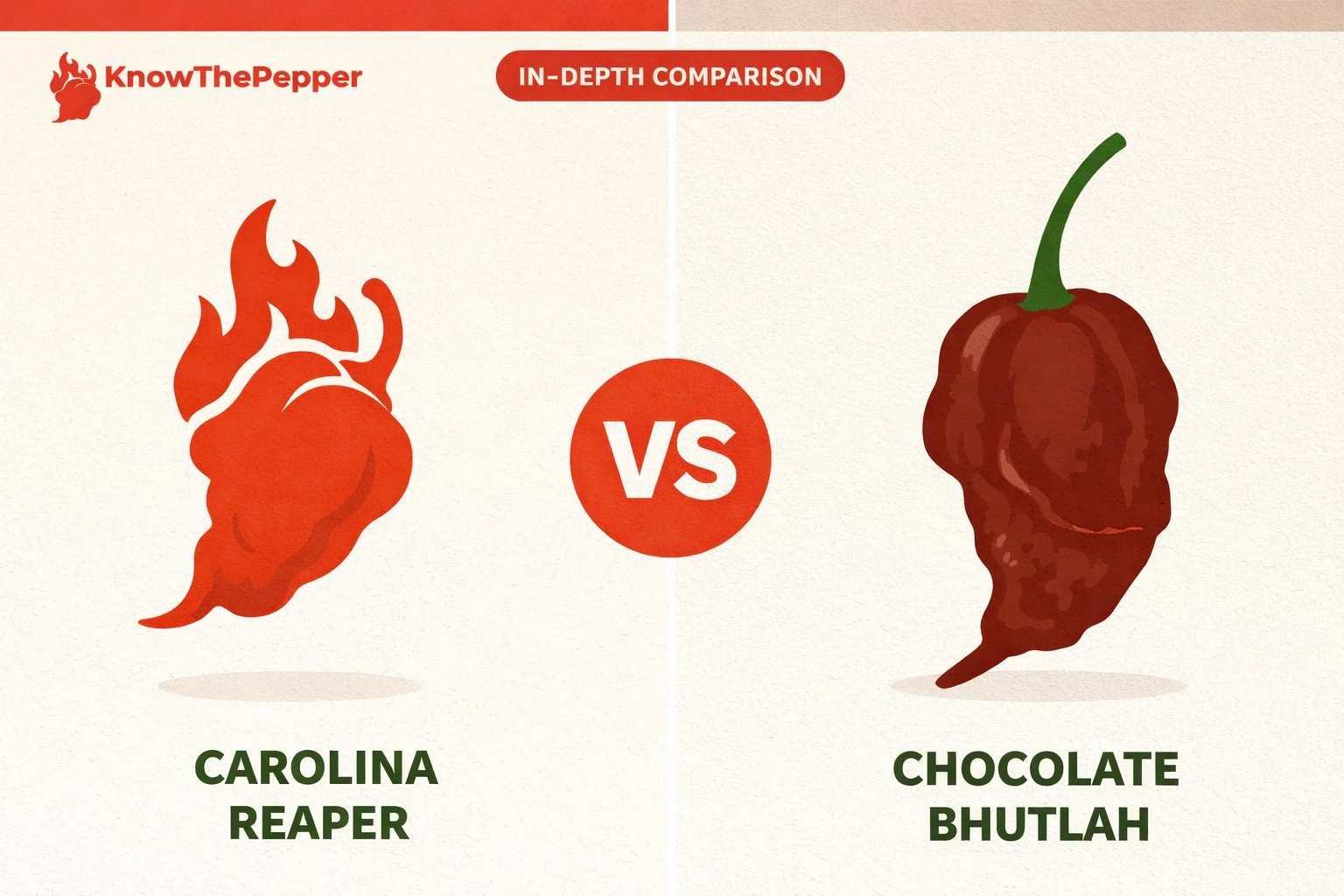
Choose 7 Pot Douglah for the named Trinidad 7 Pot line and its smaller squat brown pod. Choose Chocolate Bhutlah for the reported Douglah-descended hybrid, a longer tapered brown pod, and the slightly higher but less settled heat ceiling.
Heat Ceiling And Dose
No source in this comparison establishes a standardized lab trial that grew both cultivars together and tested multiple pods under the same protocol. Chocolate Bhutlah's two-million-SHU figure is widely repeated by secondary and seller sources, while Douglah has a narrower documented seed-source trail around its 923,000 to 1,853,396 SHU range.
New Mexico State University's Chile Pepper Institute explains that HPLC measures capsaicinoids before the result is expressed as Scoville Heat Units. Genetics, weather, growing conditions, and fruit age can change a pod's result, which makes a tested sample more precise than a cultivar label.
For sauce, measure a trimmed sliver by weight and blend it through the full batch before adding more. Pod count hides differences in pod size and placental tissue, so one Bhutlah is not a calibrated replacement for one Douglah.
Powder needs even tighter control because it disappears through a pot and can become airborne. If anyone eating the dish has not chosen superhot heat, keep the base mild and offer a clearly labeled finished sauce separately.
How Do Douglah and Chocolate Bhutlah Pods Differ?
Both cultivars ripen from green to chocolate brown, but their usual silhouettes differ. Douglah is commonly described as a smaller squat, dimpled pod near 2 inches, while Chocolate Bhutlah is generally longer, more tapered, and heavily wrinkled around 2 to 3 inches.
Source descriptions overlap more than the old copy suggested. Douglah listings use earthy or nutty language, while Chocolate Bhutlah references add fruity, floral, earthy, or smoky terms, but no controlled tasting evidence proves that every Bhutlah is smokier or every Douglah is nuttier.
The word chocolate describes ripe color rather than cocoa flavor in both names. Use the brown color and pod shape as identification clues, then confirm the seed or product line because dried brown superhots become difficult to distinguish by sight alone.
Dilution gives those source-described aromas a chance to appear before extreme heat dominates. Raw tasting is neither a reliable identification method nor a necessary step for choosing between two million-SHU peppers.
How Do You Use Douglah and Bhutlah in Sauces and Rubs?
Both peppers fit dark fermented sauce, vinegar sauce, savory chile paste, powder, and rubs when a tiny amount is spread across many servings. Douglah's documented Trinidad 7 Pot identity may matter to a cultivar-led sauce, while Bhutlah's reported ghost-and-Douglah lineage may matter to a product built around the cross.
For fermentation, let milder peppers, carrot, fruit, garlic, or onion provide most of the mash volume. Add either brown superhot below the expected dose, record its trimmed weight, and judge the fermented batch after complete blending rather than setting a universal pod ratio.
For powder or rubs, blend a measured amount into a larger carrier such as salt, sugar, paprika, or another spice before it reaches food. This improves distribution and reduces the chance that one serving receives a concentrated pocket of superhot powder.
These peppers can replace each other only when the recipe needs generic dark superhot heat rather than a named cultivar. Treat the change as not a fixed 1:1 swap, start below the original trimmed weight, and adjust after the complete sauce or seasoning blend is mixed.
Sourcing Lineage And Safety
A useful listing names 7 Pot Douglah or the exact Chocolate Bhutlah line, the Capsicum chinense species, mature brown color, expected pod shape, harvest form, and source or isolation history. A package labeled only brown ghost mix does not provide enough evidence for either identity.
Bhutlah lineage deserves an explicit caveat. Several sources describe Bhut Jolokia crossed with 7 Pot Douglah, but public accounts also distinguish later Bhutlah variants and possible additional parentage, so the product should name its line rather than borrowing one generic pedigree.
New Mexico State University identifies placental tissue as the main capsaicinoid production site, which means removing seeds alone does not control either pepper. Wear gloves, ventilate powder, keep tools separate, avoid touching the face, and wash handles, lids, and work surfaces after use.
Label fresh pods, freezer bags, dried pods, powder jars, and finished sauce with the full cultivar name and date. Clear labels protect the next cook and preserve the lineage information that appearance cannot reliably supply.
7 Pot Douglah vs Chocolate Bhutlah FAQ
- Refining Fire Chiles / Super Hot Chiles - 7 Pot Douglah Pepper
- Pepper Joe's - 7 Pot Douglah Pepper Seeds
- Sonoran Spice - Chocolate Bhutlah Pepper Guide
- New Mexico State University Circular 706 - Chile Pepper Cultivars for New Mexico