

KnowThePepper
Ghost Pepper (Bhut Jolokia): 855,000–1,041,427 SHU From Northeast India
The ghost pepper (Bhut Jolokia) held the Guinness World Record for hottest pepper from 2007 to 2011, measuring 855,000 to 1,041,427 SHU - roughly 208 times hotter than a jalapeño and about 4 times hotter than a habanero. Native to northeastern India, it carries a smoky-sweet flavor beneath its punishing heat.
Handle it with gloves and respect.
- Species: C. chinense
- Heat tier: Super-Hot (1M+ SHU)
- Comparison: 107-417x hotter than a jalapeño, depending on where the jalapeño falls in its 2,500-8,000 SHU range
What Makes Ghost Pepper Different?
Long before it became a dare on YouTube, the ghost pepper was a staple of Naga cuisine in Assam, Nagaland, and Manipur, used not as a novelty heat challenge but as a daily cooking ingredient in a region where intensely spiced food is the norm.
Botanically a Capsicum chinense variety, the ghost pepper (also called Bhut jolokia) was officially measured in 2007 by scientists at India's Defence Research and Development Organisation at 1,041,427 SHU - earning it the title of world's hottest pepper at the time. It has since been surpassed by the Trinidad Moruga Scorpion, Carolina Reaper, and others, but its heat ceiling remains extraordinary.
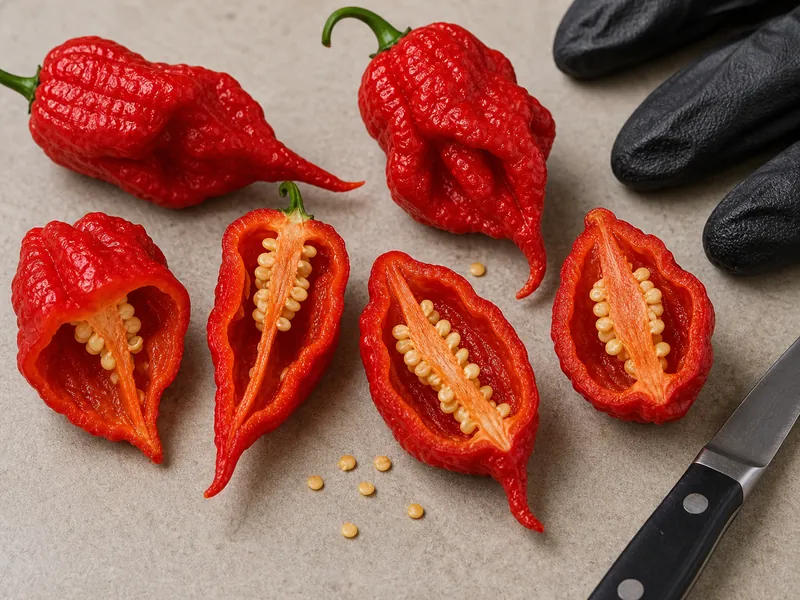
The pods are elongated and wrinkled - 2.5 to 3.5 inches long, with a bumpy, irregular texture typical of the C. chinense family. They ripen from green to a deep, glossy red, though yellow, chocolate, and peach variants exist, each with slightly different heat profiles.
Not all bhut jolokias are identical. Red Bhut Jolokia is the standard variety at 855,000 to 1,041,427 SHU.
Yellow Bhut Jolokia measures somewhat lower and has a distinctly fruity-sweet flavor.
Chocolate Bhut Jolokia carries earthy notes and still exceeds 800,000 SHU. All belong to C. chinense and share the delayed-heat characteristic of that species.
Flavor-wise, the ghost pepper has a surprisingly complex profile before the heat takes over: smoky and sweet with a brief fruit note that experienced tasters can detect in the first half-second before the burn peaks.
Where Does Ghost Pepper Come From?
Northeastern India's Naga tribes cultivated the ghost pepper for centuries before Western food culture noticed it.
Historical records from the Assam region note medicinal and pest-control use, smeared on fence lines and boundary areas, ghost pepper extract has been documented as a deterrent for wild Asian elephants, preventing them from destroying crops. The Wildlife Trust of India has documented this practice in Assam.
The Naga people used ghost peppers in combination with smoked pork and fermented bamboo shoots in regional dishes that remain part of local cuisine today. The pepper was culturally significant long before it had an international profile.
The 2007 Guinness World Record certification brought global attention.
Before that, the bhut jolokia was known to chile pepper researchers and regional Indian agriculture but had no significant international profile. The record was subsequently broken in 2011 by the Naga Viper, again in 2012 by the Trinidad Moruga Scorpion, and in 2013 by the Carolina Reaper.
Ghost peppers held the record for 6 years - longer than any subsequent record holder.
Despite losing the record, ghost peppers retained cultural prominence far exceeding their heat ranking. They remain the most widely known super-hot pepper by name, and their relative availability makes them the entry point for heat-seekers who want to go beyond habanero.
What Does Ghost Pepper Taste Like, and How Hot Is It?
The Ghost Pepper delivers 855K–1M Scoville Heat Units, placing it in the Super-Hot tier (1M+ SHU). That makes it roughly 107-417x hotter than a jalapeño, depending on where the jalapeño falls in its 2,500-8,000 SHU range.
Flavor notes: smoky and sweet.
What's in Ghost Pepper? Nutrition Facts
Ghost peppers are rich in vitamin C - a single pod can contain more than 100% of the daily recommended value, though the serving size in practice is far smaller than a whole pod. At 855,000 to 1,041,427 SHU, a small fraction of a pod is the practical use unit for most people.
The capsaicin concentration is significant enough that ghost peppers have attracted research attention beyond cooking use. India's DRDO, the same body that confirmed the Guinness record, has researched ghost pepper extract for non-lethal crowd control applications, citing capsaicin's ability to cause temporary incapacitation at these concentrations.
Standard nutritional analysis shows meaningful vitamin A (from beta-carotene in red-ripe pods), vitamin B6, and potassium content, consistent with other C. chinense varieties like habanero. The capsaicin receptor science explains why high concentrations produce delayed, intense burn rather than the immediate sharp heat of lower-SHU peppers.
For heat-source context, see our methodology and data caveats.
Which Dishes Suit Ghost Pepper?
Working with ghost peppers demands more caution than most cooks expect. The heat doesn't peak immediately, there's a 30 to 60 second delay before the full burn hits, which catches first-time users off guard.
That delay is a hallmark of C. chinense peppers: at very high capsaicin concentrations, the receptor response curve is slower to peak than with lower-SHU C. annuum peppers like jalapeños.
In Naga cuisine, ghost peppers are used in fermented fish paste (ngari) combinations, incorporated into chutneys, and added to smoked pork stews. The technique is typically to use a very small amount, often a quarter of a pod - to season a dish serving multiple people.
This is not a pepper you use by the handful.
For hot sauce production, ghost pepper works best blended with something sweet and acidic, mango, pineapple, or tamarind all offset the delayed burn and give the sauce drinkability. A starting ratio: 1 ghost pepper per 2 cups of mango puree produces a sauce that's hot but intentional.
The substitutes for ghost pepper in most recipes are habaneros used in larger quantities, roughly 3 habaneros per 1 ghost pepper approximates the heat output in sauces. When comparing ghost pepper vs habanero, the midpoint gap is approximately 4x: ghost pepper at ~950,000 SHU vs habanero at ~225,000 SHU.
If it has gone too far
- Reach for dairy first. Capsaicin dissolves in fat, so milk, yoghurt or full-fat cream work where water does not.
- Water spreads it rather than removing it, which is why rinsing the mouth makes the burn feel worse.
- Starch helps: rice or bread gives the capsaicin somewhere to go.
- For skin, wash with soap or oil rather than water alone.
- Wear gloves before cutting, and keep hands away from eyes for as long as it takes to wash properly.
Where Can You Buy Ghost Pepper, and How Do You Store It?
Fresh ghost peppers appear at specialty grocers and farmers markets in late summer. Look for pods with taut, unbroken skin and no soft spots, a fully intact ghost pepper holds its heat and flavor longer.
Avoid pods with visible softening at the stem end, which signals aging.
Dried ghost pepper powder and dried whole pods are the most reliable retail formats year-round. Store dried pods sealed in a dark, cool location for 6 to 12 months before significant potency loss.
Ground ghost pepper powder starts fading after 6 to 8 months.
Fresh pods refrigerate for 1 to 2 weeks and freeze for up to 12 months with minimal quality loss. Always handle with nitrile gloves - at this SHU level, skin contact causes lasting irritation that soap and water barely address.
Use oil or fat-based cleaners to remove capsaicin from skin.
Keep hands away from eyes and face until thoroughly cleaned.
What Is a Good Substitute for Ghost Pepper?
Compare substitutes for Ghost Pepper by form, flavor, and heat before choosing a ratio. Measured adjustments must account for the dish and the concentration of the replacement.
Direct comparisons show where flavor, form, and preparation differ in the Carolina Reaper vs Ghost and Ghost Pepper vs Moruga Scorpion matchups.
Compare Ghost Pepper with: Ghost Pepper vs Scotch Bonnet · Ghost Pepper vs Naga Viper · Ghost Pepper vs Naga Morich · Ghost Pepper vs 7 Pot Douglah
How Do You Grow Ghost Peppers?
The hardest part of growing ghost peppers isn't germination, it's maintaining the long, hot season they need to fully develop. Ghost peppers require 120 to 150 days from transplant to full maturity, significantly longer than jalapeños (70 to 85 days) or even habaneros (90 to 110 days).
Start seeds indoors 12 to 14 weeks before last frost - germination at 80 to 85°F takes 14 to 21 days, and a heat mat is non-negotiable. Without it, germination rates drop significantly and timing becomes unpredictable.
Transplant outdoors only when nighttime temps consistently stay above 60°F - ghost peppers are more cold-sensitive than most other hot peppers and will stall badly if hit by late spring cold. They need 8 to 10 hours of direct sun daily to develop full heat and yield.
Space plants 24 to 30 inches apart. Ghost peppers grow tall, often 3 to 4 feet with support, and produce 20 to 30 pods per plant in a good season.
The long season means they're best suited for USDA zones 8 to 11 without greenhouse assistance.
A useful overwintering technique: bring potted ghost pepper plants indoors before first frost, keep them above 55°F through winter, then return them outdoors the following spring. Established root systems from overwintered plants often produce significantly better yields in year two than new transplants.
For northern gardeners, a greenhouse or polytunnel extends the viable growing season. Growing ghost peppers at home covers cold-climate workarounds in detail.
Ghost Pepper FAQ


- HortScience - Bhut Jolokia paper
- Chile Pepper Institute, New Mexico State University
Species classification: C. chinense - based on published botanical taxonomy.