Ghost Pepper vs Naga Viper: Heat Evidence, Lineage, and Use
Ghost Pepper is the better-documented and easier-to-source superhot for repeatable sauce. Naga Viper has a higher historical result, but its hybrid-line provenance and the actual lot matter more than a record-number conversion.

Ghost Pepper has the stronger research record and is easier to source for a repeatable sauce. Naga Viper carries a higher historical result of 1,382,118 SHU, but product identity and lot evidence matter more than converting record numbers into a dose.
- Named identity: Bhut Jolokia from northeastern India vs British hybrid attributed to Gerald Fowler
- Published heat evidence: 855,000 to 1,041,427 SHU vs 900,000 to 1,382,118 SHU
- Evidence type: Peer-reviewed replicated field trial vs Historical record result and breeder reporting
- Sourcing risk: Broad market, verify pure form vs Line maintenance is especially important
- Best practical role: Repeatable sauce or powder vs Traceable collector batch
- Dose basis: Actual form and lot evidence vs Actual form and lot evidence
Ghost Pepper
Super-HotNaga Viper
Super-HotQuick Comparison
| Attribute | Ghost Pepper | Naga Viper |
|---|---|---|
| Named identity | Bhut Jolokia from northeastern India | British hybrid attributed to Gerald Fowler |
| Published heat evidence | 855,000 to 1,041,427 SHU | 900,000 to 1,382,118 SHU |
| Evidence type | Peer-reviewed replicated field trial | Historical record result and breeder reporting |
| Sourcing risk | Broad market, verify pure form | Line maintenance is especially important |
| Best practical role | Repeatable sauce or powder | Traceable collector batch |
| Dose basis | Actual form and lot evidence | Actual form and lot evidence |
Where Do Ghost Pepper and Naga Viper Come From?
Ghost Pepper and Naga Viper are distinct named superhots with different evidence trails. Ghost Pepper, also called Bhut Jolokia, comes from northeastern India and has a peer-reviewed New Mexico State University study, while historical accounts attribute Naga Viper to British grower Gerald Fowler.
Bosland and Baral characterized Bhut Jolokia plants from Assam as Capsicum chinense by morphology. Their molecular results also suggested introgression from Capsicum frutescens, so even Ghost Pepper's background is more precise than a simple one-species label implies.
Naga Viper is reported as a three-way hybrid involving Naga Morich, Bhut Jolokia, and Trinidad Scorpion material.
That parentage claim is part of the pepper's history, but it does not make every seed packet carrying the name genetically identical.
The practical identity difference is documentation and repeatability.
Ghost Pepper has published trials, a long-standing regional name, and broad commercial recognition, while Naga Viper depends more heavily on breeder history and the supplier maintaining a recognizable line.
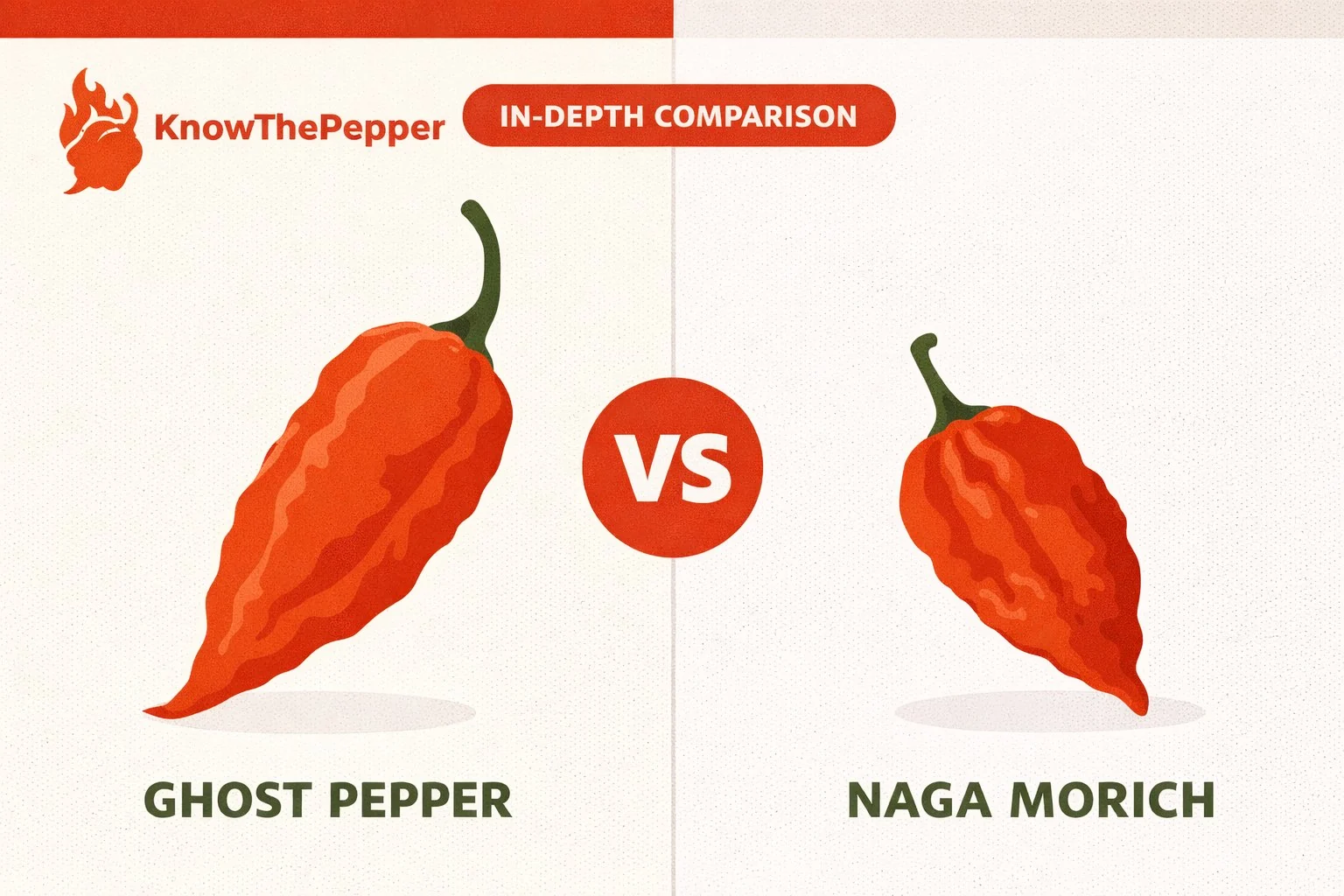
Pod shape cannot prove identity on its own because both can produce red, wrinkled, irregular superhot fruit. Use breeder or supplier records, seed provenance, and stable traits across multiple plants before treating an unknown pod as either named pepper.
Which Is Hotter, Ghost Pepper or Naga Viper?
Naga Viper has the higher famous number, but the figures do not come from one head-to-head trial. Its reported record result is 1,382,118 SHU, while Bosland and Baral measured Bhut Jolokia at 1,001,304 SHU in replicated New Mexico field plots.
The same 2007 study did not establish one permanent number for every Ghost Pepper.
A later HortScience paper summarizes Bhut Jolokia results as low as 855,000 SHU in one Indian study and documents strong changes across growing regions.
That makes a simple 1.38-to-1.00 calculation a comparison of two reported results, not a safe dosing ratio. Record heat is not a package specification, and an individual sauce, powder, or pod needs its own lot evidence.
Both peppers sit above the level where casual tasting can guide an initial dose safely. Weigh the product, dilute it into a larger base, and evaluate a small portion of the finished mixture rather than biting a raw piece.
Form changes exposure as well as concentration.
Pure powder disperses quickly through a sauce, fresh pod adds water and solids, and an extract may be far more concentrated than either named pepper.
If a vendor provides a recent laboratory result for the exact lot, that figure is more useful than a generic variety maximum. Without lot data, treat either pepper as an extreme ingredient whose dose must start below the recipe's full amount.
Two record figures do not make a dosing ratio
Bhut Jolokia reached 1,001,304 SHU in a replicated NMSU trial, while Naga Viper carries a reported 1,382,118 SHU result. Different material and testing contexts prevent a safe 1.38-to-1 conversion.
How Do Ghost Pepper and Naga Viper Taste Different?
Ghost Pepper has the better documented and more repeatable cooking identity. Published descriptions and the current profile place it in a smoky, sweet, and briefly fruity direction before extreme heat dominates perception.
Naga Viper is commonly described as fruity or floral, but those descriptors are less useful without a traceable line. A hybrid-derived plant that varies in pod shape and heat may also vary in aroma and flavor expression.
These are source summaries, not a promise that every pod will taste the same.
Ripeness, drying method, fermentation, smoke exposure, and the sauce base can change what remains perceptible after capsaicin takes over.
A sauce maker can preserve more pepper character by using a small weighed amount in a base that supports it. Fruit, vinegar, roasted vegetables, or fermentation may give the aroma somewhere to register instead of using the superhot only as a burn source.
Do not add smoke, sugar, or tropical fruit automatically because a profile uses those words. The recipe still decides whether those ingredients belong, and a different batch may express the named flavor direction weakly.
At this intensity, flavor differences are easier to compare in diluted finished sauces than in raw pods.
That approach also separates the cooking decision from a stunt tasting decision.
Which Is Better for a Repeatable Hot Sauce?
Choose Ghost Pepper for a sauce or powder you intend to reproduce. Its research record, broader commercial availability, and established Bhut Jolokia name make it easier to buy the same form again and document what entered the batch.
A Ghost Pepper hot sauce can pair a measured dose with fruit, acid, or fermented vegetables, but the base must still carry flavor after dilution. The named pepper should contribute a controlled heat curve rather than erase the rest of the recipe.
Choose Naga Viper when the specific breeder history or named hybrid is part of the product.
A small collector batch can justify the extra sourcing work if the supplier documents its line and the label states the ingredient clearly.
Naga Viper is a weaker choice for a commercial recipe that needs consistent replacement stock. A new seed line or powder supplier may not reproduce the previous batch's heat, pod phenotype, or flavor direction.
For dry seasoning, compare pure powders by weight and keep the superhot fraction separate from salt, sugar, and other spices during formulation.
A teaspoon comparison is unreliable because grind size and packing density change how much powder it holds.
For fermented sauce, record the prepared pepper weight, total batch weight, salt concentration, and final yield. Those measurements let a later batch adjust one variable at a time instead of guessing from pod count.
| Batch goal | Better first choice | Evidence behind the choice |
|---|---|---|
| Reproduce a named hot sauce | Ghost Pepper | Peer-reviewed identity and wider product availability improve traceability. |
| Feature a British hybrid story | Naga Viper | The breeder and maintained line are part of the ingredient claim. |
| Replace one pure powder with another | Use lot data | Grind density and capsaicinoid concentration vary. |
| Make an eating challenge | Neither | Challenge consumption is not a cooking need. |
Verdict
Choose Ghost Pepper for repeatable superhot cooking. It has the stronger published identity, wider availability, and more realistic path to matching a previous sauce or powder batch.
Choose Naga Viper when the named British hybrid and its provenance are the point.
The higher historical figure matters less than buying a traceable line and testing the actual product you receive.
Neither pepper is a sensible choice when a habanero-level ingredient can meet the dish's heat and flavor needs. Lower heat gives you more room to adjust without turning a small weighing error into an unusable batch.
For either pepper, the best product is the one with clear identity, form, lot information, and handling instructions. A frightening name without traceability is weak evidence.
What Should You Check Before Buying Either Pepper?
For Ghost Pepper, look for the Bhut Jolokia name, country or region information, product form, and a supplier that can answer whether the lot is pure pepper. A seasoned powder or extract is not equivalent to whole fresh or dried Ghost Pepper.
For Naga Viper seed, ask who maintained the line and whether plants were isolated from other Capsicum pollen.
The reported hybrid background makes off-type plants a larger purchasing concern than the record number printed on a listing.
Photographs can help reject an obvious mismatch, but one dramatic pod does not establish a stable seed lot. Compare several plants, mature pod shapes, color, and the supplier's breeding records.
For sauce or powder, retain the package, lot code, purchase date, and measured amount in the recipe notes. Record the source and lot so the next superhot batch can repeat the same inputs.
Avoid marketplace listings that combine several famous names into one unsupported label.
A product called Ghost Viper Reaper does not identify a cultivar, a tested heat range, or a reliable substitution path.
Handling And Cleanup
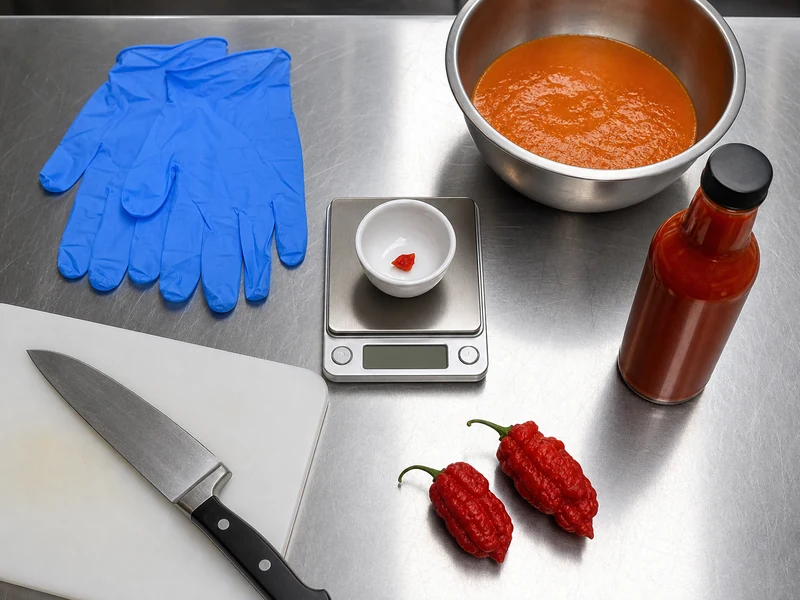
Wear intact nitrile gloves when cutting either pepper and replace them if they tear. Keep the cutting board, knife, blender parts, and waste away from children, pets, and ordinary meal preparation.
Ventilation matters when blending, heating, dehydrating, or grinding superhots because airborne particles can irritate eyes and airways.
Do not lean over an open blender or grinder when the lid comes off.
Measure the pepper before it enters the base and keep unseasoned base available for dilution. Adding more base is controllable, while trying to remove dispersed capsaicin is not.
Label the finished container with the pepper, form, batch date, and a plain extreme-heat warning.
Never put a superhot sauce into an unlabeled bottle or a container that looks like an ordinary condiment.
Clean tools with detergent and plenty of water, then wash gloved hands before removing the gloves. Capsaicin can remain on handles, taps, phones, and towels even when no red residue is visible.
If exposure causes severe symptoms, breathing difficulty, chest pain, or persistent eye pain, seek medical help. A kitchen article cannot replace emergency or poison-control advice.
Substitution
Do not convert Naga Viper and Ghost Pepper from their record numbers alone. The figures come from different evidence, and NMSU Circular 706 documents that Bhut Jolokia itself changes with accession and growing environment.
Match fresh pepper with fresh pepper, dried pod with dried pod, and pure powder with pure powder. Begin below equal prepared weight when the replacement has a higher credible lot result or when the original batch already sat near its heat limit.
When Naga Viper replaces Ghost Pepper, keep unseasoned sauce base aside and add the superhot mixture in measured stages. The goal is to preserve the recipe's finished heat, not to prove that the higher-record pepper can be noticed.
When Ghost Pepper replaces Naga Viper, do not add extra pods merely to chase the 1,382,118-SHU historical result. Adjust the complete sauce after dilution because more pepper also changes solids, aroma, color, and fermentation inputs.
A Ghost Pepper substitute is defensible when a recipe needs a named, extremely hot Capsicum chinense ingredient but not Bhut Jolokia provenance. If the product name or regional identity matters, disclose the change.
Naga Viper has no universal substitution ratio because line identity is part of the uncertainty. Supplier data for the actual powder, pod, or sauce concentrate should outrank a generic chart.
Keep a dilution reserve
Set aside unseasoned sauce base before adding either superhot. A measured reserve lets you correct an excessive dose without rebuilding the entire batch.