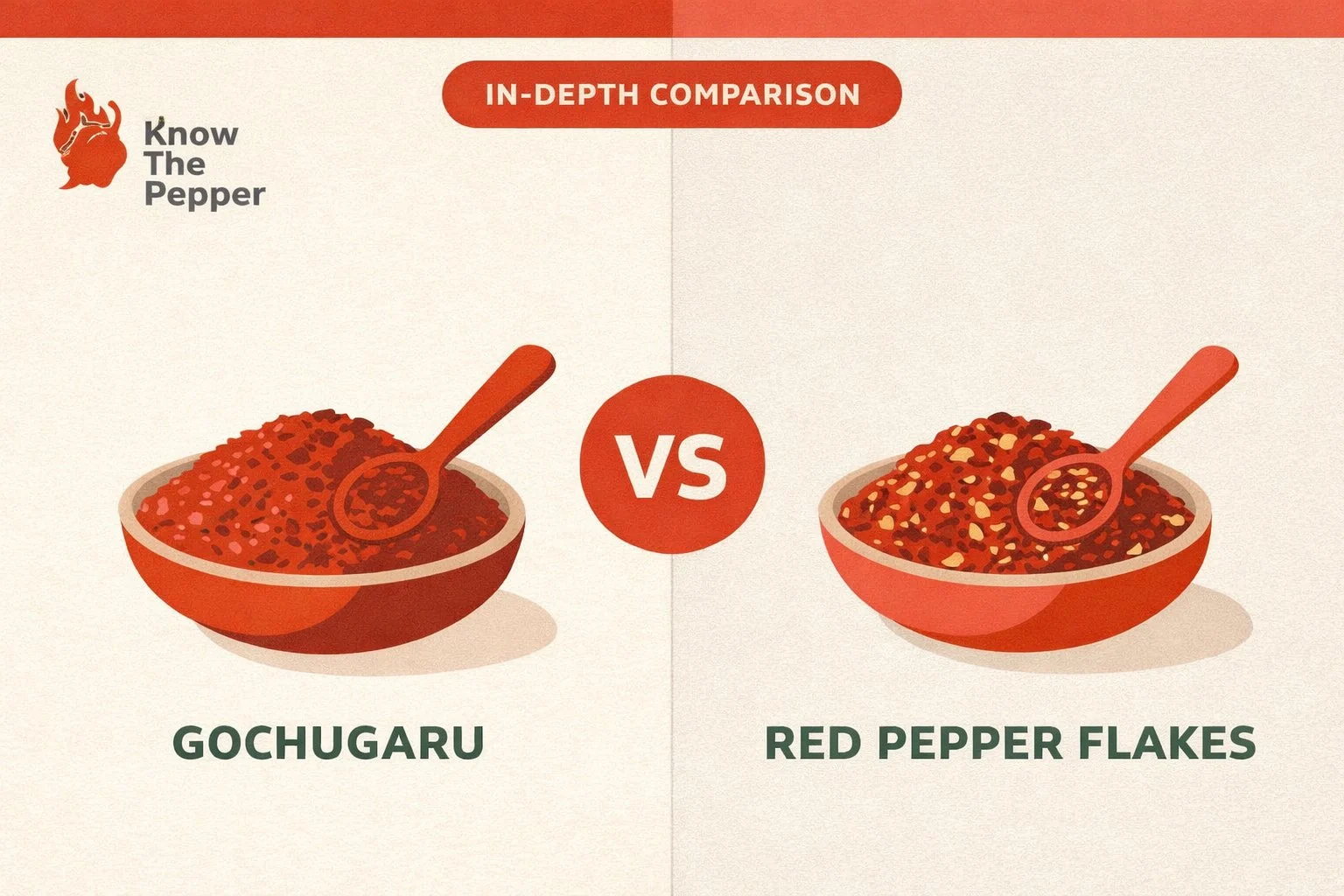
Gochugaru is the Korean chile flake for kimchi texture, gochujang-style sauces, and clean red heat. Kashmiri chili is the Indian powder for deep color in rogan josh, tandoori marinades, and butter chicken with much gentler heat.
Comparison Contributor·Updated Jun 29, 2026·
Reviewed by
Karen Liu
Quick Comparison
Gochugaru measures 2K–10K SHU while Kashmiri Chili registers 1K–2K SHU. That makes Gochugaru about 5x hotter by upper SHU range. Gochugaru is known for its smoky and sweet flavor (C. annuum), while Kashmiri Chili offers mild and sweet notes (C. annuum).
Gochugaru
2K–10K SHU
Hot · smoky and sweet
Kashmiri Chili
1K–2K SHU
Medium · mild and sweet
Heat difference: Gochugaru is about 5× hotter by upper SHU range
Species: Both are C. annuum
Best for: Gochugaru excels in everyday cooking and salsas, Kashmiri Chili in fresh salsas and mild recipes
Gochugaru is
about 5× hotter than Kashmiri Chili.
They fall in different heat tiers: Gochugaru is classified as hot while Kashmiri Chili sits in the medium range.
Gochugaru spans 2K–10K SHU, roughly 1× a jalapeño at the upper end.
Kashmiri Chili spans 1K–2K SHU.
Use the ranges to decide whether the recipe needs a measured dose, a mild overlap, or a hard substitution limit.
Tools: Scoville chart and SHU calculator.
The first time I cooked with gochugaru, I expected something close to crushed red pepper flakes. What I got instead was completely different - a deep brick-red powder with a smell closer to dried fruit and smoke than raw heat.
Gochugaru (C. annuum) is produced from elongated Korean red peppers that are sun-dried whole, then seeded and ground to varying textures - from coarse flakes to fine powder. The drying method matters enormously.
Kashmiri Chili
mildsweetC. annuum
Color is the whole point with Kashmiri chili. Cooks across South Asia reach for it specifically because it delivers a saturated, almost lacquer-red hue that synthetic food coloring can't replicate - and it does this at a mere 1,000-2,000 SHU, so the heat never overwhelms the dish.
The pods are elongated, thin-walled, and deeply wrinkled when dried, with a papery texture that grinds easily into a fine powder. Fresh pods are rarely exported; most cooks outside India encounter it as a dried whole chili or pre-ground powder.
Both peppers belong to C. annuum, so they share some underlying flavor chemistry. However, Gochugaru’s smoky and sweet notes contrast with Kashmiri Chili’s mild and sweet character.
Gochugaru brings smoky and sweet notes, so it fits recipes where that flavor should remain visible.
Kashmiri Chili leans mild and sweet, which can change the sauce, filling, marinade, or garnish even when the heat range looks close.
Culinary Uses for Gochugaru and Kashmiri Chili
Gochugaru
Gochugaru does things other dried peppers can't. The coarse grind holds texture in fermented dishes like kimchi, while the fine powder form dissolves smoothly into marinades and sauces.
For making kimchi from scratch, coarse-ground gochugaru is non-negotiable - it coats cabbage leaves evenly and continues developing flavor through fermentation. Fine-ground works better in gochujang paste, soups like sundubu jjigae, and braised dishes.
Beyond Korean cooking, gochugaru works surprisingly well as a finishing spice on roasted vegetables, eggs, and pizza. The sweet-smoky character bridges the gap between smoked paprika and standard chili flakes.
Kashmiri Chili
Kashmiri chili powder is the backbone of Rogan Josh, butter chicken, and tandoori marinades - dishes where the visual impact matters as much as flavor. The standard ratio in most restaurant-style Rogan Josh is 2-3 teaspoons per serving, enough to turn the sauce a deep amber-red without pushing heat past comfortable.
Blooming the powder in ghee or neutral oil for 30-45 seconds before adding liquids is non-negotiable if you want full color extraction. Skipping this step leaves the dish looking dull and slightly raw-tasting.
Outside Indian applications, Kashmiri chili works as a paprika substitute anywhere you want more color intensity. It performs well in Spanish-style braised meats, North African spice rubs, and even deviled egg toppings.
Start near 1:1 by amount. The heat ranges are close enough that flavor, form, and recipe role matter more than a strict Scoville conversion.
Growing Gochugaru vs Kashmiri Chili
Growing notes
Gochugaru
Growing gochugaru-style peppers is straightforward if you can give them a long, warm season. Start seeds indoors 8-10 weeks before last frost - these are C. annuum types that need consistent warmth to germinate, ideally soil temps around 80°F.
Transplant after all frost risk passes into full sun with well-draining soil. Plants reach 2-3 feet and produce heavily.
Drying is where most home growers get tripped up. Traditional sun-drying requires consistent heat and low humidity over several weeks.
Growing notes
Kashmiri Chili
Kashmiri chili is a warm-season annual that performs best in USDA zones 9-11 outdoors, though it grows well as a container plant in cooler climates when brought inside before frost. Start seeds indoors 8-10 weeks before last frost, maintaining soil temperature around 75-85°F for germination.
The plants are relatively compact - typically 18-24 inches tall - and moderately productive. They prefer well-drained, slightly acidic soil with consistent moisture.
Peppers arrived in Korea via Portuguese traders around the late 16th century, likely through Japan following the Imjin War (1592-1598). Before that, Korean cuisine relied on black pepper, mustard, and ginger for heat.
The adoption was rapid and widely adopted. Within a century, red pepper had become central to Korean food culture, fundamentally reshaping dishes that had existed for centuries.
Origin & background
Kashmiri Chili
India · C. annuum
The Kashmir Valley's cool climate and rich alluvial soil created ideal conditions for a distinct chili landrace that local farmers selected over generations for deep color and mild heat. Chili cultivation in Kashmir likely intensified after Portuguese traders introduced Capsicum species to South Asia in the 16th century, with regional varieties diverging quickly based on local culinary preferences.
Kashmiri cuisine prizes color and layered spicing over raw heat, which explains why farmers selected for pigment-dense pods rather than capsaicin. The pepper became embedded in Wazwan - the elaborate multi-course feast of Kashmiri cuisine - where dishes like Rogan Josh owe their signature crimson appearance almost entirely to Kashmiri chili powder.
Buying & Storage
Whether you’re shopping for Gochugaru or Kashmiri Chili, the same quality indicators apply. Fresh peppers should feel firm and heavy for their size, with taut, glossy skin and no soft or wet spots. Minor stem cracks known as “corking” are perfectly normal and often indicate a mature, flavorful pod.
Selection
What to look for
Firm pods with taut skin and consistent color
Should feel heavy relative to size
Minor stem cracks (“corking”) are normal
Avoid anything soft, shriveled, or with dark wet spots
Storage
How to store them
Fresh: Paper bag, crisper drawer, 1 to 2 weeks
Frozen: Wash, dry, freeze on sheet pan, 6+ months
Dried: Airtight and away from light, up to 1 year
Mistakes to avoid
Common misses
Gochugaru
Blaming the seeds. Membranes hold most capsaicin.
Adding heat too early. Capsaicin breaks down with cooking.
Not tasting individual pods. Heat varies 30%+.
Common misses
Kashmiri Chili
Equating green with unripe. Different products.
Overcooking. Cell walls break down fast.
Sealed plastic storage. Causes rot. Use paper bags.
Final call
Gochugaru vs Kashmiri Chili
Gochugaru and Kashmiri Chili
occupy very different positions on the heat spectrum. Gochugaru delivers about 5× more upper-range heat with its distinctive smoky and sweet character.
Kashmiri Chili, with its mild and sweet profile, excels in everyday cooking.
Heat gap about 5× by upper rangeGochugaru smoky and sweetKashmiri Chili mild and sweet
Texture decides this comparison before heat does. Gochugaru is often a coarse Korean flake that stays visible in kimchi and sauces.
Kashmiri chili is usually a fine powder that stains oil, yogurt, and curry bases. It behaves more like a color-and-aroma powder than a flake.
If the recipe needs red specks and fermented cabbage coating, use gochugaru. If it needs a smooth brick-red sauce with gentle warmth, use Kashmiri chili.
Color Without Same Heat
Both ingredients are loved for color, but the heat spread is not the same. Gochugaru commonly sits around 1,500-10,000 SHU, while Kashmiri chili usually sits closer to 1,000-2,000 SHU, so a one-spoon swap can turn a mild Indian sauce sharper than intended.
Color also behaves differently. Gochugaru gives a vivid red-orange flecked look; Kashmiri powder blooms into fat and dairy, turning marinades and gravy a deeper red without gritty flakes.
Fermentation Or Bloomed Oil
Fermentation favors gochugaru because coarse flakes cling to napa cabbage, radish, garlic, ginger, and brine. That texture is part of kimchi paste, not decoration.
Bloomed oil favors Kashmiri chili. In rogan josh, tandoori marinades, butter chicken, and dal tadka, the powder releases color into ghee, oil, yogurt, or tomato without leaving a coarse bite.
Use the cooking medium as the test. Brine and paste point toward Korean gochugaru. Hot fat, yogurt, and curry gravy point toward Indian Kashmiri chili.
The mistake is chasing color with more chile. Add too much gochugaru to match Kashmiri color and the heat may outrun the dish; add too much Kashmiri to mimic gochugaru texture and the sauce can taste dusty.
Swap Needs Grind And Sugar
Replacing Kashmiri chili with gochugaru usually needs grinding and restraint. Use less at first, grind if the sauce must be smooth, and add a pinch of sweet paprika only if the color still looks weak.
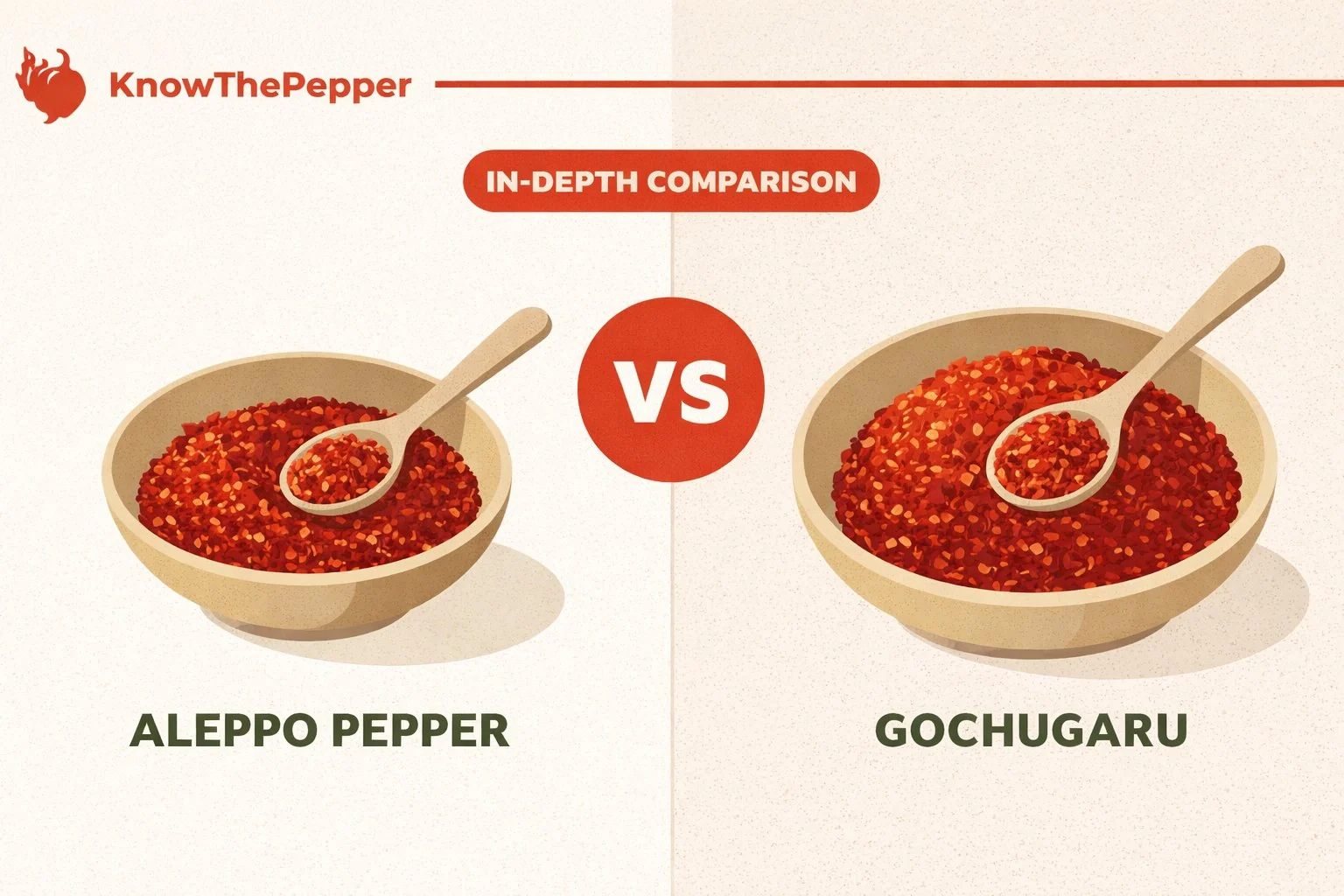
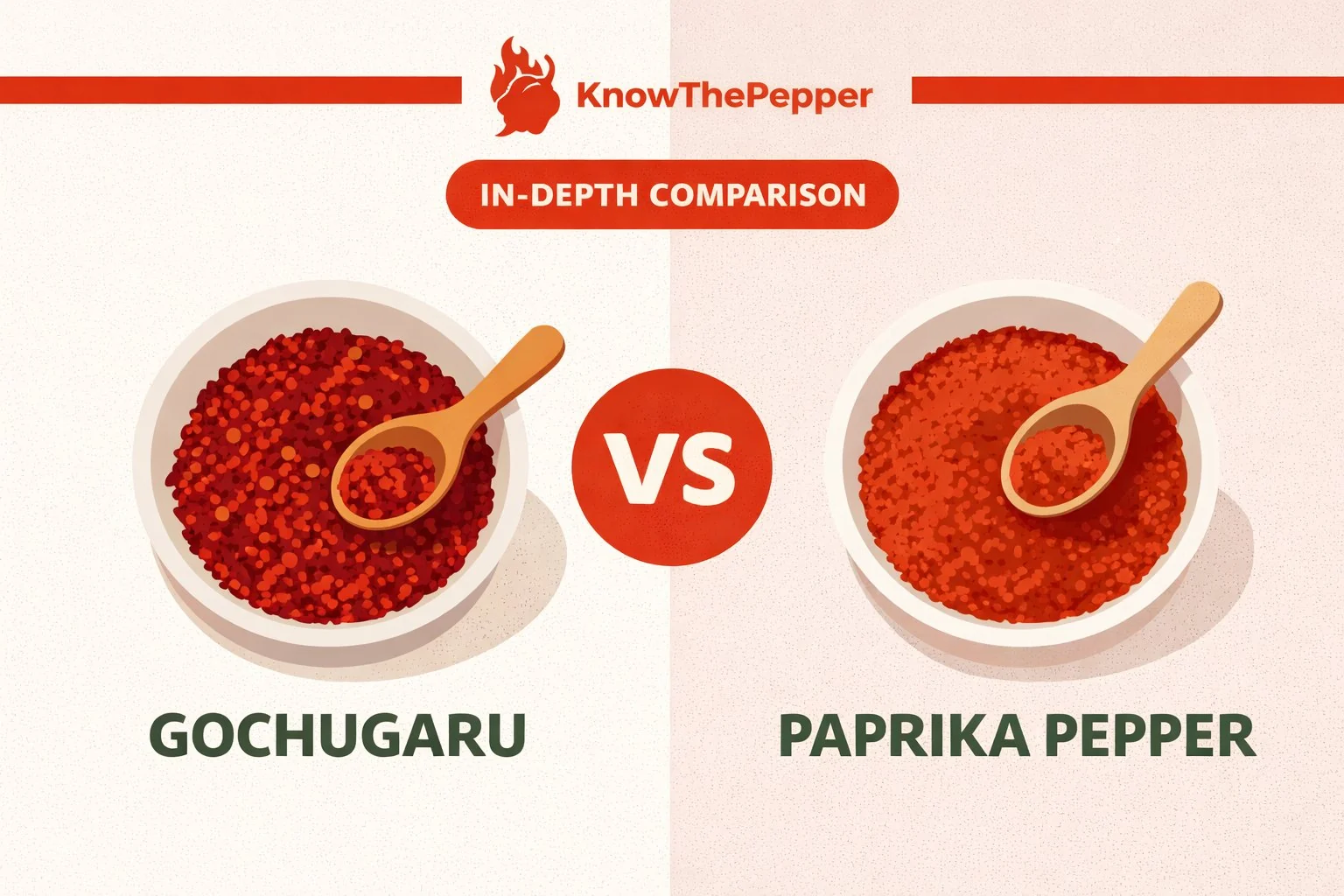
Replacing gochugaru with Kashmiri chili needs texture repair. Add less powder by volume, expect a smoother paste, and consider a small amount of mild flake if the recipe depends on visible red texture. Related pages like Kashmiri chili vs paprika and Aleppo vs gochugaru show why color and flake size are separate decisions.
Buy By Color And Language
Buy gochugaru by Korean labeling, grind size, and bright scarlet-orange color; buy Kashmiri chili by vivid brick-red powder or pliable whole pods. Store both airtight and away from light because gochugaru loses fresh aroma first, while Kashmiri powder loses the color most cooks bought it for.
Fact-Checked & Expert Reviewed
Editorial Standards: Head-to-head comparisons include blind tasting when applicable. Heat levels cross-referenced with multiple sources. All substitution ratios tested side-by-side.
Review Process:
Written by
James Thompson
(Lead Comparison Reviewer)
, reviewed by
Karen Liu
(Lead Fact-Checker & Science Editor)
. Last updated June 29, 2026.
Gochugaru vs Kashmiri Chili FAQ
It is not a good direct swap. Kashmiri chili gives color, but it lacks the coarse flake texture and Korean pepper flavor that help kimchi paste coat vegetables.
Kashmiri chili is valued for red pigments more than high heat. It colors oil, yogurt, and curry bases strongly while staying mild.
Often yes, but quality varies. Look for Korean labeling, bright red color, and coarse or fine grind notes instead of a generic red pepper flake bag.
Gochugaru can range from mild to moderately hot, often 1,500 to 10,000 SHU. Kashmiri chili is usually narrower and milder, often around 1,000 to 2,000 SHU.
Kashmiri chili is safer for low-spice cooking because the range is mild and predictable. Gochugaru is better when the recipe needs Korean flake texture and flavor.