Aleppo vs Gochugaru: Finish Flake or Kimchi Flake?

Aleppo pepper is the better flake for finishing eggs, yogurt, hummus, lamb, vegetables, and olive oil. Gochugaru is the better flake when the dish needs Korean chile color, kimchi texture, gochujang-style sauce, or sweet red warmth.

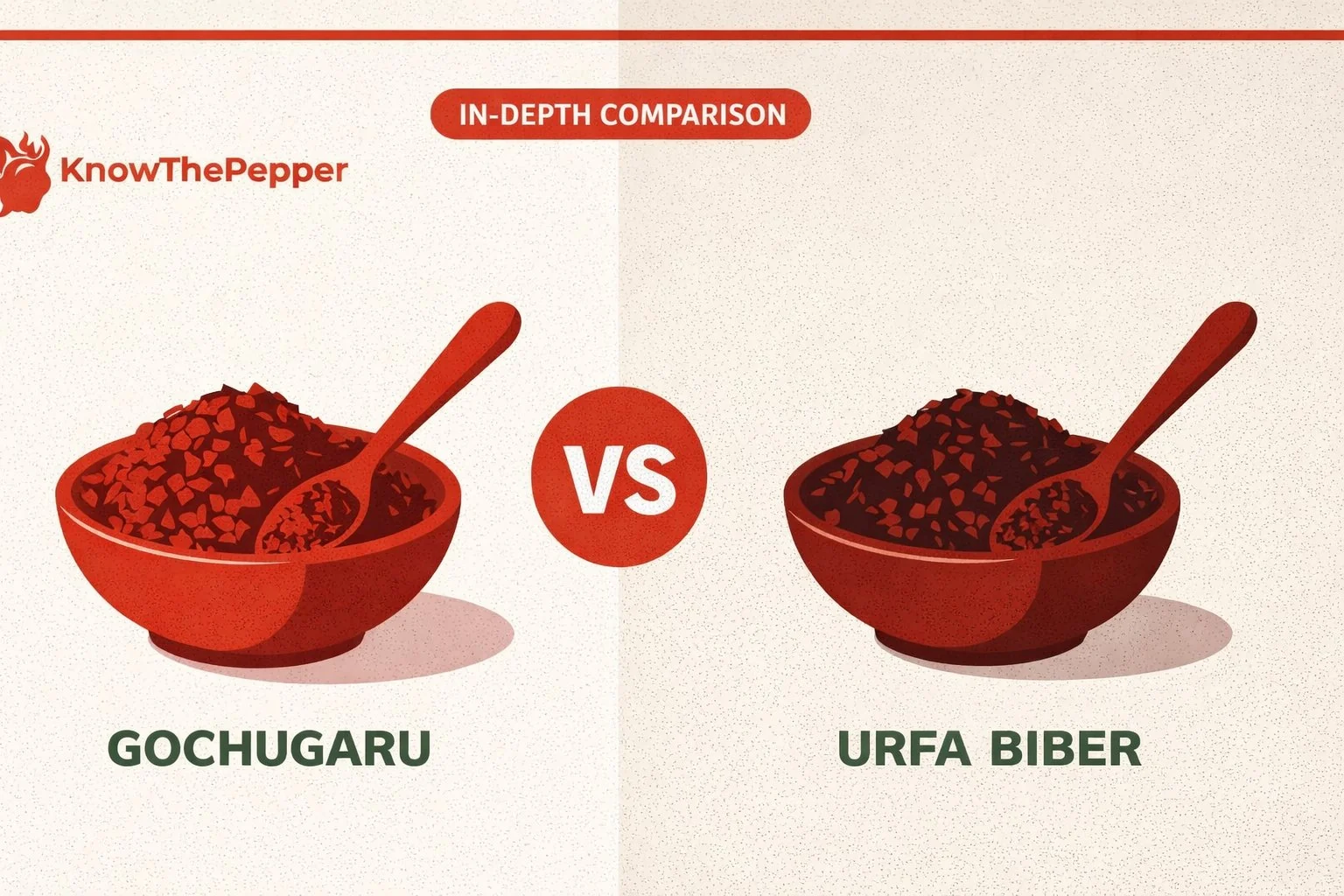
Aleppo Pepper and Gochugaru side by side for a heat and flavor comparison
Quick Comparison

Aleppo Pepper measures 10K–10K SHU while Gochugaru registers 2K–10K SHU. Their upper SHU ranges are close enough to treat as the same heat bracket. Aleppo Pepper is known for its fruity, tart, sweet-hot, lightly earthy flavor (C. annuum), while Gochugaru offers smoky and sweet notes (C. annuum).

Aleppo Pepper
10K–10K SHU
Hot · fruity, tart, sweet-hot, lightly earthy
Gochugaru
2K–10K SHU
Hot · smoky and sweet
  • Species: Both are C. annuum
  • Best for: Aleppo Pepper excels in everyday cooking and salsas, Gochugaru in fresh salsas and mild recipes

Aleppo Pepper vs Gochugaru Comparison

Attribute Aleppo Pepper Gochugaru
Scoville (SHU) 10K–10K 2K–10K
Heat Tier Hot Hot
vs Jalapeño 1x hotter 1x hotter
Flavor fruity, tart, sweet-hot, lightly earthy smoky and sweet
Species C. annuum C. annuum
Origin Syria Korea

Aleppo Pepper vs Gochugaru Heat Levels

Position on the Scoville Scale
Aleppo
Gochugaru
0 SHU3.2M SHU

Aleppo Pepper is in the same practical heat bracket.

Aleppo Pepper spans 10K–10K SHU, roughly 1× a jalapeño at the upper end. Gochugaru spans 2K–10K SHU, about 1× a jalapeño at the upper end. Use the ranges to decide whether the recipe needs a measured dose, a mild overlap, or a hard substitution limit. Tools: Scoville chart and SHU calculator.

Flavor Profile Comparison

Aleppo Pepper
fruity tart sweet-hot C. annuum

Aleppo pepper is a Syrian Halaby chile most cooks meet as coarse red flakes, not as a fresh pod. It belongs to C. annuum species profile, but its kitchen identity comes from the dried form: ripe chiles are dried, seeded, crushed, and often mixed with salt and neutral oil.

For heat, treat Aleppo as a moderate chile around 10,000 SHU. Serious Eats gives the Halaby pepper a 10,000 Scoville value, and Claremont Spice describes the flakes as around 10,000 on the Scoville scale.

Gochugaru
smoky sweet C. annuum

The first time I cooked with gochugaru, I expected something close to crushed red pepper flakes. What I got instead was completely different - a deep brick-red powder with a smell closer to dried fruit and smoke than raw heat.

Gochugaru (C. annuum) is produced from elongated Korean red peppers that are sun-dried whole, then seeded and ground to varying textures - from coarse flakes to fine powder. The drying method matters enormously.

Both peppers belong to C. annuum, so they share some underlying flavor chemistry. However, Aleppo Pepper’s fruity, tart, sweet-hot, lightly earthy notes contrast with Gochugaru’s smoky and sweet character.

Aleppo Pepper brings fruity, tart, sweet-hot, lightly earthy notes, so it fits recipes where that flavor should remain visible. Gochugaru leans smoky and sweet, which can change the sauce, filling, marinade, or garnish even when the heat range looks close.

Aleppo Pepper and Gochugaru comparison

Culinary Uses for Aleppo Pepper and Gochugaru

Aleppo Pepper

Use Aleppo pepper where you want fruit, color, and rounded heat instead of the sharp bite of generic crushed red pepper. It works on fried eggs, beans, lentil soup, grilled lamb, roast chicken, roasted carrots, potatoes, yogurt sauces, hummus, flatbread, pasta, and tomato-based stews.

The flakes bloom quickly in fat. Add a teaspoon to warm olive oil, butter, or pan drippings near the end of cooking, then spoon that oil over the dish.

Aleppo also works as a table chile. Sprinkle it over finished food the way you would use red pepper flakes, but expect more body and less immediate sting.

Gochugaru

Gochugaru does things other dried peppers can't. The coarse grind holds texture in fermented dishes like kimchi, while the fine powder form dissolves smoothly into marinades and sauces.

For making kimchi from scratch, coarse-ground gochugaru is non-negotiable - it coats cabbage leaves evenly and continues developing flavor through fermentation. Fine-ground works better in gochujang paste, soups like sundubu jjigae, and braised dishes.

Beyond Korean cooking, gochugaru works surprisingly well as a finishing spice on roasted vegetables, eggs, and pizza. The sweet-smoky character bridges the gap between smoked paprika and standard chili flakes.

Which Should You Choose?

Best fit

Choose Aleppo Pepper if…

You want milder heat
You prefer fruity, tart, sweet-hot, lightly earthy flavors
You need a C. annuum variety

Best fit

Choose Gochugaru if…

You want milder, more approachable heat
You prefer smoky and sweet flavors
You need a C. annuum variety

Can You Substitute One for the Other?

Start near 1:1 by amount. The heat ranges are close enough that flavor, form, and recipe role matter more than a strict Scoville conversion.

Growing Aleppo Pepper vs Gochugaru

Growing notes

Aleppo Pepper

Grow Aleppo pepper as a warm-season C. annuum plant, then plan the drying step as part of the crop. Fresh red pods are only the first half of the job; the familiar spice comes from ripe chiles that are dried, seeded, crushed, and lightly oiled.

Use the pepper seed-starting workflow for trays, warmth, light, and hardening off. University of Minnesota Extension recommends starting pepper seeds indoors about eight weeks before outdoor planting and transplanting after cold nights have passed.

Choose full sun, warm soil, steady moisture, and good airflow. The general pepper pest and disease guide matters because dense foliage, wet leaves, and stressed plants can reduce the number of clean red pods available for drying.

Growing notes

Gochugaru

Growing gochugaru-style peppers is straightforward if you can give them a long, warm season. Start seeds indoors 8-10 weeks before last frost - these are C. annuum types that need consistent warmth to germinate, ideally soil temps around 80°F.

Transplant after all frost risk passes into full sun with well-draining soil. Plants reach 2-3 feet and produce heavily.

Drying is where most home growers get tripped up. Traditional sun-drying requires consistent heat and low humidity over several weeks.

Where They Come From

Origin & background

Aleppo Pepper

Syria · C. annuum

The safest way to describe Aleppo pepper is as a Halaby chile tradition associated with Aleppo, Syria, rather than as a single modern supply chain. Capsicum peppers originated in the Americas and spread into Ottoman and Middle Eastern cuisines after contact-era trade, but this profile should not pretend to document an ancient Syrian cultivar record without primary evidence.

In current markets, the key historical shift is recent and sourceable. Serious Eats describes how the war in Syria reduced Syrian exports and moved much production into Turkey.

Origin & background

Gochugaru

Korea · C. annuum

Peppers arrived in Korea via Portuguese traders around the late 16th century, likely through Japan following the Imjin War (1592-1598). Before that, Korean cuisine relied on black pepper, mustard, and ginger for heat.

The adoption was rapid and widely adopted. Within a century, red pepper had become central to Korean food culture, fundamentally reshaping dishes that had existed for centuries.

Buying & Storage

Whether you’re shopping for Aleppo Pepper or Gochugaru, the same quality indicators apply. Fresh peppers should feel firm and heavy for their size, with taut, glossy skin and no soft or wet spots. Minor stem cracks known as “corking” are perfectly normal and often indicate a mature, flavorful pod.

Selection

What to look for

  • Firm pods with taut skin and consistent color
  • Should feel heavy relative to size
  • Minor stem cracks (“corking”) are normal
  • Avoid anything soft, shriveled, or with dark wet spots

Storage

How to store them

  • Fresh: Paper bag, crisper drawer, 1 to 2 weeks
  • Frozen: Wash, dry, freeze on sheet pan, 6+ months
  • Dried: Airtight and away from light, up to 1 year

Mistakes to avoid

Common misses

Aleppo Pepper

  • Blaming the seeds. Membranes hold most capsaicin.
  • Adding heat too early. Capsaicin breaks down with cooking.
  • Not tasting individual pods. Heat varies 30%+.

Common misses

Gochugaru

  • Blaming the seeds. Membranes hold most capsaicin.
  • Adding heat too early. Capsaicin breaks down with cooking.
  • Not tasting individual pods. Heat varies 30%+.
Final call

Aleppo Pepper vs Gochugaru

Aleppo Pepper and Gochugaru sit in the same heat tier but serve different roles. Aleppo Pepper delivers its distinctive fruity, tart, sweet-hot, lightly earthy character. Gochugaru, with its smoky and sweet profile, excels in everyday cooking.

Heat gap same bracket Aleppo Pepper fruity, tart, sweet-hot, lightly earthy Gochugaru smoky and sweet
Additional Aleppo Pepper and Gochugaru comparison view

Finish Or Ferment

Decide by use, not color. Aleppo is usually a table and finishing flake; gochugaru is a Korean cooking flake that often has to hydrate, stain, ferment, or coat food.

Aleppo flakes are commonly coarse, slightly oily, fruity, and sometimes salted. They work when a dish is already cooked and needs warm chile depth at the end.

Gochugaru can be coarse or fine. Coarse flakes cling to napa cabbage for kimchi; fine powder works better in stews, sauces, marinades, and gochujang-style mixtures.

If the recipe says kimchi, tteokbokki, sundubu jjigae, or Korean marinade, start with gochugaru. If the recipe says yogurt, hummus, eggs, grilled lamb, tomato, or olive oil, start with Aleppo.

Grind Is Not Detail

Grind decides whether the flake disappears or stays visible. Fine gochugaru can thicken a sauce; coarse gochugaru paints brine and cabbage; Aleppo sits on the surface with fruit, salt, and oil-friendly color.

Oil Bloom Vs Brine

Aleppo likes warm fat. Bloom it briefly in olive oil, butter, or pan drippings, then spoon that red oil over beans, eggs, flatbread, roast carrots, or grilled meat.

Gochugaru likes moisture as much as fat. In kimchi paste, the flakes hydrate with garlic, ginger, fish sauce, and vegetable juices, then keep giving color through fermentation.

That fermentation context is why peppers in Korean cooking treats gochugaru as a pantry base, not just a sprinkle. Aleppo can finish a Korean-ish sauce, but it cannot replace the flake structure in a cabbage ferment.

Heat Range Is Secondary

Aleppo and gochugaru both live mostly in mild-to-medium territory, but product style moves the burn. Salted Aleppo flakes can taste rounder even when the chile is warm; sweet gochugaru can look vivid without feeling sharp.

A hotter Aleppo batch still does not behave like kimchi gochugaru. A milder gochugaru batch still does not bring Aleppo's oily finishing character.

Substitution Repair

For a finished plate, gochugaru can cover some of Aleppo's red warmth if you add the missing fat and salt yourself. Stir it into warm oil first, then taste before salting the food.

For kimchi, the same shortcut breaks. Aleppo brings different salt, oil, grind, and regional flavor, so the cabbage paste loses the Korean flake structure that gochugaru supplies.

For non-fermented red-chile decisions, compare the format before comparing heat. Calabrian chili vs red pepper flakes is about jar paste versus shaker heat, while gochugaru vs paprika is about color, sweetness, and Korean pantry fit.
Fact-Checked & Expert Reviewed
Editorial Standards: Head-to-head comparisons include blind tasting when applicable. Heat levels cross-referenced with multiple sources. All substitution ratios tested side-by-side.
Review Process: Written by James Thompson (Lead Comparison Reviewer) , reviewed by Karen Liu (Lead Fact-Checker & Science Editor) . Last updated June 29, 2026.

Aleppo Pepper vs Gochugaru FAQ

Only in some cooked sauces or glazes. It is not a clean kimchi substitute because Aleppo often has oil or salt, while gochugaru is chosen for Korean chile color, grind, and fermentation texture.

Yes, when you mainly need mild red chile warmth. Add oil or salt separately if the original Aleppo flakes were oily or salted.

The ranges overlap and vary by product. The bigger difference is use: Aleppo is usually a finishing flake, while gochugaru is built for Korean sauces, stews, marinades, and kimchi.

Gochugaru is better for kimchi. Coarse Korean flakes hydrate and coat cabbage properly, while Aleppo changes the salt, oil, texture, and flavor direction.

Sources & References
KL
Fact-checked by Karen Liu
Research Contributor
SHU Verified
Sources Cited
Expert Reviewed
All Comparisons Browse Peppers Scoville Scale