
Aleppo Pepper vs Urfa Biber: Which Flake Fits the Dish?
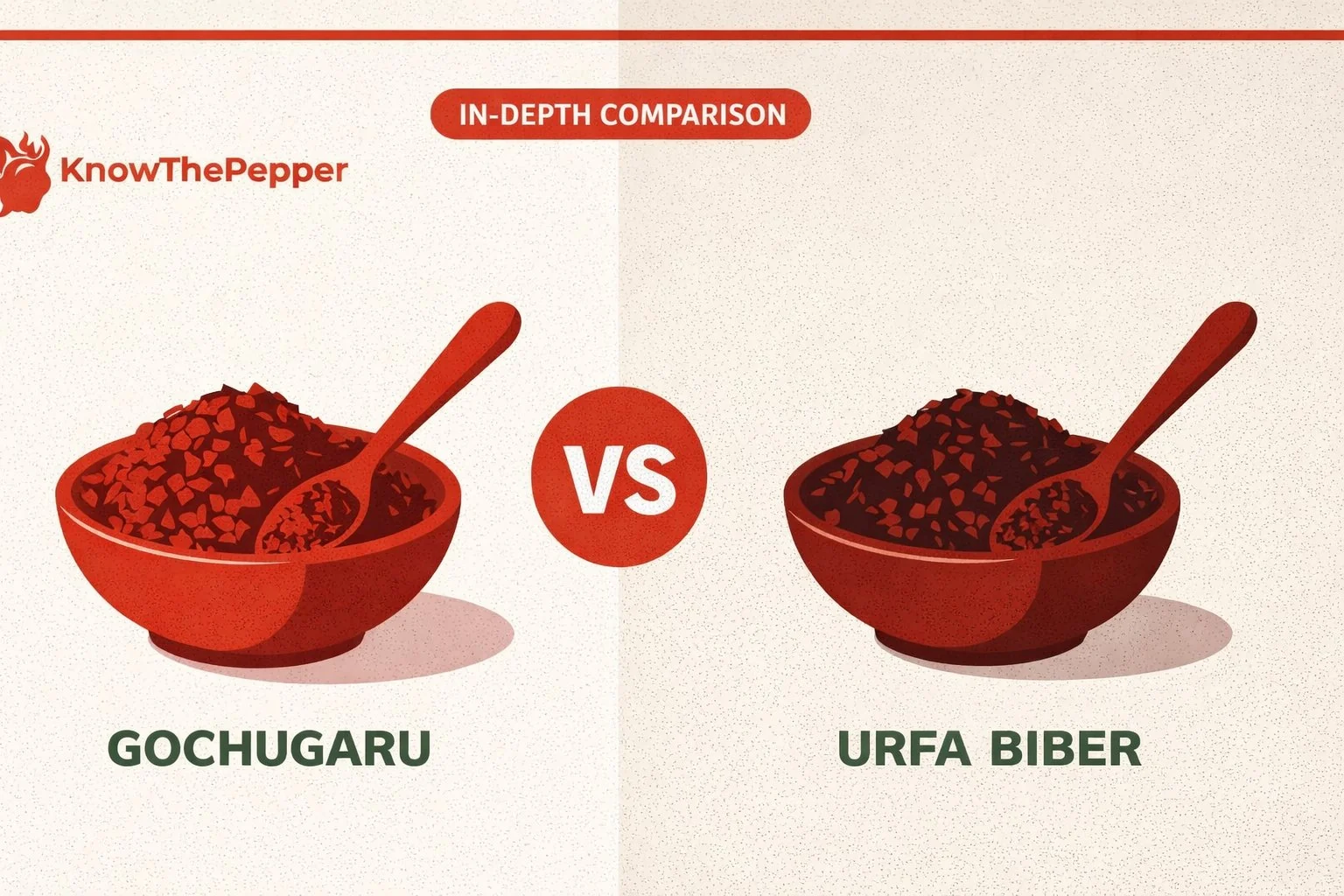
Choose Aleppo-style pepper for a brighter, redder finishing flake with tart fruit and a loose texture. Choose Urfa biber when a dish can carry a softer blackish-red flake with raisin-like cured depth. Their heat can overlap, but their processing, moisture, color, and behavior in food are different enough to change the result.

- Finished color: Deep crimson red vs Blackish red to purple-brown
- Texture: Loose, lightly oily flakes vs Soft, cohesive cured flakes
- Flavor direction: Bright red fruit and tart warmth vs Raisin, earth, cocoa, and lingering warmth
- Reference heat: About 10,000 SHU vs 5,000 to 10,000 SHU
- Best role: Finishing, lifting, red oil vs Deepening, melting into savory bases
Aleppo Pepper
HotUrfa Biber
HotQuick Comparison
| Attribute | Aleppo Pepper | Urfa Biber |
|---|---|---|
| Finished color | Deep crimson red | Blackish red to purple-brown |
| Texture | Loose, lightly oily flakes | Soft, cohesive cured flakes |
| Flavor direction | Bright red fruit and tart warmth | Raisin, earth, cocoa, and lingering warmth |
| Reference heat | About 10,000 SHU | 5,000 to 10,000 SHU |
| Best role | Finishing, lifting, red oil | Deepening, melting into savory bases |
Are Aleppo pepper and Urfa biber the same spice?
They are related red pepper flakes, not two names for one finished spice. Both come from Capsicum annuum peppers, yet Aleppo names a northern Syrian pepper tradition and the style now sold from several origins, while Urfa biber or isot identifies a cured spice associated with Şanlıurfa in southeastern Türkiye.
The word pul biber simply means flake pepper in Turkish. It does not guarantee that an unlabeled red flake has Aleppo's fruit profile or Urfa's terletme cure.
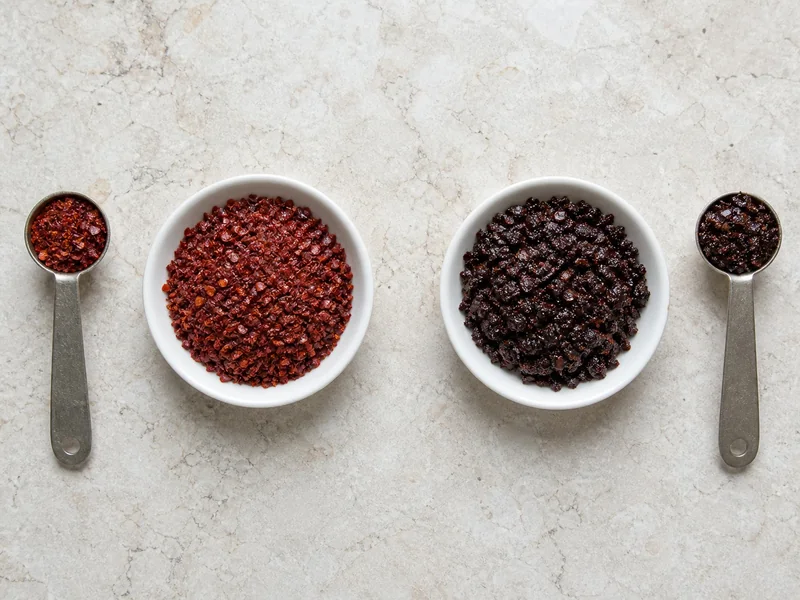
Read the country of origin and ingredient list, then inspect the flakes. Aleppo-style pepper should look deep crimson and relatively loose, while Urfa should look blackish red, soft, and slightly cohesive rather than bone dry.
Commercial recipes vary in seed level, salt, and added oil. The physical product in the package is stronger evidence than a marketing name alone.
How does processing make them taste different?
The main split begins after ripe red peppers are harvested. Red pepper flakes are dried and ground, while traditional isot receives an additional terletme stage that darkens and transforms the semi-dried fruit before final drying and milling.
In the 2017 LWT study, traditional isot started with roughly two to three days of sun dehydration. The semi-dried pieces were lightly brined, spread inside bags under the sun, turned during a six to eight day sweating stage, then dried again below 15 percent moisture before grinding.
That study compared Urfa-type fresh fruit, ordinary red pepper flakes, industrial isot, and traditional isot. Traditional isot carried 113.24 milligrams of measured volatile compounds per kilogram of dry weight, compared with 15.29 in the red pepper flakes.
The experiment did not test every commercial Aleppo jar, so those numbers are evidence for the power of the isot process rather than a universal brand score. They help explain why Urfa can smell more cured, earthy, and complex even when both products began as ripe C. annuum fruit.
Aleppo-style flakes usually lead with red fruit, tomato-like brightness, gentle tartness, and a clean warm finish. Urfa biber moves toward raisin, cocoa, earth, and a lingering softness that feels integrated with the flake's natural oils.
Processing evidence, not a brand formula. Commercial Aleppo-style products vary, while the Urfa lane reflects the traditional terletme method studied in southeastern Türkiye.
When should you use Aleppo or Urfa biber?
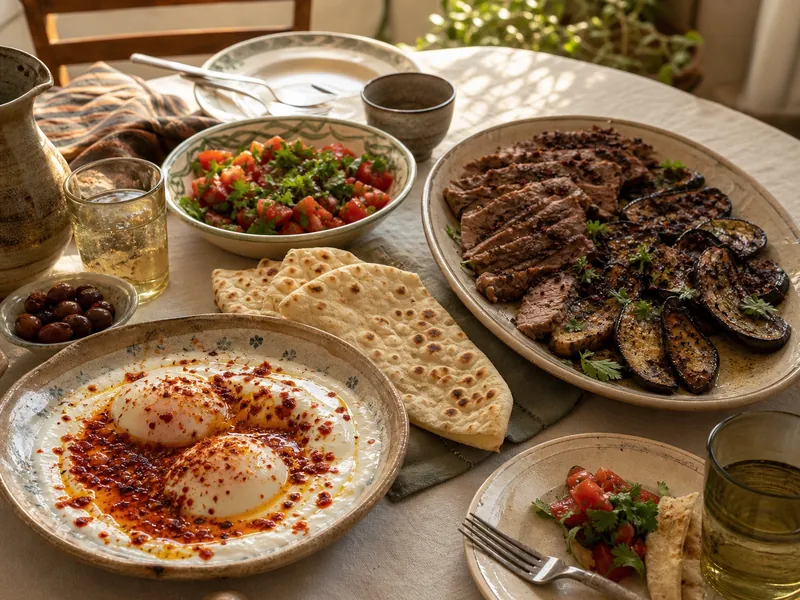
Use Aleppo-style pepper when the dish needs lift at the surface. Its crimson color and loose flakes suit yogurt, labneh, eggs, hummus, roast vegetables, tomato salad, grilled chicken, and a finishing oil that should stay visibly red.
Urfa biber has more room in foods with a dark or roasted base. The isot research names çiğ köfte, lahmacun, and kebabs as traditional uses, while its cured direction also fits lamb, beef, eggplant, lentils, browned butter, and tomato-rich braises.
The rule is not dairy versus meat. Aleppo can season lamb when brightness is useful, and Urfa can deepen eggs or yogurt when the darker tone is deliberate.
Choose by the dominant job. A garnish that must wake up a pale food points toward Aleppo, while a spice that should melt into roasted, fermented, or slow-cooked flavors points toward Urfa.
| Dish or cooking job | Aleppo-style pepper | Urfa biber |
|---|---|---|
| Yogurt, labneh, hummus | Bright red finish and gentle tart fruit | Use when a darker raisin note is intentional |
| Eggs and warm butter | Clear red oil and visible flakes | Dark cured warmth that merges with butter |
| Roast vegetables | Good for sweet or green vegetables needing lift | Good for eggplant, roots, and deeply browned edges |
| Lamb, beef, kebab | Finishing brightness or red marinade | Earthy cured depth in the mixture or sauce |
| Tomato and lentil dishes | Keeps the profile red and lively | Adds a darker, longer savory finish |
Which one should you buy?
Choose Aleppo-style pepper for bright red color, tart fruit, and a loose flake that remains easy to scatter. Choose Urfa biber for a dark, soft, raisin-like spice that becomes part of a savory base.
Keep both only if those jobs recur in your cooking. If one jar must cover both, pick the style that matches most of your dishes and use the directional corrections below rather than expecting the other flavor to appear automatically.
Which flake is hotter?
Aleppo is not automatically milder than Urfa. The canonical Aleppo reference sits near 10,000 SHU, while the Urfa reference spans 5,000 to 10,000 SHU, so the values meet at the same upper point.
Those figures describe reference products, not every spoonful. New Mexico State University explains that genetics, environment, maturity, and sampling change capsaicinoid measurements, and a commercial spice may also differ in seed content and blend.
| Evidence in front of you | What it can tell you | What it cannot promise |
|---|---|---|
| Printed heat range | A useful batch or product expectation | The exact heat of every spoon |
| Deep red or blackish color | Processing and pigment direction | A reliable heat ranking |
| First small taste | How this jar builds and lingers | How much the full dish will dilute it |
Start with a measured pinch in a spoonful of the finished base. Add the rest only after the fat, salt, and acid have dispersed the chile, because an early dry taste does not predict the final distribution.
What happens in warm oil or butter?
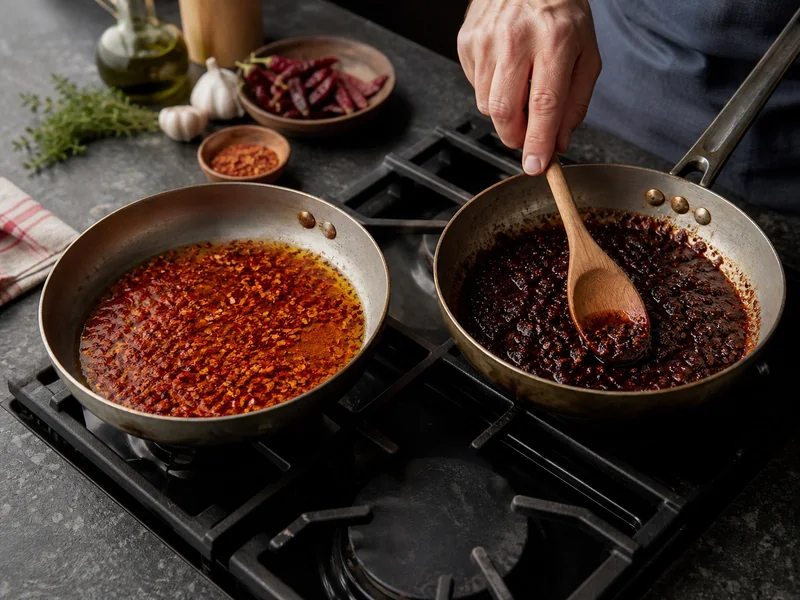
Warm fat makes the contrast easier to see. Research on chile oil shows that red pepper carotenoids and capsaicinoids move into oil, so color and pungency spread beyond the visible flakes.
Aleppo tends to tint oil a clear warm red while its loose particles remain distinct. Urfa softens into a darker burgundy suspension, and its cohesive pieces can look almost paste-like as they separate.
- Warm the fat gently. Use low heat and wait until butter melts or oil moves freely.
- Add one measured portion. Stir so every flake touches the fat instead of forming a dark pile.
- Watch color and smell. Aleppo should release bright red pigment, while Urfa should loosen and perfume the fat.
- Remove direct heat early. Residual pan heat continues the extraction after the burner is off.
- Season the food, then taste. Salt, acid, dairy, and starch change how the warmth reads.
How do you substitute without flattening the dish?
A volume-for-volume exchange can be a first test when heat is secondary, but it is not the finished adjustment. Each direction removes a different part of the original spice.
Use slightly less at first if the dark cure could dominate yogurt, eggs, salad, or a pale sauce. Restore lift with lemon, sumac, or another acid already compatible with the dish.
Start near the recipe volume, then decide whether the food actually needs more smoke, darkness, or moisture. A small amount of smoked paprika can add smoke, but it cannot recreate terletme.
- Match the grind first. Large flakes and fine flakes do not pack into a spoon equally.
- Use half to three quarters of the planned amount. Let it disperse through the dish.
- Correct only the missing quality. Add acid for lift or a restrained smoky element for depth.
- Finish the cooking step. Taste again before adding more chile.
What should you check before buying or storing them?
Freshness can erase the difference faster than substitution. A 2020 storage study found that traditional isot lost 81.76 percent of its measured volatile concentration during the first three months of room-temperature storage in the study conditions.
That number does not set a household expiry date, but it shows why a large open bag can become a poor bargain. Buy an amount you will use while its aroma is clear, then keep the package tightly sealed, cool, dark, and away from steam.
- Aleppo-style flakes: look for deep crimson color, a clean fruity smell, and flakes that are not dusty or faded orange.
- Urfa biber: expect dark color and a soft, lightly cohesive texture, but not wet patches or liquid in the package.
- Either pepper: reject visible mold, insects, musty odor, rancid oil notes, or a damaged seal.
- At the stove: use a dry spoon so steam and food residue do not enter the jar.
Aleppo Pepper vs Urfa Biber FAQ
- Capsicum annuum L. taxonomy record
- Evaluation of the volatile compounds of fresh ripened Capsicum annuum and its spice pepper
- Changes in volatile compounds, sugars and organic acids of different pepper spices during storage
- Effects of production methods on color, capsaicinoids and antioxidant capacity of pepper spices
- Carotenoids and capsaicinoids in chili oil at different frying temperatures
- The Chile Pepper in China and the Middle East
- The Scoville Scale and Chile Pepper Heat