
Gochugaru vs Paprika: Visible Korean Flakes or Smooth-Blending Powder?
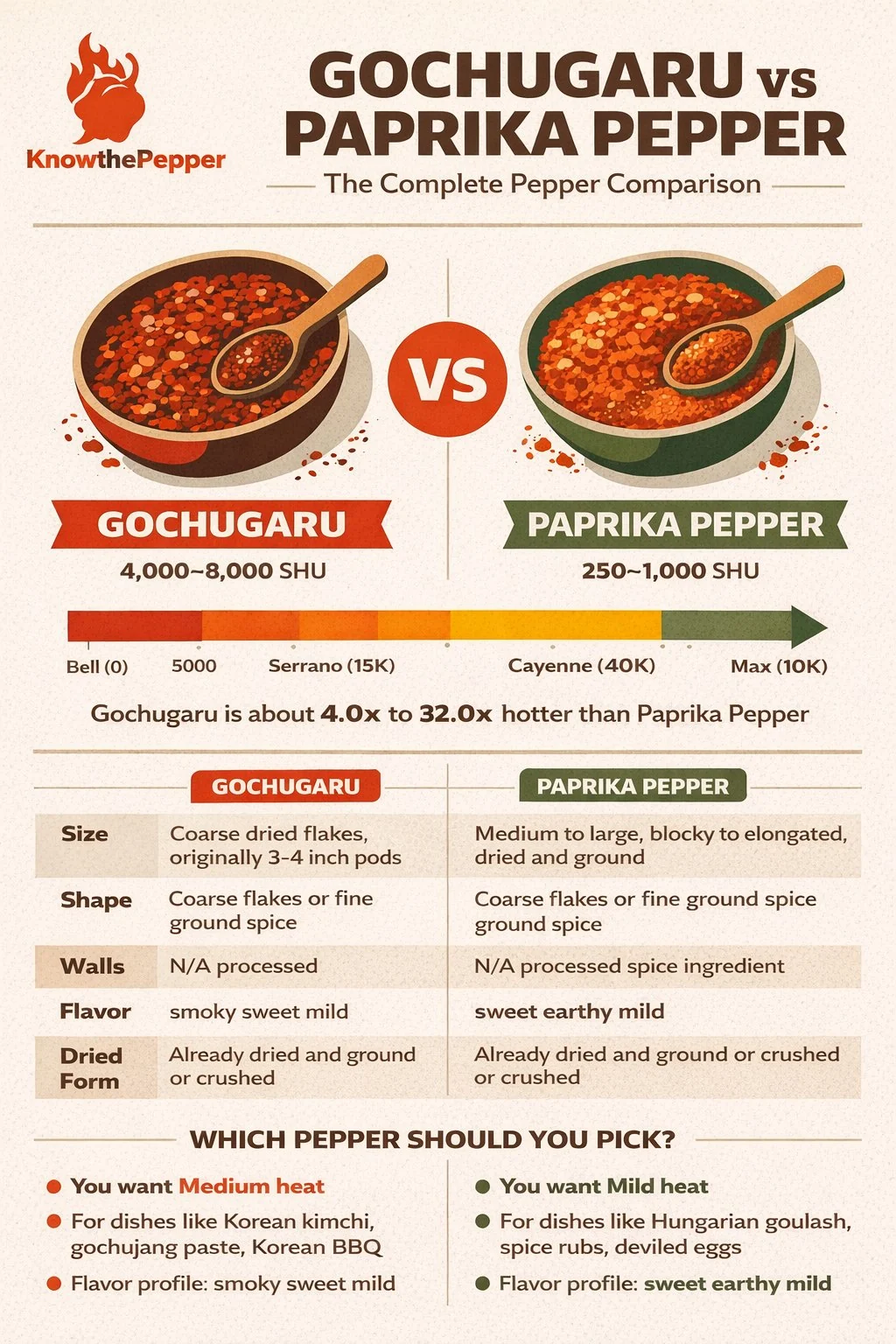
Choose gochugaru when visible flakes, a textured seasoning paste, and Korean red-pepper character matter. Choose paprika when a fine powder should disperse smoothly, supply even red color, or add a specifically labeled sweet, hot, or smoked style.

Gochugaru usually brings visible chile particles and Korean red-pepper character, while paprika is a finer powder sold in sweet, hot, and smoked styles. Choose by grind, smoke, and dish texture before comparing heat.
- Typical form: Visible flakes or coarse powder vs Fine, uniform powder
- Heat decision: Read mild, medium, or hot label vs Read sweet or hot style
- Smoke: Not automatic vs Only when labeled smoked
- Best texture job: Coating and visible speckling vs Smooth, even dispersion
- Strong first use: Kimchi and Korean seasoning vs Sauces, stews, and rubs
Gochugaru
HotPaprika Pepper
MediumQuick Comparison
| Attribute | Gochugaru | Paprika Pepper |
|---|---|---|
| Typical form | Visible flakes or coarse powder | Fine, uniform powder |
| Heat decision | Read mild, medium, or hot label | Read sweet or hot style |
| Smoke | Not automatic | Only when labeled smoked |
| Best texture job | Coating and visible speckling | Smooth, even dispersion |
| Strong first use | Kimchi and Korean seasoning | Sauces, stews, and rubs |
Which Is Hotter, Gochugaru or Paprika?
Gochugaru is often hotter than sweet paprika, but it is not reliably hotter than every paprika product. Sweet, hot, and smoked describe different decisions, and smoke does not tell you how much capsaicin is present.
The FAO and WHO Codex standard for dried chilli pepper and paprika gives useful category boundaries. Its annex places paprika at no more than 480 Scoville Heat Units, hot paprika above 480 and below 900 SHU, and dried chilli peppers at 900 SHU or more.
Those are product classes, not a promise about every Korean red pepper powder on a store shelf. Gochugaru labels may say mild, medium, or hot, and pepper cultivar, seed inclusion, harvest, and processing can shift the sensation inside a broad style.
Smoked paprika creates another source of confusion. A tin can be sweet and smoked or hot and smoked, so the word smoked answers an aroma question rather than a heat question.
This is why a fixed claim such as "gochugaru is ten times hotter" fails in a real kitchen. It compares a variable Korean product with an unspecified paprika style, then presents the result as if both jars were laboratory standards.
Use the label first.
If it says sweet paprika, expect color and pepper sweetness with little heat. If it says hot paprika, treat the jar as a mild chile powder rather than a purely decorative spice.
Then test the actual batch in the recipe base. Stir a small measured pinch into one tablespoon of broth, sauce, or dressing, wait long enough for the powder to hydrate, and compare before seasoning the whole pot.
A dry fingertip taste exaggerates surface heat and does not show how the spice behaves in fat, water, salt, or acid. A controlled sample gives you a more useful dose while keeping the rest of the dish recoverable.
The practical answer is narrow. Sweet paprika is usually milder, hot paprika narrows the gap, and the package in your hand has the final say.
Read the category before comparing heat
| Codex class | SHU boundary | What it tells you |
|---|---|---|
| Paprika | No more than 480 | Usually a color and sweetness decision |
| Hot paprika | Above 480 and below 900 | Adds mild pungency in a fine powder |
| Dried chilli pepper | 900 or more | Broader hot-pepper class, not a jar guarantee |
| Actual product | Check its label and taste | Brand and batch still control the kitchen result |
Is Gochugaru the Same as Paprika?
Gochugaru and paprika can both look red, but they are not one ingredient in two package shapes. The first distinction is physical form, followed by pepper selection and drying method.
Gochugaru commonly appears as visible flakes or a coarser powder with irregular particles. Some Korean products are ground more finely for paste-like preparations, so the name alone does not guarantee one mesh size.
Paprika commonly arrives as a fine, uniform powder. The Codex standard recognizes whole, crushed, cracked, broken, flaked, and ground dried Capsicum styles, then defines ground paprika as a powder made without placenta, seeds, calyx, or stalk.
That definition explains part of the visual difference. A mound of fine paprika looks soft and even, while coarse gochugaru shows individual fragments and may include occasional pale flecks.
The flavor split is more specific than "Korean versus European." Gochugaru can bring ripe red-pepper sweetness, moderate chile warmth, and a clean dried-fruit character, but ordinary products are not automatically smoke-dried.
Paprika spans several named styles. Sweet paprika emphasizes red-pepper sweetness and color, hot paprika adds controlled pungency, and smoked paprika adds a drying-process aroma that can dominate delicate dishes.
Pimentón de la Vera shows why the process matters. Its protected specification links the finished aroma to hot air and smoke from oak-family firewood during dehydration, so the smoke belongs to a documented production method.
That evidence does not transfer to every paprika jar. It also does not turn a lightly roasted note in one gochugaru brand into proof that gochugaru as a category is smoked.
Use sweet paprika as the neutral paprika reference when a recipe asks only for paprika. Reach for smoked paprika only when the dish benefits from wood-smoke character, not because a substitution chart treats smoke as mandatory.
The shortest buying test is visual and literal. Look for the words sweet, hot, smoked, mild, medium, coarse, or fine, then inspect the particles through a clear bag or after opening the jar.
Country of origin is useful context, but it does not replace the style line. The same red color can conceal a coarse mild Korean powder, a fine hot paprika, or an assertively smoked pimentón.
Choose the material and process you need, not the red shade that happens to look closest.
Smoke is a process choice
A protected smoked paprika such as Pimentón de la Vera gains its aroma during smoke drying over oak-family firewood. Ordinary sweet paprika and ordinary gochugaru do not inherit that process just because they share a red color.
How Does Grind Size Change the Way Each One Cooks?
Grind size changes how a pepper product coats food, disperses through liquid, and remains visible after cooking. This difference is central to kimchi and still matters in soups, stews, rubs, oils, and finishing garnishes.
How much can gochugaru particle size vary?
A Korean Journal of Food Hygiene and Safety study examined ten commercial red pepper powders. Their average particle sizes ranged from 605 to 1,251 micrometers, and the products also varied in particle distribution, color, moisture, and pH.
That measured spread rules out one cartoon version of gochugaru. Two bags can both be authentic Korean red pepper powder while one forms a relatively smooth paste and the other leaves obvious flakes across a cabbage leaf.
Fine paprika behaves differently because its small particles disperse quickly. In a wet sauce, it can tint the liquid evenly.
In warm fat, it can bloom into a smooth red base if the heat is controlled.
Coarser gochugaru hydrates more visibly. The particles catch on rough vegetable surfaces, remain legible in scallion salad or cucumber seasoning, and create speckling that a fine paprika powder cannot reproduce.
The photograph is a material comparison, not a universal color chart. Brand, cultivar, storage, and camera light can change hue, while the coarse-versus-fine geometry remains the more reliable clue.
Why does gochugaru work differently in kimchi?
The Codex standard for kimchi describes a seasoning mixture that mainly includes red pepper powder with garlic, ginger, Allium vegetables, and radish. It also expects the finished kimchi to show red-pepper color and a hot, salty, and possibly sour taste while retaining firm or crisp texture.
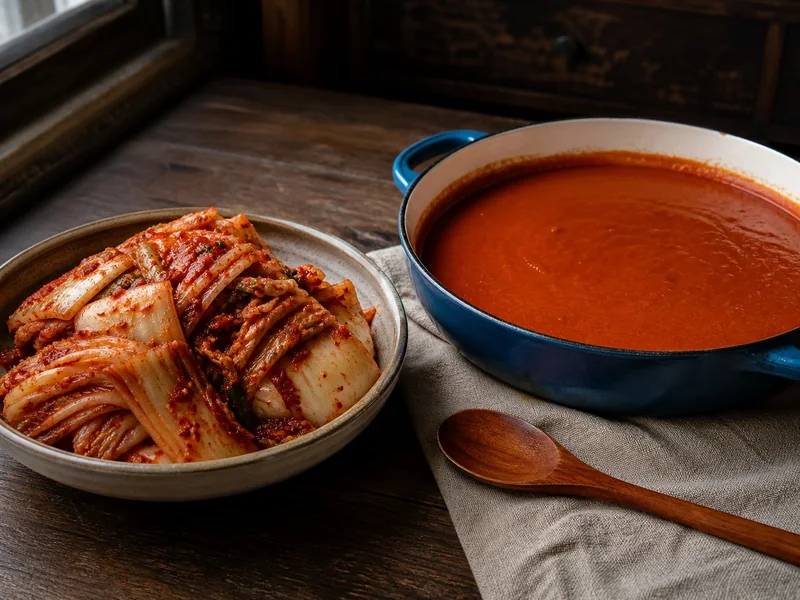
Gochugaru belongs inside that seasoning system. Hydrated particles help turn aromatics and liquid into a paste that coats folded cabbage leaves rather than simply coloring free liquid.
Paprika can provide red color, and hot paprika can contribute mild heat. Fine paprika still produces a smoother, less visibly textured paste, while smoked paprika adds an aroma that is not part of ordinary napa cabbage kimchi.
This does not mean gochugaru alone controls fermentation. Salt concentration, temperature, time, vegetable condition, and the whole seasoning mixture shape the process, so replacing one powder should never be treated as a food-safety shortcut.
For a true gochugaru kimchi result, use a Korean red pepper product whose grind and heat are labeled for kimchi or seasoning. A paprika-based emergency batch can still become a seasoned fermented vegetable, but its pepper texture and flavor identity will be different.
Which powder fits the finished dish?
Choose gochugaru when visible chile particles are part of the food. Kimchi, oi muchim, scallion salad, Korean stews, and a finishing sprinkle over eggs or noodles benefit from a flake that can be seen as well as tasted.
Choose fine sweet paprika when the red color should spread evenly through a smooth sauce, stew base, rice, sausage mixture, or dry rub. Its powder coats broad surfaces without leaving the larger fragments associated with gochugaru.
Hot paprika is useful when that same fine distribution needs a modest heat lift. Smoked paprika fits grilled beans, roasted potatoes, meat rubs, and sauces that can support a wood-smoke note, but it can overwhelm clean broths and fresh vegetable seasoning.
Raw garnish exposes staleness and particle quality most clearly. Coarse gochugaru gives visible color and intermittent warmth, while paprika creates a dusty film unless it is mixed into fat or another moist carrier.
| Reader job | Better first choice | What changes |
|---|---|---|
| Kimchi paste | Gochugaru | Visible particles coat layered vegetables and keep Korean red-pepper character |
| Smooth sauce or stew base | Sweet or hot paprika | Fine powder disperses evenly with little visible grain |
| Dry rub | Paprika style chosen by smoke and heat | Uniform particles cover the surface consistently |
| Korean vegetable seasoning | Gochugaru | Flakes remain visible among aromatics and cut vegetables |
| Smoke-forward beans or potatoes | Smoked paprika | Wood-smoke aroma becomes a deliberate part of the dish |
| Finishing sprinkle | Coarse gochugaru | Individual flakes give contrast instead of a powdery film |
Neither ingredient wins every row because the jobs are different. Gochugaru owns textured coating and visible flakes, while paprika owns smooth distribution and clearly labeled paprika styles.
Can You Substitute Paprika for Gochugaru?
Paprika can replace part of gochugaru's color and heat, but no universal spoon ratio replaces its particle texture and pepper character. Start with the job the missing ingredient performs in that specific dish.
For a smooth soup, sauce, or braise, sweet or hot paprika can be a practical substitute. The fine grind already suits the liquid, so the main adjustments are heat and aroma.
For kimchi or a wet Korean vegetable seasoning, the gap is larger. Paprika colors the paste, but it cannot recreate coarse particles by itself, and smoked paprika sends the flavor in a separate direction.
Use a staged method rather than a fixed 3-to-1 formula. It keeps each correction visible and stops one aggressive ingredient from taking over the batch.
- Identify the main need as color, heat, visible texture, or smoke.
- Choose sweet paprika for color, hot paprika for color plus mild heat, or smoked paprika only when smoke belongs in the dish.
- Add half of the recipe's gochugaru volume as paprika to a small portion of the food.
- Hydrate or bloom that sample in the same liquid or fat used by the recipe.
- Taste before adding more heat from the available chile ingredient.
- Scale only after the sample has the right color and flavor balance.
The half-volume start is a reversible test, not a replacement ratio. Fine powder packs and disperses differently from flakes, while paprika styles vary too much for one formula to predict the final heat.
Do not add cayenne automatically. A hot paprika or hot gochugaru may already supply enough pungency, and cayenne can raise heat without restoring the missing texture.
If a kimchi recipe depends on a large volume of gochugaru to build paste, the best practice is to wait for gochugaru or use the temporary batch as its own variation. Increasing paprika until the paste looks equally thick can make the flavor dusty or bitter.
The reverse swap also needs a boundary. Gochugaru can replace sweet paprika in a rustic stew or sauce when visible flakes are acceptable, but it will not dissolve into the same smooth red film.
It is a poor direct replacement for smoked paprika when smoke defines the dish. Add gochugaru only if you want chile particles and source smoke from an ingredient the recipe already supports, such as a smoked chile or a genuinely smoked seasoning.
Check the package before changing anything. A useful label identifies the product as sweet, hot, smoked, mild, medium, coarse, or fine, while a vague front panel may hide the distinction that matters most.
Also check the powder itself. Penn State Extension recommends keeping spices airtight in a dry place away from sunlight and heat, then replacing them when their characteristic aroma has faded.
Dull red color alone is not a perfect expiry test because products begin with different pigments. Weak aroma, moisture clumps, long warm storage, or a flat taste in the controlled sample are stronger reasons to replace the jar before doubling the dose.
Choose gochugaru for kimchi paste, visible chile texture, and Korean seasoning. Choose paprika for smooth color, a fine coating, or a specifically desired sweet, hot, or smoked style.
That answer is more useful than naming one overall winner. It tells you which difference survives in the finished food and which compromise a substitution cannot hide.
Two checks before adding another spoonful
- Read the exact style and grind on the package.
- Smell a small amount away from steam.
- Hydrate it in the recipe base before judging heat.
- Replace a faded or damp product before increasing the dose.
Gochugaru vs Paprika Pepper FAQ
- FAO and WHO Codex - Dried Chilli Pepper and Paprika Standard CXS 353-2022
- FAO and WHO Codex - Kimchi Standard CXS 223-2001
- Korean Journal of Food Hygiene and Safety - Commercial Red Pepper Powder Quality
- Pimentón de la Vera PDO Product Specification
- Penn State Extension - Storing Staple Ingredients in the Kitchen