
Korean Peppers: Fresh Chiles, Cheongyang, and Gochugaru
Korean peppers are central to gochugaru (chili flakes) and gochujang (chili paste). Both ingredients shape Korean fermentation and cooking traditions.

All Korean Peppers
Every variety in this collection, sorted by maximum Scoville heat rating. Click any card for the full profile with flavor notes, anatomy details, growing tips, and substitutes.


Species Breakdown
Korea peppers span multiple Capsicum species. Each species has distinct characteristics, which the profiles below explain in detail.
Four Profiles Cover Fresh Pods and Dried Red Chile
This collection displays four Korean pepper profiles: Korean Green Pepper, Cheongyang Pepper, Gochugaru, and Gochugaru Flakes. The first two lead with fresh-pod identity, while the latter two represent dried red chile entries whose package texture matters as much as the listed heat.
All four are filed under Capsicum annuum. The displayed range begins at 1,500 SHU and reaches 23,000 SHU, so “Korean pepper” alone is too broad to set either a quantity or a cooking method.
Korean Green Pepper carries crisp texture at 1,500 to 10,000 SHU.
Cheongyang raises the ceiling to 23,000 SHU.
Gochugaru requires an origin, ingredient, and grind check.
Gochugaru Flakes keep visible particles in the finished dish.
Korean Green Pepper Is the Fresh Everyday Lane
Korean Green Pepper occupies the 1,500 to 10,000 SHU lane in this inventory. It is a fresh, slender green pod decision for raw accompaniments, quick grilling, slicing, or adding near the end of cooking when green-pepper texture should survive.
Because the published range is broad, one pod cannot predict the next pod exactly. Slice and add a measured piece when serving heat-sensitive diners instead of treating the entire category as uniformly mild.
Fresh pods should feel firm and look clean, with no wet collapsed patches around the wall or stem. University of Minnesota Extension recommends careful handling and refrigeration after harvest, which helps preserve the crisp texture this lane is chosen for.
Cheongyang Moves the Fresh Decision Up in Heat
Cheongyang Pepper reaches 10,000 to 23,000 SHU, making it the hottest profile displayed here. It can still be used as a fresh green or ripe red chile, but its higher ceiling requires a smaller starting amount than the general Korean Green Pepper range.
Use the full name when heat matters because a market sign that says only “green chile” cannot establish Cheongyang identity. Seed packets also need the named cultivar and a mature-pod description before they can support a growing record.
Capsaicin concentrates in the inner placental tissue rather than the seeds themselves. Gloves, a clean cutting board, and careful knife handling reduce accidental transfer to eyes or other food.
| Profile | Published heat | Starting use |
|---|---|---|
| Korean Green Pepper | 1,500 to 10,000 SHU | Fresh texture with variable mild-to-medium heat |
| Cheongyang Pepper | 10,000 to 23,000 SHU | Smaller measured addition for stronger heat |
Gochugaru Is a Product Form, Not One Universal Cultivar
Gochugaru identifies dried Korean red chile in this collection, with a published range of 1,500 to 10,000 SHU. The word does not guarantee one cultivar, one particle size, or one ingredient formula across every producer.
Read the package for country of origin, grind, ingredients, and a best-by date. A plain chile product and a seasoned mixture are different purchases even when both look red through a clear bag.
Color alone cannot establish freshness or heat because cultivar, ripeness, drying, storage, and grind all influence the final material. Choose a product that smells clean and chile-forward, then store it airtight away from light, moisture, and stove heat.
Coarse Flakes and Fine Powder Do Different Jobs
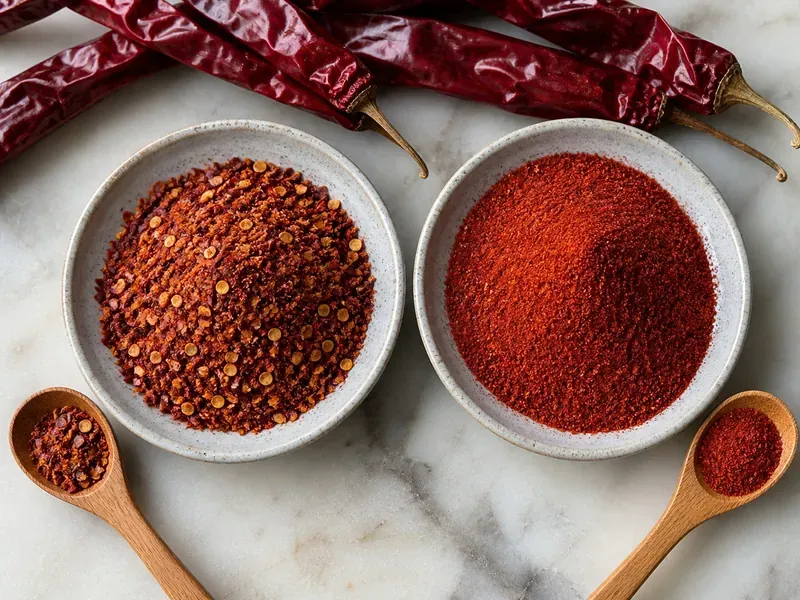
Gochugaru Flakes makes the coarse-texture choice explicit. Larger particles remain visible and disperse more slowly, while fine powder spreads color and heat more evenly through a paste, sauce, or liquid.
The in-post image shows this particle-size difference without claiming that texture alone proves origin. Coarse flakes on the left retain irregular pieces and some seeds, while the fine bowl on the right has a uniform powder that packs more densely into the same spoon.
Measure by weight when repeatability matters because a tablespoon of coarse flakes and a tablespoon of fine powder do not contain the same mass. If a recipe gives only volume, begin below the stated amount when switching to a finer grind and adjust after mixing.
Kimchi, Gochujang, and Table Use Need Separate Checks
Kimchi preparation commonly needs dried red chile that contributes color, heat, and visible texture across a large vegetable mass. A coarse or medium grind usually serves that physical job more clearly than an ultrafine powder, but the recipe and package remain the final owners of the required texture.
Gochujang is a fermented paste and cannot be replaced one-for-one with dry gochugaru. The paste brings water, salt, sweetness, and fermentation products, while dry chile changes the dish without adding that same moisture or seasoning balance.
A fresh green pepper creates another distinct result because it contributes water and crisp plant tissue. Pick fresh, flakes, powder, or paste according to the role in the dish instead of treating every red or green Korean chile product as equivalent.
Buy by Name, Grind, Ingredients, and Storage Need
For fresh use, choose Korean Green Pepper or Cheongyang by the intended heat and verify the full name. For dried use, choose the particle size first, then confirm that the ingredient list and origin statement match the recipe or purchasing goal.
Transfer opened dried chile to a clean airtight container if the package does not reseal well. Refrigeration or freezing can slow quality loss for longer storage, but the container must stay closed until it warms enough to avoid condensation on the powder.
Discard any dried chile with visible moisture, mold, insects, or a musty odor. A faded product may be weaker and duller, but adding an unmeasured extra scoop is less reliable than replacing it with a fresh package and recording the new starting amount.
Read four things before buying
- Full fresh-pepper or product name.
- Coarse, medium, or fine grind.
- Single-chile or blended ingredient list.
- Origin statement, seal, and best-by date.
Heat Level Distribution
How korean peppers distribute across the Scoville scale. Click any tier to browse all peppers at that heat level.
Heat Range Comparison
Visual breakdown of where each variety falls on the Scoville scale. Wider bars show a larger documented SHU spread between individual pods.
The causes of pepper heat variation explain why pods from one cultivar do not always measure alike.
Related Comparisons
Side-by-side breakdowns of heat, flavor, and cooking uses. Each comparison covers Scoville ratings, pod anatomy, and substitution options.
 10K SHU
vs
10K SHU
10K SHU
vs
10K SHU
Aleppo vs Gochugaru: Finish Flake or Kimchi Flake?
Aleppo pepper is the better flake for finishing eggs, yogurt, hummus, lamb, vegetables, and olive oil. Gochugaru is the better flake… 10K SHU
vs
2K SHU
10K SHU
vs
2K SHU
Gochugaru vs Kashmiri: Korean Flake vs Indian Red
Gochugaru is the Korean chile flake for kimchi texture, gochujang-style sauces, and clean red heat. Kashmiri chili is the Indian… 10K SHU
vs
10K SHU
10K SHU
vs
10K SHU
Gochugaru vs Urfa: Korean vs Turkish Flakes
Gochugaru and Urfa Biber are both dried, ground chilies with smoky personalities, but they bring distinctly different characters to… 10K SHU
vs
50K SHU
10K SHU
vs
50K SHU
Gochugaru vs Cayenne: Korean Flake vs Ground Heat
Gochugaru and cayenne are both Capsicum annuum peppers, but they land in completely different cooking worlds. Gochugaru brings a… 10K SHU
vs
1K SHU
10K SHU
vs
1K SHU
Gochugaru vs Paprika: Which One Fits Your Dish?
Choose gochugaru when visible flakes, a textured seasoning paste, and Korean red-pepper character matter. Choose paprika when a fine… 10K SHU
vs
45K SHU
10K SHU
vs
45K SHU
Gochugaru vs Red Pepper Flakes: Are They Interchangeable?
Choose gochugaru when red chile must hydrate into a seed-light coating. Choose red pepper flakes when discrete pieces should bloom in…Browse all comparisons in our comparison hub, or use the pepper tools for calculators and finders.
Related Guides
Reference guides and recipes tied to the same pepper family, region, or use-case.


Explore Other Origins
Peppers evolved in the Americas and spread worldwide through the Columbian Exchange. Each region developed distinct varieties shaped by local cuisine and climate.
Frequently Asked Questions
Keep Reading
Jump into the wider database, heat tiers, comparisons, and substitute references without another card wall.