
Caribbean Peppers for Jerk, Sauce, and Stew: Scotch Bonnet to 7 Pot
Caribbean peppers are dominated by Capsicum chinense, the species behind Scotch Bonnets, habaneros, and Trinidad Scorpions. Fruity heat is the hallmark.

Notable Varieties
All Caribbean Peppers
Every variety in this collection, sorted by maximum Scoville heat rating. Click any card for the full profile with flavor notes, anatomy details, growing tips, and substitutes.
 Super-Hot
Trinidad Moruga Scorpion
 Super-Hot
Trinidad Scorpion Butch T
 Super-Hot
7 Pot Barrackpore
 Super-Hot
7 Pot Red Giant
 Super-Hot
7 Pot Jonah
 Super-Hot
7 Pot Yellow
 Super-Hot
7 Pot White
 Extra-Hot
Chocolate Habanero
 Extra-Hot
Caribbean Red Habanero
 Extra-Hot
Scotch Bonnet
 Extra-Hot
Madame Jeanette
 Extra-Hot
Wiri Wiri
 Extra-Hot
Chocolate Scotch Bonnet
View profile → Extra-Hot
Congo Trinidad
 Extra-Hot
Jamaican Hot Chocolate
 Hot
Hot
Bishop's Crown
 Medium
Cubanelle Pepper
 Mild
Mild
Trinidad Perfume
Species Breakdown
The Caribbean peppers span multiple Capsicum species. Each species has distinct characteristics, which the profiles below explain in detail.
What This Caribbean Collection Covers
This collection brings together 12 published pepper profiles associated with Jamaica, Trinidad and Tobago, Guyana, and the wider Caribbean. It is a browse page for named Capsicum peppers, so prepared sauces, jerk blends, and unrelated spices remain outside the cultivar list.
The inventory is wider than Scotch bonnet and ordinary habanero. It includes Scotch bonnet, Caribbean Red habanero, Chocolate habanero, Madame Jeanette, Wiri Wiri, two Trinidad Scorpion profiles, and six named 7 Pot profiles.
Origin describes the regional identity carried by a cultivar or landrace, not the botanical birthplace of the genus. New Mexico State University's Chile Pepper Institute places domesticated Capsicum in the Americas, while this page focuses on the island and coastal food traditions that gave these peppers their modern names and uses.
Why Capsicum Chinense Dominates the Collection
USDA Agricultural Research Service work on Capsicum chinense documents substantial diversity within the species. That helps explain why bonnet-shaped, lantern-shaped, and deeply wrinkled pods can share a species while differing sharply in aroma, heat, color, and kitchen role.
The University of the West Indies treats Scotch bonnet as a crop with its own production and quality requirements, not as a generic label for any hot pepper. A bonnet-like silhouette is therefore a useful first clue, but the cultivar name, ripe color, source, and profile record provide a safer identification.
Jamaica, Trinidad, and Guyana Lead to Different Shortlists
Scotch bonnet is the direct starting point for Jamaican jerk, escovitch, and pepper sauce because its regional identity and fruity aroma matter as much as its heat. A generic habanero may deliver a similar level of burn, but it does not automatically reproduce the same cultivar character.
Trinidad's branch contains Trinidad Moruga Scorpion, Trinidad Scorpion Butch T, and the 7 Pot group. These are superhot choices for very small, controlled additions, while the published 7 Pot profiles also let readers compare red, yellow, white, giant, Jonah, and Barrackpore forms without treating color as a complete identity test.
Guyana's Wiri Wiri is a separate decision because its small round pods and regional use differ from both Scotch bonnet and the Trinidad superhots. Madame Jeanette provides another aromatic Caribbean option, so a cook should begin with the named regional role instead of choosing the highest SHU number.
Start with Scotch bonnet for jerk, escovitch, and pepper sauce.
Compare Trinidad Scorpion and 7 Pot profiles when controlled superhot heat is the goal.
Use Wiri Wiri when a small round pod and Guyanese identity matter.
Choose Heat Before You Choose a Recipe
KTP's published profile records put Scotch bonnet and the habanero group in the very-hot range, while Trinidad Scorpion and several 7 Pot peppers reach the superhot tier. The Scoville scale compares pungency, but a range does not tell you how much fresh pod, mash, flakes, or sauce a recipe needs.
Start with the least concentrated form that can perform the job. A whole superhot is not a one-for-one replacement for one Scotch bonnet, and a prepared pepper sauce cannot be converted from a fresh pod by SHU alone because acid, salt, fruit, and dilution change the serving concentration.
| Lane | Examples | Practical role |
|---|---|---|
| Very hot | Scotch bonnet, Caribbean Red habanero, Madame Jeanette, Wiri Wiri | Jerk, sauce, stew, fresh seasoning |
| Superhot | Trinidad Scorpion, Moruga Scorpion, 7 Pot group | Measured additions to a larger batch |
Match the Pepper to the Caribbean Dish
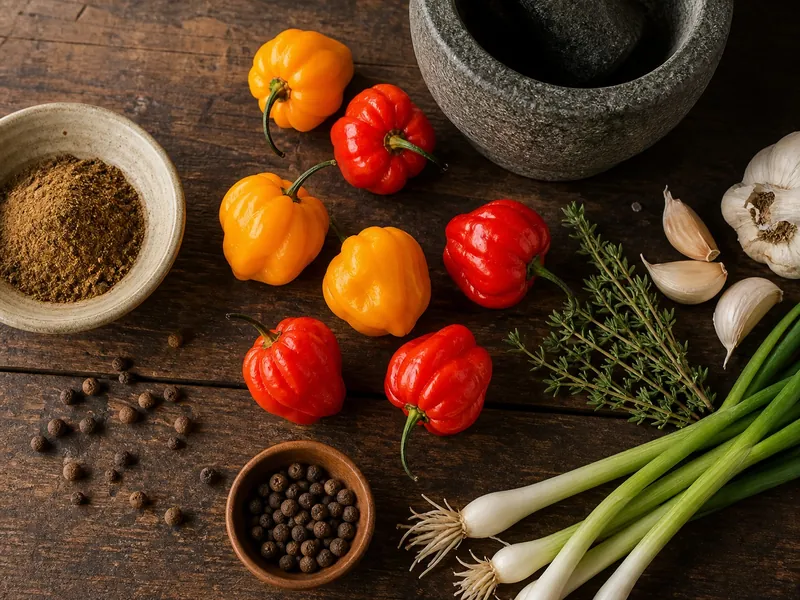
For jerk seasoning, Scotch bonnet is the clearest match because the pepper must share the mixture with thyme, scallion, garlic, and allspice without losing its aromatic identity. The visual below shows that ingredient relationship as one preparation scene rather than repeating a pepper catalog.
For a table pepper sauce, Scotch bonnet, Caribbean Red habanero, Madame Jeanette, or Wiri Wiri can each lead to a different result. Choose the named pepper first, then follow a tested formula that specifies whether the pods are fresh, cooked, fermented, or blended with vinegar.
Use Trinidad Scorpion and 7 Pot peppers only when the recipe is designed for superhot concentration. Their best role is usually a measured amount distributed through a larger batch, not a garnish that leaves diners to encounter an unpredictable piece of pod.
Buy by Identity and Handle by Heat
Buy pods or seed from a seller that gives a cultivar name and ripe color, then compare pod shape with the individual profile. Labels such as Caribbean pepper, red hot pepper, or bonnet pepper are too broad to separate Scotch bonnet, habanero, Wiri Wiri, and a 7 Pot cultivar reliably.
Wear gloves when cutting the very-hot and superhot profiles, keep hands away from the face, and wash tools after preparation. Poison Control identifies capsaicin as a strong skin and eye irritant, so controlled portions and clean handling matter even when the finished dish will be diluted.
Before buying or cutting
- Confirm the cultivar name and ripe color.
- Compare pod shape with the individual profile.
- Wear gloves for very-hot and superhot pods.
- Do not substitute a superhot pod for Scotch bonnet one for one.
Heat Level Distribution
How caribbean peppers distribute across the Scoville scale. Click any tier to browse all peppers at that heat level.
Heat Range Comparison
Visual breakdown of where each variety falls on the Scoville scale. Wider bars show a larger documented SHU spread between individual pods.
The causes of pepper heat variation explain why pods from one cultivar do not always measure alike.
Related Comparisons
Side-by-side breakdowns of heat, flavor, and cooking uses. Each comparison covers Scoville ratings, pod anatomy, and substitution options.
 2.2M SHU
vs
2M SHU
2.2M SHU
vs
2M SHU
Carolina Reaper vs Moruga Scorpion: Heat and Use
If you only want the hotter published ceiling, Carolina Reaper still edges Trinidad Moruga Scorpion in the common SHU ranges used on… 1M SHU
vs
2M SHU
1M SHU
vs
2M SHU
Ghost Pepper vs Moruga Scorpion: Heat and Sauce Use
Choose Ghost Pepper when you want a widely available superhot with smoky background heat and a slower burn. Choose Trinidad Moruga… 1.9M SHU
vs
2M SHU
1.9M SHU
vs
2M SHU
7 Pot Douglah vs Moruga: Dark Depth or Red Spike
7 Pot Douglah is the darker, earthier superhot for savory sauces, powders, and fermented mashes. Trinidad Moruga Scorpion reaches the… 1M SHU
vs
350K SHU
1M SHU
vs
350K SHU
Ghost vs Scotch Bonnet: Heat Limit or Jerk Flavor
Ghost pepper heat is the choice when the recipe is built around superhot intensity. Scotch bonnet flavor is the better choice for… 300K SHU
vs
350K SHU
300K SHU
vs
350K SHU
Datil vs Scotch Bonnet: Heat, Flavor, Best Uses
Choose datil for sweet-tangy Northeast Florida sauces and chowders. Choose Scotch bonnet for Jamaican jerk, Caribbean pepper sauce… 400K SHU
vs
350K SHU
400K SHU
vs
350K SHU
Fatalii vs Scotch Bonnet: Citrus Cut or Jerk Heat?
Choose Fatalii when a sauce, seafood dish, or fruit blend needs sharp lemon-like heat. Choose Scotch Bonnet when the dish needs…Browse all comparisons in our comparison hub, or use the pepper tools for calculators and finders.
Related Guides
Reference guides and recipes tied to the same pepper family, region, or use-case.


Explore Other Origins
Peppers evolved in the Americas and spread worldwide through the Columbian Exchange. Each region developed distinct varieties shaped by local cuisine and climate.
Frequently Asked Questions
Keep Reading
Jump into the wider database, heat tiers, comparisons, and substitute references without another card wall.