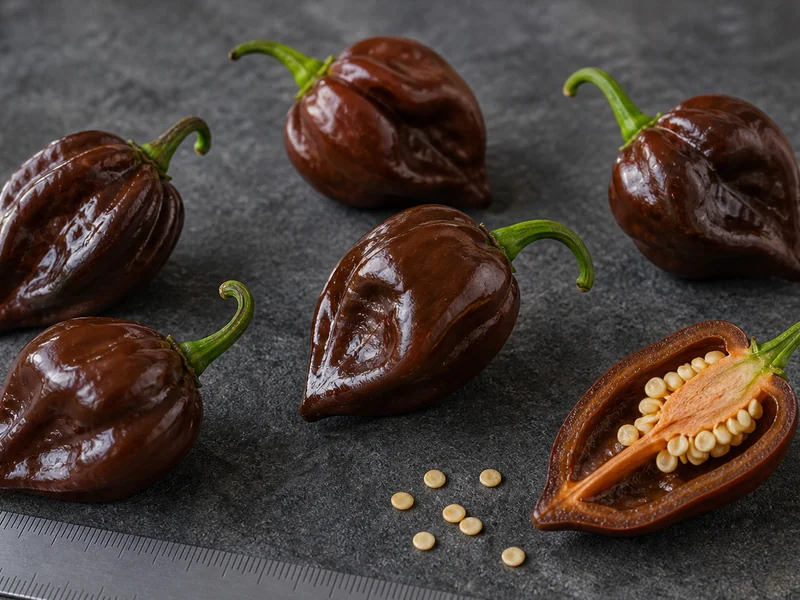
The Chocolate Habanero is a brown-ripening, open-pollinated habanero listed by Holmes Seed at 425,000 to 575,000 SHU. The supplier describes a rich, smoky flavor and names Jamaican jerk as a use. Those figures come from the cultivar listing; Rutgers' extension guidance supplies the broader habanero growing and handling advice.
Comparison: 53-230x hotter than a jalapeño, depending on where the jalapeño falls in its 2,500-8,000 SHU range
What Is Chocolate Habanero Known For?
Holmes Seed identifies Chocolate Habanero as an open-pollinated, heirloom habanero. Its pods mature from green to brown, reach about 2.5 inches, and are listed at 425,000 to 575,000 SHU. That makes it an extremely hot pepper whose catalogue range sits above the standard habanero range published by Rutgers Extension.
The same cultivar listing describes the flavor as rich and smoky. The word chocolate refers to the ripe brown color. The source does not claim that the pepper tastes like cocoa. Dark color also does not prove that pigment causes the smoky flavor, so those two traits should be treated separately.
Use gloves when cutting the pods and keep hands away from the eyes. Rutgers recommends gloves for harvesting and processing habaneros because capsaicin can irritate skin and eyes.
How Hot Is Chocolate Habanero, and What Does It Taste Like?
The Chocolate Habanero delivers
425K–575K Scoville Heat Units,
placing it in the Extra-Hot tier
(100K-1M SHU).
That makes it roughly 53-230x hotter than a jalapeño, depending on where the jalapeño falls in its 2,500-8,000 SHU range.
Holmes Seed specifically identifies Chocolate Habanero as an ingredient for Jamaican jerk. It can also serve anywhere a cook wants habanero-level heat with the cultivar's reported smoky character, but the amount should be adjusted to the people eating the dish rather than taken from a fixed ratio.
For a first batch, add a small piece to a sauce or marinade, blend, then taste before adding more. Removing the pale placental tissue may reduce some heat, but it does not make an extremely hot pod mild. Use a Scotch bonnet or standard habanero only when its different heat range and flavor fit the recipe.
Where Can You Buy Chocolate Habanero, and How Do You Store It?
Seed catalogues are the clearest documented source for this cultivar. Match a ripe pod to the seller's green-to-brown color description and the approximate 2.5-inch fruit size, but do not use color alone to identify an unknown pepper.
For freezing, the National Center for Home Food Preservation instructs cooks to wash hot peppers, remove the stems, package them without headspace, seal, and freeze. Frozen pods soften after thawing, so reserve them for cooked sauces, stews, and marinades. Wear gloves during preparation.
Judging ripeness on a brown pepper
Look for deep, uniform mahogany. Patchy green or bronze means it is not finished.
The skin should be firm and unwrinkled; softness is age rather than ripeness.
Colour is the only ripeness cue here, because the pod does not change shape as it ripens.
Refrigerate in a paper bag or a breathable container rather than sealed plastic.
Wear gloves. At 425,000 to 577,000 SHU the oil transfers readily from fingers to eyes.
Which Peppers Can Replace Chocolate Habanero?
Compare substitutes for Chocolate Habanero by form, flavor, and heat before choosing a ratio. Measured adjustments must account for the dish and the concentration of the replacement.
How Do You Start and Grow Chocolate Habanero Peppers?
Holmes Seed lists about 105 days for this cultivar. Rutgers advises starting habanero seed indoors 8 to 10 weeks before transplanting and waiting until nighttime temperatures remain above 55°F. Habaneros perform best around 70 to 85°F. Temperatures outside the suitable range can reduce fruit set.
These are general habanero production guidelines, not a cultivar trial for Chocolate Habanero. Local weather, transplant age, and growing method can shift the harvest date.
The Chocolate Habanero requires careful handling. Take these precautions to avoid painful capsaicin burns.
Wear disposable gloves when cutting or handling superhot peppers, then remove them carefully and wash your hands
Keep hands away from your face and clean knives, boards, and counters with hot soapy water after prep
Rinse eyes with clean running water for 15 to 20 minutes if pepper juice gets in them, and seek medical help if pain or vision symptoms persist
Open a window when cooking because heated capsaicin can irritate eyes, throat, and lungs
Capsaicin is fat-soluble, so pepper-burn relief comes from dairy and oil, not water.
Editorial Review
Editorial Standards: Heat, species, origin, and use claims are checked against available source material, with uncertainty labeled where the record is thin or disputed.