How the Scoville Scale Measures Pepper Heat, From Taste Panels to HPLC
The Scoville scale measures capsaicinoid concentration as Scoville Heat Units, or SHU. Modern labs use HPLC rather than taste panels, so use the numbers as a heat range guide, not a promise of how every pepper or hot sauce will feel.
What does the Scoville scale actually measure?
The Scoville scale expresses the pungency of chile peppers and chile products in Scoville Heat Units, or SHU. The underlying chemical target is capsaicinoids, the family of compounds that creates the familiar chile burn.
A higher SHU result means more capsaicinoid heat in the tested sample. It does not mean better flavor, a faster burn, or a fixed reaction from every person.
Read SHU as a concentration result. A bell pepper at 0 SHU has no measurable capsaicinoid pungency, while a pepper near 1,000,000 SHU contains a much greater concentration in the tested material.
Capsaicin and dihydrocapsaicin provide most of the pungency in many chile samples, with smaller capsaicinoids contributing to the total. Modern methods can separate these compounds before the laboratory converts their measured amounts into the familiar scale.
The word heat is sensory shorthand. The pepper does not raise mouth temperature in proportion to its number, and SHU does not measure the pungency of black pepper, mustard, ginger, or wasabi.
How did the original Scoville test work?
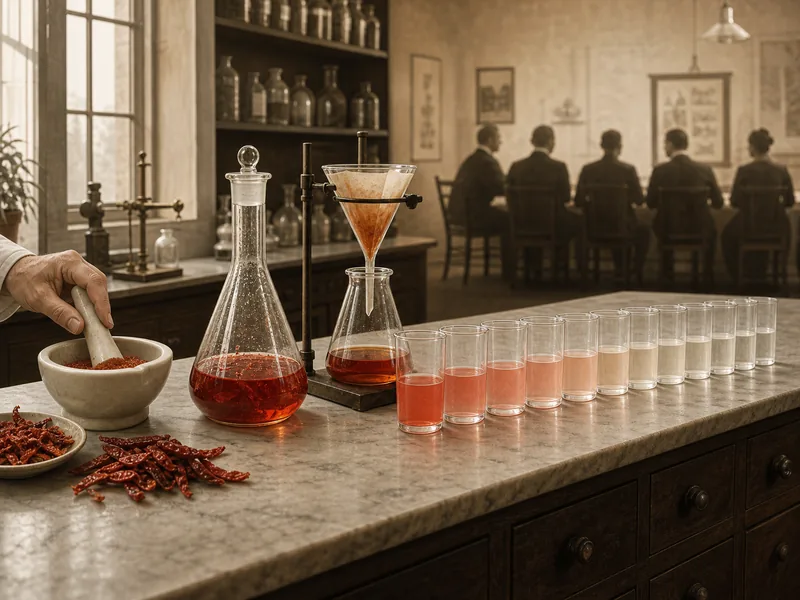
Wilbur Scoville published his Note on Capsicums in 1912 while working in the Parke-Davis laboratory. His organoleptic method used human detection to compare the pungency of capsicum preparations.
- Prepare the capsicum sample. The pungent material had to be represented consistently enough for comparison.
- Extract the pungent compounds. Alcohol carried the capsaicinoids out of the sample.
- Dilute the extract. Sweetened water reduced the concentration through a controlled series.
- Find the sensory endpoint. Tasters identified the dilution at which pungency was no longer detectable.
- Report the dilution. The required dilution became the basis of the Scoville value.
The method established a systematic comparison when direct biting could not. New Mexico State University notes that tasting quickly saturates the mouth and that panel sensitivity varies, which limits repeatability and the number of samples a person can assess.
An organoleptic result therefore depended on both the sample and the people judging it. That subjectivity is the central reason analytical laboratories moved to instrumental separation.
How do laboratories measure SHU today?
Modern laboratories commonly quantify capsaicinoids with high-performance liquid chromatography, usually shortened to HPLC. The instrument does not taste a pepper or display SHU directly.
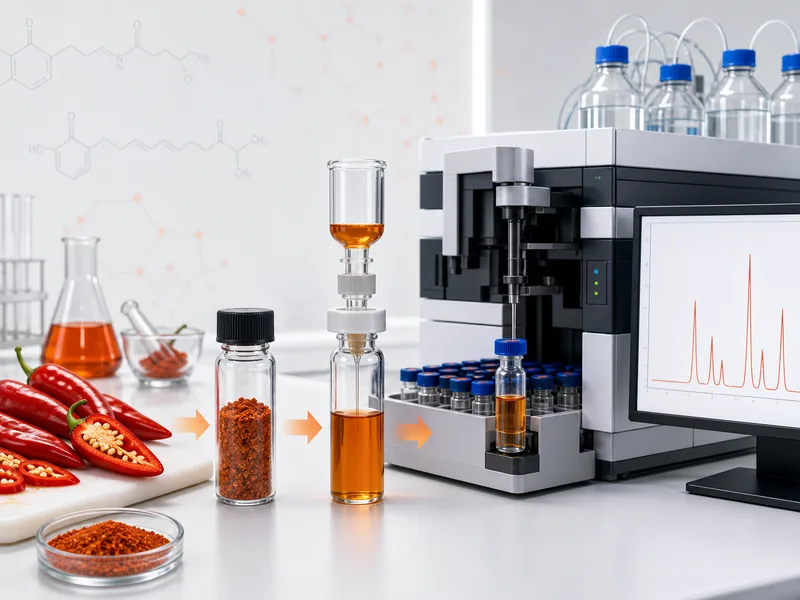
| Stage | What happens | Why it matters |
|---|---|---|
| Sampling | Selected fruit or product material represents the lot being tested | A poor sample can produce a precise result for the wrong material |
| Drying and grinding | Moisture is controlled and tissue becomes a uniform powder | Water and uneven pieces would distort concentration |
| Extraction | A solvent removes capsaicinoids from a measured mass | Extraction efficiency affects what reaches the instrument |
| Separation | The HPLC column separates compounds that leave at different times | Capsaicin and related capsaicinoids can be measured individually |
| Quantification | Peak response is compared with analytical standards | The output becomes a concentration before SHU conversion |
NMSU describes HPLC as objective, reliable, and consistent compared with the taste test. ASTA Method 21 likewise specifies an HPLC method for capsicums and oleoresins and calculates total pungency from major capsaicinoids.
Objectivity does not erase every source of variation. Sampling, preparation, extraction, calibration, and the calculation convention still need to be reported well enough for two results to be compared.
How is a lab result converted to SHU?
The instrument first reports capsaicinoid concentration, often in parts per million on a stated sample basis. A calculation then weights the measured compounds and converts that chemical result into SHU.
Common modern approximation: total capsaicinoid concentration in ppm × 16 ≈ SHU. Under that convention, 500 ppm corresponds to about 8,000 SHU.
The HPLC study by Al Othman and coauthors uses 16 million SHU as the pure-capsaicin reference. The later UFLC study by Usman and coauthors uses an older factor of 15, so the calculation method belongs beside the result.
| Analytical result | Using the ×16 convention | Interpretation |
|---|---|---|
| 100 ppm | About 1,600 SHU | Mild chile-level concentration |
| 500 ppm | About 8,000 SHU | Upper-jalapeno-range concentration |
| 2,500 ppm | About 40,000 SHU | Cayenne-range concentration |
| 62,500 ppm | About 1,000,000 SHU | Superhot-level concentration |
This table demonstrates the arithmetic, not a laboratory protocol. The sample basis, target compounds, weighting factors, extraction, and method version decide whether a specific result can use that shortcut.
Pure capsaicin is a reference endpoint rather than a cooking ingredient. A claim above the expected pure-compound limit needs careful scrutiny of what was measured and how the value was expressed.
Is the Scoville scale linear?
SHU numbers express proportional concentration, so 100,000 SHU represents roughly ten times the capsaicinoid heat concentration of 10,000 SHU under the same method and sample basis. Human discomfort does not have to increase by the same factor.
A linear chart makes mild and medium peppers collapse into a tiny space beside million-SHU fruit. A logarithmic axis solves that display problem by giving each tenfold interval equal width.
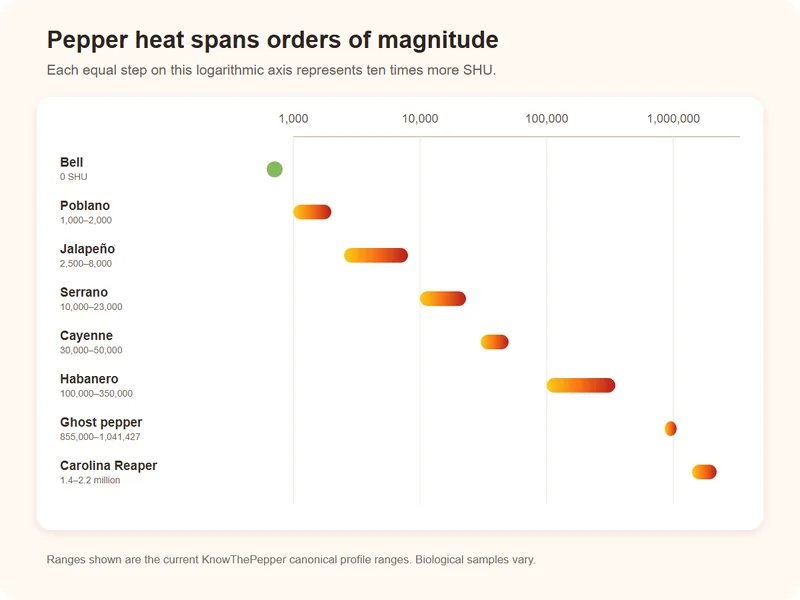
Zero cannot sit on a logarithmic axis because no power of ten equals zero. The bell pepper marker is therefore shown separately from the numeric intervals.
Use ratios for concentration comparisons and use the log chart for visual placement. Neither one predicts an individual's pain response with mathematical precision.
What do common Scoville ranges look like?
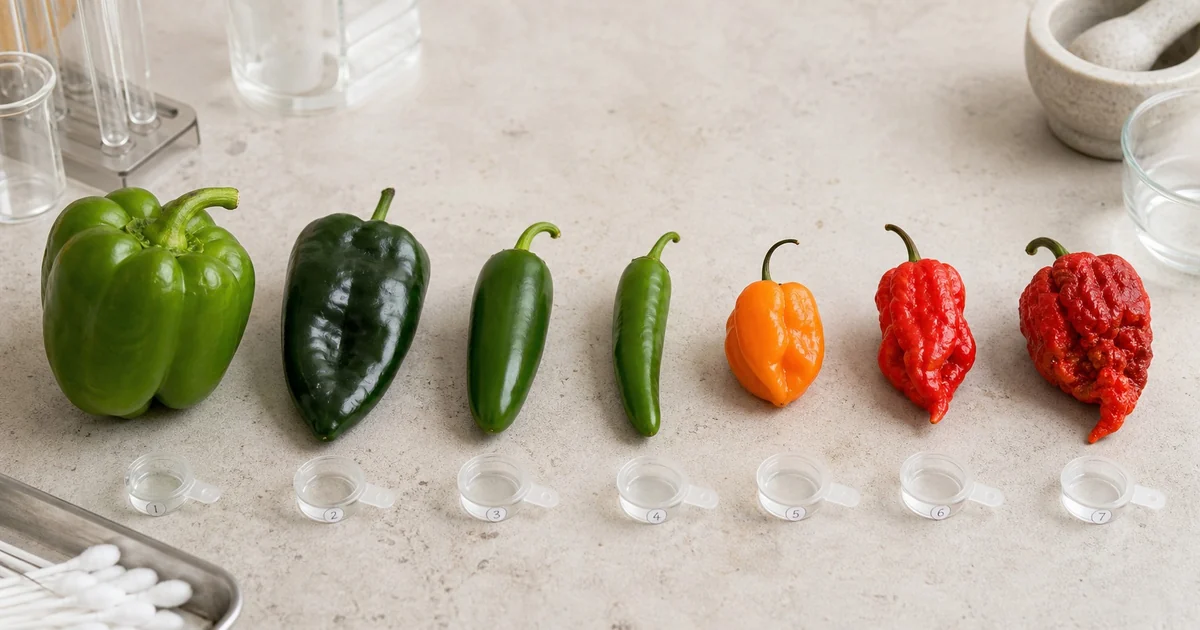
Published pepper values are usually ranges because a cultivar does not produce one immutable concentration. The current KnowThePepper profile ranges below provide landmarks, not guaranteed readings for a pod in your hand.
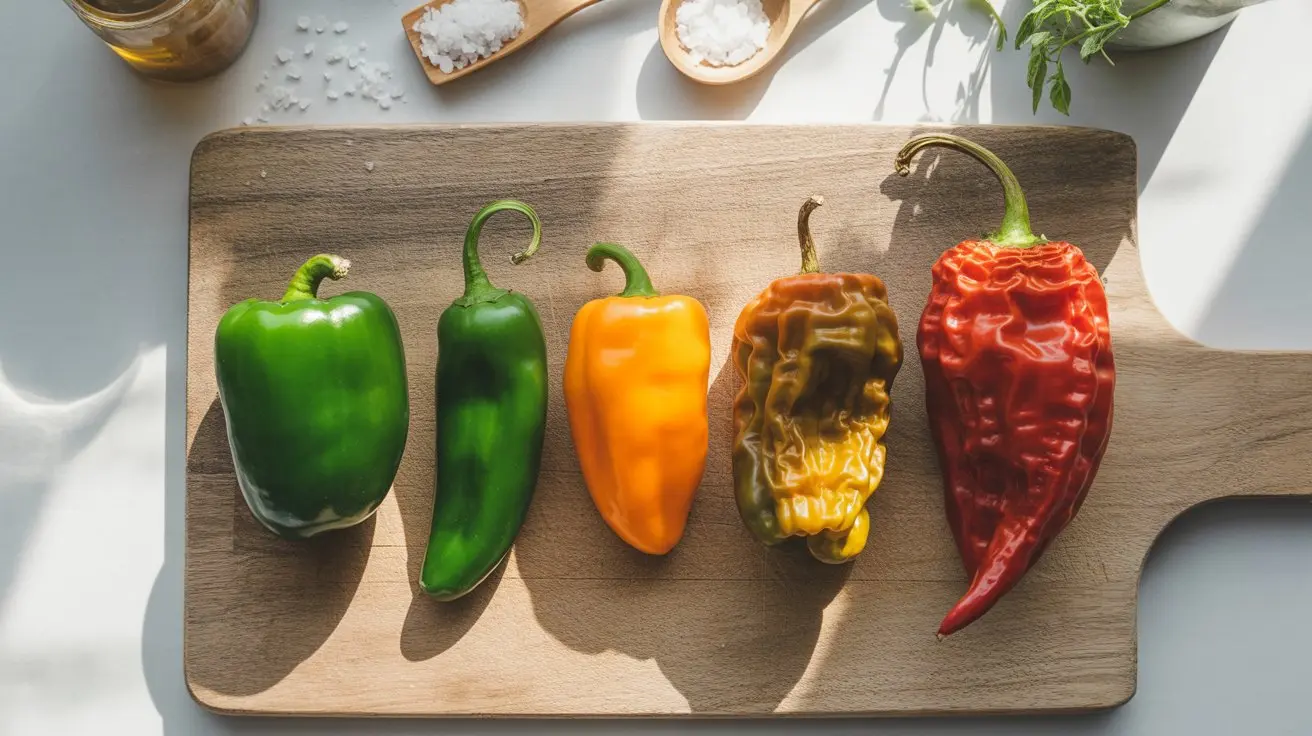
| Pepper | Canonical range | Scale position | Practical reading |
|---|---|---|---|
| Bell pepper | 0 SHU | No capsaicinoid heat | Flavor and body without chile burn |
| Poblano | 1,000 to 2,000 SHU | Mild | Gentle warmth with substantial fresh flesh |
| Jalapeno | 2,500 to 8,000 SHU | Mild to medium | Noticeable but highly variable heat |
| Serrano | 10,000 to 23,000 SHU | Medium | More concentrated fresh-chile heat |
| Cayenne | 30,000 to 50,000 SHU | Hot | A useful powder and sauce benchmark |
| Habanero | 100,000 to 350,000 SHU | Extra hot | A small amount can dominate a dish |
| Ghost pepper | 855,000 to 1,041,427 SHU | Superhot | Requires careful handling and dilution |
| Carolina Reaper | 1.4 to 2.2 million SHU | Superhot | The range spans more than an entire habanero maximum |
Range overlap matters. A hot specimen from a lower-listed cultivar can exceed a mild specimen from the next group, especially where published intervals touch or cross.
Do not convert a category name into a dose. A quarter of a large mild pepper and a quarter of a small hot pepper contribute different masses, water, flavor, and capsaicinoid concentration.
Why does one pepper variety have an SHU range?
A variety has a genetic capacity for pungency, while environment and fruit development influence the concentration expressed in a particular harvest. NMSU explicitly warns that a genetically low-heat plant will not become a hot cultivar merely because it experiences stress.
| Source of variation | What can change | What the SHU report needs |
|---|---|---|
| Genetics | The cultivar's ability to produce capsaicinoids | Correct cultivar or breeding-line identity |
| Location and season | Temperature, water, and other growing conditions | Site, year, and treatment context when relevant |
| Fruit age | Capsaicinoid concentration during development | A defined maturity or harvest stage |
| Position and fruit selection | Variation among pods from one plant or field | A representative sampling plan |
| Sample preparation | Water content and tissue distribution | Fresh or dry basis and included tissue |
| Analytical method | Extraction, target compounds, and conversion | Method name and calculation convention |
A single pod measurement answers a narrower question than a composite made from many fruit. Both can be valid, but they should not be presented as though they describe the same population.
This is why a precise-looking value with six digits can still have limited reach. Instrument precision describes the analyzed extract, while biological sampling determines how far that result can be generalized.
Why can the same SHU feel different?
SHU compresses capsaicinoid concentration into one number, while eating adds compound profile, food structure, serving size, contact area, and personal sensitivity. Equal results therefore do not guarantee equal experiences.
| Factor | What SHU captures | What the bite adds |
|---|---|---|
| Capsaicinoid profile | A weighted total | Different proportions of capsaicin and related compounds |
| Food matrix | The tested concentration | Oil, water, starch, and solids change distribution |
| Dose | Heat per tested mass | The amount actually eaten changes total exposure |
| Contact pattern | No mouth geometry | A smooth sauce coats differently from a pepper piece |
| Individual response | No tolerance or sensitivity | People detect and interpret the same exposure differently |
A thin sauce can spread across the mouth faster than a coarse salsa even when their tested concentrations match. A large serving of a lower-SHU product can also deliver more total capsaicinoids than a tiny dab of a higher-SHU one.
Use the number to compare chemical pungency under similar conditions. Use form, portion, and ingredient list to predict how the food will behave.
Where is capsaicin concentrated in a pepper?
Capsaicinoids are produced in glands or vesicles on the pale placental tissue inside a chile fruit. Seeds do not manufacture capsaicin, although their surfaces can pick it up because they touch the placenta.
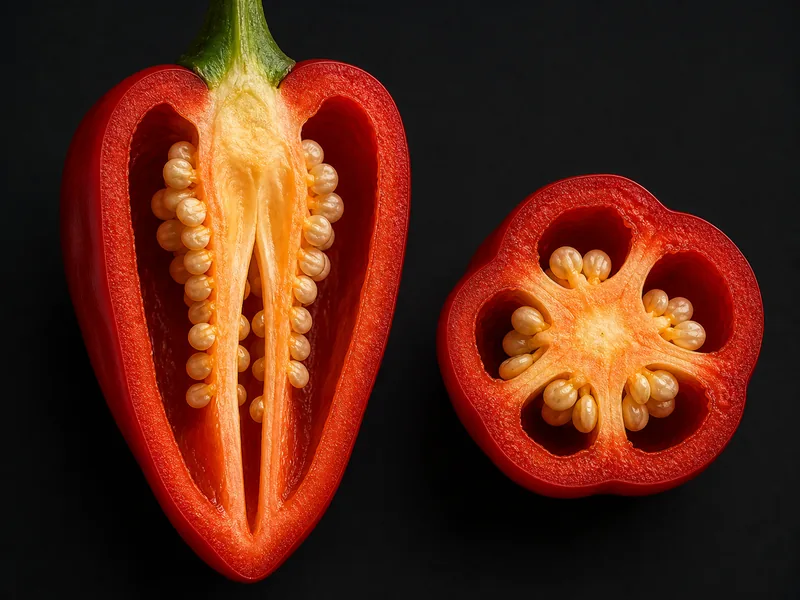
Removing seeds alone leaves much of the hot placental tissue behind. Trimming seeds together with the pale ribs usually removes more pungent material, but it cannot promise a fixed reduction because capsaicinoids can contact the inner wall and vary across the fruit.
Handle hot peppers by their measured range, not by seed count. Wear appropriate gloves for very hot fruit and avoid touching eyes or other sensitive skin.
The outer wall supplies much of the fruit's water, color, and texture. Removing the inner structure can therefore alter both heat and the way a stuffed, blended, or sliced pepper behaves.
Can you compare SHU across peppers, powders, and sauces?
You can compare values only after confirming that they describe equivalent samples. A dry powder, fresh fruit, concentrated extract, and finished sauce contain different amounts of water and other ingredients.
| Product | What may have been tested | Main comparison trap |
|---|---|---|
| Fresh pepper | One fruit or a composite sample | Water, maturity, and pod selection affect concentration |
| Dried powder | Ground dry material | Removing water concentrates compounds per unit mass |
| Oleoresin or extract | A concentrated capsicum ingredient | The value does not represent normal serving size |
| Finished hot sauce | The final blended product | Vinegar, water, fruit, salt, and other ingredients dilute the pepper |
| Marketing claim | Sometimes the hottest ingredient rather than the product | The label may not state the tested sample or method |
A sauce made with a million-SHU pepper is not automatically a million-SHU sauce. The final rating depends on how much pepper enters the formula and whether the completed batch was actually tested.
Prefer claims that identify the laboratory, method, sample, and lot. Treat a number copied from an ingredient profile as a heat-direction clue rather than a finished-product measurement.
How should you use SHU when cooking?
Use SHU to choose a starting amount, then correct for the pepper's form, flavor, and the size of the dish. A ratio can reduce risk, but it cannot create a perfect one-for-one substitution.
Rough concentration ratio: replacement amount ≈ original amount × original SHU ÷ replacement SHU. Use conservative range endpoints when the exact samples are unknown.
Suppose a recipe uses cayenne near 40,000 SHU and the replacement habanero is estimated near 200,000 SHU. The arithmetic suggests about one-fifth as much pepper material for similar capsaicinoid concentration.
That one-fifth is only a starting point. Fresh habanero adds water and fruit aroma, while cayenne powder adds dry solids and spreads more evenly through a dish.
- Compare the full ranges. Use the hotter end of the replacement range when avoiding excess heat matters.
- Match the physical form. Fresh pods, flakes, powders, sauces, and extracts distribute differently.
- Reduce first. Add more after the pepper has dispersed through the whole dish.
- Restore missing body or flavor separately. A smaller amount of hotter pepper may need a mild pepper, puree, or dry spice to replace volume.
- Keep superhots out of casual ratio experiments. Tiny measurement errors become large serving differences at extreme concentrations.
For a mixed group, season the base conservatively and offer a measured condiment separately. This keeps the shared dish readable while allowing individual heat adjustment.
What can the Scoville scale not tell you?
The scale measures capsaicinoid pungency well enough to compare documented samples, but it does not describe the whole pepper or the whole eating experience. A complete choice still needs flavor, form, portion, evidence quality, and handling context.
| Question | Does SHU answer it? | What to inspect instead |
|---|---|---|
| Does the pepper taste fruity, grassy, smoky, or bitter? | No | Cultivar and preparation notes |
| Will the burn arrive quickly or spread slowly? | Not by itself | Food form, capsaicinoid profile, and serving pattern |
| How hot will this exact pod be? | Only if that material was tested | Batch testing and careful tasting |
| How pungent are black pepper, mustard, ginger, or wasabi? | No | Measures suited to their different compounds |
| Is the product safe to handle or consume? | No | Ingredient, concentration, packaging, and safety guidance |
| Will every person feel the same intensity? | No | Portion, sensitivity, and prior exposure |
The best use of SHU is narrow and valuable. It places documented capsaicinoid concentration on a common scale, supports rough comparisons, and helps you avoid obviously mismatched substitutions.
Keep the method and sample attached to the number. A range with clear evidence is more useful than an exact-looking value whose fruit, product, or test cannot be identified.
How the Scoville Scale Measures Pepper Heat, From Taste Panels to HPLC FAQ
- Scoville, W. L. 1912, Note on Capsicums
- Measuring Chile Pepper Heat, New Mexico State University
- ASTA Method 21, Pungency of Capsicums and Their Oleoresins by HPLC
- Determination of Capsaicin and Dihydrocapsaicin Using HPLC
- Capsaicin and Dihydrocapsaicin Determination Using UFLC
- New Mexico State University Chile Pepper Cultivars and SHU Variation