

KnowThePepper
Cheongyang Pepper: Korea's Standard Hot Chile for Stews and Tteokbokki
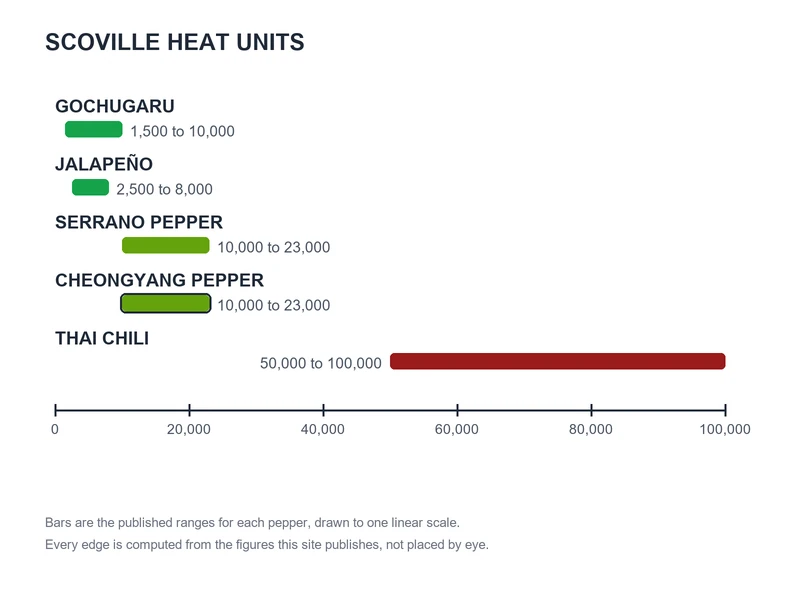
The cheongyang pepper is South Korea's standard hot chile at 10,000 to 23,000 SHU, about three times a jalapeno at the midpoint of each range.
Slender and bright green ripening to red, it carries the working heat in stews, tteokbokki and fresh banchan. It was bred in 1983 from a Thai pepper crossed with a Jeju pepper, and the name comes from two counties that are not Cheongyang.
- Species: C. annuum
- Heat tier: Hot (10K-100K SHU)
- Comparison: 1-9x hotter than a jalapeño, depending on where the jalapeño falls in its 2,500-8,000 SHU range
What Kind of Pepper Is Cheongyang Pepper?
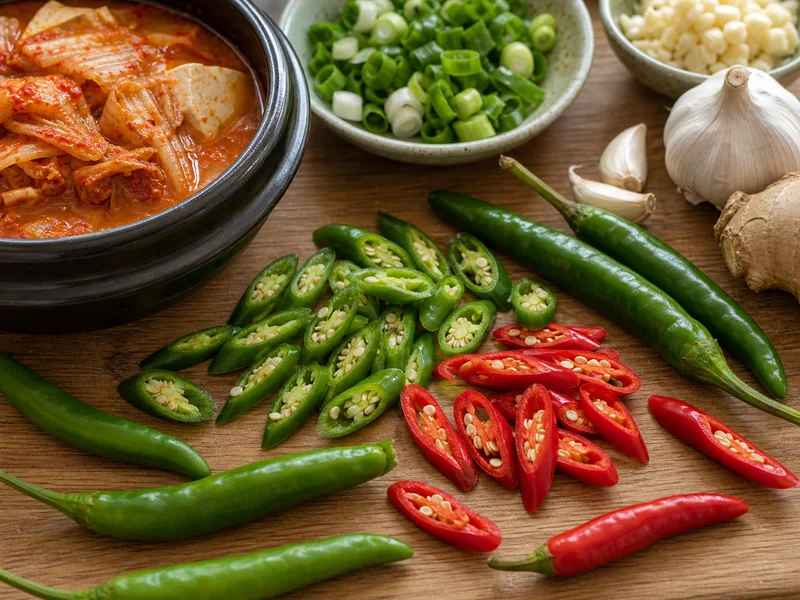
The cheongyang pepper is a slender tapered pod, 5 to 7 cm long, ripening from deep green to red.
The flavor runs sharp and direct, with little sweetness sitting behind the heat.
At 10,000 to 23,000 SHU it sits in the hot band, on the same published range as a serrano from end to end. The burn arrives fast and centers on the palate rather than settling in the throat, which makes it easier to steer in a simmered dish than the number suggests.
It is a Capsicum annuum, the same species as the bell pepper and the jalapeno, and it behaves like neither. Plants grow upright at 60 to 80 cm with the fruit pointing skyward, which makes the pods easy to find at harvest.
In Korean cooking the pepper is not an option among several. It is the default heat in doenjang jjigae, in tteokbokki sauce and on a plate of banchan.
Where Did Cheongyang Pepper Originate?
The cheongyang pepper was made in 1983 by a private Korean seed company, crossing a Thai pepper with a traditional Jeju pepper. The Academy of Korean Studies records that the National Institute of Horticultural and Herbal Science later produced an identical variety from the same two parents.
It was not bred for the kitchen at all. The target was capsaicin extraction for curry manufacture, which never became economic.
What saved the variety was growers finding that the pods worked in soup and stew, and the pepper spread from there into Korean cooking on its own merits.
The name is the most misunderstood thing about it. It takes its first syllable from Cheongsong and its second from Yeongyang, two counties in North Gyeongsang Province where farmers first grew it out.
Cheongyang County in South Chungcheong is a different place that happens to share the resulting name.
Sources placing the pepper's development there have read the name backwards, and the mistake is common enough that it reaches English-language reference pages. It has since become the reference point among Korean peppers, and accounts for a large share of the country's fresh chile crop.
How Hot Is Cheongyang Pepper? Heat and Flavor
The Cheongyang Pepper delivers 10K–23K Scoville Heat Units, placing it in the Hot tier (10K-100K SHU). That makes it roughly 1-9x hotter than a jalapeño, depending on where the jalapeño falls in its 2,500-8,000 SHU range.
Flavor notes: bright and crisp.
What Nutrients Does Cheongyang Pepper Provide?
USDA FoodData Central puts raw hot chili peppers near 40 calories per 100 g, most of it carbohydrate. That is a class-level entry rather than a panel for this cultivar, because no database publishes one for cheongyang specifically, and the figure should be read that way.
Vitamin C is the number worth knowing. Fresh chilies in this size class carry a large share of a day's intake in a 100 g serving, and cooking cuts it, so raw pods in banchan deliver more than the same weight simmered into a stew.
Capsaicin concentrates in the pale placenta that holds the seeds rather than in the seeds themselves.
Scraping seeds alone therefore does less than most cooks expect, and cutting the white membrane out is what actually lowers the heat. The pepper also supplies modest amounts of vitamin A, potassium and vitamin B6.
What Is Cheongyang Pepper Best Used For?
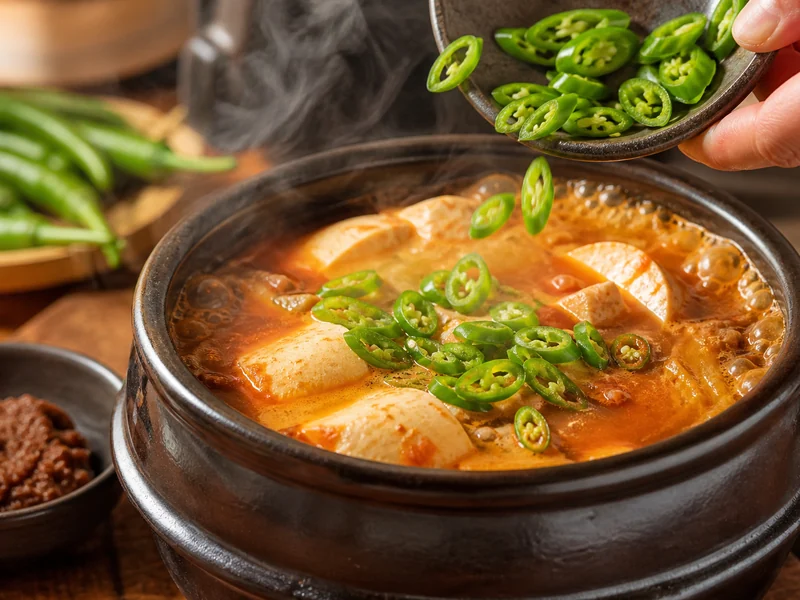
Sundubu jjigae is where the pepper does its clearest work. Sliced thin and added early, it puts a clean penetrating heat through the broth without fighting the soft tofu.
The same quality makes it standard in tteokbokki sauce, where the sharpness cuts the sweetness of the gochujang rather than adding to it.
Fresh pods are also eaten whole at the table beside doenjang paste, a pairing that sets a crisp raw bite against a fermented one. Pickling works well too, since thin rounds in rice vinegar with garlic hold their heat for several weeks.
For swaps a serrano replacement goes in at 1:1, which is unusually safe advice because the two peppers are published on the identical 10,000 to 23,000 range.
What changes is the flavor rather than the heat, since the serrano brings more green vegetal weight and the cheongyang stays sharper.
Dried and ground it makes a coarse powder that stands in as a gochugaru substitute when the dish wants more heat than gochugaru itself brings.
Against the lemon drop it reads cleaner and more linear, which suits savory braises and does little for ceviche.
How Should You Buy and Store Cheongyang Pepper?
The label is the obstacle, not the supply. Korean grocery stores carry these year-round, but the sign usually reads hot green pepper or gives the Korean name alone.
Choose pods that are firm and glossy with no soft spots, since a slightly waxy surface is normal and shrivelling near the stem is not.
Refrigerate them unwashed in a paper bag or a loose dry cloth, where they hold for 1 to 2 weeks. Washing before storage traps moisture against the skin and shortens that window, so wash at the point of use instead.
Whole pods freeze without blanching and keep about 6 months, holding heat and flavor but losing the raw crunch. Thawed pods therefore belong in cooked dishes rather than on a banchan plate.
Dried whole pods keep 6 to 12 months airtight and away from light, and ground powder fades faster than whole pods do.
What Can You Use Instead of Cheongyang Pepper?
No dedicated substitute guidance is published for Cheongyang Pepper yet.
What Does Cheongyang Pepper Need to Grow Well?
Start seed 8 to 10 weeks before the last frost indoors. Germination runs best at 26 to 29 C, 80 to 85 F, which usually means a heat mat under the tray, and takes 10 to 14 days.
Transplant once night temperatures hold above 15 C, 60 F, spacing plants 45 to 50 cm apart in at least six hours of sun. The plants stay compact but crop heavily, so a stake or a cage earns its place once the pods start setting.
Soil has to drain, because this pepper does not tolerate wet feet. Feed balanced at transplant, then shift to lower nitrogen and higher phosphorus once flowering starts.
Pods reach harvestable green at roughly 70 to 75 days from transplant, and leaving them to redden deepens the heat and adds a little sweetness.
In humid weather watch for anthracnose, the same rot that troubles the thin-walled de arbol, and water at the base rather than overhead. Expect 30 to 50 pods from a healthy plant.
Season at a glance
- Sow indoors 8 to 10 weeks before the last frost, on a heat mat at 26 to 29 C
- Expect germination in 10 to 14 days
- Transplant once nights hold above 15 C, spacing 45 to 50 cm
- Stake or cage as the first pods set, because the plants crop heavily for their size
- Harvest green at roughly 70 to 75 days from transplant
- Leave pods to redden for slightly deeper heat and a little sweetness
- Water at the base in humid weather to keep anthracnose down
Cheongyang Pepper FAQ


- Academy of Korean Studies, Encyclopedia of Korean Culture, cheongyang pepper (E0080047)
- USDA FoodData Central, SR Legacy 170108, Peppers, hot chile, raw
- Capsicum annuum L. - USDA GRIN Taxonomy
Species classification: C. annuum - based on published botanical taxonomy.