
Gochugaru vs Red Pepper Flakes: Are They Interchangeable?
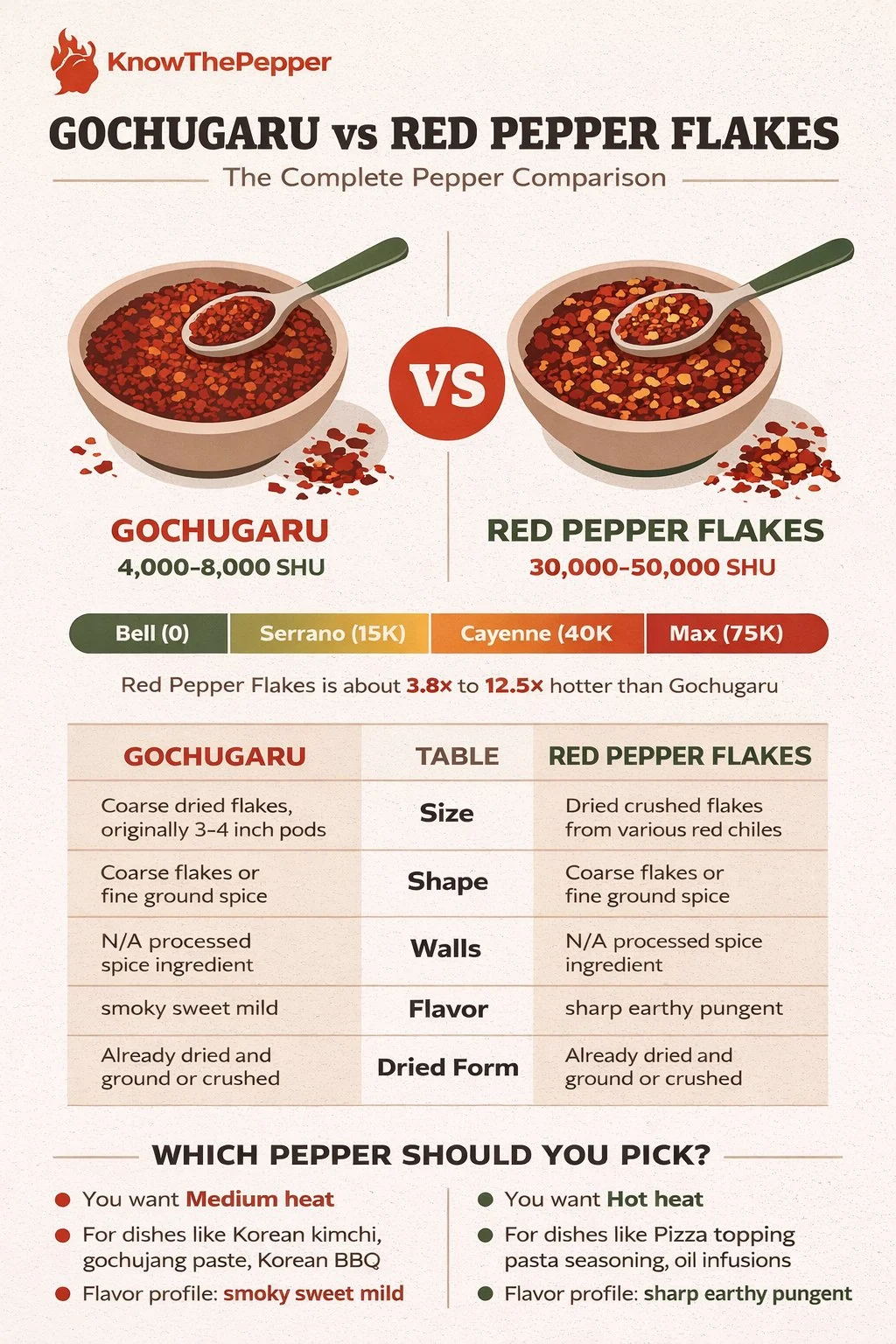
Choose gochugaru when red chile must hydrate into a seed-light coating. Choose red pepper flakes when discrete pieces should bloom in oil or add adjustable finishing heat.

Gochugaru is a Korean red-pepper product chosen by grind and use, while generic red pepper flakes are a variable crushed pod-and-seed format. Gochugaru usually builds a hydrated coating; crushed flakes usually stay discrete in oil or on finished food.
- Product identity: Named Korean red-pepper product vs Generic crushed chile format
- Visible makeup: Soft flakes or powder, often seed-light vs Pod fragments with visible seeds
- Heat evidence: Read mild, hot, or product claim vs Read named blend or product claim
- Wet behavior: Can build a cohesive coating vs Usually stays in discrete pieces
- Strong first job: Kimchi and wet seasoning mixtures vs Oil blooming and finishing heat
Gochugaru
HotRed Pepper Flakes
HotQuick Comparison
| Attribute | Gochugaru | Red Pepper Flakes |
|---|---|---|
| Product identity | Named Korean red-pepper product | Generic crushed chile format |
| Visible makeup | Soft flakes or powder, often seed-light | Pod fragments with visible seeds |
| Heat evidence | Read mild, hot, or product claim | Read named blend or product claim |
| Wet behavior | Can build a cohesive coating | Usually stays in discrete pieces |
| Strong first job | Kimchi and wet seasoning mixtures | Oil blooming and finishing heat |
Are Gochugaru and Red Pepper Flakes the Same Ingredient?
No. Gochugaru and generic red pepper flakes are both dried red Capsicum products, but the names do not describe the same retail ingredient. Gochugaru is a Korean red-pepper product sold by grind and intended use, while "red pepper flakes" usually describes a crushed format rather than one fixed cultivar or heat specification.
The Korean Ministry of Food and Drug Safety defines red pepper powder or shredded red pepper as dried red pepper fruit that has been chopped, shredded, or powdered. That definition covers more than one particle size, which is why a bag may be labeled for kimchi, seasoning, or paste instead of simply "flakes."
A jar labeled only as crushed red pepper may combine dried pod pieces and seeds without naming a cultivar. Another product can use a different chile mix and still carry the same common name.
The names alone do not support a universal heat multiplier. A mild gochugaru and a hot crushed-pepper blend may be far apart, while two differently labeled products can overlap.
Visible seeds are not a Scoville meter. New Mexico State University explains that capsaicinoids are produced in glands associated with the placenta inside the pod, while seeds can pick up pungent compounds through contact.
That distinction corrects a common shortcut. A seed-heavy jar often signals a different texture and product composition, but the pale seeds did not manufacture the heat.
Read the package for a named pepper, a mild or hot statement, a grind description, or a measured heat claim. If the label gives none of those, treat the heat as unknown rather than borrowing a number from another brand.
Test the actual jar in the food that will carry it. Stir one small pinch into a tablespoon of warm broth or sauce, wait two minutes, then compare before seasoning the pot.
The answer is practical rather than numerical. Identify the product first, then dose the batch you own.
What the package can actually tell you
| Clue | Useful conclusion | What it cannot prove |
|---|---|---|
| Mild or hot label | Relative style within that product line | One universal SHU range |
| Named chile or measured SHU | A stronger starting dose clue | Exact heat in every batch |
| Visible seeds | Texture and product composition | That seeds produced the capsaicin |
| No heat information | Run a small hydrated test | A safe fixed substitution ratio |
How Do Gochugaru and Red Pepper Flakes Differ in Texture?
The useful physical contrast is not simply "fine versus coarse." It is the whole particle field, including flake thickness, hard seed pieces, powdery fines, and how evenly those parts are distributed.
Commercial gochugaru varies more than a single product photo suggests. A study of ten Korean red pepper powders reported average particle sizes from 605 to 1,251 micrometers, alongside differences in particle distribution, color, moisture, and pH.
A kimchi grind can therefore look soft and granular without being a fine powder. Generic crushed red pepper often shows larger pod shards mixed with conspicuous pale seeds, although the exact blend remains brand-dependent.
What happens when both are hydrated?
Put equal pinches in separate dishes and add the same small amount of warm water. After several minutes, seed-light gochugaru usually makes a more continuous red coating, while a coarse seed-and-pod blend remains visibly broken into separate pieces.
This is a kitchen observation test, not a promise that every bag behaves identically. Grind, age, moisture, and the amount of seed and pod material can change the result.
The diagram uses equal vessels and equal treatment so you can inspect cohesion rather than color alone. Paste formation matters when the seasoning must cling to folded cabbage or vegetables.
What happens in oil?
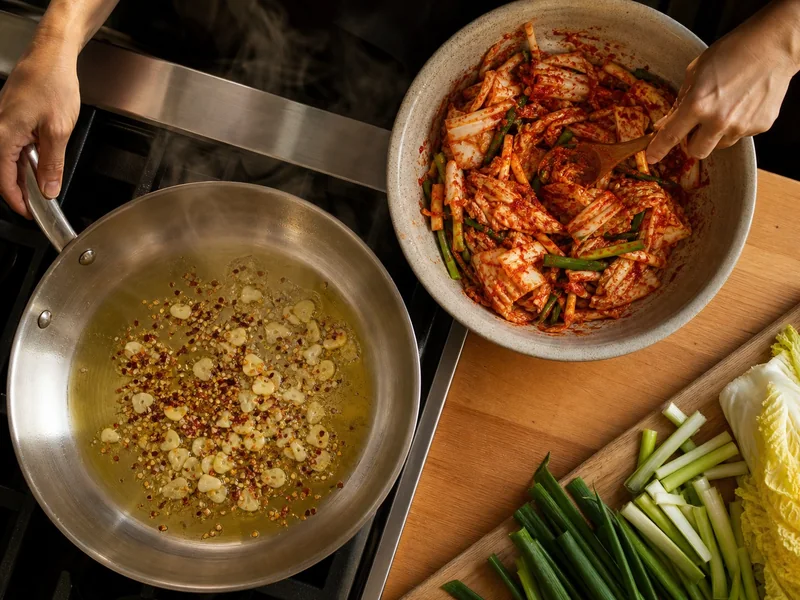
Crushed red pepper is well suited to a short bloom in warm oil because separate flakes can perfume the fat and remain visible. Keep the heat moderate, especially when garlic is present, because small fragments can darken before the rest of the dish is ready.
Gochugaru can also bloom in fat, but a finer or softer grind colors the oil more evenly and can thicken a wet seasoning base. That is useful behavior in a sauce, yet it is different from the scattered flake effect expected on pizza or pasta.
Do they taste the same?
No, although the difference should not be reduced to a slogan. Fresh gochugaru often gives a broad ripe-red-pepper aroma around its heat, while a generic crushed blend can feel sharper when hard pod fragments remain on the tongue.
Those are useful tendencies, not protected formulas. Cultivar, drying temperature, grind, seed fraction, age, and storage can move either product away from the version you remember.
Neither name guarantees smoke. If smoke matters, the package should identify a smoked process or smoked ingredient instead of asking you to infer it from dark color.
Smell a pinch before it touches steam, then taste the hydrated sample. A flat aroma, dusty bitterness, or damp clumps are stronger rejection clues than a slightly dull shade.
Use the material and aroma tests together.
Cohesive coating points toward gochugaru. Discrete seeded flakes point toward finishing heat and oil infusion.
Which Works Better in Kimchi, Pizza, and Pasta?
The dish decides which difference matters. Kimchi needs a red seasoning mixture that spreads through layered vegetables, while pizza and pasta often need small bursts of heat that stay visible at the surface.
Why does kimchi favor gochugaru?
The Codex standard for kimchi describes a seasoning mixture based mainly on red pepper powder with garlic, ginger, other Allium vegetables, and radish. It also expects red-pepper color and a hot, salty taste in the finished food.
Gochugaru fits that wet mixture because the right grind hydrates through the aromatics and coats cabbage without filling every bite with hard seed pieces. The choice is about distribution and texture as much as heat.
Generic crushed red pepper can make cabbage hot, but it often leaves isolated pod fragments and seeds instead of building the same red body. Increasing the amount until the paste looks right can overshoot heat before it fixes texture.
Where do generic red pepper flakes make more sense?
Generic crushed red pepper fits pizza, pasta sauce, eggs, roasted potatoes, salads, chili, and tacos. Those uses share a flexible role: the flakes add visible, adjustable heat without needing to become the body of a seasoning paste.
Warm garlic oil is an especially clear fit. The oil distributes pungency through pasta or vegetables while the flakes remain identifiable, so a small amount can affect a large serving.
Gochugaru still works outside Korean food. It brings broad red color and a softer flake texture to marinades, braises, cucumber salads, eggs, noodles, and roasted vegetables when a less jagged finish suits the dish.
| Cooking job | Better first choice | Reason |
|---|---|---|
| Kimchi seasoning paste | Gochugaru | Hydrates into a seed-light coating across layered vegetables |
| Pizza or table sprinkle | Red pepper flakes | Discrete flakes deliver intermittent surface heat |
| Garlic oil or aglio e olio | Red pepper flakes | Visible pieces bloom in fat without needing to form a paste |
| Korean cucumber or scallion seasoning | Gochugaru | Soft flakes cling among moist cut vegetables and aromatics |
| Smooth red sauce | Fine gochugaru or another ground chile | Fewer hard fragments interrupt the sauce |
| Last-minute heat correction | Whichever jar you have tested | Actual product heat matters more than the generic name |
The process image shows the distinction in motion. One product becomes part of a wet coating, while the other remains a visible heat accent in oil.
Can You Substitute Red Pepper Flakes for Gochugaru?
You can substitute one for the other in some soups, sauces, marinades, and vegetable dishes, but the swap is never just a volume conversion. First decide whether the missing ingredient supplies heat, a cohesive red coating, or visible flakes.
For a soup or loose sauce that calls for gochugaru, generic red pepper flakes can provide heat. They cannot guarantee the same fruit character, seed-light texture, or even distribution.
Use a reversible trial:
- Move one-half cup of the prepared food into a separate bowl.
- Add one small pinch of the replacement and stir it through the same liquid or fat used in the recipe.
- Wait two minutes so dry particles can hydrate and pungency can spread.
- Taste for heat, then inspect seed pieces, bitterness, and coating.
- Scale the successful sample to the pot only after both flavor and texture work.
This method does not claim that one pinch equals another. It gives you a controlled place to stop before a hot or coarse replacement changes the whole batch.
Do not use generic red pepper flakes as a routine gochugaru replacement in kimchi. A large kimchi batch depends on enough red pepper material to build seasoning paste, so a hotter seed-and-pod blend can become harsh while the coating still remains wrong.
In a small emergency batch, you can accept a different style and use far less of the unknown product, but call the result a variation. Do not chase the expected red body by repeatedly adding more flakes.
The reverse swap is easier for pizza, pasta, soup, or eggs when softer heat is welcome. Start with the same small visual pinch of gochugaru, taste, and add more only if the dish needs it.
Do not compensate for a mild result by building a thick dusty layer on a dry finished food. If the surface becomes powdery or the chile flavor dominates, the substitution has already failed even if the heat remains low.
Freshness can change the decision. Keep both products airtight in a cool, dry, dark place, and replace a jar that smells flat, shows moisture clumps, or tastes bitter in the controlled sample.
Choose gochugaru for kimchi paste, hydrated coatings, and soft red-pepper texture. Choose red pepper flakes for oil blooming, table seasoning, and discrete bursts of heat.
Gochugaru vs Red Pepper Flakes FAQ
- Korean Ministry of Food and Drug Safety - Standards for Red Pepper Powder or Shredded Red Pepper
- FAO and WHO Codex - Kimchi Standard CXS 223-2001
- New Mexico State University Extension - Growing Chile Peppers in New Mexico Gardens
- Korean Journal of Food Hygiene and Safety - Commercial Red Pepper Powder Quality