
Habanero vs Red Savina: A Hotter Cultivar With a Similar Fruity Flavor
The habanero and Red Savina habanero share the same species, similar fruity character, and nearly identical appearance, but the Red Savina was once certified as the world's hottest pepper, and it still hits nearly twice as hard as a standard habanero. Understanding where they diverge helps you pick the right one for your heat tolerance and recipe goals.

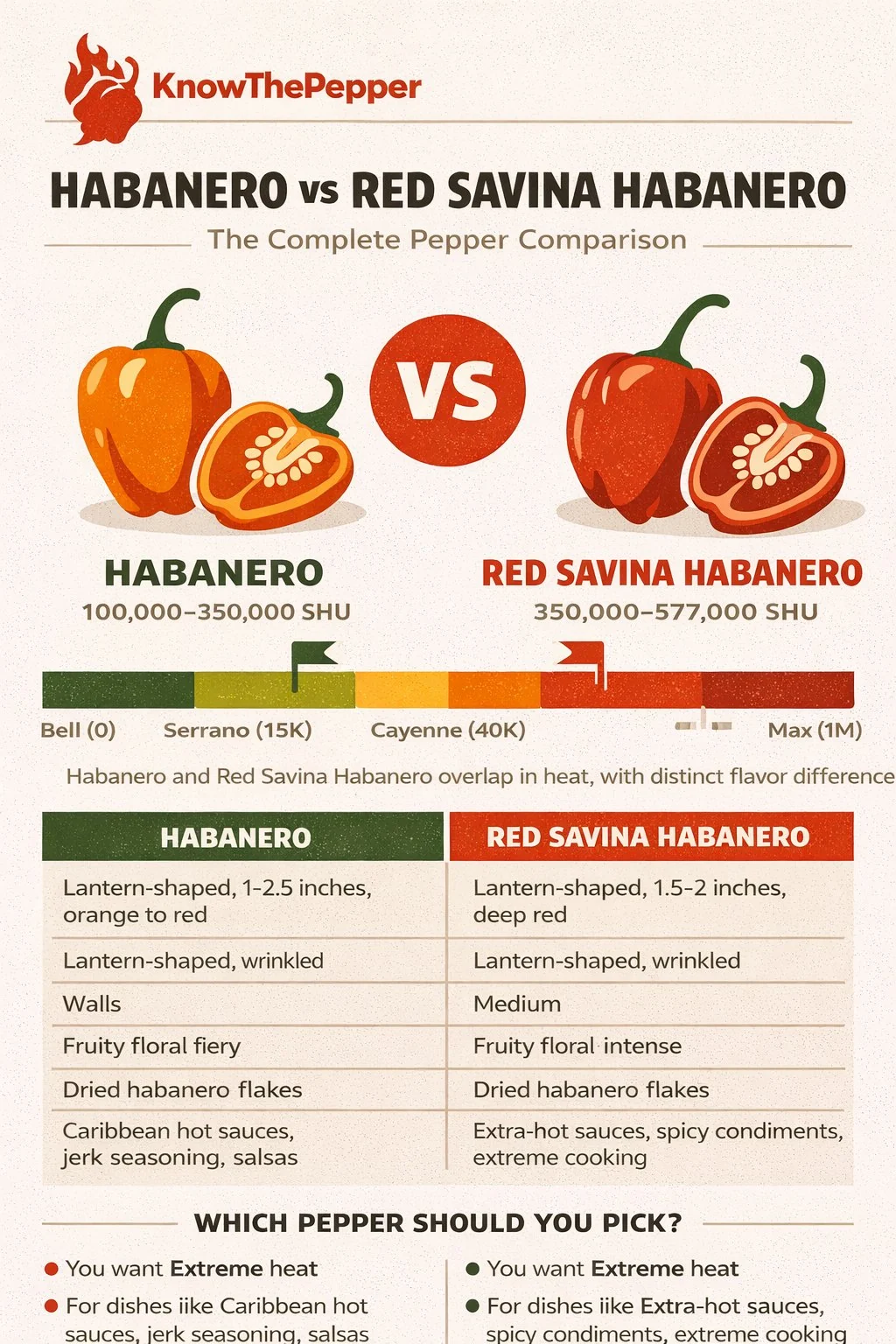
Habanero
Extra-HotRed Savina Habanero
Extra-HotQuick Comparison
| Attribute | Habanero | Red Savina Habanero |
|---|---|---|
| Scoville evidence | 100K-350K SHU | 350K-580K SHU |
| Heat Tier | Extra-Hot | Extra-Hot |
| vs Jalapeño | 44x hotter | 73x hotter |
| Flavor | fruity and citrusy | fruity and intense |
| Species | C. chinense | C. chinense |
| Origin | Mexico | USA |
How Much Hotter Is Red Savina Than a Regular Habanero?
The standard habanero's fruity orange fire lands between 100,000 and 350,000 SHU - already a serious pepper that sits firmly in the extra-hot heat classification. At the low end, that's roughly 12 times hotter than a jalapeño.
At the top of its range, closer to 40 times hotter.
Most grocery-store habaneros cluster around 150,000-200,000 SHU in practice.
The Red Savina habanero operates in a different league entirely. Its range runs 350,000-580,000 SHU, which means even its mildest specimens match the hottest standard habaneros.
At peak heat, a Red Savina can be nearly 70 times hotter than a jalapeño - and about 1.6 times hotter than a typical habanero.
From 1994 to 2006, the Red Savina held the Guinness World Record for hottest pepper, a record confirmed through HPLC capsaicinoid testing. It lost that title to the ghost pepper's record-breaking capsaicin levels, which eventually pushed the conversation into super-hot pepper territory entirely.
The burn character matters as much as the number. Both peppers share the chinense slow-build pattern, heat arrives 10-15 seconds after contact, then climbs steadily and lingers.
The Red Savina's burn tends to sit higher in the mouth and throat, while the standard habanero's heat often stays more centered on the tongue.
Neither is forgiving to the uninitiated.
Do Red Savina and Regular Habanero Taste the Same?
Both peppers belong to Capsicum chinense, and that shared genetics shows in the flavor: fruity, floral, with a citrus-forward aroma that distinguishes the species from the earthier C. annuum varieties. Cut either one open and the smell alone signals serious heat.
The standard habanero delivers bright citrus and tropical fruit notes - think mango, apricot, and a faint floral quality that makes it surprisingly useful in fruit-based salsas and hot sauces. Its flavor is assertive but not overwhelming when used in moderation, which is why it became the backbone of so many Caribbean and Mexican hot sauces.
The habanada pepper's heatless habanero flavor profile exists precisely because that underlying taste is worth preserving.
The Red Savina carries those same fruity notes but with more intensity and a slightly deeper, almost wine-like richness underneath. Some growers describe it as more complex, the heat doesn't just amplify, it seems to concentrate the flavor alongside it.
That said, at Red Savina heat levels, most palates are processing burn signals more than subtle flavor nuances.
In cooking, the standard habanero's flavor integrates more gracefully into dishes where you want heat and flavor contribution. The Red Savina is better suited to applications where you want maximum heat with fruity backup, hot sauce blends, fermented mashes, or small-batch extracts.
The aroma of both is intensely floral when roasted, though the Red Savina's capsaicin concentration can make working with it without gloves genuinely unpleasant.
Culinary Uses
For everyday cooking, the standard habanero is the workhorse. It anchors Mexican pepper-based sauces and marinades from the Yucatan, where habanero salsa is table-standard.
A single pepper, seeded and minced, adds serious heat to a pot of black beans or a mango salsa for 4-6 people.
Whole roasted habaneros blended with garlic, lime, and oil make a fast hot sauce that keeps refrigerated for weeks.
The Red Savina demands more respect in the kitchen. Treat it the way you'd treat any high-capsaicin ingredient, use gloves, ventilate the space, and start with half the quantity you'd use for a standard habanero.
A Red Savina where a recipe calls for one habanero will roughly double the heat output.
For hot sauce makers, the Red Savina shines in small-batch ferments where its intensity can be diluted with volume, a few peppers go a long way in a half-gallon jar.
Both peppers work well in the same flavor contexts: tropical fruit pairings (pineapple, mango, papaya), citrus-based marinades, Caribbean jerk blends, and fermented hot sauces. The Fresno pepper's milder fruity profile is a useful reference point, the habanero sits dramatically above it in heat, and the Red Savina above that.
For drying and powder, the Red Savina produces an intensely hot powder that should be measured in pinches, not teaspoons. Standard habanero powder is more versatile for general seasoning.
Both peppers freeze well, flash freeze on a sheet pan, then bag them for storage up to 12 months without significant flavor loss.
Substitution ratio when swapping Red Savina for standard habanero: use 0.5-0.6 Red Savinas per habanero called for, adjusting to taste.
Which Should You Choose, Habanero or Red Savina?
If you cook regularly with habaneros and want manageable, well-rounded heat with genuine flavor contribution, the standard habanero is the practical choice. It's widely available, predictable in heat output, and versatile across salsas, marinades, and hot sauces.
The Red Savina is for people who specifically need more heat from the same fruity chinense flavor base, hot sauce producers chasing intensity, growers interested in cultivating the C. chinense species at its upper limits, or experienced chileheads who find standard habaneros comfortable.
Neither pepper is a casual weeknight ingredient for heat-sensitive cooks. But between the two, the standard habanero offers more control.
The Red Savina rewards those who know exactly what they're doing with it, and punishes those who don't.
For most home kitchens, the habanero is the better tool. For those chasing the ceiling of fruity-hot flavor, the Red Savina is worth the extra care it demands.
Service Examples
Choose standard habanero heat profile when a recipe needs fruity heat but still has to serve a mixed table.
Orange habaneros are strong enough for Caribbean-style hot sauce, mango salsa, jerk marinade, pickled onions, and vinegar sauces, but the dose is easier to control. One small habanero can season a full batch of salsa without making it a pure heat test.
Choose Red Savina habanero when the recipe is built for serious habanero heat and the chile is the headline.
Red Savina works in very hot vinegar sauce, pepper mash, fermented hot sauce, and chile extracts where the goal is a stronger version of the same chinense fruit. It is not the better casual substitute for a standard habanero.
For a quart of fruit salsa, use one regular habanero first. For a quart of hot sauce aimed at chile-heads, use one Red Savina where you might use two standard habaneros, then taste before adding more.
Can Red Savina Replace a Regular Habanero?
Red Savina can replace a regular habanero, but not at the same count unless the recipe is meant to be much hotter.
A practical home ratio is 1 Red Savina for 2 standard habaneros when the standard habaneros are average heat. If your Red Savina pods are especially strong, start with half a pod.
Regular habanero can replace Red Savina more easily: use two regular habaneros for every Red Savina and accept a softer ceiling. The fruit character stays close because both sit in the habanero family, but the Red Savina has a sharper red-fruit intensity and a harder burn.
Use habanero substitute guidance when availability is the problem. Use Red Savina only when the recipe actually benefits from a hotter habanero, not just any fruity pepper.
Buying And Prep Notes
Standard habaneros are easier to find fresh, frozen, dried, and in sauce form.
That availability makes them better for repeatable recipes. If you test a mango hot sauce in June and remake it in October, regular habaneros are more likely to give the same result from store to store.
Red Savina is more specialized.
Fresh pods are less common, and seed-grown heat can vary by source. Buy from a grower or seed seller that identifies the cultivar clearly, because a generic red habanero is not automatically Red Savina.
Prep both with gloves, especially when making mash or sauce.
Remove placenta tissue if you want fruit with less heat, but do not expect a Red Savina to become mild after trimming. Its capsaicin load is still much higher than a standard habanero.
For fermented sauce, weigh the pods and salt by percentage rather than counting peppers. A Red Savina batch can overshoot quickly if you count pods as though they were standard orange habaneros.
Quick Choice Matrix
Use standard habanero when fruity heat needs to stay usable in salsa, hot sauce, marinades, and pickles. It is the better pick for repeatable recipes and mixed-heat audiences.
Use Red Savina when the recipe intentionally asks for a hotter habanero profile. It is the better pick for chile-head hot sauce, pepper mash, and very small-dose heat building.
Do not swap pod for pod unless extreme heat is expected. Choose habanero for control, Red Savina for a higher ceiling.
Is Red Savina Just a Red Habanero?
The common mistake is treating Red Savina as a red-colored standard habanero.
It is a hotter cultivar, so pod-count swaps can push salsa or sauce past the intended heat. Start with less, especially in uncooked fruit salsas where the pepper has no long simmer to soften its bite.
How Many Habaneros Equal One Red Savina?
Use half to one Red Savina for two regular habaneros when the dish can take extra heat. Use two regular habaneros for one Red Savina when fruit matters more than maximum burn.
Resting Chopped Pepper for Raw Salsa
For raw salsa, rest the chopped pepper in citrus for ten minutes before final seasoning. The fruit note opens up while the heat becomes easier to judge.
Habanero vs Red Savina Habanero FAQ
- Guinness World Records - Hottest Chili
- Capsicum chinense Jacq. - USDA GRIN Taxonomy
- Bosland, P.W. & Baral, J.B. - 'Bhut Jolokia' the World's Hottest Known Chile Pepper is a Putative Naturally Occurring Interspecific Hybrid (HortScience, 2007)