
Habanero vs Thai Chili: Heat, Flavor, and Best Uses
Choose habanero when a sauce needs very high heat plus a fruity, citrus-like aroma. Choose Thai chili when small whole, sliced, or crushed pods should deliver direct heat through a mortar, wok, curry, or dipping sauce.

Habanero generally occupies the hotter published range and adds a pronounced fruity, citrus-like aroma. Thai chili is a variable market category whose small pods suit crushing, slicing, oil blooming, and whole-pod use.
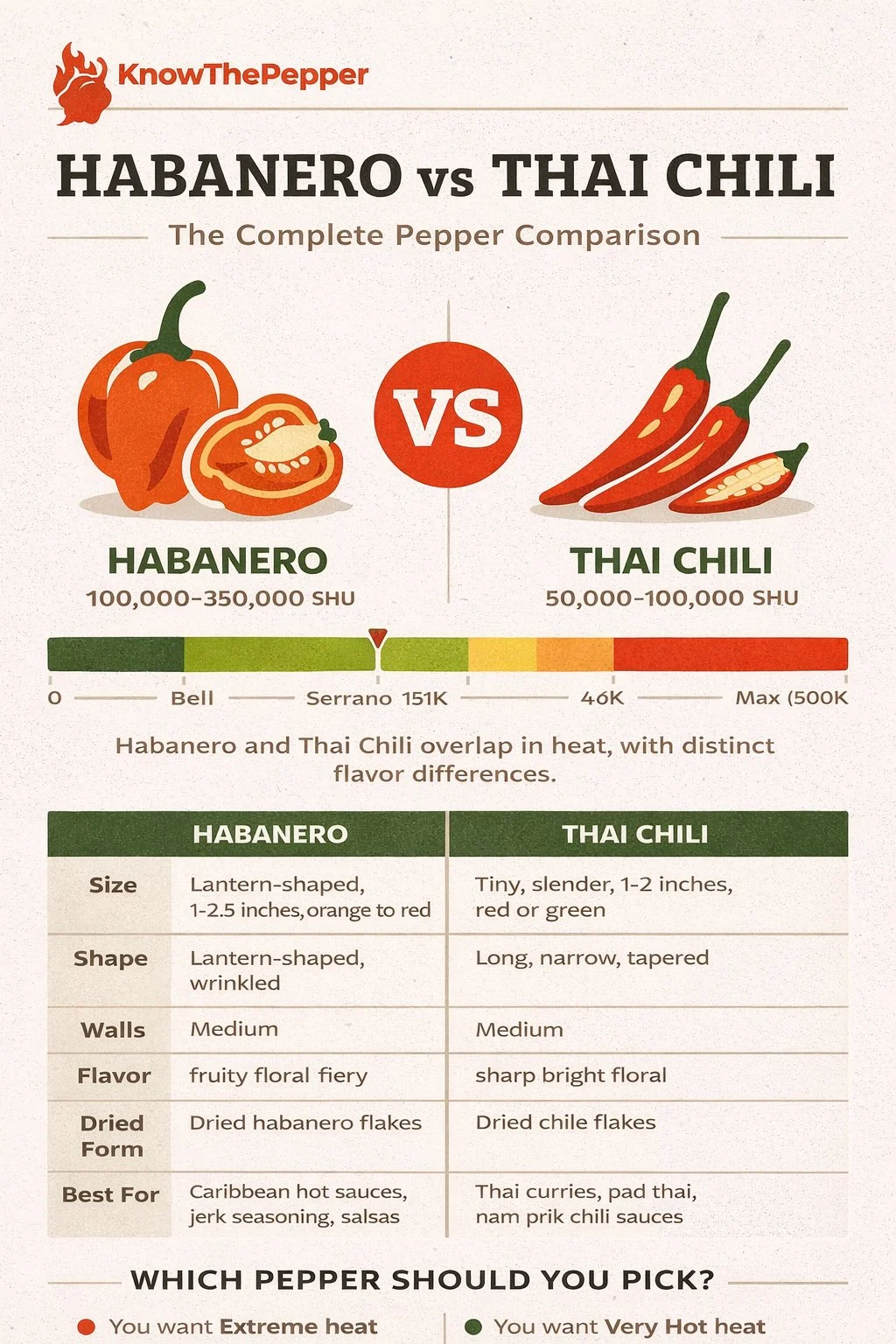
- Published heat band: 100,000 to 350,000 SHU vs 50,000 to 100,000 SHU
- Market identity: Named Capsicum chinense type vs Variable small-chili category
- Pod form: Broad and lantern-shaped vs Narrow and pointed
- Aromatic role: Fruity, citrus, and floral vs Varies, often used for direct chile heat
- Strong first job: Blended aromatic hot sauce vs Mortar, wok, curry, or dipping sauce
Habanero
Extra-HotThai Chili
HotQuick Comparison
| Attribute | Habanero | Thai Chili |
|---|---|---|
| Published heat band | 100,000 to 350,000 SHU | 50,000 to 100,000 SHU |
| Market identity | Named Capsicum chinense type | Variable small-chili category |
| Pod form | Broad and lantern-shaped | Narrow and pointed |
| Aromatic role | Fruity, citrus, and floral | Varies, often used for direct chile heat |
| Strong first job | Blended aromatic hot sauce | Mortar, wok, curry, or dipping sauce |
Which Is Hotter, Habanero or Thai Chili?
Habanero usually occupies the hotter published range. Iowa State University Extension lists habanero at 100,000 to 350,000 Scoville heat units and Thai bird's-eye at 50,000 to 100,000 SHU.
The ranges meet at 100,000 SHU, so the hottest Thai bird's-eye can reach the bottom of the habanero band.
That shared boundary does not make the peppers interchangeable, because most of the habanero range extends far above it.
| Comparison point | Habanero | Thai bird's-eye reference |
|---|---|---|
| Published heat band | 100,000 to 350,000 SHU | 50,000 to 100,000 SHU |
| Typical pod outline | Broad, wrinkled, lantern-shaped | Narrow, smooth, pointed |
| Species reference | Capsicum chinense | Capsicum annuum |
| Useful first decision | Choose when higher heat and aroma are both wanted | Choose when small pods and direct chile heat fit the technique |
Does Thai chili name one exact cultivar?
No. Thai chili is a market category used for several small hot peppers, and a package may say Thai chili, bird chili, or bird's-eye without naming a cultivar.
A Thai Department of Agriculture study identifies bird chili as Capsicum annuum, while the department's variety records document multiple Thai pepper selections. The evidence supports a category boundary, not one universal pod with one fixed heat level.
Look at the package and the pepper itself.
A named cultivar, country of origin, ripe color, fresh or dried form, and any measured heat claim are more useful than the broad retail label.
Habanero has a clearer species identity, but its heat still varies with cultivar and growing conditions. An orange supermarket habanero should not be assumed to deliver exactly the midpoint of a published range.
How should you compare the batch you have?
Cut a very small piece from each pod with separate utensils, then test the pieces in equal spoonfuls of the food that will carry them. This matters because fat, water, sugar, acid, and serving temperature change how quickly pungency reaches your mouth.
Wait before increasing the dose. A pod count is not a measurement when one pepper is broad and exceptionally hot while the other is narrow, variable, and sold under a category name.
The measured answer is therefore clear but bounded.
Start with habanero when the dish calls for the higher heat band, and start with the Thai chili in front of you when the cooking method calls for small pods that can be crushed, sliced, or left whole.
What the published ranges mean
| Evidence | Useful conclusion | Boundary |
|---|---|---|
| 100,000 to 350,000 SHU | Habanero generally occupies the higher band | Cultivar and growing conditions still vary |
| 50,000 to 100,000 SHU | Thai bird's-eye reference is lower overall | The Thai-chili label can cover different products |
| Shared 100,000 boundary | The ranges can touch | It does not create a universal pod ratio |
How Do Habanero and Thai Chili Release Heat and Aroma?
The broad habanero and narrow Thai chili do not release heat or aroma through food in the same way. Pod shape changes the amount of flesh and inner tissue in each cut, while the chosen cut changes whether pungency arrives in scattered bites or spreads through the whole dish.
The pale tissue that holds the seeds is the important handling area.
Capsaicinoids are associated with the inner placental tissue, and the seeds can become coated through contact, so scraping out loose seeds alone does not remove every hot surface.
A broad habanero slice can include flesh, wall, and a large piece of inner core at once. A thin Thai-chili ring is smaller, yet every ring may carry some inner tissue and distribute many hot points through a wok or bowl.
The equal-scale image below answers a question that a generic heat chart cannot.
It shows why one whole pod, one slice, and one teaspoon of mince are not comparable units across these shapes.
What does habanero add beyond heat?
UF/IFAS describes habanero fruit with fruity, citrus, and floral characteristics. Those aromas can remain obvious even when the pepper is a small part of a mango sauce, carrot sauce, citrus marinade, or vinegar-based hot sauce.
That aromatic force is useful when the recipe has room for it. It can also redirect a dipping sauce whose main balance should come from lime, fish sauce, garlic, herbs, or fermented ingredients.
Ripe color matters.
An orange or red habanero often presents a fuller ripe-fruit aroma than an immature green pod, although color alone cannot predict exact heat.
What does a Thai chili contribute?
A small Thai chili usually functions as a direct chile ingredient rather than a fruit base. Crushed pods can disappear into a mortar paste, sliced rings can remain visible in a dipping sauce, and whole bruised pods can perfume a curry while staying removable.
The flavor is not identical across every item sold as Thai chili. Green pods can taste more grassy, ripe red pods can taste rounder, and dried pods introduce a different toasted or stored character depending on processing.
Use a two-part ingredient test before choosing.
Smell a freshly cut surface for fruit, grass, or stale storage notes, then taste a tiny amount in a spoonful of the finished sauce base.
This separates two decisions that are often collapsed. Heat decides how much you can tolerate, while aroma decides whether the pepper belongs in the dish at all.
Which Cooking Methods Suit Habanero and Thai Chili?
Choose by the way the pepper enters the food.
Thai chilies fit techniques that use small pods as separate hot pieces, while habanero fits preparations that blend a very hot aromatic pepper into a larger sauce volume.
When does Thai chili fit the technique?
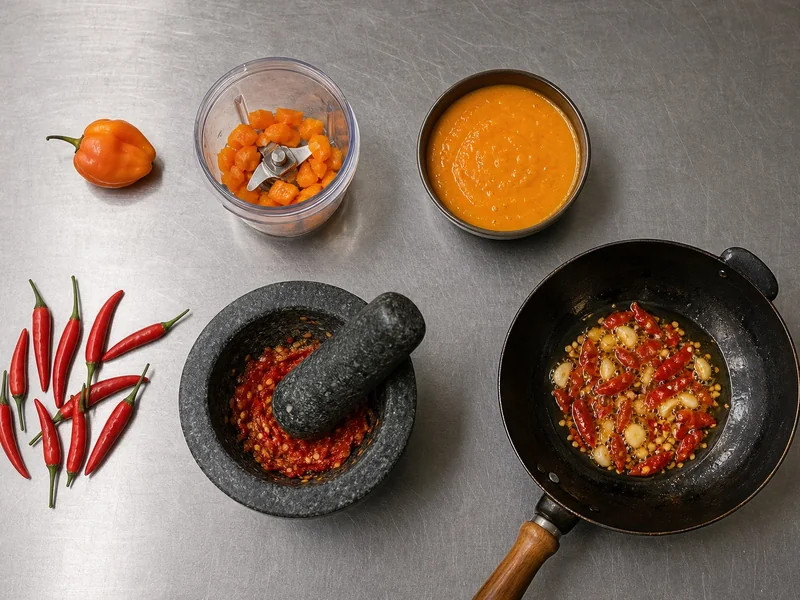
A mortar can bruise one or two small chilies with garlic and other aromatics before liquid is added. That action tears the pods, releases pungency into a concentrated paste, and lets the cook stop while recognizable chile pieces still remain.
Thin rings work differently. They spread through a fish-sauce dip, noodle bowl, stir-fry, or curry so each serving receives several small points of heat rather than one fully blended burn.
Warm oil can carry pungency across a wok dish, but the fragments need moderate heat and close attention.
Darkened chile pieces become bitter, especially when garlic or other small aromatics are cooking beside them.
Whole or lightly bruised small chilies offer another useful control. They can contribute aroma and heat during cooking, then be removed before serving when diners should not bite directly into every pod.
When does habanero fit the technique?
Habanero is especially effective in a blender. A small weighed or measured portion can disperse through fruit, vegetables, vinegar, and salt, producing a smooth hot sauce whose heat and aroma reach every spoonful.
That uniformity is valuable in mango hot sauce, carrot-based sauce, jerk-style marinades, and other mixtures that welcome its fruity character.
It is risky in a small raw condiment because one extra piece can change the entire bowl.
| Cooking job | Better first choice | Why |
|---|---|---|
| Mortar paste with garlic | Thai chili | Small pods crush into a concentrated paste in controllable steps |
| Fish-sauce dipping bowl | Thai chili | Thin rings provide visible, distributed points of heat |
| Stir-fry or hot oil | Thai chili | Small slices can bloom through oil while remaining distinct |
| Fruit-forward hot sauce | Habanero | High heat and citrus-floral aroma integrate through a blended base |
| Smooth vinegar sauce | Habanero | A small amount can season a larger liquid volume evenly |
| Removable whole-pod infusion | Small Thai chili | Bruised whole pods can be counted and removed before serving |
The process image shows the practical split. One path moves through a mortar and hot pan, while the other moves through a blender into a smooth fruit or vegetable sauce.
Neither pepper owns an entire cuisine, and either can appear outside these examples.
The useful choice comes from the intended texture, the point when heat enters the recipe, and whether habanero aroma improves or distracts from the other ingredients.
Can You Substitute Habanero for Thai Chili?
You can substitute in either direction, but there is no responsible pod-for-pod conversion. The heat bands are unequal, the pod sizes are unequal, and habanero can change aroma before a Thai-chili replacement reaches the same visual volume.
Can habanero replace Thai chili?
Use habanero when only the heat function must be replaced and the dish can accept fruity, citrus-like aroma.
Begin with a tiny piece in a separate sample rather than dropping a fraction of a whole pod into the main pan.
Do not use the swap silently when visible rings, crushed small pods, or removable whole chilies are part of the eating experience. Habanero mince can supply pungency, but it cannot reproduce those physical roles.
A mortar paste also changes when habanero enters it. The broader, wetter piece can spread quickly through the aromatics, so add it after the first crushing step and inspect the paste before adding more.
Can Thai chili replace habanero?
Thai chili can build heat in a loose sauce, curry, or marinade.
It usually takes more pepper material to approach a hot habanero result, which can add extra skin, seeds, green flavor, or visible fragments.
Stop before those additions damage texture or drown the base in direct chile flavor. A sauce that needs habanero's recognizable aroma may need a closer aromatic substitute rather than more Thai chilies.
Use this reversible method:
- Move a small measured portion of the dish into a separate bowl.
- Add one tiny piece or pinch of the replacement, using clean utensils and gloves for habanero.
- Mix it through the same fat or liquid that carries heat in the full recipe.
- Wait two minutes, then check heat, aroma, texture, and visible pepper material.
- Scale only the successful sample, and repeat in small steps instead of multiplying a guessed pod ratio.
The stop rule depends on direction.
Stop adding habanero when its fruit aroma begins to dominate, even if the sample could tolerate more heat.
Stop adding Thai chili when skin, seeds, green flavor, or coarse texture becomes distracting, even if the sauce remains milder than a habanero version.
Choose Thai chili for small-pod technique and direct distributed heat. Choose habanero for higher heat plus a deliberate aromatic role.
If the recipe depends on both the original pepper's flavor and physical form, change the recipe name or wait for the correct ingredient instead of pretending the substitution is exact.
Habanero vs Thai Chili FAQ
- Iowa State University Extension - Growing Peppers in the Home Garden
- Thai Department of Agriculture - Bird Chili Research
- UF/IFAS - Habanero Pepper
- USDA GRIN - Capsicum annuum
- USDA GRIN - Capsicum chinense