

KnowThePepper
Thai Chili: What the Name Covers and How Hot the Pencil-Thin Pods Run
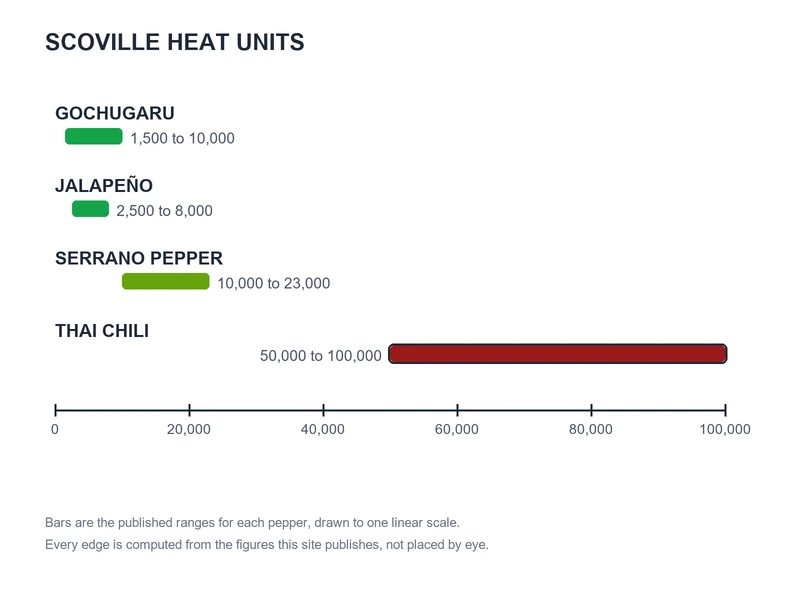
The Thai chili is a small but ferocious pepper registering 50,000-100,000 SHU - roughly on par with a scotch bonnet in raw heat. Native to Thailand and central to Southeast Asian cooking, these finger-length pods deliver a bright, peppery burn that hits fast and lingers.
Fresh, dried, or ground, they are the backbone of countless regional dishes across the continent.
- Species: C. annuum
- Heat tier: Hot (10K-100K SHU)
- Comparison: 6-40x hotter than a jalapeño, depending on where the jalapeño falls in its 2,500-8,000 SHU range
What Makes Thai Chili Different?
Thai chilis are small, thin, fierce, and essential. They punch well above their size, roughly 6-40x hotter than a jalapeño, in pods that are typically 1-3 inches long and no wider than a pencil.
The term 'Thai chili' covers a range of related Capsicum annuum varieties used across Thai cuisine and throughout Southeast Asia. Two are most common in Western markets.
Prik kee nu (literally 'mouse dropping pepper' in Thai, for the size) measures 50,000-100,000 SHU and is the standard variety used fresh in Thai cooking.
Bird's eye chili is sometimes used interchangeably with Thai chili, though technically bird's eye refers to a slightly different thin-fleshed variety also used across Cambodian, Vietnamese, and Indonesian cooking, the heat range overlaps significantly.
The flavor profile is sharp, bright, and clean with a fast-building heat that peaks quickly and fades relatively fast, characteristics of C. annuum at this heat level, unlike the delayed burn of C. chinense varieties like habanero. That fast heat suits Thai cuisine's flavor layering, where the chile burn is one element balanced against sweet, sour, salty, and umami.
Red and green Thai chilis are the same pepper at different ripeness stages. Red Thai chilis are fully ripe and slightly sweeter.
Green ones are younger with a sharper, greener flavor. Both measure similarly in heat, ripeness doesn't reduce SHU significantly at this variety.
Most Thai dishes that specify color are making a flavor choice, not a heat one.
For the Thai chili and serrano, the heat range overlaps at the serrano's upper end but the flavor profiles differ significantly, serranos carry more grassy, vegetal character; Thai chilis are sharper and more neutral.
| Name | Heat | Where you meet it |
|---|---|---|
| Prik kee nu | 50,000 to 100,000 SHU | The standard fresh chile of Thai cooking |
| Bird's eye chile | Overlapping range | Used interchangeably in Western markets, though the term is broader |
| Dried Thai chile | Same pod, concentrated | Small cellophane bags at Asian grocers |
Where Did Thai Chili Originate?
Capsicum peppers arrived in Southeast Asia via Portuguese traders in the 16th century, moving from the Americas through Portuguese trade routes that connected Goa, Malacca, and the Spice Islands. What happened next was rapid adoption: within a century, chili peppers had replaced or supplemented indigenous heat sources (long pepper, black pepper, galangal) across Thai, Vietnamese, and Indonesian cuisines.
Thai cuisine's integration of chili was particularly thorough. By the 18th century, the pepper had become structurally embedded in Thai cooking, not an addition to existing dishes but a defining element of new flavor combinations that emerged from the integration.
The nam prik (chili paste) traditions that appear across Thailand reflect centuries of adaptation.
The small-fruited, high-heat Thai varieties that dominate the market today represent generations of selection for the specific characteristics Thai cooks value: thin flesh that blends smoothly in pastes, high heat-to-mass ratio for efficient seasoning, and flavor that doesn't overpower other aromatics in complex curry pastes.
Commercial export of Thai chilis expanded significantly in the late 20th century as Southeast Asian cuisine gained global reach. Today they're available fresh and dried across most Western cities with any significant Asian grocery market.
What Does Thai Chili Taste Like, and How Hot Is It?
The Thai Chili delivers 50K–100K Scoville Heat Units, placing it in the Hot tier (10K-100K SHU). That makes it roughly 6-40x hotter than a jalapeño, depending on where the jalapeño falls in its 2,500-8,000 SHU range.
Flavor notes: bright and peppery.
Thai Chili Nutrition Facts
Thai chilis are nutritionally dense relative to their small size. A 100g serving provides approximately 40 calories with significant vitamin C - often 100-150mg, exceeding daily recommended value, alongside vitamins A, B6, and potassium.
Thai chilis contain enough capsaicin that regular consumption at traditional cooking levels may contribute to the metabolic and anti-inflammatory effects documented in capsaicin research. Thai populations with high chile consumption are subjects in several ongoing epidemiological studies examining capsaicin's role in cardiovascular health.
The why capsaicin burns applies here as with all hot peppers, C. annuum varieties like Thai chilis produce a faster-peaking, shorter-duration burn than C. chinense varieties at similar SHU levels. For heat-source context and data caveats, see our methodology.
Which Dishes Suit Thai Chili?
In Thai cooking, chilis function in three distinct modes: fresh in salads and as table condiment, pounded into curry pastes, and dried or fried in stir-fries. Each mode produces a different flavor output from the same pepper.
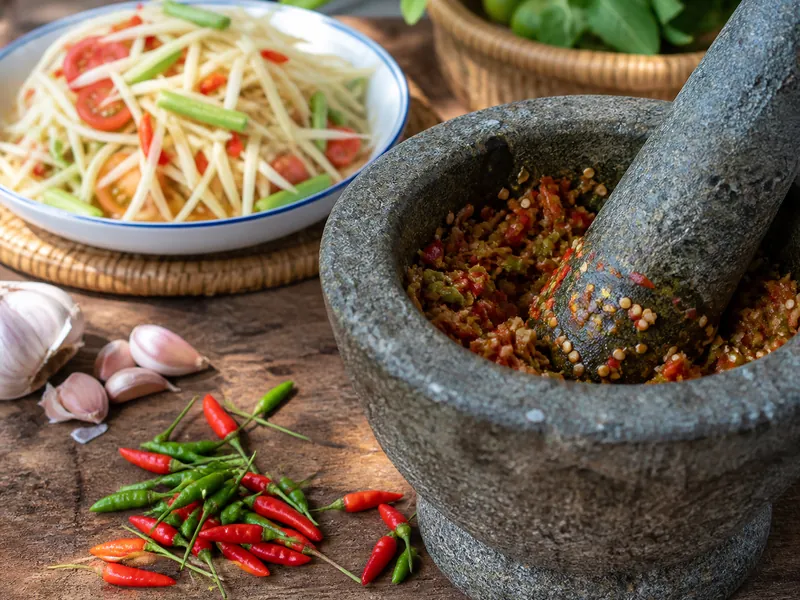
Fresh Thai chilis sliced thin and added directly to som tam (green papaya salad) contribute their full fresh sharpness. A traditional recipe uses 2-4 prik kee nu per serving - adjustable to taste.
The seeds and placenta stay in. Removing them is less common in Thai cooking than in Mexican applications.
For homemade red or green curry paste, 6-8 dried or fresh Thai chilis per cup of curry paste is a baseline for medium heat in the final dish. Adjust up or down based on preference, then scale by how much paste goes into the dish.
Commercial curry pastes vary widely in heat. Homemade gives real control.
Pad Thai and stir-fries typically use dried Thai chilis fried in oil at the start of cooking, a technique that blooms capsaicin into the oil and distributes heat throughout the dish. 2-3 dried chilis per serving is common.
They're typically left in the dish but not eaten whole.
Thai chili sauce (sriracha is the most internationally recognized version, though the Thai original differs from American sriracha) uses red Thai chilis fermented briefly before blending with garlic, sugar, and vinegar.
When fresh Thai chilis aren't available, the best substitutes for Thai chili include dried Thai chilis (soaked in hot water for 20 min), serrano peppers at the upper end of their range, or cayenne in equivalent quantities.
Sliced thin into som tam and set out as a table condiment, where the sharpness arrives undiluted. Two to four pods per serving is a traditional starting point.
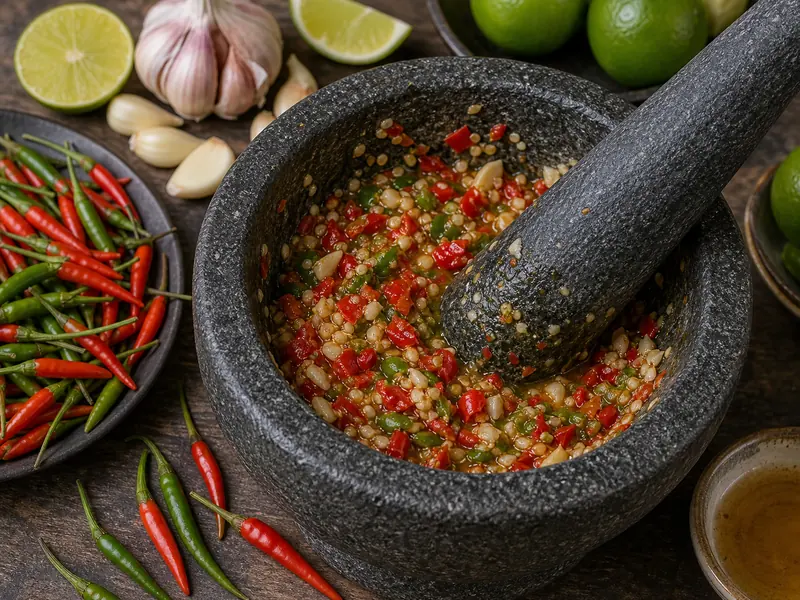
Worked into red or green curry paste at roughly six to eight pods per cup, where the heat spreads through fat and aromatics rather than sitting on top.
Dropped whole into hot oil for a stir-fry, which turns the burn rounder and toastier than the fresh pod ever tastes.
How Do You Buy and Store Thai Chili?
Any Asian grocery will have these, year-round, and well-stocked specialty markets usually do too. Look for firm, unwrinkled pods with no soft spots.
Colour tells you which stage you are buying: green ones should be bright and vivid. Red ones should be deep and uniform without dark patches at the stem.
Fresh pods keep 1-2 weeks refrigerated in a paper bag. For longer storage, freeze whole pods, no prep needed.
Thai chilis freeze particularly well because the thin walls hold up to freeze-thaw better than thick-walled peppers. Frozen Thai chilis can go directly into cooking from frozen.
Dried Thai chilis (typically sold in small cellophane bags at Asian grocers) store for 12+ months sealed in a cool, dark location. The drying process concentrates the heat and adds a slightly smoky character.
Use gloves when handling large quantities, at 50,000-100,000 SHU, prolonged skin contact causes irritation. Single-pod handling for cooking is generally fine without gloves, but washing hands thoroughly before touching your face is non-negotiable.
What Is a Good Substitute for Thai Chili?
Compare substitutes for Thai Chili by form, flavor, and heat before choosing a ratio. Measured adjustments must account for the dish and the concentration of the replacement.
Direct comparisons show where flavor, form, and preparation differ in the Habanero vs Thai Chili and Jalapeno vs Thai Chili matchups.
Compare Thai Chili with: Thai Chili vs Cayenne · Thai Chili vs Tabasco
What Does Thai Chili Need to Grow Well?
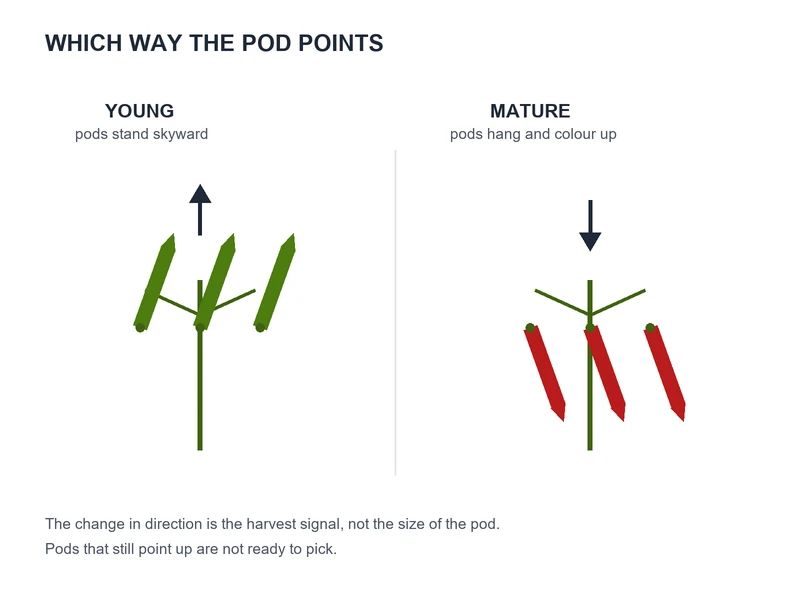
Thai chili plants are compact, prolific, and heat-loving, one of the easier ornamental and cooking hot peppers to grow in containers. Plants reach 12-24 inches tall and produce pods that stand upright when young, pointing skyward, then droop as they mature, a natural harvest indicator.
Start seeds indoors 8-10 weeks before last frost at 75-85°F soil temperature. Germination takes 10-21 days.
Thai chili plants prefer slightly warmer conditions than jalapeños and tend to produce better yields in warm summers.
Transplant spacing: 12-18 inches apart - plants are more compact than jalapeños and can be positioned closer. They want 8+ hours of direct sun for maximum production and heat development.
Fruits mature in 70-85 days from transplant, ripening from green through yellow to red. The red stage has higher capsaicin than green, though both are fully usable.
A productive plant yields 100+ pods per season - the highest pod count of any variety in this profile collection.
Container growing works exceptionally well, a 3-gallon pot is sufficient for a compact Thai chili plant, making it a viable windowsill or balcony crop. They also overwinter well indoors in bright conditions and often produce into a second season with minimal care.
The upright pod orientation and attractive coloring at various ripeness stages makes Thai chilis popular as ornamental plants. The growing for Thai peppers covers container-specific management.
Thai Chili FAQ


- Chile Pepper Institute - New Mexico State University
- USDA FoodData Central - Hot Peppers
- Peppers - UC Small and Organic Farm Advisor, UC ANR
- Bosland & Votava, Peppers: Vegetable and Spice Capsicums (2nd ed.)
Species classification: C. annuum - based on published botanical taxonomy.