
Jalapeno vs Thai Chili: Crisp Green Rings or Pods for the Mortar and Wok
Choose jalapeno when the pepper should provide crisp green flesh, rings, dice, or a stuffing cavity. Choose Thai chili when a small amount should deliver concentrated heat through a mortar, dipping sauce, curry, or wok.

Thai bird's-eye occupies a much hotter published band than jalapeno. Jalapeno provides thick, crisp pepper body, while Thai chili provides concentrated heat through small pods and thin cuts.
- Published heat band: 2,500 to 10,000 SHU vs 50,000 to 100,000 SHU
- Fresh pod form: Thick, blunt, and substantial vs Slender, pointed, and small
- Best kitchen unit: Dice, rings, or cavities vs Tiny pieces, paste, or whole infusion
- Strong first use: Salsa, pickles, toppings, poppers vs Mortar paste, dip, curry, wok
Jalapeño
MediumThai Chili
HotQuick Comparison
| Attribute | Jalapeño | Thai Chili |
|---|---|---|
| Published heat band | 2,500 to 10,000 SHU | 50,000 to 100,000 SHU |
| Fresh pod form | Thick, blunt, and substantial | Slender, pointed, and small |
| Best kitchen unit | Dice, rings, or cavities | Tiny pieces, paste, or whole infusion |
| Strong first use | Salsa, pickles, toppings, poppers | Mortar paste, dip, curry, wok |
Which Is Hotter, Jalapeno or Thai Chili?
Thai bird's-eye occupies a much hotter published band than jalapeno.
Iowa State University Extension lists bird's-eye, identified there as Thai chili pepper, at 50,000 to 100,000 Scoville heat units. Jalapeno sits at 2,500 to 10,000 SHU.
Those bands do not overlap.
Even the top of the jalapeno reference band is one fifth of the bottom of the Thai bird's-eye band, but that comparison still does not produce a reliable five-for-one kitchen ratio. Pod mass, cultivar, growing conditions, ripe stage, and the amount of inner tissue in each cut all change the dose that reaches the food.
| Decision point | Jalapeno | Thai bird's-eye reference |
|---|---|---|
| Published heat band | 2,500 to 10,000 SHU | 50,000 to 100,000 SHU |
| Fresh pod form | Thick, blunt, and comparatively large | Slender, pointed, and small |
| Useful kitchen unit | Chopped volume, rings, or prepared cavities | Tiny measured pieces or a tested paste |
| Primary risk | Too much green flesh before enough heat | Too much heat before enough pepper body |
Does Thai chili mean one exact pepper?
No. Thai chili is a market label rather than one guaranteed cultivar. Thai Department of Agriculture records include numerous named Thai selections across Capsicum annuum and Capsicum frutescens, including several peppers recorded under local bird-chili names.
The Iowa State range is therefore best read as a bird's-eye reference band, not a promise about every bag sold as Thai chili. Check whether the package names a cultivar, whether the pods are fresh or dried, and whether they are green or fully red before deciding how to use them.
Jalapeno is a more recognizable market type, but its heat is not fixed either. New Mexico State University explains that genetics, weather, growing conditions, and fruit age affect capsaicinoid content, so two jalapeno batches can feel different even when the pods look alike.
How should you test a real batch?
Test heat in the food that will carry it.
Mix one tiny, measured piece into a spoonful of salsa, sauce, broth, or curry base, then wait before increasing the amount.
Fat, liquid, acid, sugar, and serving temperature change how pungency reaches the mouth. A raw bite and a finished spoonful answer different questions, which is why tasting the isolated pod can lead to a poor full-batch decision.
Use separate utensils and avoid touching your face. Iowa State recommends gloves for sensitive hands because capsaicin transfers easily and can irritate skin, eyes, and mouth.
The practical answer is direct. Pick Thai chili when concentrated heat is the job, and pick jalapeno when moderate heat must arrive with substantial green pepper flesh.
Read the heat gap without inventing a ratio
| Evidence | Useful conclusion | Boundary |
|---|---|---|
| 2,500 to 10,000 SHU | Jalapeno is the moderate reference | Real pods still vary |
| 50,000 to 100,000 SHU | Thai bird's-eye is much hotter | Thai chili is a broad market label |
| No overlap between bands | Heat jobs differ sharply | Pod count still ignores mass and inner tissue |
How Do Jalapeno and Thai Chili Work in a Dish?
A jalapeno acts partly like a vegetable.
Its thick wall can remain crisp in salsa, soften on a grill, hold brine as a pickle, or support filling as a popper.
A small Thai chili acts more like a concentrated seasoning. Its thin wall contributes little bulk, while narrow rings, crushed fragments, or a pounded paste can spread many hot points through a dish.
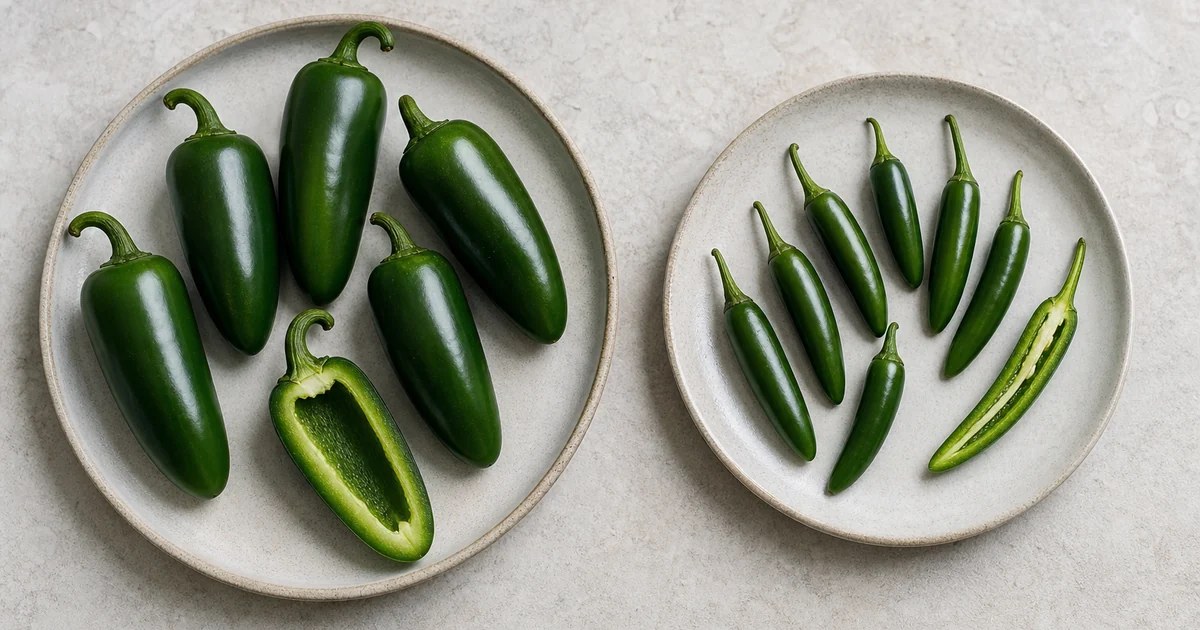
The equal-scale cutaway below makes the physical difference visible. One jalapeno half occupies far more area than several Thai-chili halves, so replacing by pod count changes both the amount of flesh and the amount of capsaicinoid-rich inner tissue.
Where is the heat inside each pod?
New Mexico State University notes that seeds are not the source of heat.
They can become coated because they sit next to the placenta, the pale internal tissue associated with capsaicinoids.
Removing loose seeds while leaving most of the pale ribs can reduce clutter without removing the hottest surfaces. For a milder jalapeno dice, trim the ribs with the jalapeno cutting method and judge the result in a sample.
That same operation is harder on a tiny Thai chili. Its narrow cavity leaves little room to scrape cleanly, and slicing the whole pod creates repeated cross-sections that carry flesh, inner tissue, and possibly coated seeds into the food.
How do their flavors pull a dish in different directions?
Jalapeno supplies a fresh green aroma, moist crunch, and a mild bitter edge that works with tomato, onion, lime, cheese, beans, corn, and grilled meat. Red-ripe jalapeno tastes rounder, but the familiar supermarket version is usually green.
Thai chili varies with the pepper behind the label. Fresh green pods can taste grassy, ripe red pods can feel less raw, and dried pods introduce stored or toasted notes that a fresh jalapeno does not provide.
Do not let the color make the decision alone.
Smell the cut surface, inspect whether the pod is fresh or dried, and test a tiny portion in the actual sauce base.
Jalapeno changes body and flavor together, while Thai chili can change heat long before it changes volume. That distinction matters more than whether both peppers happen to be green or red.
Which Cooking Methods Suit Jalapeno and Thai Chili?
Follow the preparation method.
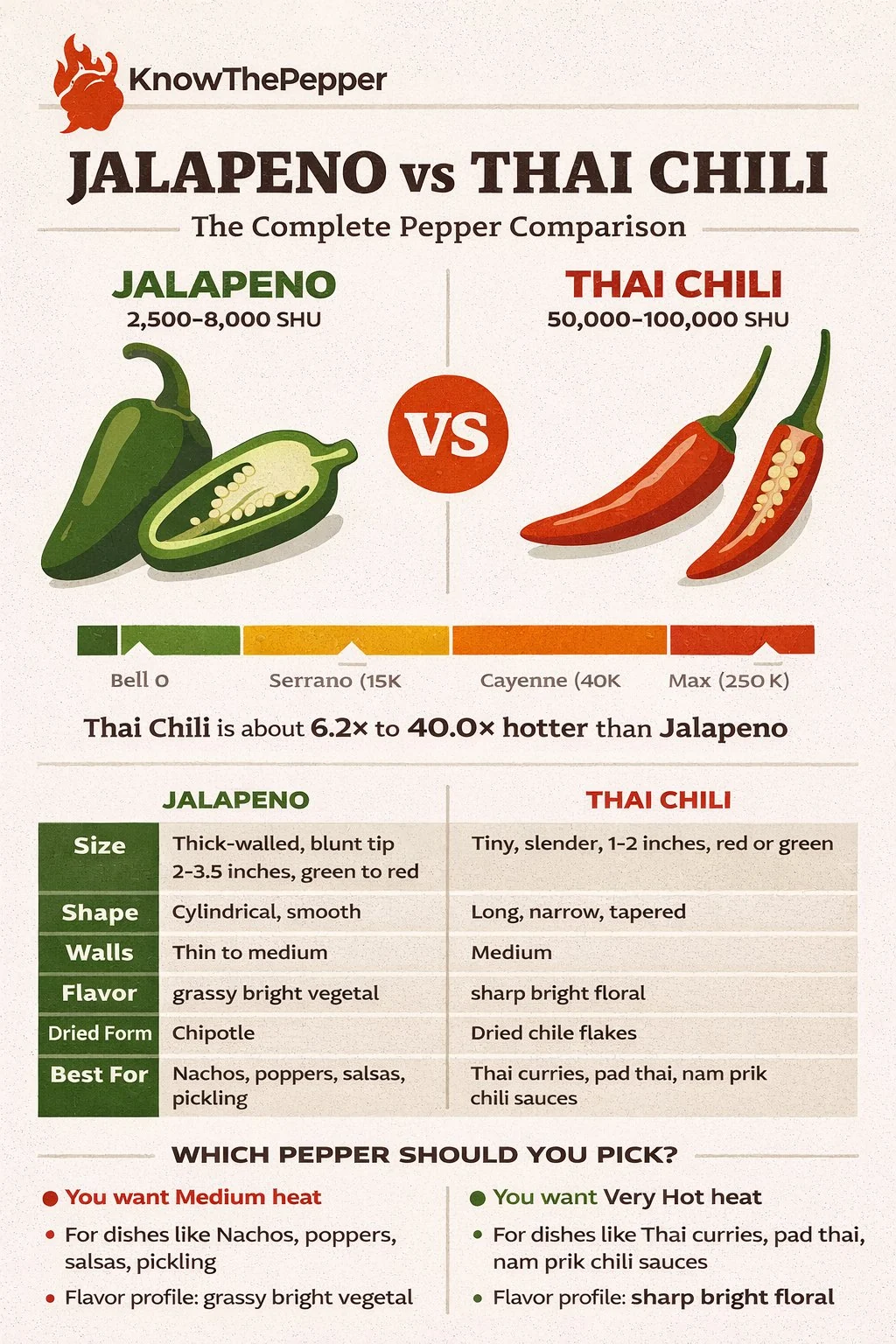
The photograph pairs jalapeno with slicing, dicing, pickling, and stuffing, while Thai chili moves through crushing, thin slicing, dipping liquid, and a hot pan.
When does jalapeno fit better?
Use jalapeno when the eater should see and feel the pepper. Thick rings stay recognizable on nachos and burgers, dice add wet crunch to pico de gallo, and split pods form a practical shell for cheese or meat filling.
Pickling also depends on physical volume. Pickled jalapeno rings carry brine, acid, and salt in a way that a few tiny Thai-chili slices cannot reproduce.
Grilling or roasting softens the wall and adds browned flavor without making the pepper disappear. That gives jalapeno a useful middle position between a raw vegetable and a hot seasoning.
When does Thai chili fit better?
A mortar can crush one or two small chilies with garlic and other aromatics before liquid enters the mixture.
The cook can stop while visible fragments remain or continue until the pepper is dispersed through a paste.
Thin slices release heat quickly into a dipping sauce, noodle bowl, or soup. A whole bruised pod can also season a curry and remain removable before serving, which provides a form of control that minced chili cannot.
Hot oil distributes pungency across a stir-fry, but small pepper and garlic fragments can darken quickly.
Add them with close attention and move the food before bitterness develops.
| Cooking job | Better first choice | Reason |
|---|---|---|
| Fresh salsa with visible pepper | Jalapeno | Dice provide moisture, crunch, and moderate green heat |
| Stuffed pepper or popper | Jalapeno | The thick wall forms a usable cavity |
| Pickled rings | Jalapeno | Broad slices carry brine and remain easy to portion |
| Mortar paste | Thai chili | Small pods crush into a concentrated hot base |
| Fish-sauce dip | Thai chili | Thin rings distribute small hot bites without adding bulk |
| Wok or curry infusion | Thai chili | Crushed or bruised pods spread heat through liquid or oil |
What if the recipe needs both body and stronger heat?
Use the peppers as separate controls. Jalapeno can supply the required chopped volume while part of a Thai chili raises the heat in a tested sample.
This two-pepper approach works when a salsa needs visible green dice but diners want more pungency than the jalapeno batch provides.
It also works in a cooked sauce where vegetable body and final heat can be adjusted at different stages.
Keep the hotter addition measurable and optional. One shared bowl can remain moderate while a small finishing condiment carries the Thai chili for diners who want it.
Can You Substitute Thai Chili for Jalapeno?
Substitution works only when the recipe can lose one pepper's physical role.
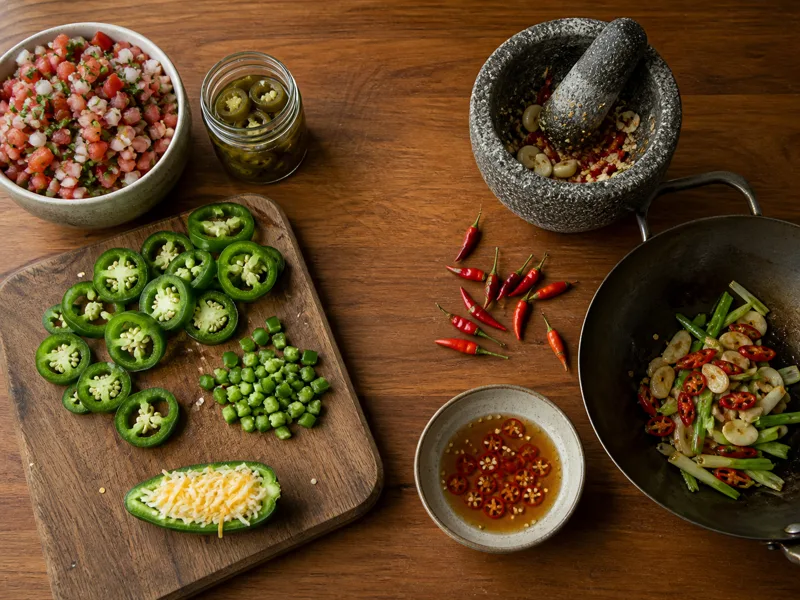
Thai chili can replace jalapeno heat in a sauce, but it cannot create jalapeno rings, chopped vegetable volume, pickle slices, or a stuffing cavity.
Jalapeno can replace some Thai-chili flavor and pepper material, but it rarely reaches the same heat before extra flesh changes the dish. The correct direction depends on what the original pepper was doing.
Can Thai chili replace jalapeno?
Use Thai chili when the jalapeno was minced into a liquid and its texture was unimportant.
Start with a tiny piece in a separate portion, mix completely, wait, and add another measured piece only if the food still needs heat.
Keep jalapeno body from another ingredient if the recipe needs it. Bell pepper, poblano, cucumber, or the existing tomato and onion can maintain volume, depending on the dish, while Thai chili supplies the missing pungency.
Reject the swap for poppers, broad pickled rings, or a garnish where diners expect a substantial green slice. A tiny hot pod cannot imitate those shapes.
Can jalapeno replace Thai chili?
Use jalapeno when a milder result is acceptable and its green flavor suits the recipe.
It can work in a gentle dipping sauce, fried rice, soup, or curry, but the added dice or slices will be more visible and wetter.
Do not keep adding jalapeno only to chase the Thai-chili band. Stop when extra flesh, raw green flavor, or moisture begins to change the dish, then use the Thai chili substitute guide if a closer hot option is needed.
What is the safest method in either direction?
Use the staged checklist below so the full dish remains recoverable until the sample succeeds.
A guessed whole-pod ratio commits the batch before heat and physical form have both been checked.
Choose jalapeno for edible pepper structure and moderate green heat. Choose Thai chili for concentrated heat delivered through small pieces, paste, oil, or liquid.
When the dish needs both, preserve the body first and tune the heat separately.
Test either substitution in five reversible steps
- Name the original job. Decide whether the pepper supplied heat, body, a visible cut, a cavity, or a combination.
- Separate a sample. Move one measured spoonful of the food into a small bowl.
- Add a tiny measured piece. Mix it through the same liquid or fat that carries heat in the full recipe.
- Wait and judge the full result. Check heat, aroma, texture, moisture, and visible pepper material.
- Scale only the successful sample. Stop when either heat or physical form reaches its limit.
Jalapeño vs Thai Chili FAQ
- Iowa State University Extension - Growing Peppers in the Home Garden
- New Mexico State University - New Mexico Chile Cultivars
- Thailand Department of Agriculture - Capsicum Germplasm Records
- USDA GRIN - Capsicum annuum
- USDA GRIN - Capsicum frutescens