
Malagueta vs Peri Peri: Pepper, Sauce, or Marinade?
Malagueta and piri-piri can both name Capsicum frutescens, but peri-peri often means a finished sauce. Match the physical ingredient first, then use source-specific heat evidence and the recipe role to control the swap.

Malagueta
Peri Peri
Are Malagueta and Peri Peri the Same Pepper?
Malagueta and peri peri often belong to the same species, but the names do not promise the same ingredient. Brazil's Ministry of Agriculture registers Malagueta as Capsicum frutescens, and Mozambique's plant-health inventory also maps piri-piri to Capsicum frutescens.
That botanical overlap explains why the pods can look closely related.
It does not prove that a Brazilian malagueta accession and an African piri-piri accession are the same cultivar, size, or heat.
The name peri peri also crosses a second boundary. On a seed packet it can mean a plant, while on a restaurant menu or bottle it usually points to a prepared chile sauce.
Ask what physical ingredient the recipe expects first. A whole pod, dried flake, chile vinegar, table sauce, and marinade cannot be compared as if each were an interchangeable pepper.
This distinction resolves the apparent contradiction in many recipes.
One writer may be naming the chile itself, while another is naming a seasoned mixture that already carries acid, fat, garlic, and salt.
Where Do Malagueta and Peri Peri Come From?
Embrapa describes malagueta as Brazil's best-known and most consumed Capsicum frutescens type.
The agency says it is planted nationwide and identifies Minas Gerais, Bahia, and Ceará as prominent growing states.
The Brazilian Ministry of Agriculture has registered Malagueta as a named cultivar since 1999. That record gives the Brazilian name a specific agricultural identity instead of treating it as a loose synonym for every small hot chile.
Piri-piri has a different regional life. Mozambique's official crop inventory uses piri-piri as the common name for Capsicum frutescens, and Mozambique tourism material places the ingredient in coastal cooking with chicken, coconut, and seafood.
South African Tourism describes piri-piri as part of Afro-Lusitanian cooking and notes that English usage commonly shifts the Portuguese spelling piri-piri to peri-peri.
The spelling change does not establish a new species.
The most defensible conclusion is narrower than a single invention story. American Capsicum plants moved through Portuguese trade networks, then Brazilian and African cooks developed distinct names, products, and dish traditions around them.
Which Is Hotter, Malagueta or Peri Peri?
A universal heat winner would overstate the evidence. Embrapa gives about 175,000 SHU for the malagueta described on its consumer page, while Oregon State Extension describes its broader Capsicum frutescens piri group at 30,000 to 50,000 SHU.
Those numbers come from authorities, yet they describe different reference sets rather than a controlled head-to-head trial.
Embrapa's own germplasm research found fruit length, weight, wall thickness, flowering time, and other traits varying across Brazilian Capsicum frutescens accessions.
Natural variation makes a generic web range even less decisive. Cultivar, growing conditions, fruit maturity, drying, and the amount of placenta retained can change the capsaicinoid dose that reaches a dish.
A prepared sauce creates another layer of dilution.
Oil, citrus, vinegar, garlic, salt, and mild pepper solids can make one tablespoon carry far less chile than one tablespoon of mashed raw pods.
Use a source-specific heat figure as a warning, not a conversion formula. For repeatable cooking, identify the exact product and control the addition by prepared weight or measured volume.
The figures describe different reference sets
Embrapa reports about 175,000 SHU for its malagueta reference, while Oregon State Extension gives 30,000 to 50,000 SHU for its piri group. Identify the exact cultivar or product before using either figure to dose a dish.
How Big Is a Malagueta Pod?
Embrapa describes a typical malagueta pod at about 2.5 cm long and 0.5 cm wide, with a narrow shape, thin flesh, and seeds visible beneath the skin. Its cultivar table also shows that products sold within the malagueta group can run from tiny malaguetinha pods to longer forms.
A 2017 Embrapa germplasm study measured fruit lengths from 0.6 to 4.6 cm and weights from 0.1 to 1.4 g across Brazilian Capsicum frutescens accessions.
That documented spread explains why one photograph or pod count cannot define the group.
Oregon State Extension describes piri-group Capsicum frutescens pods as slim, tapered, upright, and roughly 1 to 3 inches long. North Carolina Extension likewise lists Piri Piri and Malagueta among cultivars of the same upright-fruiting species.
Shape can still reject an obvious mismatch. A broad, thick-walled, downward-hanging pepper does not fit the usual evidence for either ingredient.
However, small, narrow, upright, and red is only a family resemblance.
A reliable identity also needs the cultivar name, seller, country or region, and intended product form.
How Do Malagueta and Peri Peri Taste Different?
The cleanest flavor difference comes from context and form, not a universal tasting adjective.
A fresh malagueta pod contributes direct chile aroma and heat, while a clear malagueta vinegar adds acidity without the garlic and oil expected in many peri-peri sauces.
Embrapa places malagueta beside beans, meat dishes, acarajé, and fish moqueca. In those settings, the pepper can season the dish or sit on the table in a simple preserve, leaving the cook control over the other aromatics.
South African Tourism defines the familiar piri-piri sauce through chile, olive oil, and garlic. Visit Portugal describes piri-piri chicken and the same chile sauce with charcoal-grilled fish, which makes browning, fat, and smoke part of the finished flavor.
A dried piri-piri pod is not automatically lemony or garlicky.
Those notes enter through the sauce recipe, so transferring them to the pepper itself confuses cultivar evidence with condiment formulation.
Compare like with like before describing flavor. Raw pod belongs beside raw pod, chile vinegar beside chile vinegar, and finished sauce beside a finished sauce with a known ingredient list.
When Should You Use Malagueta Instead of Peri Peri?
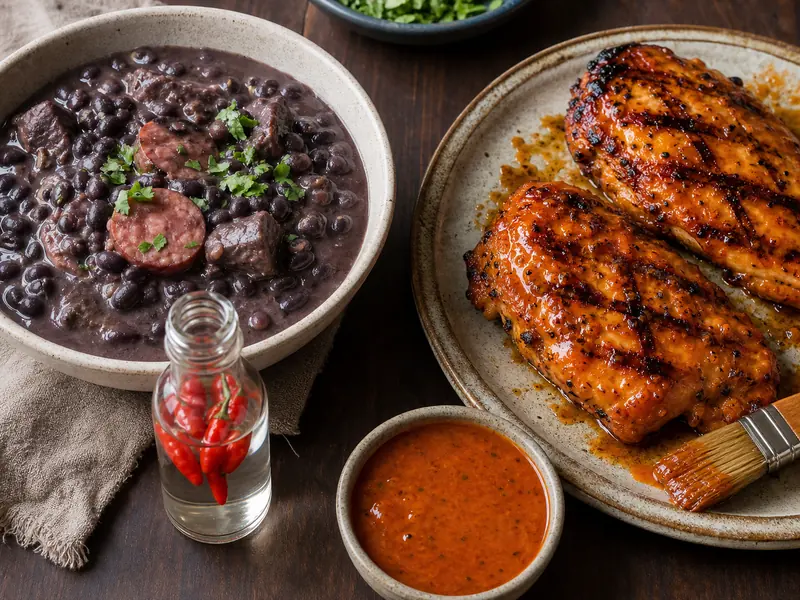
Choose malagueta when a Brazilian recipe names the pod or expects clean chile heat that the diner can add separately. Embrapa specifically connects it with feijoada, acarajé, rabada, dobradinha, and fish moqueca.
In those dishes, extra garlic, citrus, or oil may already be controlled elsewhere in the recipe. A finished peri-peri sauce can upset that balance even when its chile is botanically related.
Choose piri-piri pods when a Mozambican or Portuguese recipe names the chile as raw material.
Mozambique tourism includes piripiri in chicken preparations and describes it as part of coastal cooking with seafood and coconut.
Choose prepared peri-peri sauce when the recipe asks you to marinate, baste, glaze, or serve a seasoned condiment.
Visit Portugal identifies piri-piri chicken and grilled fish as established uses, while South African Tourism describes the sauce as chile with olive oil and garlic.
The recipe verb often settles the choice faster than the country name. Chop or steep usually points toward the pepper, while marinate, brush, baste, or serve as a sauce points toward a prepared mixture.
Neither ingredient is confined to one flag. The practical safeguard is to preserve the dish's expected acid, fat, salt, and aromatic load instead of assigning every bottle or pod a national label.
| The recipe asks for | Better first choice | What the choice preserves |
|---|---|---|
| A Brazilian pod or clear chile vinegar | Malagueta | Clean heat without automatic garlic or oil |
| A raw African piri-piri chile | Piri-piri pods | The named pepper form |
| A marinade or basting sauce | Prepared peri-peri | Chile, acid, fat, garlic, and salt together |
| An emergency raw-pod swap | Prepared weight | A measurable starting dose instead of pod count |
Which Should You Choose, Malagueta or Peri Peri?
For Brazilian beans, moqueca, acarajé, or a clear table preserve, start with malagueta in the form the recipe names. It keeps the chile dose separate from garlic, citrus, and oil.
For piri-piri chicken, grilled fish, prawns, or a recipe that uses the chile mixture as a marinade or baste, start with prepared peri-peri sauce.
The seasoned liquid performs more work than heat alone.
For a recipe that names whole piri-piri pods, buy pods rather than assuming a bottle is equivalent. The sauce may add enough salt, acid, and oil to change texture and seasoning before the pepper dose is correct.
When both products are raw pods, there is no reliable universal winner. Identify the package, weigh the usable chile, and add it gradually.
The final decision is therefore about ingredient role.
Match pod to pod and sauce to sauce, then adjust heat within that matched form.
How Do You Swap Raw Malagueta and Peri Peri Pods?
When both sides are fresh or dried pods, remove stems and compare the usable weight. Start with less than the full recipe amount because source-specific heat figures span widely and individual pods can depart from a named average.
Pod count is especially weak here.
Embrapa documents large variation inside Brazilian Capsicum frutescens, so three tiny fruits may weigh less than one larger fruit sold under the same broad name.
Add the minced or blended chile to a measured portion of the dish first. Once the heat and flavor are evenly dispersed, scale that result into the remaining batch.
For a table condiment, keep a mild base separate and let diners add heat individually. This approach protects the main pot without claiming that one culture's pepper has a fixed ratio to another.
Prepared weight is the starting control, not a promise of equal heat.
The finished dish still owns the last adjustment because salt, fat, acid, and serving temperature change how the burn is perceived.
Can Malagueta Pods Make Peri-Peri Sauce?
A malagueta pod can supply the chile in a peri-peri-style sauce, but it cannot supply the entire sauce by itself.
The prepared mixture still needs the acid, garlic, oil, and salt required by the specific recipe.
South African Tourism names olive oil and garlic in piri-piri sauce, while official Portuguese and Mozambican food sources show that regional preparations vary. Some pair the heat with lemon, coconut, bay, grilled fish, or chicken rather than one universal commercial formula.
Build the missing parts in a separate bowl. Add a small measured amount of chile, mix completely, then correct acid, salt, and oil before increasing heat.
The reverse swap has a stricter limit.
Bottled peri-peri sauce cannot become plain malagueta vinegar because removing garlic, oil, salt, or citrus after mixing is not practical.
If a Brazilian dish needs only bright table heat, use drops of the finished sauce and accept the flavor change, or choose a plain chile vinegar instead. Do not keep adding sauce merely to chase the heat of a raw pod.
Buying And Label Check
Begin with the back label because the front may use piri-piri, peri-peri, African bird's eye, or malagueta as overlapping marketing terms.
The ingredient list reveals whether you are buying raw chile, a simple preserve, or a finished condiment.
For whole pods, check the species and cultivar when the supplier provides them. Country or region helps with context, but it cannot replace a cultivar name because Capsicum frutescens is grown across several continents.
For sauce, read ingredients in order and note the amounts of oil, vinegar or citrus, garlic, salt, sugar, and mild pepper solids.
A bottle led by water or mild pepper cannot be dosed like a mash led by hot chile.
For seeds, the photograph is weak evidence. A credible packet should name the cultivar or accession and should not rely only on the phrase bird's eye, which can refer to unrelated peppers in other markets.
Buy the form that matches the recipe before comparing price or SHU. Net weight, ingredient order, species, cultivar, and country provide a stronger decision than the front-label spelling alone.
Handling And Storage
Treat both raw pod types as very hot even when a package gives no SHU figure.
Capsaicin transfers from cut surfaces to hands, knives, boards, and towels, so use gloves for concentrated prep and wash tools before touching another ingredient.
Keep fresh pods dry and refrigerated, then discard fruit with spreading soft spots, mold, or leaking tissue. Do not seal visible surface moisture against the skin.
Store dried pods airtight and away from heat, light, and humidity. Label the container with the exact product name and purchase date because small red chiles become difficult to distinguish once separated from their package.
For homemade chile vinegar or sauce, follow a tested preservation process rather than assuming the pepper or a splash of acid makes the bottle shelf-stable.
Refrigeration is the safer default when a validated pH and heat process are unavailable.
That storage distinction reinforces the article's main choice. A raw pepper and a prepared sauce remain different products after the cooking is finished.
Substitution
Raw malagueta and raw piri-piri can substitute only after their form is matched. Remove stems, compare prepared weight, and add the replacement in stages because the published heat figures describe different source sets.
When malagueta replaces a prepared peri-peri sauce, rebuild the missing acid, garlic, oil, and salt separately. Mix and taste that base before adding more chile.
When bottled peri-peri replaces malagueta or simple chile vinegar, begin with drops and account for every extra ingredient on the label. Garlic, citrus, oil, salt, and sugar may change the dish before the desired heat is reached.
A malagueta substitute should preserve the expected form and clean chile role. A peri-peri substitute should preserve whether the recipe needs a pod, dry seasoning, table sauce, or marinade.
Never use a universal pod-count ratio for this pair. Cultivar variation and product formulation make that precision look stronger than the evidence.
Match the form before the heat
Pod can replace pod by prepared weight and staged tasting. Finished sauce must be treated as a compound ingredient because it also changes acid, salt, fat, and aromatics.
Malagueta vs Peri Peri FAQ
- Brazil Ministry of Agriculture, National Cultivar Registry: Malagueta
- Embrapa Vegetables, Pimenta Malagueta
- Embrapa Vegetables, Capsicum Cultivars
- Embrapa, Genetic Variability of a Brazilian Capsicum frutescens Collection
- Oregon State University Extension, Grow Your Own Peppers
- North Carolina Extension, Capsicum frutescens
- Mozambique Plant Protection, Import Conditions Crop List
- Visit Mozambique, Culture and Gastronomy
- South African Tourism, Afro-Lusitanian Food
- Visit Portugal, The Portuguese Menu