Padrón and shishito peppers occupy the same culinary niche - small, blister-friendly, mostly mild - yet they come from opposite ends of the world and behave differently on the plate. The key distinction most cooks discover fast: Padróns play a spicy roulette where roughly 1 in 10 turns hot, while shishitos are almost uniformly gentle. Understanding those differences shapes how you cook, serve, and substitute them.
Comparison Contributor·Updated Jun 26, 2026·
Reviewed by
Karen Liu
Quick Comparison
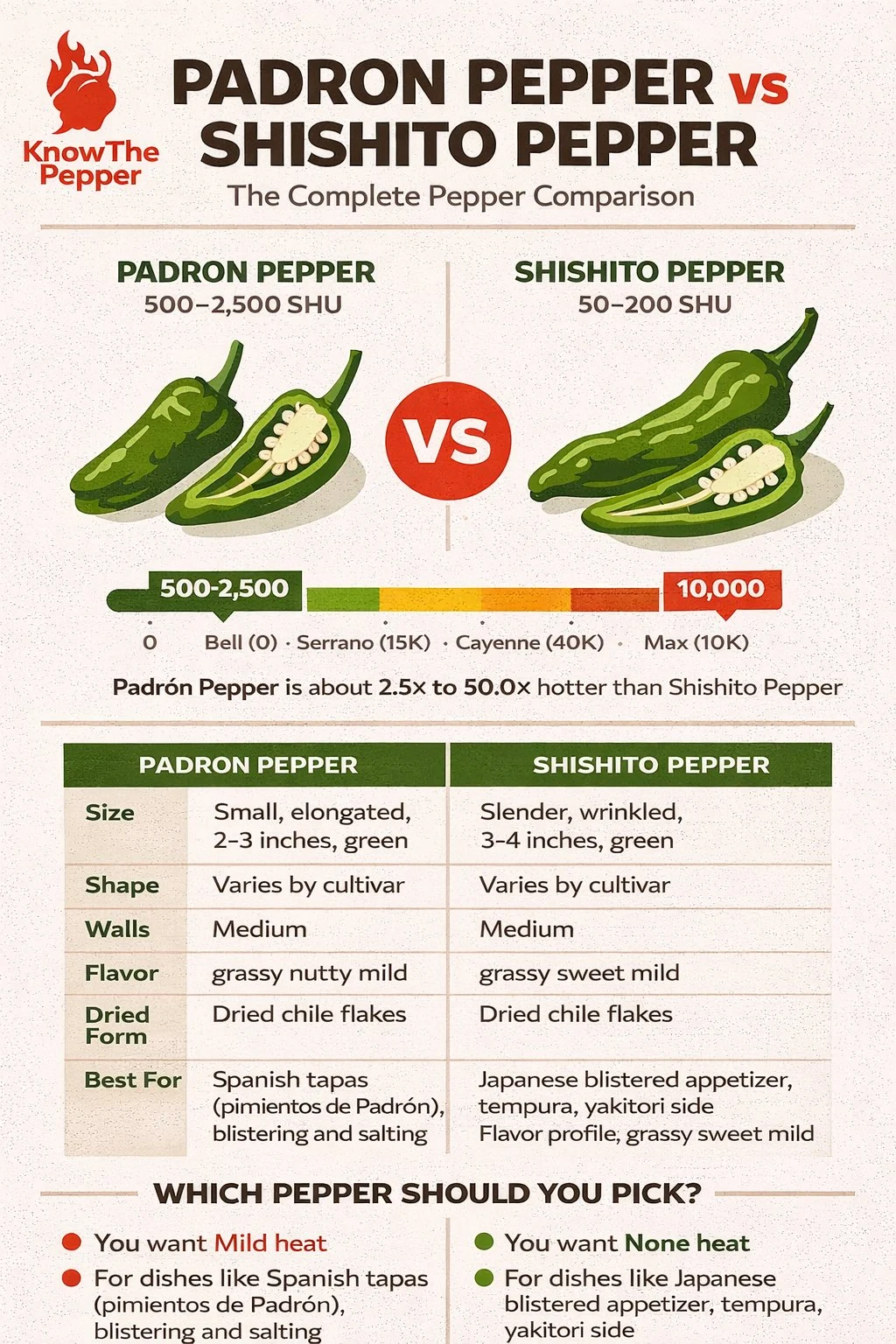
Padrón Pepper measures 500–3K SHU while Shishito Pepper registers 50–200 SHU. That makes Padrón Pepper about 13x hotter by upper SHU range. Padrón Pepper is known for its mild and grassy flavor (C. annuum), while Shishito Pepper offers sweet and grassy notes (C. annuum).
Padrón Pepper
500–3K SHU
Medium · mild and grassy
Shishito Pepper
50–200 SHU
Mild · sweet and grassy
Heat difference: Padrón Pepper is about 13× hotter by upper SHU range
Species: Both are C. annuum
Best for: Padrón Pepper excels in everyday cooking and salsas, Shishito Pepper in fresh salsas and mild recipes
Both peppers sit at the mild end of the Scoville scale's position for edible peppers, registering anywhere from 0 to 500 SHU under typical conditions - though Padróns can spike considerably higher.
The shishito holds steady in the 50-200 SHU band almost without exception. That makes it cooler than a Fresno chili (2,500-10,000 SHU) by a factor of roughly 12 to 50 times. It is one of the most reliably mild peppers you will encounter in any market.
Padrón is where things get interesting. Most fruits from a given plant read between 500 and 2,500 SHU, but the famous 'hot ones' can reach 5,000 SHU - still well below a Fresno's ceiling, but enough to startle someone expecting zero heat. That variance is real and unpredictable; the same plant, the same day, produces both types.
The cause is partly environmental. Padróns grown under stress - drought, heat, late in the season - produce more capsaicin. Shishitos show far less of this response, which is why they became a restaurant staple for heat-averse diners. If you want the low-intensity feel of the mild pepper range with zero surprises, shishito wins. If the roulette element sounds fun, Padrón delivers exactly that.
Crack open a bag of Padrón peppers and you get something unusual: a built-in game of chance.
Shishito Pepper
50–200 SHU
sweetgrassy
C. annuum
Shishitos belong to Capsicum annuum peppers as a species, the same broad botanical family that includes bell peppers, jalapeños, and most of the peppers you'll find at any grocery store.
Strip away the heat question and these two peppers taste genuinely different, not just interchangeable.
Shishito has a grassy, slightly sweet flavor with a thin skin that chars quickly. There is a faint citrus note when eaten fresh, and the flesh stays tender rather than crunchy. The aroma when blistered is clean and vegetal - almost green bell pepper in character, but lighter and less watery. The seeds are minimal and the walls are thin, so the whole pod cooks in under three minutes.
Padrón carries more weight. The flavor is earthier, with a slight bitterness at the finish and a denser flesh that holds up longer in a pan. When blistered in good olive oil, it picks up a nuttiness that shishito rarely achieves. The skin is slightly thicker, the pod more irregular in shape, and the aroma during cooking leans more savory than sweet.
Those differences matter at the table. Shishito's delicacy makes it a better candidate for lighter accompaniments - citrus-based dipping sauces, flaky salt, a squeeze of lemon. Padrón's earthiness pairs naturally with cured meats, aged cheese, and the salty-fat combination that defines Spanish bar food. Both peppers benefit from high heat and minimal fuss, but they reward different flavor pairings. For a closer look at how shishito stacks up against another thin-skinned Asian variety, the crunchier texture and milder profile matchup with Korean green peppers covers that ground well.
Culinary Uses for Padrón Pepper and Shishito Pepper
Padrón Pepper
Medium
The classic preparation - pimientos de Padrón - is almost aggressively simple: whole peppers blistered in olive oil over high heat until the skins char and blister, then finished with coarse sea salt. No trimming, no seeding, no sauce.
The standard preparation is almost aggressively simple: blister shishitos whole in a dry cast iron skillet or under a broiler until the skins char and blister in spots, then hit them with flaky salt. That's it.
Pimientos de Padrón - the classic Galician tapa - is the defining preparation for the Spanish pepper: whole pods blistered in a screaming-hot cast iron pan with olive oil, finished with coarse sea salt, and served immediately. That dish exists because of Padrón's specific flavor and the heat-roulette dynamic. Guests eat them fast, straight from the pan, and the occasional hot one is part of the experience. Replicating that with shishito works structurally but loses the tension.
Shishito found its American audience through izakaya-style blistering - same technique, different context. A hot skillet, a bit of neutral oil, two to three minutes until the skins blister and char in spots, then flaky salt. Some cooks finish with a drizzle of sesame oil or a splash of soy sauce. The pepper handles both directions (Japanese minimalist or Spanish-influenced) without complaint.
Beyond blistering, both peppers work well in tempura, where the thin walls cook through quickly in hot oil. Shishito is slightly more common in this application because of its Japanese origin. Padróns can be stuffed - their thicker flesh holds a small amount of cheese or salt cod - while shishito's thin walls make stuffing impractical.
Substitution ratio is essentially 1:1 by count for blistering applications. Flavor will shift - expect the earthier, slightly richer profile of Padrón versus shishito's cleaner taste - but the cooking method, timing, and serving style transfer directly. If a recipe specifically relies on the heat-roulette element, shishito cannot replicate that; you would need Padróns or a different approach entirely.
For anyone building a pepper-forward mezze or appetizer spread, both fit. Check the shishito alternatives guide if availability is the issue - several peppers can step in depending on what you are trying to achieve.
Choose shishito when the audience includes heat-sensitive eaters, when you want a consistent mild base for a dipping sauce application, or when the Japanese flavor context matters. Its predictability is a feature, not a limitation - restaurants use it precisely because no guest gets an unpleasant surprise.
Choose Padrón when the occasion calls for that interactive, slightly risky tapa experience, when you want more savory depth from the pepper itself, or when pairing with bold accompaniments like jamón or Manchego. The earthiness holds its own against stronger flavors in a way shishito does not.
For home cooking, Padróns are harder to source outside of specialty markets or late summer farmers markets. Shishito has become a near-year-round grocery store item in many regions. If you are growing your own, both are manageable plants - a solid seed-to-harvest growing walkthrough covers the basics that apply to both varieties.
Neither pepper is superior. They serve the same cooking moment with different personalities.
Can You Substitute One for the Other?
Start near 1:1 by amount. The heat ranges are close enough that flavor, form, and recipe role matter more than a strict Scoville conversion.
Growing Padrón Pepper vs Shishito Pepper
Growing notes
Padrón Pepper
Padrón peppers follow the same basic calendar as most C. annuum varieties: start seeds indoors 8–10 weeks before last frost, transplant after soil temperatures reach 60°F, and expect first harvest roughly 70–80 days after transplant.
They prefer full sun and consistent moisture - Galicia's cool, humid climate shaped them, so they tolerate cooler summers better than most peppers. That said, they still need warmth to fruit well.
Plant spacing of 18 inches between plants gives enough airflow to reduce fungal issues, which matter more with thin-walled varieties. Unlike the long-season cultivation requirements of large Anaheim-type peppers, Padróns fruit relatively early and keep producing through the season if you harvest consistently.
Growing notes
Shishito Pepper
Shishitos are productive, relatively compact plants that suit both garden beds and large containers. They thrive in the same conditions as most C. annuum varieties - full sun, consistent moisture, and warm soil above 60°F at night before transplanting.
Start seeds indoors 8–10 weeks before your last frost date. Germination is reliable at 75–85°F; a heat mat helps considerably.
The plants are vigorous and branch well without much intervention. Fruit sets prolifically once daytime temperatures settle between 70–85°F.
Where They Come From
Origin & background
Padrón Pepper
Spain · C. annuum
Padrón peppers take their name from the municipality of Padrón in Galicia, northwestern Spain, where Franciscan monks are believed to have introduced the seeds from the Americas in the 16th century. The variety adapted to Galicia's cool, wet climate over generations, developing the thin-walled, mild character that distinguishes it from hotter American relatives.
By the 20th century, Padróns had become an iconic tapa across Spain, particularly associated with the Galician summer harvest from July through September. The famous Spanish saying - "Os pementos de Padrón, uns pican e outros non" (Padrón peppers: some are hot, some are not) - entered common usage as a proverb about life's unpredictability.
Origin & background
Shishito Pepper
Japan · C. annuum
Shishitos trace their roots to the Japanese pepper-growing tradition, where they've been cultivated for centuries. The variety likely descended from peppers introduced to Japan from Portugal in the 16th century, after Portuguese traders brought Capsicum species from South America to East Asia.
In Japan, shishitos became a fixture of izakaya culture - the casual pub-style dining that forms the backbone of Japanese social eating. Blistered and salted, they were a natural bar snack: quick to prepare, easy to share, and forgiving of a little char.
Buying & Storage
Whether you’re shopping for Padrón Pepper or Shishito Pepper, the same quality indicators apply. Fresh peppers should feel firm and heavy for their size, with taut, glossy skin and no soft or wet spots. Minor stem cracks known as “corking” are perfectly normal and often indicate a mature, flavorful pod.
Selection
What to look for
Firm pods with taut skin and consistent color
Should feel heavy relative to size
Minor stem cracks (“corking”) are normal
Avoid anything soft, shriveled, or with dark wet spots
Storage
How to store them
Fresh: Paper bag, crisper drawer, 1 to 2 weeks
Frozen: Wash, dry, freeze on sheet pan, 6+ months
Dried: Airtight and away from light, up to 1 year
Mistakes to avoid
Common misses
Padrón Pepper
Equating green with unripe. Different products.
Overcooking. Cell walls break down fast.
Sealed plastic storage. Causes rot. Use paper bags.
Common misses
Shishito Pepper
Equating green with unripe. Different products.
Overcooking. Cell walls break down fast.
Sealed plastic storage. Causes rot. Use paper bags.
Final call
Padrón Pepper vs Shishito Pepper
Padrón Pepper and Shishito Pepper
occupy very different positions on the heat spectrum. Padrón Pepper delivers about 13× more upper-range heat with its distinctive mild and grassy character.
Shishito Pepper, with its sweet and grassy profile, excels in everyday cooking.
Heat gap about 13× by upper rangePadrón Pepper mild and grassyShishito Pepper sweet and grassy
Choose Padron peppers when the dish is a Spanish-style tapa with olive oil, blistered skins, and flaky salt. The appeal is the occasional hot pod, so Padron peppers are best served whole and simple.
Choose shishito peppers when the dish needs a milder Japanese-style blistered pepper with a thinner skin and a more predictable table experience. Shishitos work well with sesame, soy, bonito flakes, lemon, or a light dipping sauce.
Both peppers are usually pan-blistered, but Padron leans tapas and heat roulette. Shishito leans mild snack pepper with a gentler flavor.
Swap Limits
Padron and shishito can replace each other in blistered-pepper dishes at a 1:1 volume ratio. The dish will still work, but the heat expectation changes.
Padron is more likely to surprise the table with a hot pepper. Shishito is usually milder and more predictable, though occasional hot shishitos exist.
Do not chop either pepper before blistering if the classic texture matters. Whole pods char better and keep the snack format intact.
Buying And Prep Notes
Buy small, firm pods with thin skins. Oversized Padron peppers are more likely to be hot and tougher. Oversized shishitos can lose the delicate texture that makes them easy to snack on.
Cook both in a very hot pan with a little oil until blistered, then salt immediately. Avoid crowding the pan; steaming makes the skins limp instead of blistered.
Serve quickly. These peppers are best while the skins are still wrinkled, hot, and lightly charred.
Quick Choice Matrix
Use Padron for Spanish tapas, olive oil, flaky salt, and occasional heat.
Use shishito for milder blistered peppers, Japanese-style seasoning, and predictable snacking.
If surprise heat is welcome, choose Padron. If the table wants mild, choose shishito.
Final Choice
Padron is the better pepper for a classic tapas experience. Shishito is the better pepper for a mild, easy appetizer. The cooking method overlaps, but the expected heat and cultural context differ.
Common Mistake
The common mistake is overcooking both peppers until they collapse. They need blistering, not stewing, so use high heat and a fast pan.
Ratio Note
Use a 1:1 volume ratio for blistered appetizers. Adjust only for expected heat and pod size.
Service Style Difference
Padron peppers are usually served as a shared plate with the heat surprise built into the experience. Olive oil and salt are enough because the pepper itself provides the story.
Shishito peppers are more flexible as a mild appetizer. They can take sesame oil, soy, citrus, miso, bonito, garlic, or a dipping sauce without fighting the pepper's mild profile.
That makes Padron the more traditional minimalist plate and shishito the easier party snack.
Do Not Use When
Do not use Padron if the table needs predictable mild heat. Do not use shishito if the dish is specifically trying to recreate Spanish pimientos de Padron.
Final Choice 2
Padron is the better choice for a Spanish tapas plate built around olive oil, salt, and the chance of a hot pod. Shishito is the better choice for a mild blistered appetizer with Japanese-style seasonings or dipping sauces. If surprise heat is part of the fun, choose Padron. If predictability matters, choose shishito.
Dose And Prep Note
Cook either pepper hot and fast. Stop when skins blister and collapse slightly, not when the pods turn soft and wet.
Shopping Safeguard
Shopping note: buy small pods and cook them the same day when possible. Older pods wrinkle, toughen, and lose the delicate snap that makes the blistered-pepper plate work. For parties, shishito is safer because fewer guests will be surprised by heat. Keep lemon wedges or a dipping sauce separate so the blistered skins stay dry and crisp at the table.
Fact-Checked & Expert Reviewed
Editorial Standards: Head-to-head comparisons include blind tasting when applicable. Heat levels cross-referenced with multiple sources. All substitution ratios tested side-by-side.
Review Process:
Written by
James Thompson
(Lead Comparison Reviewer)
, reviewed by
Karen Liu
(Lead Fact-Checker & Science Editor)
. Last updated June 26, 2026.
Padrón Pepper vs Shishito Pepper FAQ
Capsaicin production in Padróns is triggered by environmental stress - drought, high temperatures, and late-season growing conditions all push individual fruits toward higher SHU levels. The same plant can produce both mild and hot pods simultaneously, which is why the heat distribution feels random even within a single batch.
Structurally yes - the blistering method and 1:1 count substitution work fine. The flavor will be slightly cleaner and less earthy, and you lose the heat-roulette dynamic that defines the traditional Padrón tapa experience.
Shishito has become significantly more available year-round at mainstream US grocery stores, often sold in small bags near other specialty produce. Padróns remain more seasonal and are typically found at specialty markets, Spanish importers, or farmers markets in late summer.
Occasionally - roughly 1 in 10 shishitos can carry a mild kick, similar in concept to Padrón but far less pronounced when it does occur. The heat ceiling for a 'hot' shishito is much lower than what a stressed Padrón plant can produce.
For Padrón, good Spanish olive oil is traditional and adds flavor that complements the earthy pepper. For shishito, neutral oils like grapeseed or avocado work well when finishing with sesame oil, or olive oil if going in a Mediterranean direction.