Bird's Eye vs Peri Peri: Fresh Chile or Sauce Pepper?

Bird's eye chili is the better choice for sharp fresh heat in Thai, Vietnamese, and Filipino dishes. Peri peri is the better choice when the food leans toward African or Portuguese-style sauce, citrus, garlic, oil, and grilled meat.

Bird's Eye Chili and Peri Peri side by side for a heat and flavor comparison
Quick Comparison

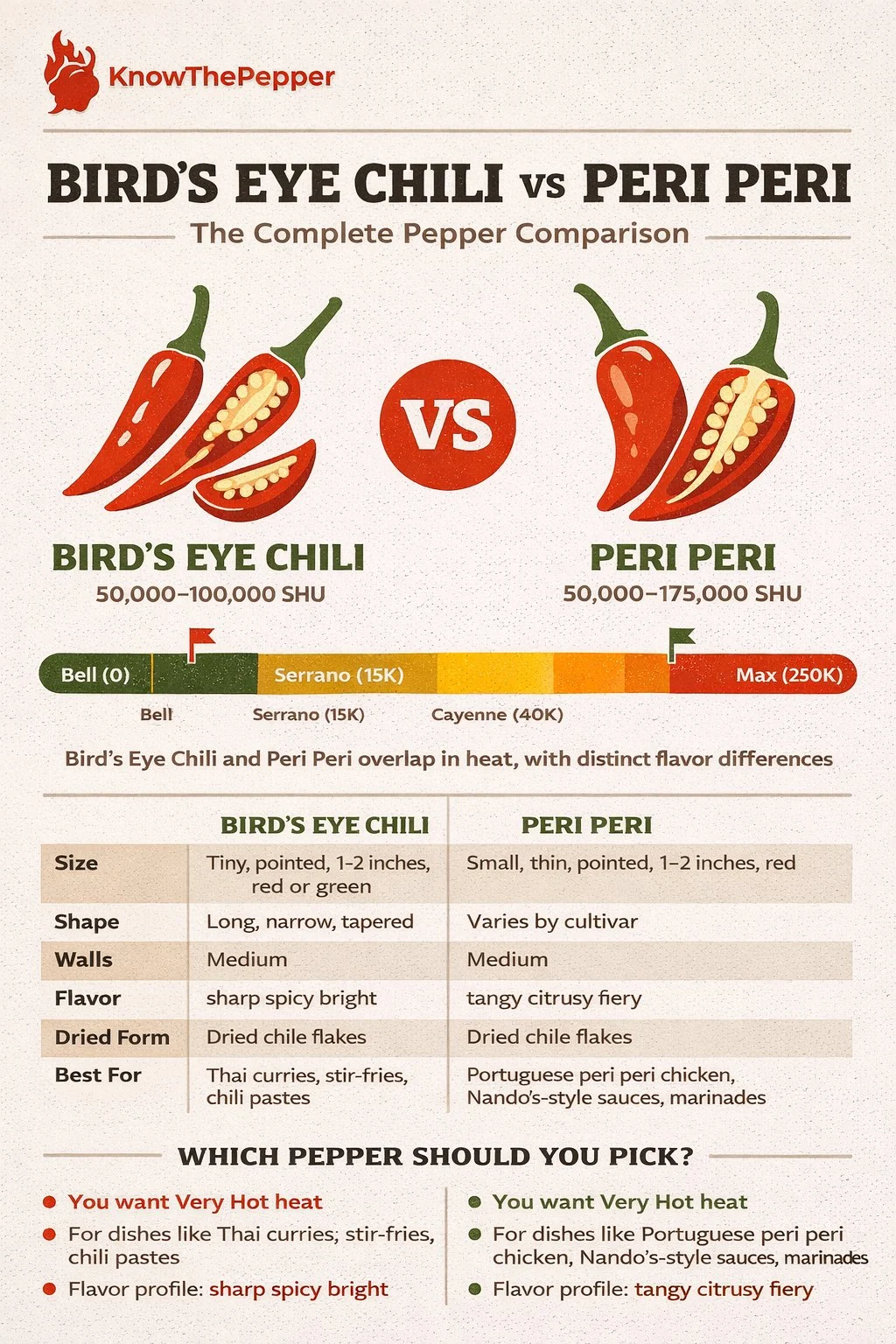
Bird's Eye Chili measures 50K–100K SHU while Peri Peri registers 50K–175K SHU. That makes Peri Peri about 1.8x hotter by upper SHU range. Bird's Eye Chili is known for its sharp, peppery, bright heat flavor (C. annuum), while Peri Peri offers citrusy and hot notes (C. frutescens).

Bird's Eye Chili
50K–100K SHU
Hot · sharp, peppery, bright heat
Peri Peri
50K–175K SHU
Extra-Hot · citrusy and hot
  • Heat difference: Peri Peri is about 1.8× hotter by upper SHU range
  • Species: C. annuum vs C. frutescens
  • Best for: Bird's Eye Chili excels in hot sauces and extreme dishes, Peri Peri in hot sauces and spicy dishes

Bird's Eye Chili vs Peri Peri Comparison

Attribute Bird's Eye Chili Peri Peri
Scoville (SHU) 50K–100K 50K–175K
Heat Tier Hot Extra-Hot
vs Jalapeño 13x hotter 22x hotter
Flavor sharp, peppery, bright heat citrusy and hot
Species C. annuum C. frutescens
Origin Mexico, Central America, or South America; now grown in South and Southeast Asia Africa

Bird's Eye Chili vs Peri Peri Heat Levels

Position on the Scoville Scale
Bird's
Peri
0 SHU3.2M SHU

Peri Peri is about 1.8× hotter than Bird's Eye Chili. They fall in different heat tiers: Bird's Eye Chili is classified as hot while Peri Peri sits in the extra-hot range.

Bird's Eye Chili spans 50K–100K SHU, roughly 13× a jalapeño at the upper end. Peri Peri spans 50K–175K SHU, about 22× a jalapeño at the upper end. Use the ranges to decide whether the recipe needs a measured dose, a mild overlap, or a hard substitution limit. Tools: Scoville chart and SHU calculator.

Flavor Profile Comparison

Bird's Eye Chili
sharp peppery bright heat C. annuum

Bird's eye chili is hot in a very practical way: UF/IFAS lists Thai pepper, also called bird's eye chili or bird's chili, at 50,000-100,000 Scoville Heat Units. That places it in the hot pepper range, clearly above most jalapeno and serrano use cases and close enough to cayenne that small pod counts matter.

The name needs a little care. UF/IFAS treats Thai pepper as a cultivar type derived from the C. annuum species group, but it also notes that these peppers are often confused with similar C. frutescens cultivars.

Peri Peri
citrusy hot C. frutescens

The first time I encountered peri peri in its raw form - not the bottled sauce, but the actual fresh pepper - I was struck by how the citrus hit before the heat. That sequence matters.

Capsicum frutescens at its finest, the peri peri (also spelled piri piri) grows as a compact, upright plant with small elongated pods that ripen from green through yellow to red. The mature red fruits carry the most heat, measuring up to 175,000 SHU when fully ripe under good sun.

Bird's Eye Chili (C. annuum) and Peri Peri (C. frutescens) come from different species, giving them fundamentally different flavor profiles.

Bird's Eye Chili brings sharp, peppery, bright heat notes, so it fits recipes where that flavor should remain visible. Peri Peri leans citrusy and hot, which can change the sauce, filling, marinade, or garnish even when the heat range looks close.

Bird's Eye Chili and Peri Peri comparison

Culinary Uses for Bird's Eye Chili and Peri Peri

Bird's Eye Chili

Bird's eye chili works best when a dish needs fresh, fast heat in a small footprint. Slice it into fish-sauce dips, pound it into chile pastes, simmer it into soups, or add thin rings to stir-fries near the end of cooking.

Fresh pods taste greener and sharper than dried pods. Dried bird's eye chilies lose water, so the heat can feel more concentrated per gram, with a deeper aroma that fits curry pastes, chile oils, and spice blends.

For heat calibration, compare against neighboring peppers. milder serrano pepper profile are much milder.

Peri Peri

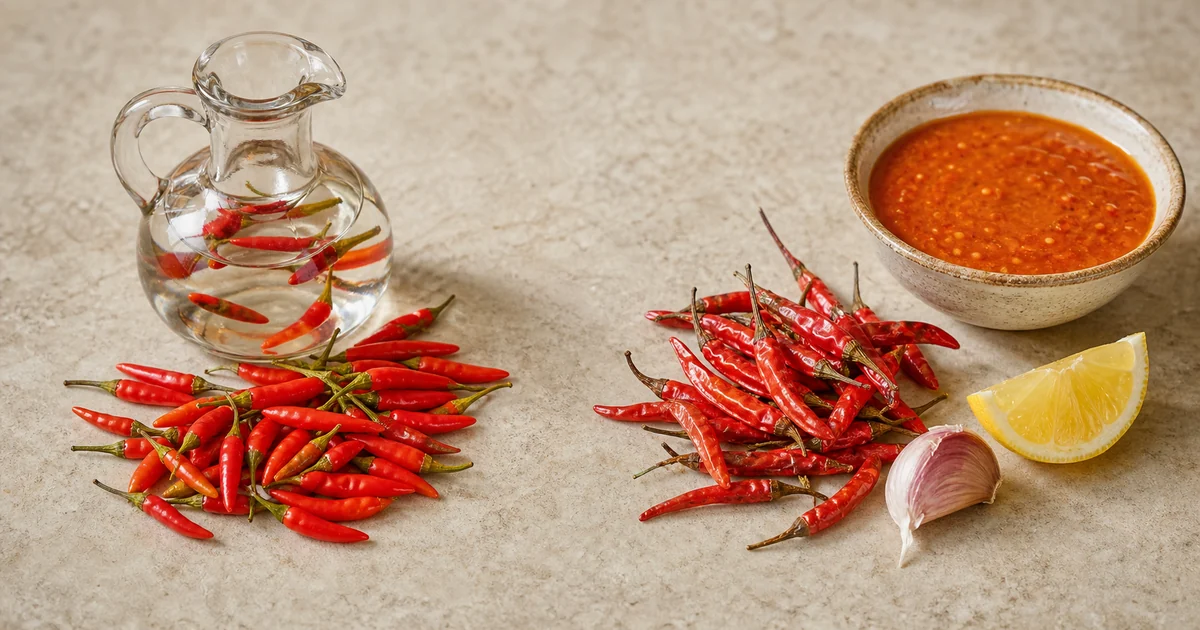
Peri peri's thin walls and citrus-forward flavor make it one of the most flexible hot peppers for sauce work. The classic preparation is simple: blend fresh or dried peri peri with garlic, lemon juice, oil, and salt.

For marinades, dried and ground peri peri penetrates meat faster than thicker-walled peppers. A 2-hour marinade with peri peri powder, citrus, and oil will flavor chicken thighs more deeply than a 24-hour soak with something like a dried ancho.

The heat sits in a range comparable to Malagueta's intense, sharp burn - both are serious peppers that reward measured use. Start with half a teaspoon of dried peri peri per pound of protein and adjust from there.

Which Should You Choose?

Best fit

Choose Bird's Eye Chili if…

You want milder heat
You prefer sharp, peppery, bright heat flavors
You need a C. annuum variety

Best fit

Choose Peri Peri if…

You want maximum heat
You prefer citrusy and hot flavors
You need a C. frutescens variety

Can You Substitute One for the Other?

Hotter replacement

Replacing Bird's Eye Chili with Peri Peri

Use slightly less by weight. Start below the recipe amount and adjust after tasting.

Milder replacement

Replacing Peri Peri with Bird's Eye Chili

Increase gradually, but expect the flavor balance to change before the heat matches exactly.

Growing Bird's Eye Chili vs Peri Peri

Growing notes

Bird's Eye Chili

Bird's eye chili needs the same warm-season discipline as other hot Capsicum plants. University of Minnesota Extension recommends starting pepper seed about eight weeks before planting outside, then transplanting after nighttime lows are above 50 F. Warm soil matters because pepper seedlings stall when the root zone stays cold.

UF/IFAS notes that Thai pepper plants can grow tall, up to about 6 feet, and produce small tapering fruit about an inch long. In containers, choose a pot that can support a hot pepper with many pods and keep watering steady.

Pest pressure is familiar rather than exotic. Aphids, mites, and fungal problems are easier to manage before they spread, so use the pepper pests and diseases guide when leaves curl, stipple, yellow, or spot.

Growing notes

Peri Peri

Peri peri grows best in full sun with well-draining soil and consistent warmth - it's a tropical species that does not tolerate frost. Start seeds indoors 10-12 weeks before last frost, keeping soil temperature at 80-85°F for germination.

The plants stay compact, typically reaching 18-24 inches, which makes them workable in containers. A 5-gallon pot with quality potting mix and a slow-release fertilizer will carry a plant through a full season.

For comparison, the cultivation approach for its close botanical relative is nearly identical - both prefer the same temperature ranges and soil conditions.

Where They Come From

Origin & background

Bird's Eye Chili

Mexico, Central America, or South America; now grown in South and Southeast Asia · C. annuum

Do not read the Southeast Asian association as a clean origin claim. UF/IFAS says Thai pepper's origin might be Mexico, Central America, or South America, while noting that it is now commonly grown in South and Southeast Asian countries.

The reason the common name feels Thai is culinary use. Small hot chiles became central to Thai, Vietnamese, Indonesian, Malaysian, and other regional cooking systems after Capsicum peppers moved through global trade.

Origin & background

Peri Peri

Africa · C. frutescens

Peri peri's story is a colonial trade route in miniature. Portuguese explorers brought Capsicum frutescens to East and Southern Africa in the 15th and 16th centuries, where it naturalized so thoroughly that most people assume it's indigenous.

The name comes from the Swahili and Ronga words for pepper, and the pepper became central to Mozambican, Angolan, and South African cooking long before it got famous in the West.

Buying & Storage

Whether you’re shopping for Bird's Eye Chili or Peri Peri, the same quality indicators apply. Fresh peppers should feel firm and heavy for their size, with taut, glossy skin and no soft or wet spots. Minor stem cracks known as “corking” are perfectly normal and often indicate a mature, flavorful pod.

Selection

What to look for

  • Firm pods with taut skin and consistent color
  • Should feel heavy relative to size
  • Minor stem cracks (“corking”) are normal
  • Avoid anything soft, shriveled, or with dark wet spots

Storage

How to store them

  • Fresh: Paper bag, crisper drawer, 1 to 2 weeks
  • Frozen: Wash, dry, freeze on sheet pan, 6+ months
  • Dried: Airtight and away from light, up to 1 year

Mistakes to avoid

Common misses

Bird's Eye Chili

  • Blaming the seeds. Membranes hold most capsaicin.
  • Adding heat too early. Capsaicin breaks down with cooking.
  • Not tasting individual pods. Heat varies 30%+.

Common misses

Peri Peri

  • Skipping gloves. Capsaicin absorbs through skin.
  • Using too much. Start with a quarter pod.
  • Drinking water for the burn. Use dairy instead.
Final call

Bird's Eye Chili vs Peri Peri

Bird's Eye Chili and Peri Peri occupy very different positions on the heat spectrum. Peri Peri delivers about 1.8× more upper-range heat with its distinctive citrusy and hot character. Bird's Eye Chili, with its sharp, peppery, bright heat profile, excels in everyday cooking.

Heat gap about 1.8× by upper range Bird's Eye Chili sharp, peppery, bright heat Peri Peri citrusy and hot

Name Trap

Names get messy here. Bird's eye chili is a broad market name for small hot chiles used across South and Southeast Asian cooking, while peri peri usually points to African piri-piri peppers and the sauce style built around them.

So the question is not only whether the pods are related. It is whether the recipe expects fresh chopped heat or a sauce pepper with lemon, garlic, oil, and grilled-food habits.

Heat And Species Labels

The heat ranges overlap. Bird's eye chili often sits around 50,000 to 100,000 SHU, and peri peri is often listed around 50,000 to 175,000 SHU.

Peri peri can have the higher ceiling, but label certainty is messy because piri-piri names move across regions, seed sellers, and sauce brands.

Species labels help, but they do not solve the kitchen decision. This DB treats bird's eye as C. annuum and peri peri as C. frutescens; market bags may be less tidy.

The Thai alias problem is narrower because the food system is already fixed. Bird's eye vs Thai chili handles that naming overlap; this comparison separates Asian fresh-chile use from peri-peri sauce identity.
Fresh Mortar Vs Marinade

Bird's eye wins in a mortar, dipping sauce, soup, or stir-fry where one tiny pod should cut through fish sauce, lime, herbs, or hot oil.

Peri peri does not need that same fresh snap to do its job. It can be dried, powdered, blended with lemon and garlic, or held in oil before it reaches grilled chicken or shrimp.

Substitution By Dish

Peri peri wins when the pepper is going into grilled chicken, shrimp, roasted vegetables, olive oil, lemon, garlic, and vinegar-based hot sauce. That sauce structure is part of the flavor.

In Thai or Vietnamese food, a peri-peri swap can taste like the dish changed regions. Use less if the peri peri batch is at the high end, and avoid finished sauces when the recipe needs clean chopped chile.

In a peri-peri marinade, bird's eye supplies heat but not the frame. Add lemon, garlic, oil, and salt deliberately; if the choice stays within Portuguese-speaking chile traditions, malagueta vs peri peri is the tighter decision.

Shopping Rule

Buy bird's eye by freshness and pod size when the dish needs raw snap. Buy peri peri by form: fresh pod, dried pod, powder, oil, or finished sauce.

For a bottle-style sauce, the pepper is only one part of the result. The hot sauce method matters because acid, salt, garlic, and oil decide whether peri peri tastes bright or flat.

Fact-Checked & Expert Reviewed
Editorial Standards: Head-to-head comparisons include blind tasting when applicable. Heat levels cross-referenced with multiple sources. All substitution ratios tested side-by-side.
Review Process: Written by James Thompson (Lead Comparison Reviewer) , reviewed by Karen Liu (Lead Fact-Checker & Science Editor) . Last updated June 29, 2026.

Bird's Eye Chili vs Peri Peri FAQ

Sometimes the names overlap, but they are not identical in cooking use. Bird's eye usually points to small Asian hot chiles, while peri peri often points to African piri-piri peppers and sauce traditions.

The ranges overlap. Bird's eye often runs about 50,000 to 100,000 SHU, while peri peri is often listed around 50,000 to 175,000 SHU.

Yes. It can supply the heat, but add lemon, garlic, oil, salt, and vinegar deliberately because those sauce ingredients are part of the peri-peri identity.

It can add heat, but it may taste regionally off if the peri peri is already citrusy, oily, or sauce-based. Fresh bird's eye is cleaner for Thai mortar pastes and dips.

Sources & References
KL
Fact-checked by Karen Liu
Research Contributor
SHU Verified
Sources Cited
Expert Reviewed
All Comparisons Browse Peppers Scoville Scale