Bird's Eye vs Siling Labuyo: Generic Name or Filipino Chile?
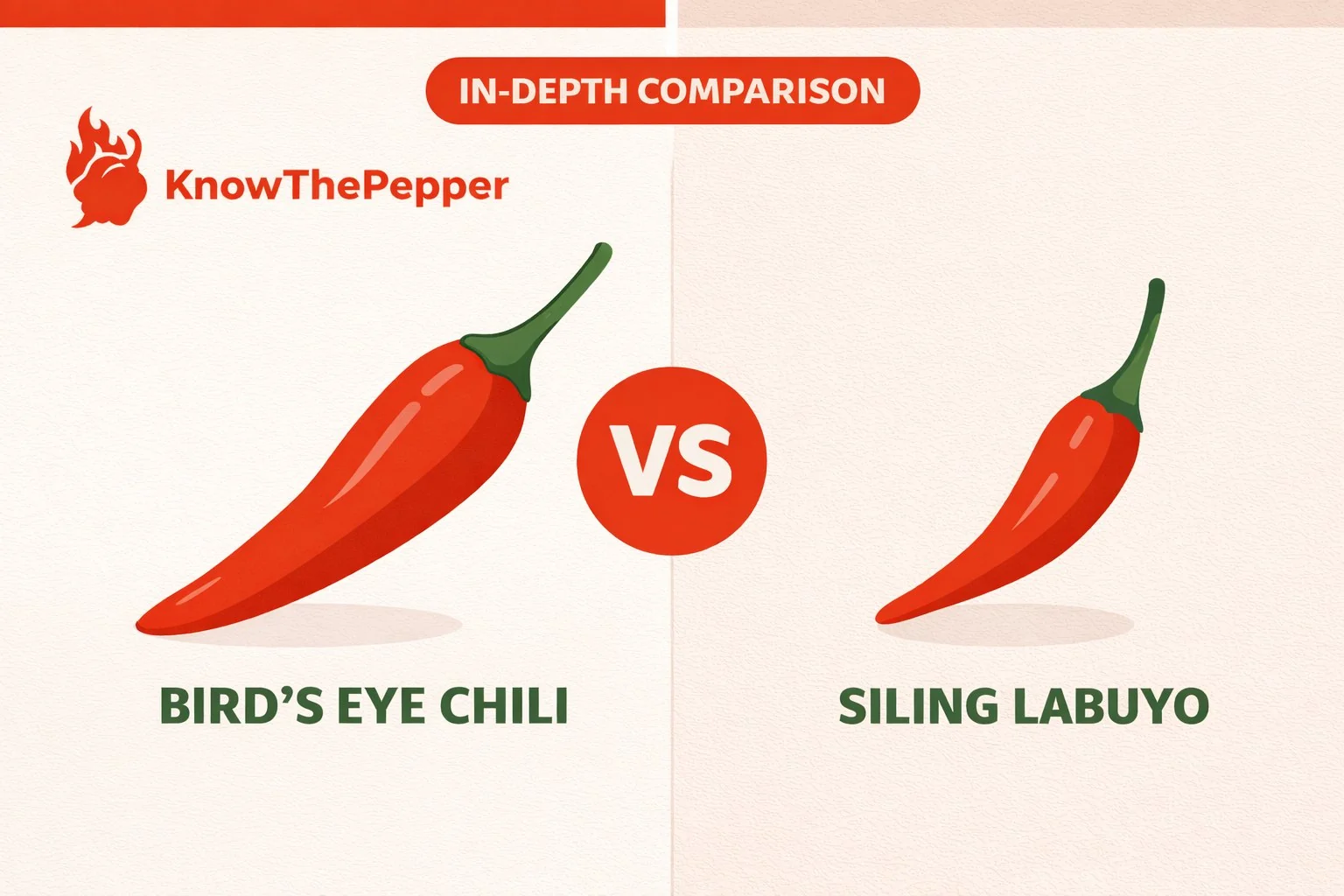
Bird's eye chili is a broad market name for small hot chilies used across South and Southeast Asia. Siling Labuyo is the Filipino chile with sharper table-sauce identity, often tied to vinegar dips, sawsawan, sinigang, and adobo heat.
Comparison Contributor·Updated Jun 29, 2026·
Reviewed by
Karen Liu
Quick Comparison
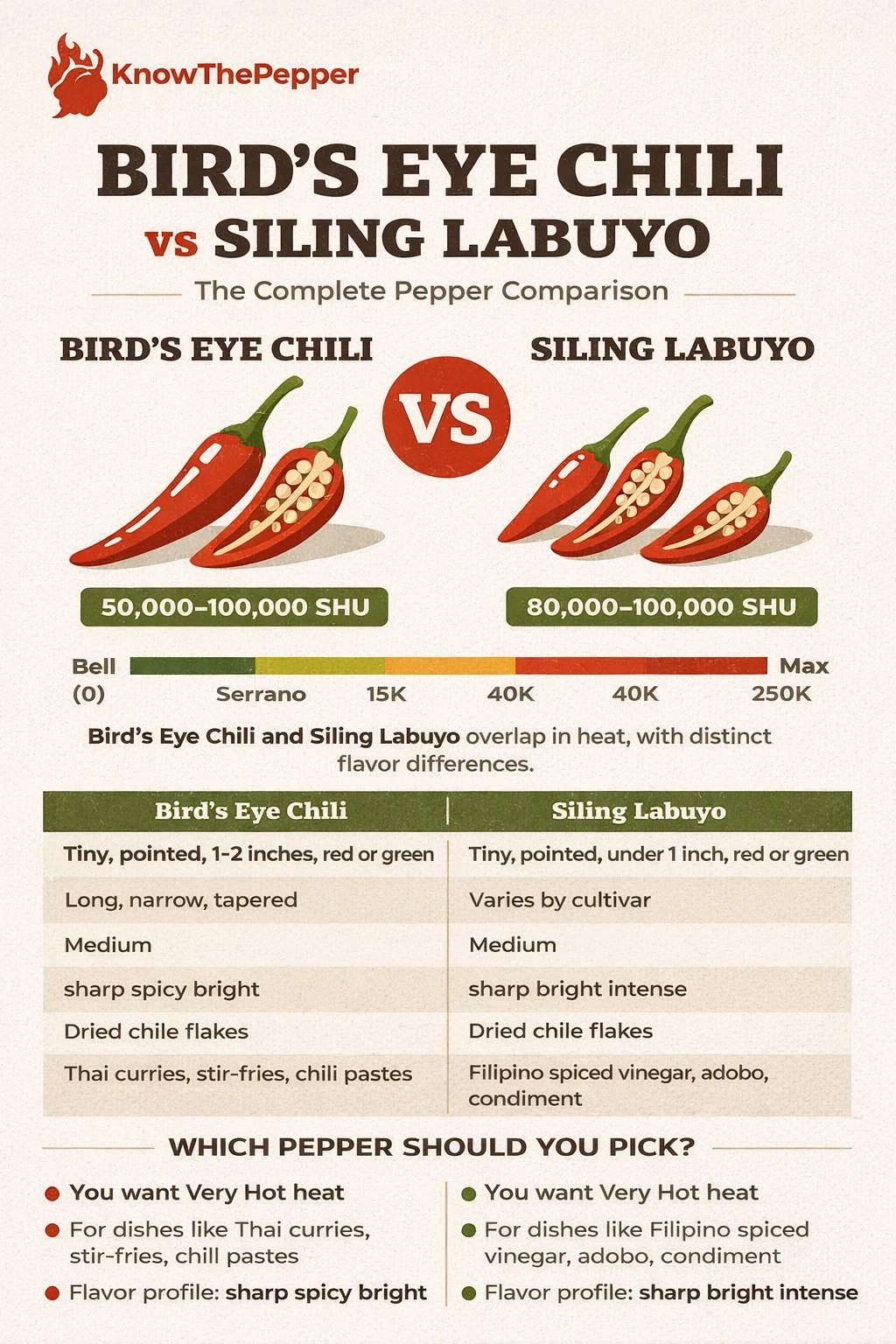
Bird's Eye Chili measures 50K–100K SHU while Siling Labuyo registers 80K–100K SHU. Their upper SHU ranges are close enough to treat as the same heat bracket. Bird's Eye Chili is known for its sharp, peppery, bright heat flavor (C. annuum), while Siling Labuyo offers sharp and pungent notes (C. frutescens).
Bird's Eye Chili
50K–100K SHU
Hot · sharp, peppery, bright heat
Siling Labuyo
80K–100K SHU
Hot · sharp and pungent
Species:C. annuum vs C. frutescens
Best for: Bird's Eye Chili excels in hot sauces and extreme dishes, Siling Labuyo in hot sauces and spicy dishes
Mexico, Central America, or South America; now grown in South and Southeast Asia
Philippines
Bird's Eye Chili vs Siling Labuyo Heat Levels
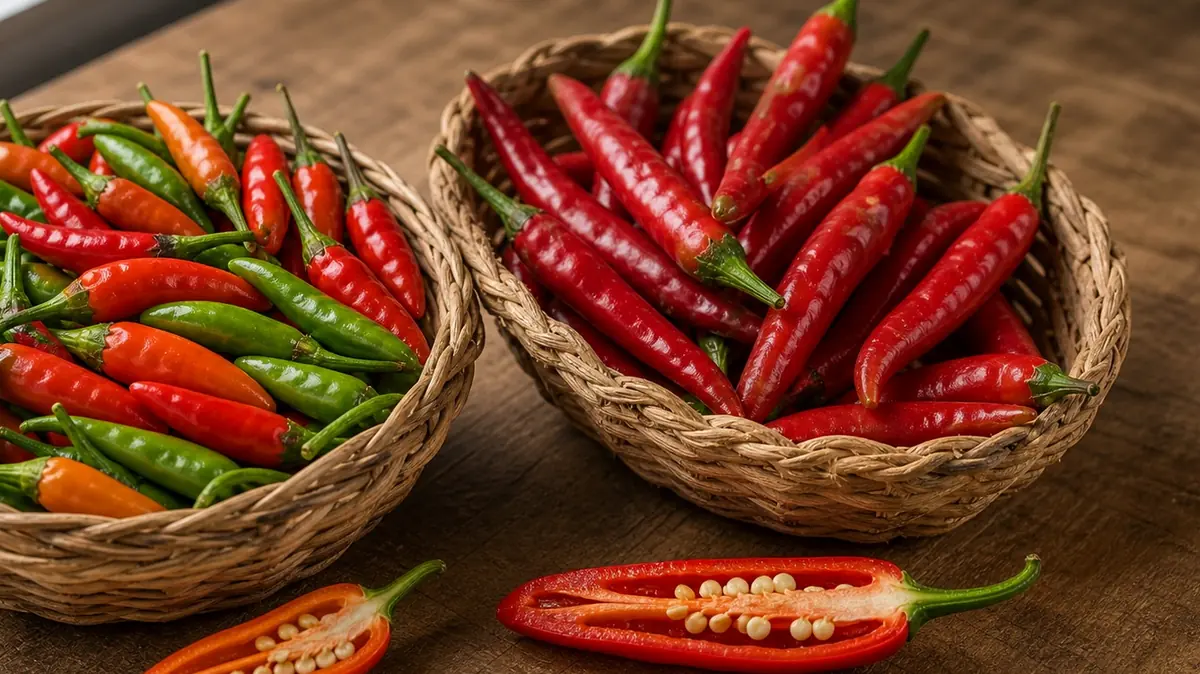
Start with the name on the package. Bird's eye chili can mean several small hot peppers, including Thai-style C. annuum, African piri-piri type, or another small red chile. Siling Labuyo points to the Filipino pepper used at the table and in vinegar.
Bird's eye chili is hot in a very practical way: UF/IFAS lists Thai pepper, also called bird's eye chili or bird's chili, at 50,000-100,000 Scoville Heat Units.
Siling Labuyo
80K–100K SHU
sharppungent
C. frutescens
The first time I encountered Siling Labuyo at a Manila street market, the vendor laughed when I bought a whole bag - then handed me a glass of water I didn't ask for.
Bird's eye chili gives a clean, sharp burn from a small pod. It works when the dish needs heat without much sweetness or body.
Siling Labuyo tastes more pungent and savory in vinegar. Crushed pods season cane vinegar, soy, calamansi, garlic, fried fish, grilled pork, and sour soups in a way a generic small chile may not copy.
Culinary Uses for Bird's Eye Chili and Siling Labuyo
Bird's Eye Chili
Hot
Bird's eye chili works best when a dish needs fresh, fast heat in a small footprint. Slice it into fish-sauce dips, pound it into chile pastes, simmer it into soups, or add thin rings to stir-fries near the end of cooking.
Siling Labuyo anchors sawsawan, the vinegar-based dipping sauces that define Filipino table culture. The simplest version - crushed fresh chilies steeped in cane vinegar - accompanies fried fish, grilled pork, and lechon with minimal fuss and maximum effect.
Siling Labuyo makes the most sense when the food will touch Filipino vinegar, sawsawan, sinamak, sinigang, adobo, ginataan, or fried food served with a dipping sauce.
For Thai-style cooking, bird's eye or Thai chili is usually the safer label. For Filipino cooking, Siling Labuyo is the more exact choice.
A supermarket bird's eye chili can replace Siling Labuyo when heat is the main need. It works less well when the dish depends on Filipino table vinegar, because the pepper is part of the flavor people expect.
If the recipe says only small red chili, choose by cuisine before you choose by Scoville number.
Can You Substitute One for the Other?
Start near 1:1 by amount. The heat ranges are close enough that flavor, form, and recipe role matter more than a strict Scoville conversion.
Growing Bird's Eye Chili vs Siling Labuyo
Growing notes
Bird's Eye Chili
Bird's eye chili needs the same warm-season discipline as other hot Capsicum plants. University of Minnesota Extension recommends starting pepper seed about eight weeks before planting outside, then transplanting after nighttime lows are above 50 F. Warm soil matters because pepper seedlings stall when the root zone stays cold.
UF/IFAS notes that Thai pepper plants can grow tall, up to about 6 feet, and produce small tapering fruit about an inch long. In containers, choose a pot that can support a hot pepper with many pods and keep watering steady.
Pest pressure is familiar rather than exotic. Aphids, mites, and fungal problems are easier to manage before they spread, so use the pepper pests and diseases guide when leaves curl, stipple, yellow, or spot.
Growing notes
Siling Labuyo
Siling Labuyo behaves like the perennial it is - given warm temperatures and decent soil, it will grow into a shrubby plant 2–4 feet tall that produces prolifically for multiple seasons. In USDA zones 10–12, it overwinters without intervention.
Start seeds indoors 8–10 weeks before transplant, maintaining soil temperature around 80–85°F for germination. C. frutescens varieties can be slower to sprout than annuum types - patience matters here.
Full sun is non-negotiable: 6–8 hours minimum. The plant tolerates drought better than waterlogging, so err toward underwatering once established.
Where They Come From
Origin & background
Bird's Eye Chili
Mexico, Central America, or South America; now grown in South and Southeast Asia · C. annuum
Do not read the Southeast Asian association as a clean origin claim. UF/IFAS says Thai pepper's origin might be Mexico, Central America, or South America, while noting that it is now commonly grown in South and Southeast Asian countries.
The reason the common name feels Thai is culinary use. Small hot chiles became central to Thai, Vietnamese, Indonesian, Malaysian, and other regional cooking systems after Capsicum peppers moved through global trade.
Origin & background
Siling Labuyo
Philippines · C. frutescens
The name translates loosely as "wild chili" in Tagalog - labuyo suggesting something untamed and self-seeding, which describes its growth habit perfectly. Capsicum frutescens arrived in the Philippines through Spanish colonial trade routes in the 16th century, likely via the Manila Galleon trade connecting Acapulco to Manila.
Once established, the pepper naturalized so thoroughly across the islands that it became indistinguishable from indigenous flora. Filipino culinary identity absorbed it completely.
Buying & Storage
Whether you’re shopping for Bird's Eye Chili or Siling Labuyo, the same quality indicators apply. Fresh peppers should feel firm and heavy for their size, with taut, glossy skin and no soft or wet spots. Minor stem cracks known as “corking” are perfectly normal and often indicate a mature, flavorful pod.
Selection
What to look for
Firm pods with taut skin and consistent color
Should feel heavy relative to size
Minor stem cracks (“corking”) are normal
Avoid anything soft, shriveled, or with dark wet spots
Storage
How to store them
Fresh: Paper bag, crisper drawer, 1 to 2 weeks
Frozen: Wash, dry, freeze on sheet pan, 6+ months
Dried: Airtight and away from light, up to 1 year
Mistakes to avoid
Common misses
Bird's Eye Chili
Blaming the seeds. Membranes hold most capsaicin.
Adding heat too early. Capsaicin breaks down with cooking.
Not tasting individual pods. Heat varies 30%+.
Common misses
Siling Labuyo
Blaming the seeds. Membranes hold most capsaicin.
Adding heat too early. Capsaicin breaks down with cooking.
Not tasting individual pods. Heat varies 30%+.
Final call
Bird's Eye Chili vs Siling Labuyo
Bird's Eye Chili and Siling Labuyo
sit in the same heat tier but serve different roles. Bird's Eye Chili delivers its distinctive sharp, peppery, bright heat character.
Siling Labuyo, with its sharp and pungent profile, excels in everyday cooking.
Heat gap same bracketBird's Eye Chili sharp, peppery, bright heatSiling Labuyo sharp and pungent
At the store, check the origin and package wording. Filipino groceries are more likely to say Siling Labuyo or Filipino chili. General Asian markets may use bird's eye, Thai chili, or small hot chili for several lookalike pods.
To replace Siling Labuyo, start with one small bird's eye chili per pod, then taste the vinegar or broth before adding more. To replace bird's eye chili with Siling Labuyo, start lower if the dish should not taste Filipino-hot.
For Thai-style package names, Bird's Eye vs Thai Chili is the closer comparison. This article should help with the Filipino chile choice.
Fact-Checked & Expert Reviewed
Editorial Standards: Head-to-head comparisons include blind tasting when applicable. Heat levels cross-referenced with multiple sources. All substitution ratios tested side-by-side.
Review Process:
Written by
James Thompson
(Lead Comparison Reviewer)
, reviewed by
Karen Liu
(Lead Fact-Checker & Science Editor)
. Last updated June 29, 2026.
Bird's Eye Chili vs Siling Labuyo FAQ
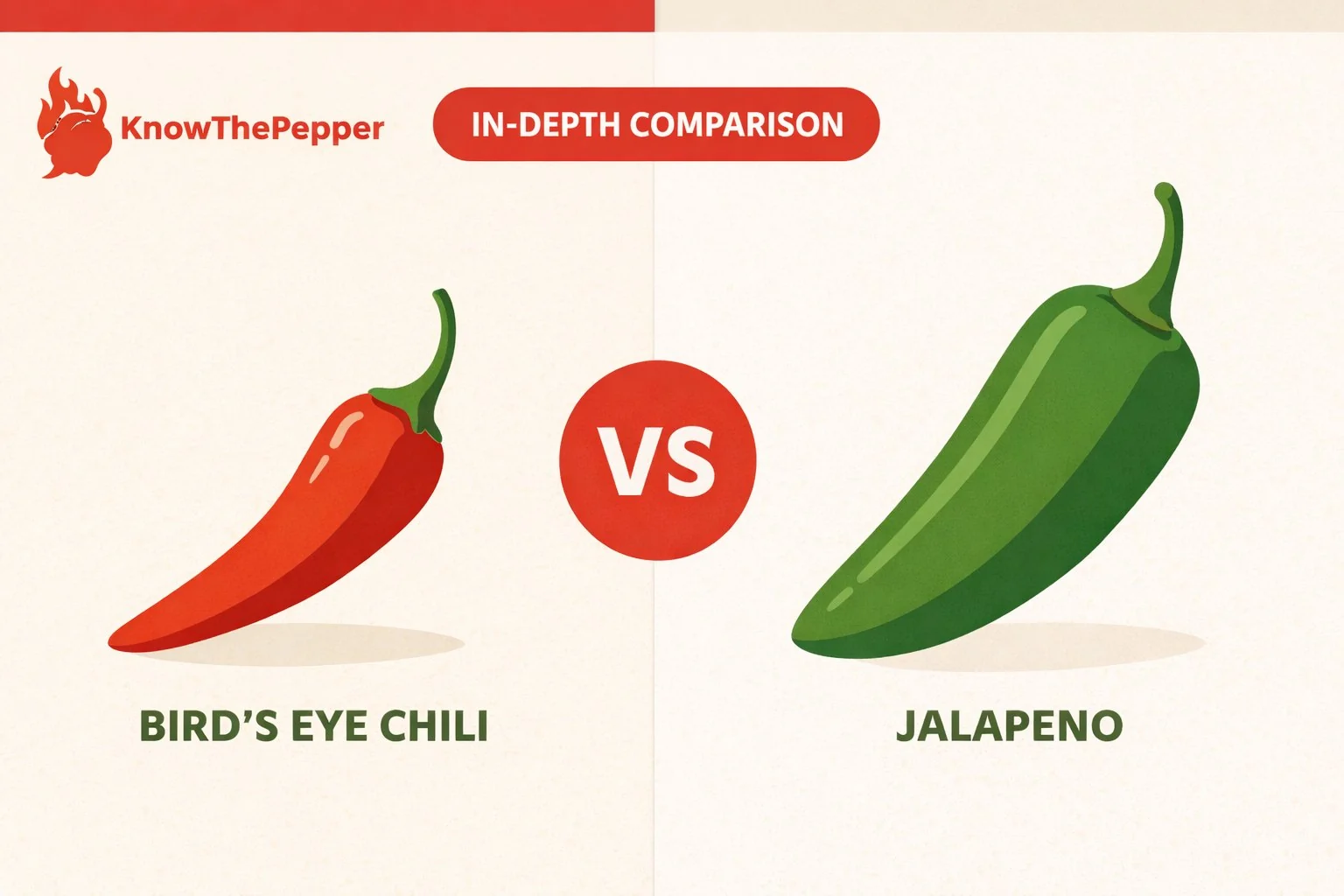
Not exactly. Siling Labuyo is a Filipino chile identity, while bird's eye chili is often a broad market label for small hot chilies. They can overlap in heat and appearance, but the recipe context matters.
They overlap, but Siling Labuyo usually starts near the hotter end at about 80,000-100,000 SHU. Bird's eye chili is often listed around 50,000-100,000 SHU.
Yes if Siling Labuyo is unavailable. Use one small pod at a time, crush it into vinegar, and taste before adding more because small pods vary a lot.
Buy Siling Labuyo when you can find it. Bird's eye chili works as a heat substitute, but Siling Labuyo is the more route-specific choice for Filipino table sauces and sour broths.