
Thai Chili vs Bird's Eye: Are They Really the Same?
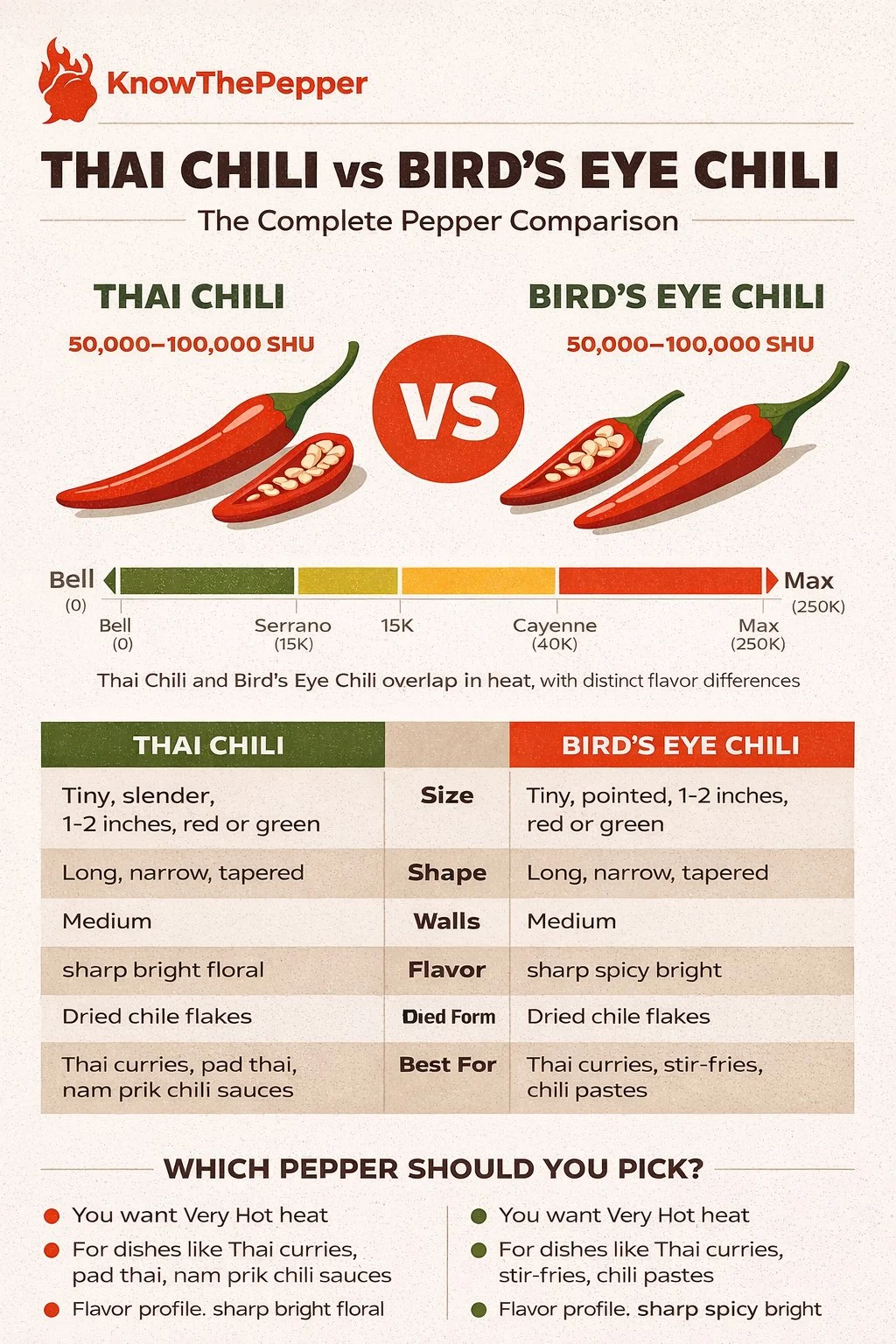
Thai chili and bird's eye chili often describe the same small hot pepper type in US references, but the labels are not precise worldwide. Check origin, cultivar, pod size, and stated heat. When both products match, substitute by prepared weight or mince volume instead of pod count.

Thai chili and bird's eye often describe the same small hot pepper type, but the labels are not globally precise. Verify origin, cultivar, pod size, and stated heat. If both products fit the 50,000 to 100,000 SHU band, choose for the dish and substitute by prepared amount.
- Name relationship: Broad Thai-market term vs Overlapping visual market term
- Typical published heat: 50,000 to 100,000 SHU vs 50,000 to 100,000 SHU
- Strongest identity evidence: Thai origin plus cultivar or local name vs Origin, species, and measured pod size
- Cooking advantage: Clear fit for named Thai dishes vs Practical small-pod heat when source is verified
- Best swap measure: Prepared weight or mince volume vs Prepared weight or mince volume
Thai Chili
HotBird's Eye Chili
HotQuick Comparison
| Attribute | Thai Chili | Bird's Eye Chili |
|---|---|---|
| Name relationship | Broad Thai-market term | Overlapping visual market term |
| Typical published heat | 50,000 to 100,000 SHU | 50,000 to 100,000 SHU |
| Strongest identity evidence | Thai origin plus cultivar or local name | Origin, species, and measured pod size |
| Cooking advantage | Clear fit for named Thai dishes | Practical small-pod heat when source is verified |
| Best swap measure | Prepared weight or mince volume | Prepared weight or mince volume |
Do the Names Mean the Same Pepper Everywhere?
Thai chili and bird's eye chili can mean the same pepper in a recipe or US produce aisle, but the names are not interchangeable in every seed catalog or country. University of Florida IFAS describes Thai pepper as also called bird's eye chili or bird's chili, then warns that it is often confused with similar Capsicum frutescens cultivars.
That gives the useful answer to the naming question. A bag labeled Thai chili may contain the same small, tapering Capsicum annuum type another shop calls bird's eye, while a bag labeled bird's eye may come from a different small-fruited line with its own origin and pod shape.
Why the label can change while the pepper looks familiar
Thai chili is a market category as often as it is a cultivar name. Thailand grows many small hot peppers, and English packaging compresses local names, sizes, and selections into a few familiar terms.
Bird's eye is also a visual name used for small peppers whose upright fruit can be easy for birds to see. The phrase appears on Asian products, African products, and seed listings that do not always refer to the same species.
The most reliable label includes more than a common name. Country of origin, a cultivar or local name, a botanical name, a measured pod size, and a stated heat range create a much stronger identity than “Thai” or “bird's eye” alone.
Is one reliably hotter?
The standard comparison is a draw. UF/IFAS places Thai pepper at 50,000 to 100,000 Scoville heat units, and Iowa State Extension lists bird's eye chili, with Thai chili pepper in parentheses, in the same 50,000 to 100,000 band.
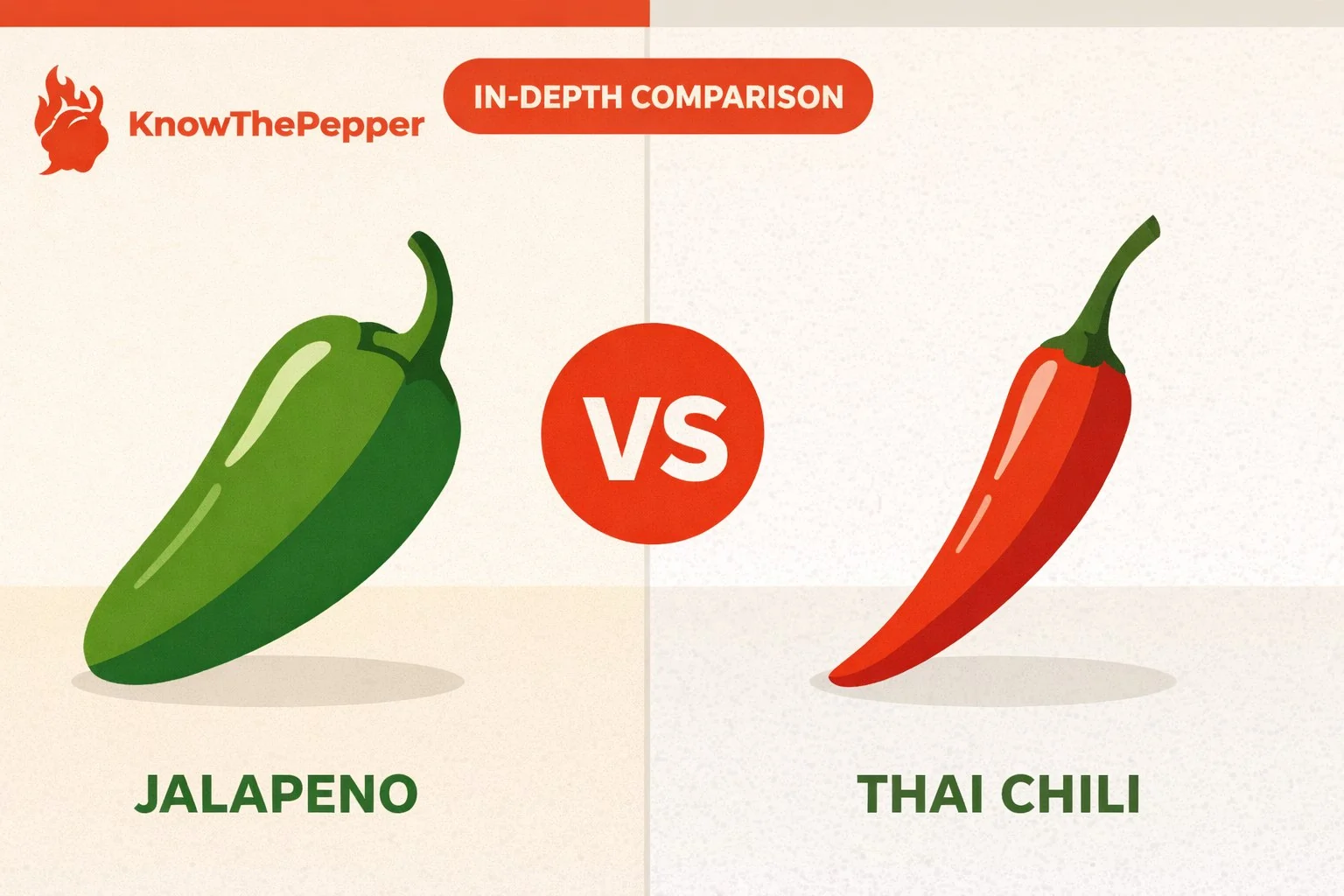
That range is roughly ten to forty times the commonly cited 2,500 to 10,000 SHU span for jalapeño. Both labels should therefore signal a genuinely hot ingredient, even when one batch lands below another.
No package name can predict a single pod. Cultivar, growing conditions, maturity, storage, and natural fruit-to-fruit variation can shift the experience, while the amount of pale placental tissue changes how much capsaicin enters the dish.
Use the declared heat range when the seller provides one. When it does not, treat the smaller or unfamiliar product as an unknown hot pepper and test it through a measured portion of the finished food.
| What you know | What it supports | What it does not prove |
|---|---|---|
| Thai chili on a US label | Likely small hot Asian-market pepper | One universal cultivar |
| Bird's eye on a label | Small, pointed hot-pepper type | Thai origin or one species |
| 50,000 to 100,000 SHU | A seriously hot working range | The exact heat of one fruit |
| Country and cultivar | Much stronger product identity | Identical heat in every harvest |
How Can You Tell Thai Chili and Bird's Eye Apart?
Begin with features you can verify. The Australian Department of Agriculture describes imported bird's eye chilies as usually about 2 to 3 centimeters long, while UF/IFAS describes Thai pepper fruit as small, tapering, and about one inch long in the cultivar it profiles.
Those descriptions overlap rather than creating a clean dividing line. Some packages sold as Thai chili contain longer, slender pods, but length alone cannot prove that a pepper belongs to a different cultivar.
Read the pod and the package together
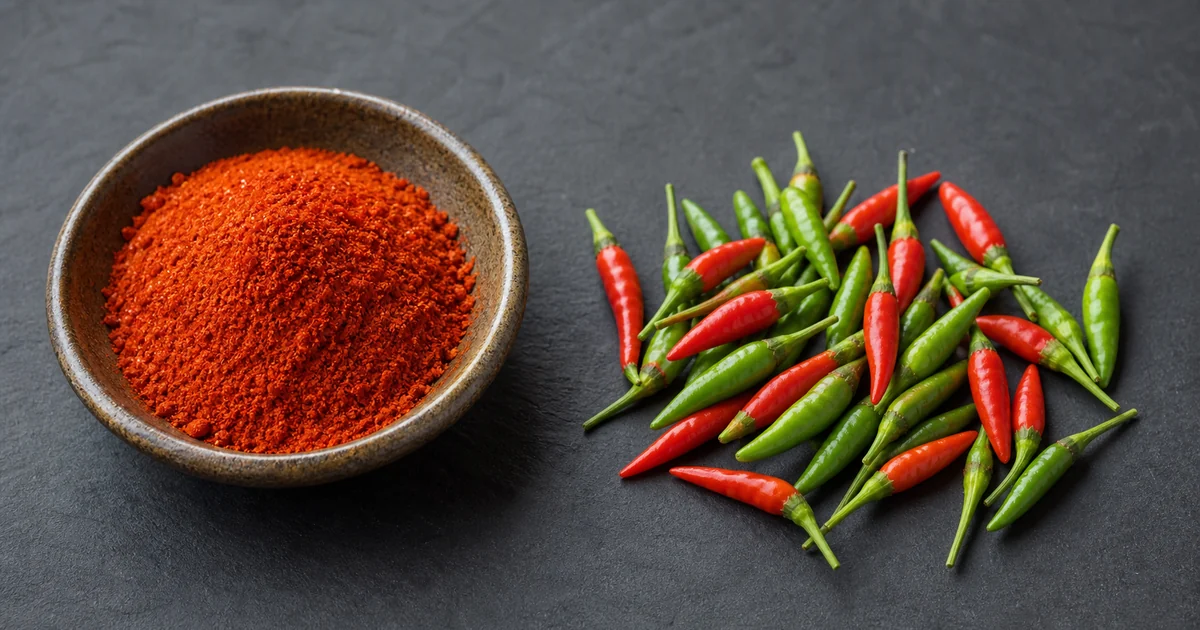
Look for a smooth, narrow body, a pointed end, and thin walls around a central seed cavity. The identification image places longer market-style Thai pods beside smaller bird's-eye-type pods and cuts one of each open, so the relative scale and shared interior remain visible.
The stem should look fresh rather than blackened or collapsed. Skin may be taut or lightly wrinkled according to the variety, but wet spots, mold, leaking flesh, and deep soft patches indicate damage rather than identity.
Color tells you maturity more often than name. Green pods are generally harvested before full ripeness, while red pods have developed longer on the plant, and both colors can appear under either market label.
Check the package for origin and a more specific name before relying on shape. A Thai origin or a name such as prik kee noo provides useful context, while an African origin means the broad bird's eye label may point to a different regional product.
How green, red, fresh, and dried forms behave
Green small chilies tend to bring a sharper vegetal aroma and a firm snap. Ripe red fruit often tastes rounder and slightly sweeter, although cultivar and freshness can matter more than a tidy green-versus-red rule.
Fresh pods release juice and aroma as they are sliced, bruised, or pounded. Their thin walls also let heat move quickly into a dressing, table sauce, or stir-fry.
Dried pods lose fresh green notes and gain a concentrated, sometimes earthy aroma. A dried pepper also weighs far less than its fresh equivalent, so equal weights do not represent equal numbers of fruit or the same water content.
Do not force a universal flavor winner between two ambiguous names. First identify origin and form, then decide whether the recipe needs fresh brightness, ripe sweetness, dried concentration, or simply controlled heat.
Some Thai-market packs contain longer slender pods
Green and red usually describe ripeness, not a unique name
Both groups can release heat quickly when sliced or pounded
Origin, cultivar, and stated heat beat the common name alone
Which Should You Use in a Thai Dish?
For a Thai dish, choose the product with the clearest Thai identity when both are available. A well-documented Thai chili or prik kee noo is a better first choice than a generic bird's eye package from an unknown or non-Thai source.
That does not make the other package unusable. It means the name on the recipe carries information about place, aroma, and expected pod size that should be preserved when the ingredient is easy to obtain.
Pounded pastes and table condiments
A mortar ruptures the thin flesh and spreads chile through garlic, herbs, shrimp paste, salt, or acid. The result is different from dropping intact pods into the same mixture because pounded placental tissue disperses capsaicin through every bite.
Table condiments need similar control. Thin slices in fish sauce or vinegar release heat gradually, while a fine mince produces a faster and more even burn.
For som tam or another mortar-pounded preparation, begin with fewer pods than a casual count in the recipe suggests if your package is unfamiliar. Crushing extracts more heat than leaving the same fruit mostly intact.
Stir-fries, curries, soups, and whole-pod use
Brief frying carries chile aroma into oil and spreads it across the pan. It can soften raw edges, but University of California guidance cautions that Thai pepper heat does not simply disappear during cooking.
A curry or soup dilutes the pepper through a larger volume, yet reduction can concentrate the final dish. Add an initial measured portion early for integration, then reserve a smaller amount for adjustment near the end.
Whole pods create a different result. An intact or lightly bruised chile can perfume broth while limiting the amount of exposed tissue, but a diner who bites the pod receives a concentrated dose.
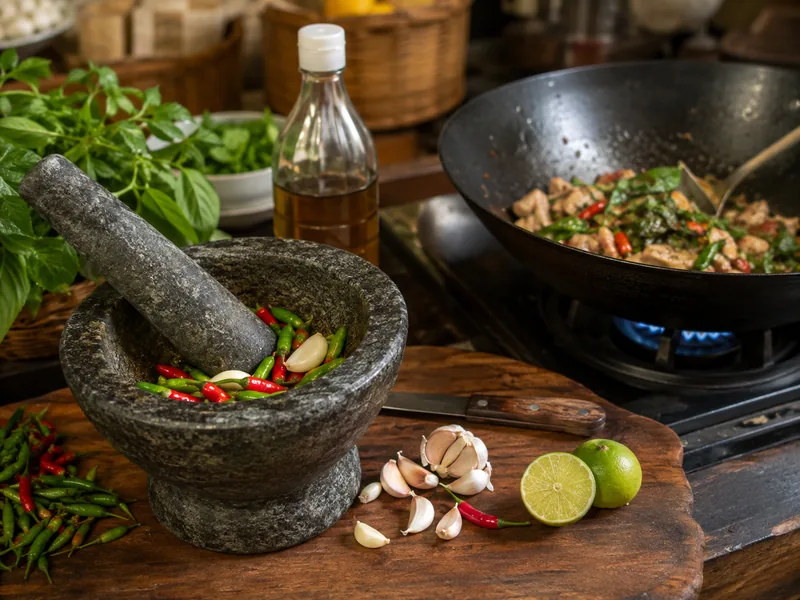
The kitchen image shows both pounding and wok cooking because these methods answer different reader needs. One builds a paste or condiment from ruptured fruit, while the other distributes sliced peppers through hot fat and a finished dish.
When “bird's eye” points outside Thailand
A generic bird's eye product may still work in a Thai stir-fry, curry, or table sauce when its heat and pod form are close. Check the origin first, especially when the same label is attached to an African pepper intended for a different sauce tradition.
Choose by function only after acknowledging that difference. Thin walls, clean heat, and small size can make a practical swap, but they do not turn every bird's eye pepper into one Thai cultivar.
Choose the pepper form for the cooking action
| Cooking action | Pepper form | What changes |
|---|---|---|
| Pound in a mortar | Fresh green or red pods | Ruptured flesh spreads aroma and heat through the paste |
| Slice into table sauce | Thin fresh rings | Heat extracts gradually into fish sauce, vinegar, or citrus |
| Fry with aromatics | Sliced or minced fresh pods | Hot oil distributes aroma across the pan |
| Simmer in curry or soup | Measured mince or whole pod | Minced pepper disperses heat, while an intact pod creates a localized dose |
| Grind dried pods | Fully dried fruit | Less water and concentrated aroma change the substitution |
What Should You Check Before Buying?
The best purchase is the soundest, best-documented pepper that fits the dish. Favor a package that names origin, cultivar or local type, harvest form, and heat over one that offers only a broad English label.
Use five checks in the produce aisle
Read the country of origin before comparing color. Thailand, Vietnam, another Asian source, or an African source gives the common name a more useful frame.
Look for a cultivar or local name. Prik kee noo, Thai Hot, African bird's eye, and a bare “bird's eye” label do not carry the same level of specificity.
Measure one representative pod if size affects the recipe. The Australian bird's eye reference of about 2 to 3 centimeters is useful evidence, but a longer pod is not automatically wrong or mild.
Inspect condition separately from identity. Choose firm fruit without mold, leaking cuts, deep soft spots, or badly collapsed stems.
Finally, read any stated SHU range or heat warning. A credible 50,000 to 100,000 SHU label tells you more about dosing than a picture of flames on the package.
What if the package gives almost no information?
Treat it as an unknown small hot pepper rather than inventing certainty. Buy a small amount, photograph the label, measure a pod, and note whether the fruit is green, red, fresh, dried, upright, or pendant.
That record makes the first batch useful. If the pepper gives the right heat, aroma, and texture, you can repeat the purchase or ask the seller for the source next time.
Fresh condition can outweigh a perfect name in a flexible weeknight dish. For a recipe whose identity depends on a specific Thai pepper, however, waiting for the documented ingredient is the more reliable choice.
Read the package in this order
- Origin: note the country before interpreting the common name.
- Specific name: prefer a cultivar or local type over a bare market term.
- Size and form: measure one pod and note whether it is fresh, dried, green, or red.
- Condition: reject mold, leaks, deep soft spots, and collapsed stems.
- Heat statement: use a credible SHU range to plan the first dose.
A flame graphic is not a heat measurement
Packaging art can signal that a product is hot, but it cannot tell you whether the peppers sit at 50,000 SHU, 100,000 SHU, or somewhere outside that band. Use a stated range, cultivar evidence, and a controlled first batch.
Can You Substitute One for the Other?
You can usually substitute one package for the other when both contain small, thin-walled peppers in the same broad heat band. The safe starting point is prepared weight or fine-mince volume, not the number of pods.
A count fails because one package may hold 2-centimeter fruit while another holds peppers twice that length. Trim stems and damaged flesh before measuring so the comparison reflects what will enter the dish.
Use a staged substitution
- Prepare the sauce, curry, stir-fry base, or dressing before opening the pepper package.
- Put on food-safe gloves, trim one or two pods, and weigh or finely mince the usable fruit.
- Add one-half to three-quarters of the expected amount when the batch is unfamiliar.
- Disperse the pepper through the food, then taste a diluted spoonful after the flavors have combined.
- Add the reserved portion in small increments only if the dish needs more heat.
The exact starting fraction depends on the dish and the people eating it. A raw table sauce exposes the full dose quickly, while a large curry distributes the same amount through more food.
Match form as well as quantity. Replace fresh with fresh when aroma matters, and rehydrate or grind dried pods only when the recipe can absorb their concentrated flavor and lower water content.
Control where the heat goes
Fine mincing and pounding spread capsaicin widely. Slices create identifiable hot pieces, while a whole pod creates a milder surrounding liquid until the skin breaks or someone bites it.
Most capsaicin is produced around the pale seed-bearing placenta. Removing loose seeds changes texture, but removing some placental tissue has the larger effect on heat.
New Mexico State University recommends gloves and keeping hands away from the eyes when handling pungent chile. Wash the knife, board, scale, and your hands before touching ready-to-eat food or another person.
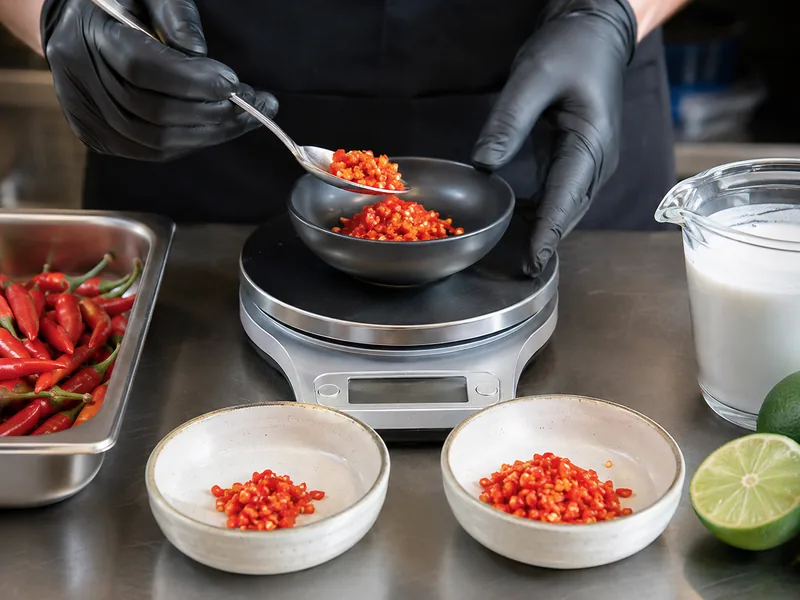
The weighing image turns the substitution into a visible process. Two separated portions let you add a conservative dose first while keeping the rest available for a controlled correction.
Use the swap freely when the pepper supplies background heat in a complex dish. Keep the documented Thai type when a raw condiment, paste, or named regional preparation puts the chile itself in the foreground.
What the substitution measure should match
| Recipe situation | Match first | Hold back for adjustment |
|---|---|---|
| Raw table sauce | Fine-mince volume and ripeness | At least one-quarter of the planned dose |
| Mortar-pounded paste | Prepared weight and fresh form | Enough pepper to correct after pounding |
| Large curry or soup | Prepared weight and batch volume | A smaller finishing portion |
| Dried for fresh | Recipe-specific dried amount | Do not use equal fresh weight |
| Unknown package | One conservative measured portion | The entire remainder |
Thai Chili vs Bird's Eye Chili FAQ
- University of Florida IFAS - Pepper Production in Miami-Dade County
- Iowa State University Extension - Growing Peppers in the Home Garden
- Australian Department of Agriculture - Fresh Bird's Eye Chillies Import Fact Sheet
- Thailand National Bureau of Agricultural Commodity and Food Standards - Thai Agricultural Standard for Chilli
- New Mexico State University Extension - Processing Fresh Chile Peppers
- University of California Small Farms Network - Thai Pepper