

KnowThePepper
NuMex Heritage Big Jim: Thicker Walls and Steadier Heat at 9,500 SHU
The NuMex Heritage Big Jim is a massive New Mexico green chile bred at New Mexico State University, producing pods that can stretch past 12 inches in length. NMSU CR-706 lists it at 9,500 SHU, hotter than standard NuMex Big Jim and useful for roasted green chile sauce, rellenos, and stews.
- Species: C. annuum
- Heat tier: Medium (1K-10K SHU)
- Comparison: 1-4x hotter than a jalapeño, depending on where the jalapeño falls in its 2,500-8,000 SHU range
What Is NuMex Heritage Big Jim?
NuMex Heritage Big Jim is a New Mexican pod-type chile selected from original NuMex Big Jim germplasm for better uniformity, thicker walls, and more consistent heat. NMSU CR-706 lists its heat level at 9,500 SHU, which makes it hotter than the original NuMex Big Jim average and strong enough for roasting, green chile sauce, and chile rellenos.
The cultivar still keeps the Big Jim job: large, flattened pods with thick walls. The difference is control.
NMSU describes the Heritage selection as more uniform than the original, with selections made for traditional flavor, improved fruit quality, easy destemming, and uniform heat.
Use this profile as the heat anchor for NuMex Heritage Big Jim, not generic Hatch chile ranges. Hatch-style chiles vary widely by cultivar, but this specific NMSU selection has a documented 9,500 SHU value in the cultivar release summary.
Where Did NuMex Heritage Big Jim Originate?
The Big Jim chile has deep roots in New Mexico's agricultural identity. The original Big Jim was released by NMSU horticulturist Dr. Roy Nakayama in 1975, immediately setting records as the world's largest chile pepper at the time.
Over subsequent decades, commercial seed production drifted from the original genetics. Yields and uniformity were prioritized over the variety's distinctive character.
The Heritage designation emerged from NMSU's effort to restore the original open-pollinated line, essentially rescuing what made Big Jim significant in the first place.
New Mexico's chile culture, centered around the regional pepper traditions of the Southwest, treats the Big Jim as a staple rather than a specialty item. It's the chile that fills roadside roasters every September, perfuming entire towns with smoke.
The Heritage version reconnects modern growers to that original standard.
How Hot Is NuMex Heritage Big Jim, and What Does It Taste Like?
The NuMex Heritage Big Jim delivers 9.5K Scoville Heat Units, placing it in the Medium tier (1K-10K SHU). That makes it roughly 1-4x hotter than a jalapeño, depending on where the jalapeño falls in its 2,500-8,000 SHU range.
What's in NuMex Heritage Big Jim? Nutrition Facts
Green NuMex Heritage Big Jim pods are low in calories and high in vitamin C - a single large pod can deliver well over 100% of the daily recommended intake. The thick flesh also provides vitamin A, potassium, and dietary fiber.
Because this variety is essentially capsaicin-free, it lacks the metabolic effects associated with hot peppers. What it does offer is a nutrient-dense vegetable that can be eaten in quantity without heat tolerance being a factor.
Roasting causes some vitamin C loss but concentrates other compounds and improves the bioavailability of certain antioxidants. Frozen roasted chiles retain most of their nutritional value well.
How Do You Cook With NuMex Heritage Big Jim?
Roasting is the essential first step with NuMex Heritage Big Jim. The thick skin needs to blister and char before the flesh underneath becomes usable, hold each pod directly over a gas flame or slide them under a broiler until blackened on all sides, then steam in a covered bowl for 15 minutes before peeling.
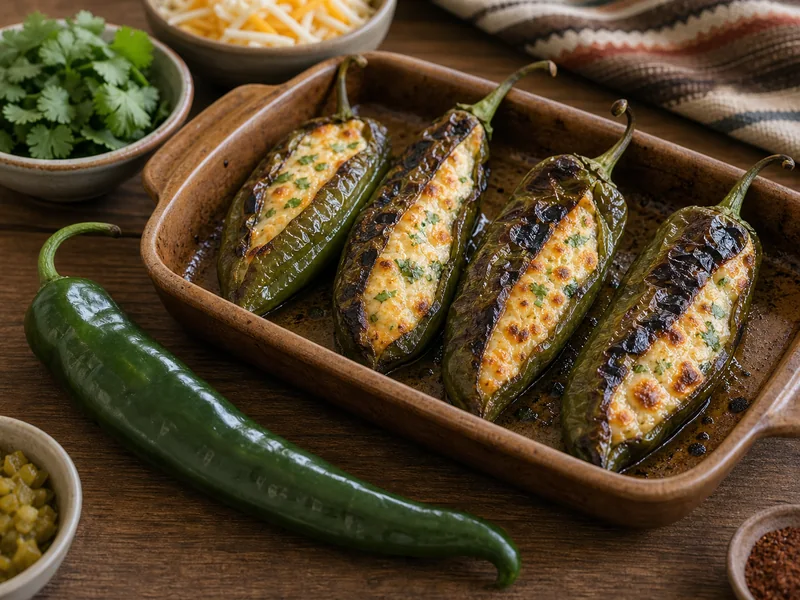
Once roasted and peeled, the applications multiply fast. The pods are large enough to stuff whole with cheese, picadillo, or seasoned beans, a classic chile relleno format.
Chopped roasted flesh goes into green chile stew, enchilada sauce, and breakfast burritos.
Pureed with garlic and a little stock, it becomes a flexible green chile sauce that freezes beautifully.
The 9,500 SHU heat profile is noticeable but still controlled enough to carry roasted green chile dishes without overwhelming other flavors. It pairs naturally with pork, corn, white beans, and aged cheeses.
For something different, try making a pepper jelly from roasted green chiles - the result is savory-sweet with real depth.
Compared to the smoky dried heat of chipotle or the bright medium heat of Fresno, Big Jim is about roasted flavor volume with a real but manageable bite. That's its strength.
You can use a lot of it.
Dried and ground, the red-ripe pods produce classic New Mexico red chile powder, foundational to red enchilada sauce and posole.
How Do You Buy and Store NuMex Heritage Big Jim?
Fresh NuMex Heritage Big Jim pods appear at New Mexico farmers markets and specialty grocers throughout August and September. Look for firm, glossy pods with no soft spots or wrinkling.
Size varies, but anything under 8 inches is undersized for this variety.
Roasted and frozen green chile, often labeled simply 'Hatch' - is widely available year-round in the Southwest and increasingly in national grocery chains.
For home storage: fresh pods keep 1 to 2 weeks refrigerated. Roasted, peeled pods freeze for up to 12 months with minimal quality loss.
Vacuum sealing extends that further.
Dried red pods stored in an airtight container away from light stay viable for 1 to 2 years.
Which Peppers Can Replace NuMex Heritage Big Jim?
No dedicated substitute guidance is published for NuMex Heritage Big Jim yet.
What Does NuMex Heritage Big Jim Need to Grow Well?
NuMex Heritage Big Jim needs a long season, plan for 90 to 100 days from transplant to mature green chile. Start seeds indoors 8 to 10 weeks before your last frost date.
Soil temperatures for germination should stay above 70°F.
The plants grow tall, often reaching 3 feet or more, and the heavy pods will pull branches down without support. Stake early, before the fruit sets.
In the ground, space plants 18 to 24 inches apart, they need room to spread.
Full sun is non-negotiable. New Mexico's high-desert climate is the native context here, which means these plants want intense light and warm nights.
In humid climates, watch for fungal issues.
Good airflow between plants helps.
For complete seed-starting and transplant guidance, the process mirrors other large-fruited annuums. Consistent moisture during pod development prevents blossom drop and cracking.
Back off on nitrogen once flowering begins, too much encourages foliage at the expense of fruit.
Harvest green pods before any color change for the classic flavor. For red chile, leave pods on the plant until fully red, typically 3 to 4 weeks past green maturity.
The NuMex Joe E. Parker offers a useful comparison for gardeners new to New Mexico-style chiles.
NuMex Heritage Big Jim FAQ


- NMSU CR-706 - The Chile Cultivars of New Mexico State University, 1913-2022
Species classification: C. annuum - based on published botanical taxonomy.