
Which African Peppers Fit Your Dish: Piri Piri, Fatalii, or Peppadew?
Capsicum peppers originated in the Americas before cooks and growers adopted them across Africa. This collection covers published cultivars associated with Africa and its named regions.

All African Peppers
Every variety in this collection, sorted by maximum Scoville heat rating. Click any card for the full profile with flavor notes, anatomy details, growing tips, and substitutes.


Species Breakdown
Africa peppers span multiple Capsicum species. Each species has distinct characteristics, which the profiles below explain in detail.
What Counts as an African Pepper Here?
The phrase “African pepper” does not name one plant. Kew Science lists grains of paradise as Aframomum melegueta, a ginger-family species native from western tropical Africa to Angola, while Kew's Medicinal Plant Names Services also shows that “Guinea pepper” can refer to several unrelated plants.
This collection uses the phrase more narrowly for edible Capsicum chiles associated with African regions. It does not cover grains of paradise, Ethiopian pepper, black pepper, or every locally named chile landrace on the continent, so readers can compare like with like instead of mixing unrelated spices.
Edible Capsicum profiles with a documented African or named African-regional identity.
Grains of paradise, Ethiopian pepper, black pepper, and prepared spice blends are different ingredients.
Are Chile Peppers Native to Africa?
No domesticated Capsicum species began in Africa. Kew Science places the wild ancestors of Capsicum annuum in Bolivia and southern Brazil, says domestication began at least 6,100 years ago, and records that the crop was later planted extensively in Portuguese colonies in Africa, India, and Asia.
That history explains why a chile can be American in botanical origin and still be central to African farming and cooking. The useful question is therefore where a cultivar or preparation developed after introduction, not whether the genus itself evolved on the continent.
Which African Peppers Are in This Collection?
The current collection contains four published profiles tied to Africa or a named African region: Fatalii, piri piri, peri peri, and Peppadew. Those cards cover three Capsicum species and a heat span from 280 to 400,000 SHU, which is broad enough that the name alone cannot predict how a pepper should be used.
This is a practical comparison set, not a complete census of African chiles. It excludes cultivars whose published origin record does not name Africa, and it avoids folding regional spice blends such as berbere or harissa into a cultivar list because a blend and a pepper variety answer different cooking questions.
Are Piri Piri and Peri Peri the Same?
In common ingredient language, piri piri and peri peri often point to African bird's eye chile rather than two clearly separated species. A 2026 University of California Agriculture and Natural Resources pepper handout presents “Peri-Peri/Piri-Piri” together as African bird's eye chiles, and Oregon State University Extension places African Birdseye, also called piri, in Capsicum frutescens.
KTP keeps separate piri piri and peri peri profiles because those spellings appear on different seed, ingredient, and sauce labels, but both published profiles currently use C. frutescens and 50,000 to 175,000 SHU. Do not treat the spelling on a package as proof of a different botanical cultivar without a breeder, seed accession, or producer specification.
Piri piri and peri peri commonly point to African bird eye chile in ingredient language.
A spelling difference alone does not establish a separate cultivar or species.
Which African Pepper Matches Your Heat Tolerance?
KTP's published profile records place Fatalii at 125,000 to 400,000 SHU, piri piri and peri peri at 50,000 to 175,000 SHU, and Peppadew at 280 to 650 SHU. On the Scoville scale, that makes Fatalii the hottest option in this set and Peppadew the mildest by a very wide margin.
The ranges overlap neither at the mild end nor between Fatalii's minimum and the bird's eye maximum, so the first decision is straightforward. Use Peppadew when a dish needs sweet, tangy pepper character without a strong burn, choose bird's eye chile when the sauce should be distinctly hot, and reserve Fatalii for diners who already tolerate high-heat C. chinense peppers.
| Pepper | Published range | Best starting use |
|---|---|---|
| Peppadew | 280 to 650 SHU | Stuffing, antipasto, grain salads |
| Piri piri / peri peri | 50,000 to 175,000 SHU | Sauce, marinade, flakes |
| Fatalii | 125,000 to 400,000 SHU | Citrus-led high-heat sauce |
How Should You Choose an African Pepper for Cooking?
For piri piri sauce, the University of Rhode Island Community Nutrition program combines bird's eye chile with garlic, lemon juice, oil, onion, herbs, and vinegar. That acid-and-oil format suits the small C. frutescens pods and gives cooks a controlled way to distribute their heat through a marinade or sauce rather than biting into a whole pod.
Fatalii serves a different job because its published profile describes citrusy, fruity flavor alongside much higher heat, making it a better fit for a homemade hot sauce where fruit or bright acidity can carry that character. Peppadew is the opposite choice, with a mild sweet and tangy profile that fits stuffing, antipasto, grain salads, and flatbreads when texture and acidity matter more than capsaicin.
Piri piri and peri peri also work as dried flakes or ground chile when a cook wants measured heat without adding much bulk. Start from the quantity in a tested recipe or product directions because Scoville ranges compare pungency, while they do not prescribe a universal spoon measurement for fresh pods, dry powder, and prepared sauce.
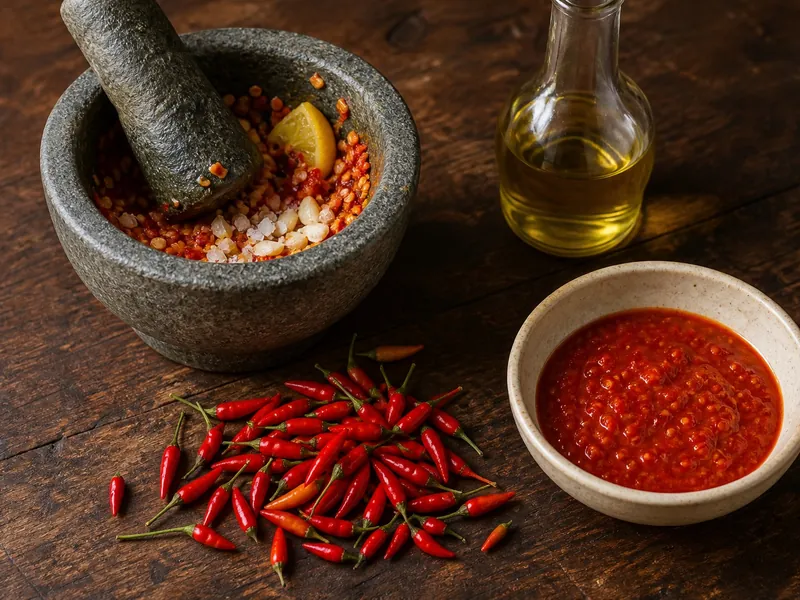
How Should You Handle the Hotter Pods?
Poison Control identifies capsaicin as an intense irritant to skin, eyes, and the digestive tract, and recommends rubber, latex, or nitrile gloves while working with hot peppers. That precaution is appropriate for the bird's eye profiles and especially Fatalii, whose upper published range reaches 400,000 SHU.
Keep hands away from the face, ventilate the room when grinding or heating dried chile, and wash tools and work surfaces after preparation. If pepper juice reaches an eye, Poison Control advises rinsing with room-temperature water for 15 to 20 minutes, while serious breathing trouble or persistent symptoms require direct medical or poison-center advice.
The white placental tissue inside a pod carries much of its capsaicinoid load, as the New Mexico State University Chile Pepper Institute explains in its pepper anatomy materials. Removing that tissue can reduce the amount transferred into a dish, but it does not make a very hot pod mild, so controlled portioning and the capsaicin guide remain more reliable than judging heat by color or pod size.
Hot-pepper handling
- Wear nitrile, latex, or rubber gloves for bird eye and Fatalii pods.
- Keep hands away from eyes and face while cutting or grinding.
- Ventilate the room when heating or grinding dried chile.
- Rinse an exposed eye with room-temperature water for 15 to 20 minutes and seek poison-center advice if symptoms persist.
Heat Level Distribution
How african peppers distribute across the Scoville scale. Click any tier to browse all peppers at that heat level.
Heat Range Comparison
Visual breakdown of where each variety falls on the Scoville scale. Wider bars show a larger documented SHU spread between individual pods.
The causes of pepper heat variation explain why pods from one cultivar do not always measure alike.
Related Comparisons
Side-by-side breakdowns of heat, flavor, and cooking uses. Each comparison covers Scoville ratings, pod anatomy, and substitution options.
 400K SHU
vs
350K SHU
400K SHU
vs
350K SHU
Fatalii vs Scotch Bonnet: Citrus Cut or Jerk Heat?
Choose Fatalii when a sauce, seafood dish, or fruit blend needs sharp lemon-like heat. Choose Scotch Bonnet when the dish needs… 400K SHU
vs
350K SHU
400K SHU
vs
350K SHU
Fatalii vs Habanero: A Citrus Twist on the Classic
Fatalii and habanero are both C. chinense peppers with overlapping SHU ranges and similar fruity-citrus flavor profiles, yet they… 175K SHU
vs
50K SHU
175K SHU
vs
50K SHU
Piri Piri vs Cayenne: Bird's Eye vs Dried Powder
Piri piri and cayenne are both workhorses of the hot sauce world, but they sit in surprisingly different positions. Piri piri ranges… 650 SHU
vs
500 SHU
650 SHU
vs
500 SHU
Peppadew vs Cherry Pepper: Brine, Brand, and Bite
Peppadew behaves like a branded brined condiment with predictable sweet tang and gentle warmth. Cherry pepper behaves like a broader… 650 SHU
vs
1K SHU
650 SHU
vs
1K SHU
Peppadew vs Piquillo: Brined or Roasted?
Peppadew is the sweet-brined, crisp choice for cold stuffed bites and tangy accents. Piquillo is the flame-roasted, soft choice for… 500 SHU
vs
650 SHU
500 SHU
vs
650 SHU
Biquinho vs Peppadew: Size, Brine, and Best Uses
Biquinho is a small Brazilian pepper type, while Peppadew is a trademarked sweet-pickled product made for a bolder, larger bite…Browse all comparisons in our comparison hub, or use the pepper tools for calculators and finders.
Related Guides
Reference guides and recipes tied to the same pepper family, region, or use-case.


Explore Other Origins
Peppers evolved in the Americas and spread worldwide through the Columbian Exchange. Each region developed distinct varieties shaped by local cuisine and climate.
Frequently Asked Questions
Sources & References
- Kew Science — Capsicum annuum L.
- Kew Science — Aframomum melegueta K.Schum.
- Kew Science — Medicinal Plant Names Services: Guinea pepper
- Oregon State University Extension — Grow Your Own Peppers
- University of California Agriculture and Natural Resources — Peppers
- University of Rhode Island Community Nutrition — Peri Peri Sauce
- National Capital Poison Center — Capsaicin: When the Chili Is Too Hot
Keep Reading
Jump into the wider database, heat tiers, comparisons, and substitute references without another card wall.