
Chili vs Chile: Which Spelling to Use for the Pepper, Powder, and Stew
Chili is the standard American spelling for the pepper, the powder, the sauce, and the stew. Chile is the Spanish-derived spelling, and New Mexico State University reserves it for the fruit itself.

Chili
Standard American spellingChile
Spanish-derived spelling- Where you see it: General American English and most U.S. packaging vs Mexico, the U.S. Southwest, and Spanish-language writing
- Plural: chilies or chilis vs chiles
- On a menu: A chili dog is topped with the stew vs A chile dog is topped with minced peppers
Chili vs Chile at a glance
| Attribute | Chili | Chile |
|---|---|---|
| What it names in U.S. English | The pepper, the powder, the sauce, and the stew | The pepper itself, and dishes that keep the pepper in the name |
| Where you see it | General American English and most U.S. packaging | Mexico, the U.S. Southwest, and Spanish-language writing |
| Plural | chilies or chilis | chiles |
| On a menu | A chili dog is topped with the stew | A chile dog is topped with minced peppers |
| Capitalized | Never a place | Chile is the South American country |
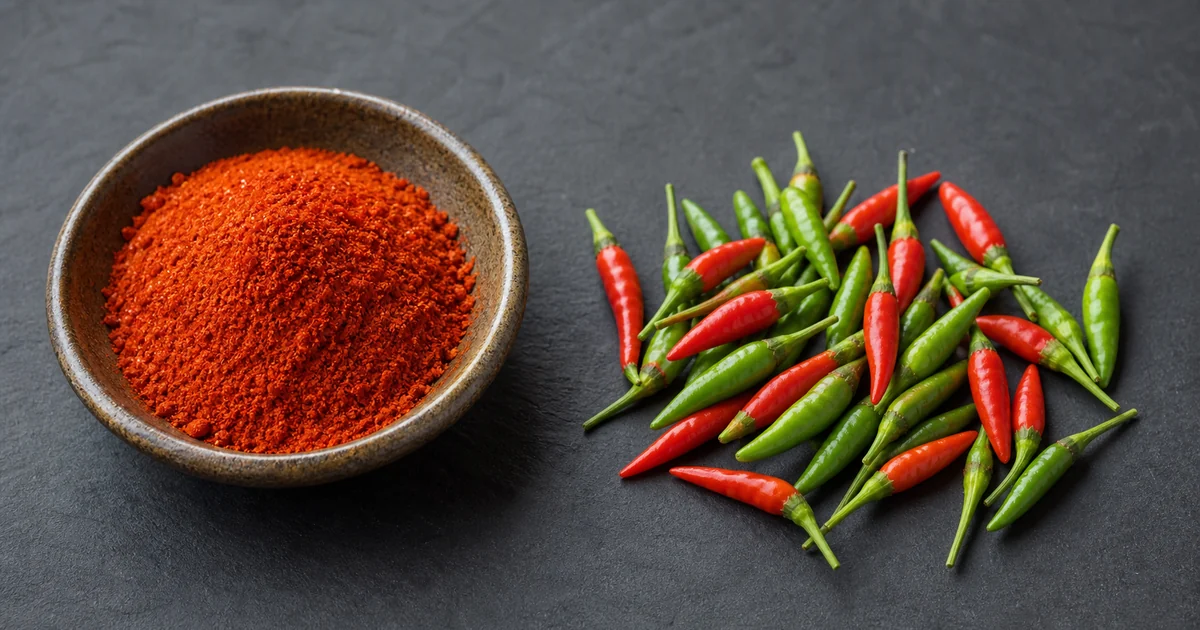
Chili and Chile side by side
Merriam-Webster lists four food senses under one spelling, so the words around chili do most of the defining.
Chile keeps the pepper itself in view, which is why cultivar and dish names hold on to it.
What Each Spelling Means
Merriam-Webster puts the difference down to location rather than meaning. Its usage note calls chili the standard American English name for the hot pepper as well as the spicy stew, condiment, and spice in which it is a prominent ingredient.
That is four different things sharing one spelling, which accounts for most of the confusion the word causes.
British English prefers chilli. The dictionary gives its plurals as chillies or chillis.
Chile is the Spanish-derived spelling, common in southwestern areas of the U.S. where Spanish is frequently used, and its plural is chiles.
American plurals for chili split two ways, chilies and chilis, and both are listed as standard.
None of the three spellings names a different plant. A jalapeño is the same fruit whether the label calls it a chili, a chile, or a chilli.
The Two Rules That Disagree
Two respected sources answer this question differently, and they are not answering the same question. One describes how people write, the other prescribes what each spelling should point at.
Merriam-Webster's rule is geographic, so American English takes chili, British English takes chilli, Spanish-influenced regions take chile, and what the word refers to never enters into it.
New Mexico State University's Chile Pepper Institute draws the line somewhere else entirely. Its FAQ reserves chile for the plant or fruit from the plant, and chili for a cooked dish of meat, beans, tomatoes and chile powder.
Under that rule the spelling tells you what kind of thing you are looking at rather than where the writer lives.
Merriam-Webster is describing usage across English. The Chile Pepper Institute is setting a working rule for a growing region that treats the distinction as load-bearing.
Neither is wrong, and a New Mexico label can follow one rule while a dictionary records the other.
For a reader deciding what to buy or cook, the Institute's rule predicts more. For a reader deciding how to spell a word in their own writing, the dictionary's rule does.
The rest of this page follows whichever of the two answers the question in front of it.
Is Chili Powder the Same as Chile Powder?
This is the one spelling difference that changes what comes out of the pan. Merriam-Webster records it as a working distinction among cooks rather than a dictionary rule.
Chili powder with an i usually implies a powder of ground-up dried peppers mixed with a blend of other spices. Chile powder with an e is reserved for a pure powder of dried peppers only.
A U.S. blend commonly carries cumin, garlic, oregano, and salt alongside the ground pepper.
Swap one for the other and the seasoning shifts twice over. You lose the single-pepper character, and you add spices the recipe may already be calling for separately.
Ancho ground on its own tastes sweet and raisin-like, which a blend flattens into general warmth.
The ingredient list is the only reliable test. One item means a single-pepper powder, and anything longer is a blend.
When the jar in the cupboard turns out to be the wrong kind, the usual chili powder swaps get you closer than thinning a blend with more of itself.
Reading A Label
Most of the ambiguity clears once you read the whole phrase instead of the final letter. The wordings below cover almost everything a U.S. or U.K. shelf will show you.
| Wording | Most likely meaning | What to check |
|---|---|---|
| Fresh green chile | A fresh pepper, often a New Mexico type | Variety and heat level |
| Red chile powder | Ground dried red pepper | Whether it is one cultivar or several |
| Chili powder | A U.S. seasoning blend | Whether salt is the first ingredient |
| Chili sauce | A sweet, vinegared condiment | Sugar, vinegar, and heat |
| Chile sauce | A cooked sauce built on peppers | Whether it is red or green |
| A bowl of chili | The stew | Regional style and whether it has beans |
| Chile relleno | A stuffed fresh pepper | Which pepper the recipe names |
| Chilli con carne | The stew, written for a U.K. reader | Nothing, it is the same dish |
Merriam-Webster notes that chili sauce takes all three spellings, so that row is where the spelling tells you least.
Chili sauce in an American aisle is usually a tomato-based condiment shelved near the ketchup. A jar labelled chile sauce in a Southwestern market is more often a cooking sauce built on roasted New Mexico chile.
Where Does the Word Chili Come From?
All three spellings run back to a single word. Merriam-Webster traces an early record of it to a 16th-century dictionary of Nahuatl, the language of the Aztecs, where it appears transcribed as chilli.
Spanish-speaking Mexicans adopted and modified it as chile.
English picked it up in the 17th century in several forms at once, chille, chile, and chilli. The shortened chili is attested later.
It surfaces in British writing well before it settled as the American standard.
Thackeray used it in Vanity Fair in 1848, in a scene where Rebecca Sharp is handed one at dinner. She thought a chili was something cool, as its name imported, and was served with some.
The joke only lands because the word looked like chilly to an English reader who had never met the fruit.
Chilly is a separate word that happens to sound the same, and it means cold. It shares no ancestry with the pepper, which is why no dictionary lists it as a fourth spelling.
The stew sense arrived later still. Americans seem to have been the first to shorten chili con carne to chili, which becomes established in English by the late-1800s.
The chili dog followed by the mid-1900s, which is roughly the point at which the American spelling stopped being about the pepper at all.
Is the Chile Pepper Named After the Country Chile?
Lowercase chile names the pepper. Capitalized Chile names the South American country.
Merriam-Webster makes the point explicitly, that the pepper word is unrelated to the chili-pepper-shaped country of Chile.
The resemblance is a coincidence of English spelling rather than a shared root. The pepper word came through Nahuatl and Spanish, and the country name did not.
Product labels often set everything in capitals anyway, so a country-of-origin line settles it faster than case does.
Picking One And Sticking To It
A publication can set a house spelling without flattening every name it prints. The rule that survives contact with real recipes is to standardize the generic word and leave proper names alone.
A spice shelf shows the split plainly, where cayenne and paprika carry English names nobody argues about.
The jars beside them keep Spanish ones. Morita and chile de árbol each name one specific dried pepper, so anglicizing them would throw away the information.
Red pepper flakes sit in between, a generic English label for whatever hot pepper the packer crushed.
- Use chili for the American stew and for any product whose own label spells it that way.
- Use chile when naming a specific pepper in Mexican or Southwestern cooking, following the grower where one is named.
- Use chilli when writing for readers in the U.K., Australia, India, or elsewhere in the Commonwealth.
- Keep proper names intact, so chile de árbol never becomes chili de arbol.
- Follow the producer on a named product such as chipotle in adobo.
- Say which powder you mean whenever a recipe calls for one, because the reader cannot tell from the spelling alone.
Merriam-Webster's own closing advice is to be aware of your audience when writing down a recipe or creating a menu.
Serving up the wrong spelling might cause some indigestion, as the dictionary puts it. The cost is small in a blog post and larger on a package a shopper reads in one glance.
Bottom Line
Chili, chile, and chilli all name the same fruit. What separates them is where the writer is and, sometimes, what they are pointing at.
Merriam-Webster settles the question by region, and the Chile Pepper Institute settles it by referent.
Follow the dictionary when you are writing. Follow the Institute when you are shopping, because that is the rule that predicts what is in the jar.
Neither rule tells you how hot any of it is, which is what the Scoville scale is for.
Chili vs Chile
Chili vs Chile FAQ
- Where In the World to Use 'Chili,' 'Chilli,' and 'Chile' - Merriam-Webster
- Chile Pepper Institute FAQs - New Mexico State University