
Calabrian Chili vs Fresno: Which Pepper to Use?
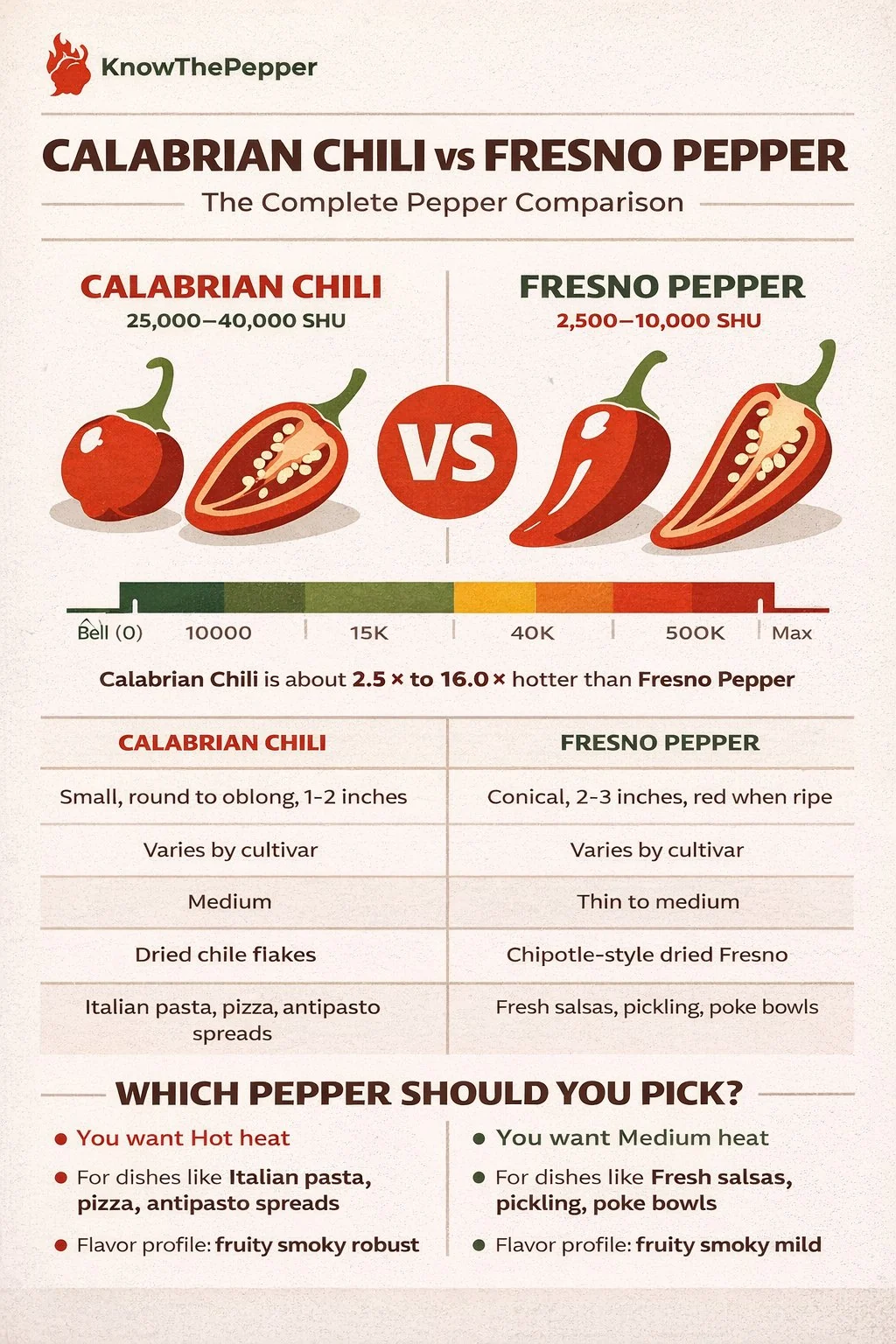
Calabrian chili and Fresno share a surprisingly similar flavor DNA - both fruity, both carrying a smoky undertone - but their heat levels tell a very different story. Calabrian chili sits at 25,000-40,000 SHU, while Fresno lands between 2,500-10,000 SHU, making the Italian import anywhere from 3 to 16 times hotter depending on individual specimens. Choosing between them comes down to how much fire you want behind that shared fruitiness.

Calabrian Chili measures 25K–40K SHU while Fresno Pepper registers 3K–10K SHU — making Calabrian Chili 4× hotter. Calabrian Chili is known for its fruity and smoky flavor (C. annuum), while Fresno Pepper offers fruity and smoky notes (C. annuum).
- Heat difference: Calabrian Chili is 4× hotter
- Species: Both are C. annuum
- Best for: Calabrian Chili excels in everyday cooking and salsas, Fresno Pepper in fresh salsas and mild recipes
Calabrian Chili
HotFresno Pepper
HotCalabrian Chili vs Fresno Pepper Comparison
Calabrian Chili vs Fresno Pepper Heat Levels
The first time someone handed me a Calabrian chili paste and told me it was 'basically like a Fresno,' I understood the confusion - the aroma is genuinely similar. Then I tasted it.
Calabrian chili registers at 25,000-40,000 SHU, placing it firmly in the hot pepper intensity band alongside cayennes and Thai bird chilies. Fresno comes in at a much more approachable 2,500-10,000 SHU, sitting in the medium-heat pepper category - closer to a poblano ceiling than a cayenne floor.
For reference, a guajillo pepper typically tops out around 5,000 SHU. A ripe Fresno at its hottest matches that ceiling. A Calabrian chili at its mildest is already 5x hotter than a guajillo, and at peak heat it can reach 8x that benchmark. That gap matters enormously in practical cooking.
Both peppers build heat through capsaicin concentration - if you want to understand why that compound triggers the burn sensation in the first place, the chemistry is worth knowing. But the experiential difference here is that Fresno heat arrives quickly and fades relatively fast, while Calabrian chili delivers a slower, more persistent burn that lingers on the palate.
Fresno's position on the Scoville unit spectrum puts it in a range most home cooks handle comfortably without dairy backup. Calabrian chili demands more respect - a little goes further than most people expect the first time.
Flavor Profile Comparison
Calabria, the sun-scorched toe of Italy's boot, produces a pepper that reflects its terroir completely — intense, complex, and a little wild.
The Fresno pepper gets mistaken for a red jalapeño constantly — same conical shape, similar color, sold side by side at the grocery store.
Strip away the heat differential and these two peppers are closer relatives than their geography suggests. Both lead with bright, berry-adjacent fruitiness. Both carry a subtle smokiness that deepens when cooked. On paper, nearly identical. In practice, the nuances matter.
Fresno pepper flavor is clean and forward - the fruitiness reads almost like a ripe red cherry or cranberry, with the smokiness staying politely in the background. Raw Fresno has a crisp, almost bell-pepper-like freshness that softens into something richer when roasted or charred. It's an American-grown pepper with a flavor profile designed, essentially, by accident - Fresno was bred as a commercial crop, not an artisan ingredient, yet it developed genuinely complex taste.
Calabrian chili carries more weight. The fruitiness is there, but it's darker - think dried cherry or sun-ripened plum rather than fresh berry. The smokiness is more pronounced, likely amplified by the traditional drying and oil-packing methods used in Calabria. As an Italian regional pepper with centuries of culinary tradition behind it, Calabrian chili has been shaped by preservation techniques that concentrate and transform its base flavors.
The texture difference also affects flavor perception. Fresno arrives fresh or pickled, delivering moisture and brightness. Calabrian chili most commonly appears as a paste or in oil, which means the flavor hits differently - richer, more saturated, almost umami-adjacent from the oil infusion.
For dishes where you want the pepper to sing clearly, Fresno's transparency is an asset. When you want depth that integrates into the background of a sauce or braise, Calabrian chili's density does work that Fresno simply cannot.
Culinary Uses for Calabrian Chili and Fresno Pepper
These peppers overlap in some applications and diverge sharply in others - knowing which is which saves a lot of overseasoned dinners.
Fresno excels anywhere you'd use a fresh pepper with moderate heat. Salsas, ceviches, quick pickles, grain bowls, and tacos all benefit from its bright, approachable character. It holds its shape beautifully when sliced thin for garnish or roasted whole. For the Fresno vs. red jalapeño heat and flavor matchup, the two are close enough that Fresno substitutes 1:1 in most fresh applications. The same logic applies when looking at the Fresno versus jalapeño side-by-side - Fresno runs slightly hotter at its peak but behaves similarly in the kitchen.
Calabrian chili dominates in cooked, oil-based, and preserved applications. A spoonful of Calabrian chili paste stirred into pasta aglio e olio transforms it. It belongs in pizza sauce, braised meats, compound butters, and aioli. Even a small amount - 1/4 teaspoon of paste - adds heat and complexity that would require 2-3 whole Fresno peppers to approximate, and even then the flavor character won't match exactly.
For the Peperone di Senise versus Calabrian chili comparison, you see how dramatically Calabrian peppers differ even within the same Italian regional tradition - context matters when sourcing.
Substitution guidance: Replace Calabrian chili paste with Fresno at a 3:1 ratio by volume (3 minced Fresnos per 1 teaspoon paste), and add a pinch of smoked paprika to approximate the depth. Going the other direction - replacing Fresno with Calabrian - use 1/3 the volume and taste aggressively as you go. The heat spike is real.
Both peppers work in egg dishes, grain salads, and roasted vegetable preparations. Calabrian chili in oil doubles as a finishing drizzle in ways fresh Fresno cannot.
Which Should You Choose?
If your recipe calls for fresh pepper presence - something to slice, roast, or pickle - Fresno is the practical choice. It delivers genuine fruitiness and moderate heat without overwhelming other ingredients, and it's widely available at most grocery stores. The step-by-step pepper growing walkthrough is worth consulting if you want a steady home supply, since Fresno is one of the easier C. annuum species peppers to cultivate in most climates.
Calabrian chili wins when you need concentrated flavor and heat in a small footprint - pasta, pizza, braises, and compound sauces where a jar of paste does heavy lifting without bulk. It's not a fresh-pepper substitute; it's a different category of ingredient entirely.
The honest answer: keep both. Fresno for fresh applications and weeknight cooking, Calabrian chili paste in the pantry for when a dish needs that specific Italian-heat depth. They're not competing - they're complementary tools with a shared flavor language.
Can You Substitute One for the Other?
Yes — direct substitution works. Calabrian Chili and Fresno Pepper are close enough in heat to swap at roughly 1:1. The main difference will be flavor. For more swap options, explore ranked alternatives with conversion ratios.
Growing Calabrian Chili vs Fresno Pepper
If you’re deciding which pepper to grow at home, consider your climate and patience level. Calabrian Chili and Fresno Pepper have different maturation times and temperature preferences. Hotter varieties generally need a longer, warmer growing season to develop their full capsaicin content. Our zone-based planting date tool can pinpoint the best sowing window for your area.
Growing Calabrian chilies follows the standard C. annuum playbook, but they particularly reward warm, dry conditions — which makes sense given their origin.
Transplant outdoors once nighttime temps stay above 55°F. These plants prefer full sun and well-drained soil; they'll tolerate drought better than many peppers but produce more flavorful pods with consistent moderate watering.
Pods mature in 80–90 days from transplant. Harvest when fully red for maximum fruity character.
Fresnos are straightforward to grow but reward growers who manage water stress deliberately. Start seeds indoors 8–10 weeks before last frost — they germinate well at 80–85°F soil temperature and typically sprout within 10–14 days.
Transplant after all frost risk has passed, spacing plants 18 inches apart in full sun. They need at least 6–8 hours of direct light daily.
For more heat in your harvest, reduce watering by about 30% during the final 2–3 weeks of ripening. This mild drought stress increases capsaicin concentration noticeably — the same technique used commercially to push Fresnos toward the upper end of their 10,000 SHU ceiling.
History & Origin of Calabrian Chili and Fresno Pepper
Both peppers carry centuries of culinary heritage. Calabrian Chili traces its roots to Italy, while Fresno Pepper originates from USA. Understanding their backstory helps explain why each pepper developed its distinctive traits.
Buying & Storage
Whether you’re shopping for Calabrian Chili or Fresno Pepper, the same quality indicators apply. Fresh peppers should feel firm and heavy for their size, with taut, glossy skin and no soft or wet spots. Minor stem cracks known as “corking” are perfectly normal and often indicate a mature, flavorful pod.
- Firm pods with taut skin and consistent color
- Should feel heavy relative to size
- Minor stem cracks (“corking”) are normal
- Avoid anything soft, shriveled, or with dark wet spots
- Fresh: Paper bag, crisper drawer — 1–2 weeks
- Frozen: Wash, dry, freeze on sheet pan — 6+ months
- Dried: Airtight, away from light — up to 1 year
The Verdict: Calabrian Chili vs Fresno Pepper
Calabrian Chili and Fresno Pepper sit in the same heat tier but serve different roles. Calabrian Chili delivers 4× more heat with its distinctive fruity and smoky character. Fresno Pepper, with its fruity and smoky profile, excels in everyday cooking.
Frequently Asked Questions
Related Comparisons
Sources pending verification.
