Jalapeño vs Poblano: Heat, Flavor and Best Uses for Cooking
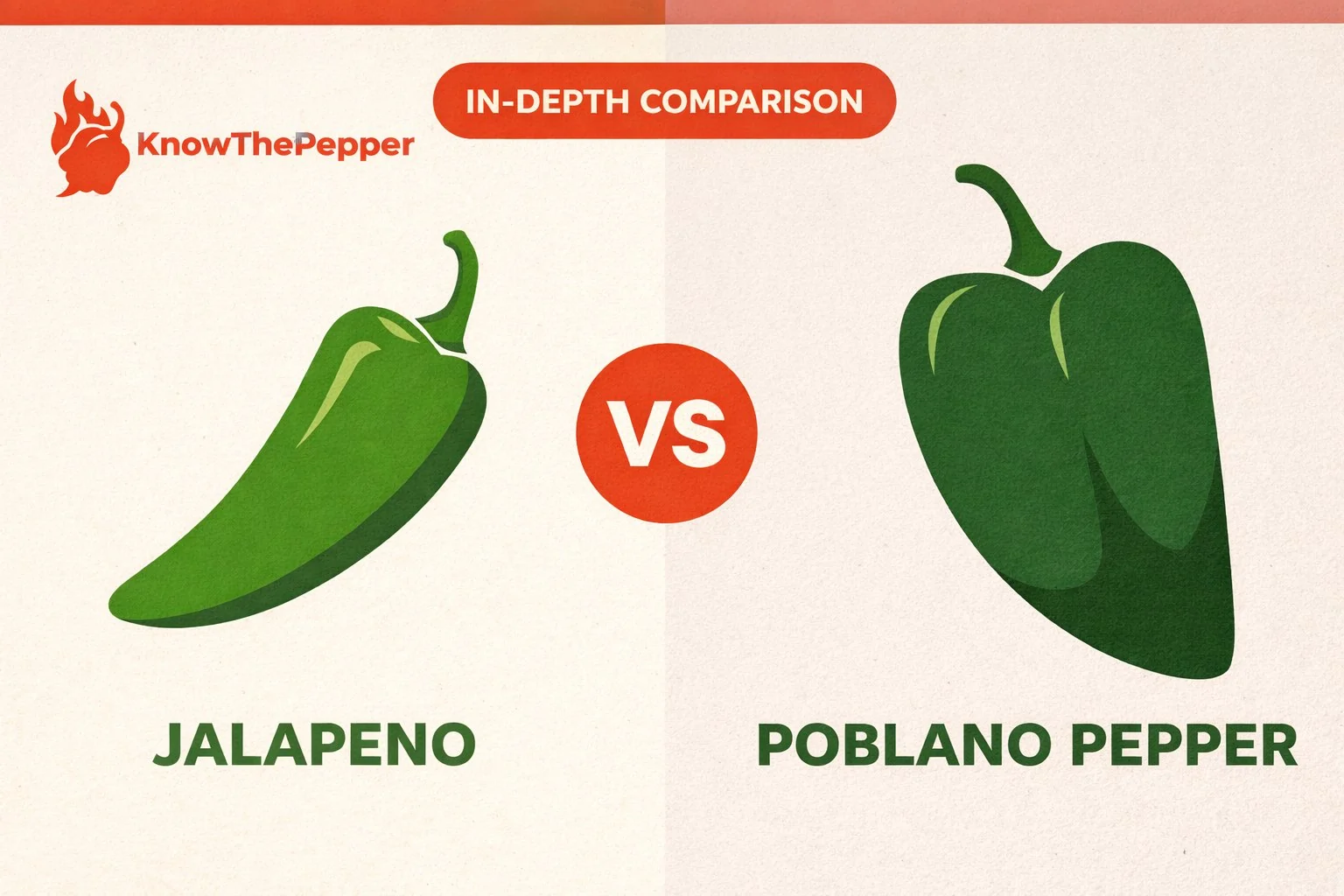
Jalapeño and poblano are both Mexican-born members of C. annuum, but they sit in very different places on the heat scale and serve different roles in the kitchen. The jalapeño runs 2,500–8,000 SHU, while the poblano tops out around 1,000–2,000 SHU — making the jalapeño anywhere from 1.5 to 8 times hotter depending on individual fruit. Flavor-wise, they're almost opposites: jalapeños bring bright, grassy snap while poblanos deliver a deep, earthy richness that transforms completely when dried into ancho chiles.
Comparison Contributor·Updated Jun 21, 2026·
Reviewed by
Karen Liu
Quick Comparison
Jalapeño measures 3K–8K SHU while Poblano Pepper registers 1K–2K SHU. That makes Jalapeño about 4x hotter by upper SHU range. Jalapeño is known for its Grassy, crisp, lightly sweet when red flavor (C. annuum), while Poblano Pepper offers earthy and rich notes (C. annuum).
Jalapeño
3K–8K SHU
Medium · Grassy, crisp, lightly sweet when red
Poblano Pepper
1K–2K SHU
Medium · earthy and rich
Heat difference: Jalapeño is about 4× hotter by upper SHU range
Species: Both are C. annuum
Best for: Jalapeño excels in everyday cooking and salsas, Poblano Pepper in fresh salsas and mild recipes
The numbers tell the first part of the story. Poblanos land between 1,000 and 2,000 SHU, placing them firmly in what most heat charts call the low end of medium-intensity peppers — noticeable warmth, but nothing that lingers uncomfortably. Jalapeños clock in at 2,500 to 8,000 SHU, meaning even the mildest jalapeño beats the hottest poblano by at least 500 units, and a fully ripe red jalapeño can hit four times the ceiling of a poblano.
For a useful reference point: a Fresno chile averages around 2,500–10,000 SHU, putting it in the same general neighborhood as jalapeños. Poblanos sit measurably below both. If a Fresno is your benchmark for 'moderate heat,' expect a jalapeño to match or slightly exceed that, and a poblano to feel noticeably tamer.
What makes the jalapeño's heat interesting is its variability. Stress factors — drought, high temperatures, soil composition — push capsaicin production upward. A grocery-store jalapeño grown under comfortable conditions might read closer to 2,500–3,500 SHU. One from a hot, dry garden in late summer can approach the upper range. Poblanos are more consistent; their thick walls and lower capsaicin baseline don't swing as dramatically.
The burn character differs too. Jalapeño heat hits the front of the mouth and mid-palate with a clean, quick sharpness. Poblano's mild heat is broader and slower — you feel it as warmth rather than sting. Understanding why capsaicin binds to TRPV1 receptors explains why these two peppers, despite being botanical cousins, produce such different sensations at the table.
The poblano is Mexico's most important large fresh chile - the backbone of chiles rellenos, the base of mole negro, and the fresh pepper that most closely bridges mild bell peppers and the heat of jalapeños.
Strip away the heat and you're left with two genuinely distinct flavor profiles. Jalapeños have a brightness that's almost vegetal — grassy, slightly acidic, with a fresh green quality that makes raw slices pop in a salsa or on a nacho. Ripe red jalapeños soften that edge and pick up a subtle fruitiness, but the characteristic snap never fully disappears.
Poblanos operate in a different register entirely. Their flavor is earthy, almost chocolatey in the way a good dark roast coffee is — complex without being sharp. There's a mild bitterness at the skin that roasting converts into something smoky and rich. Raw poblano has a pleasant vegetal depth; roasted and peeled, it becomes almost meaty, with a texture and flavor concentration that few fresh peppers can match.
Aroma is another point of divergence. Fresh jalapeños have a distinct, assertive smell — cut one open and the scent announces itself. Poblanos smell milder raw, but the moment they hit a dry skillet or open flame, they release an aroma that's nutty and complex. This is why they're the standard choice for chiles rellenos and mole negro foundations: the roasted depth can't be replicated with a hotter, sharper pepper.
Both belong to the broader Mexican pepper growing tradition and share the C. annuum species, which also includes bells, cayennes, and serranos. But within that species, jalapeño and poblano represent nearly opposite flavor strategies — one built for bright, punchy contrast, the other for slow-building, layered depth.
Culinary Uses for Jalapeño and Poblano Pepper
Jalapeño
Medium
Use raw green jalapeños when you want crunch and grassy heat. Dice them small for pico de gallo, slice them thin for tacos and sandwiches, or mince one pod into guacamole when serrano would be too sharp.
Roasting and peeling is the starting point for most poblano applications. Hold the pepper over a gas flame or under a broiler, turning until the skin chars black on all sides - usually 8–12 minutes total.
Chiles rellenos is where poblanos are irreplaceable. The pepper's size (typically 4–5 inches), thick walls, and earthy flavor make it the structural and cooking foundation of the dish — stuff it with cheese or picadillo, batter it, fry it, and that roasted poblano flavor carries everything. No other fresh pepper handles that role as well. The comparison to bell pepper's milder profile makes clear why bells fall short: not enough flavor complexity.
For mole negro and other long-cooked sauces, dried poblanos — sold as ancho chiles — provide the dark, raisin-like depth that defines the sauce. Fresh poblanos also work sliced into rajas, the cream-braised strips served with corn and onion that pair with almost any protein.
Jalapeños cover more ground. Raw, they go into pico de gallo, guacamole, ceviche, and relishes where their brightness reads as freshness rather than heat. Pickled jalapeños (en escabeche) are a different ingredient entirely — vinegar softens the heat and adds tang. Smoked and dried, they become chipotles, which share some of the poblano's depth but with considerably more fire.
For heat-swapping: replacing a jalapeño with a poblano cuts heat by roughly 60–75% and shifts flavor toward earthiness. Going the other direction — subbing jalapeño for poblano — adds significant heat and loses the structural qualities needed for stuffed preparations. In cooked salsas or stews, the swap works better than in fresh applications.
The cayenne-to-jalapeño heat jump and the bird's eye versus jalapeño intensity gap both illustrate how jalapeños sit in a practical middle zone — hot enough to matter, mild enough for broad audiences. Poblanos occupy a different niche: maximum flavor with minimum heat penalty.
If your goal is heat with fresh flavor — salsas, pickling, anything where you want the pepper's presence felt — jalapeño is the answer. It's flexible, widely available, and its 2,500–8,000 SHU range gives you room to calibrate by choosing younger green fruit or riper red ones.
If you want depth without fire — stuffed peppers, roasted preparations, slow-cooked sauces — poblano has no real substitute. Its earthy richness at 1,000–2,000 SHU means it adds complexity without overwhelming the dish, and its size and wall thickness open up cooking techniques jalapeños simply can't support.
For everyday cooking, keeping both on hand makes sense. They don't compete — they complement. Jalapeño handles the heat and brightness; poblano handles the body and earthiness. Together, they cover most of what Mexican-inspired cooking demands, and they're among the most approachable peppers for cooks at any experience level.
Can You Substitute One for the Other?
Start near 1:1 by amount. The heat ranges are close enough that flavor, form, and recipe role matter more than a strict Scoville conversion.
Growing Jalapeño vs Poblano Pepper
Growing notes
Jalapeño
Jalapeños are forgiving, but they still want warm pepper conditions. Start seed indoors about 8 weeks before transplanting or buy sturdy starts, then move plants outside after frost risk has passed and nights are reliably warm.
University of Minnesota Extension notes that peppers need warm soil, full sun, and steady moisture. In a garden bed, space jalapeño plants about 18-24 inches apart so air can move around the canopy.
Use a container only if it gives the roots enough room. A 5-gallon pot is a practical minimum for one plant, with drainage holes and a potting mix that does not stay soggy.
Growing notes
Poblano Pepper
Poblanos grow well in most North American climates given a full growing season. Start seeds indoors 8–10 weeks before last frost at 75–85°F soil temperature.
Transplant spacing: 18–24 inches apart in full sun with 6–8 hours of direct light daily. Poblanos are slightly more shade-tolerant than most hot peppers, though full sun produces better yield and more developed flavor.
Poblanos take 65–80 days from transplant to green maturity - the standard harvest stage for fresh cooking. Leaving them to ripen to red takes another 2–3 weeks and transforms the flavor toward sweetness.
Where They Come From
Origin & background
Jalapeño
Mexico · C. annuum
The name jalapeño points back to Jalapa, the older English spelling associated with Xalapa in Veracruz. That origin clue is useful, but it does not mean every modern jalapeño in a grocery bin came from Veracruz.
Modern jalapeño identity is also shaped by breeding. NMSU lists named jalapeño cultivars such as NuMex Primavera, NuMex Vaquero, and NuMex Jalmundo, and the Vaquero pedigree includes Early Jalapeño and TAM Jalapeño.
Origin & background
Poblano Pepper
Mexico · C. annuum
The poblano takes its name from Puebla, the central Mexican state where it has been cultivated for centuries. Puebla is one of Mexico's most culinarily significant regions - home to mole poblano, the complex sauce built around dried anchos (dried poblanos) that represents one of Mexico's most celebrated culinary achievements.
Pre-Columbian cultivation of large C. annuum varieties in Mesoamerica is well-documented archaeologically. The poblano's size, mild heat, and thick flesh suggest it was bred over generations for culinary versatility - the thick walls that survive stuffing and roasting are agricultural decisions, not accidents.
Buying & Storage
Whether you’re shopping for Jalapeño or Poblano Pepper, the same quality indicators apply. Fresh peppers should feel firm and heavy for their size, with taut, glossy skin and no soft or wet spots. Minor stem cracks known as “corking” are perfectly normal and often indicate a mature, flavorful pod.
Selection
What to look for
Firm pods with taut skin and consistent color
Should feel heavy relative to size
Minor stem cracks (“corking”) are normal
Avoid anything soft, shriveled, or with dark wet spots
Storage
How to store them
Fresh: Paper bag, crisper drawer, 1 to 2 weeks
Frozen: Wash, dry, freeze on sheet pan, 6+ months
Dried: Airtight and away from light, up to 1 year
Mistakes to avoid
Common misses
Jalapeño
Equating green with unripe. Different products.
Overcooking. Cell walls break down fast.
Sealed plastic storage. Causes rot. Use paper bags.
Common misses
Poblano Pepper
Equating green with unripe. Different products.
Overcooking. Cell walls break down fast.
Sealed plastic storage. Causes rot. Use paper bags.
Final call
Jalapeño vs Poblano Pepper
Jalapeño and Poblano Pepper
sit in the same heat tier but serve different roles. Jalapeño delivers about 4× more upper-range heat with its distinctive Grassy, crisp, lightly sweet when red character.
Poblano Pepper, with its earthy and rich profile, excels in everyday cooking.
Heat gap about 4× by upper rangeJalapeño Grassy, crisp, lightly sweet when redPoblano Pepper earthy and rich
Choose Jalapeño when the recipe needs clean medium-to-hot heat and a flavor profile built around bright and grassy. It is the better fit for salsa, pickling, roasting, stuffing, and everyday cooking where moderate heat is enough.
Choose Poblano Pepper when the dish needs mild to medium heat and a flavor profile built around earthy and rich. It is the better fit for salsa, pickling, roasting, stuffing, and everyday cooking where moderate heat is enough.
The practical decision is not just heat. Wall thickness, dried versus fresh form, sweetness, smoke, and regional use all change the result. If a recipe names one pepper because of a regional sauce, pickle, paste, or stuffing method, use that pepper first and treat the other as an adjustment, not an equal swap.
Heat And Substitution Notes
Jalapeño is listed at 2,500-8,000 SHU. Poblano Pepper is listed at 1,000-2,000 SHU. At midpoint, Jalapeño runs about 3.5x hotter than Poblano Pepper. That is only a planning number, but it keeps substitutions from drifting wildly.
For substitution, start by matching the role before matching the number. If the pepper is mainly there for color or body, use volume as the guide. If it is there for heat, start with half the hotter pepper and taste before adding more. If it is a dried chile comparison, match by seeded weight after stems are removed, not by pod count.
Flavor is the second correction. Add a little vinegar or lime when the replacement tastes flat, a pinch of sugar when the replacement tastes bitter, and a small amount of smoked paprika only when the original pepper had smoke. Do not add smoke to a bright fresh-pepper dish unless the recipe already points that way.
Practical Decision Notes
The practical split is fresh heat versus green pepper body. Jalape - o gives a compact medium burn at 2,500-8,000 SHU, while poblano stays mild at 1,000-2,000 SHU. By midpoint, jalape - o is about 3.5 times hotter, and its smaller walls carry heat into salsa or chopped toppings faster.
Use jalape - o when the dish needs bite: pico de gallo, guacamole, cornbread, nachos, quick pickles, and green hot sauce. Use poblano when the pepper is part of the structure: rajas, chiles rellenos, stuffed peppers, roasted strips, soups, and cream sauces.
The swap changes texture as much as heat. A poblano can replace several jalape - os for volume, but it will not provide the same grassy snap or quick burn. A jalape - o can replace poblano for heat, but it cannot act as a stuffing shell. For roasted sauces, mix one jalape - o with roasted poblano when you need both body and a clean heat lift.
Fact-Checked & Expert Reviewed
Editorial Standards: Head-to-head comparisons include blind tasting when applicable. Heat levels cross-referenced with multiple sources. All substitution ratios tested side-by-side.
Review Process:
Written by
James Thompson
(Lead Comparison Reviewer)
, reviewed by
Karen Liu
(Lead Fact-Checker & Science Editor)
. Last updated June 21, 2026.
Jalapeño vs Poblano Pepper FAQ
Yes — poblanos top out at 2,000 SHU while jalapeños start at 2,500 SHU, so even the hottest poblano is milder than the mildest jalapeño. The heat character is also different: poblano warmth is broad and slow, while jalapeño delivers a sharper front-of-mouth sting.
Not practically — jalapeños are too small and thin-walled to stuff and fry in the same way. For a stuffed pepper preparation, you'd need a larger C. annuum variety like an Anaheim or cubanelle if poblanos aren't available.
Dried poblanos become ancho chiles, one of the most widely used dried peppers in Mexican cooking. The drying process concentrates the earthy, slightly fruity flavor and deepens the color to a dark reddish-brown.
Capsaicin production in jalapeños responds to environmental stress — drought, heat, and soil conditions all push the SHU higher. A commercially grown jalapeño under consistent irrigation can be significantly milder than one grown in a hot, dry garden.
Yes — both are Capsicum annuum, the same botanical species that includes bell peppers, cayennes, and serranos. Despite sharing a species, they were developed in different regions of Mexico and selected for very different culinary traits over centuries.