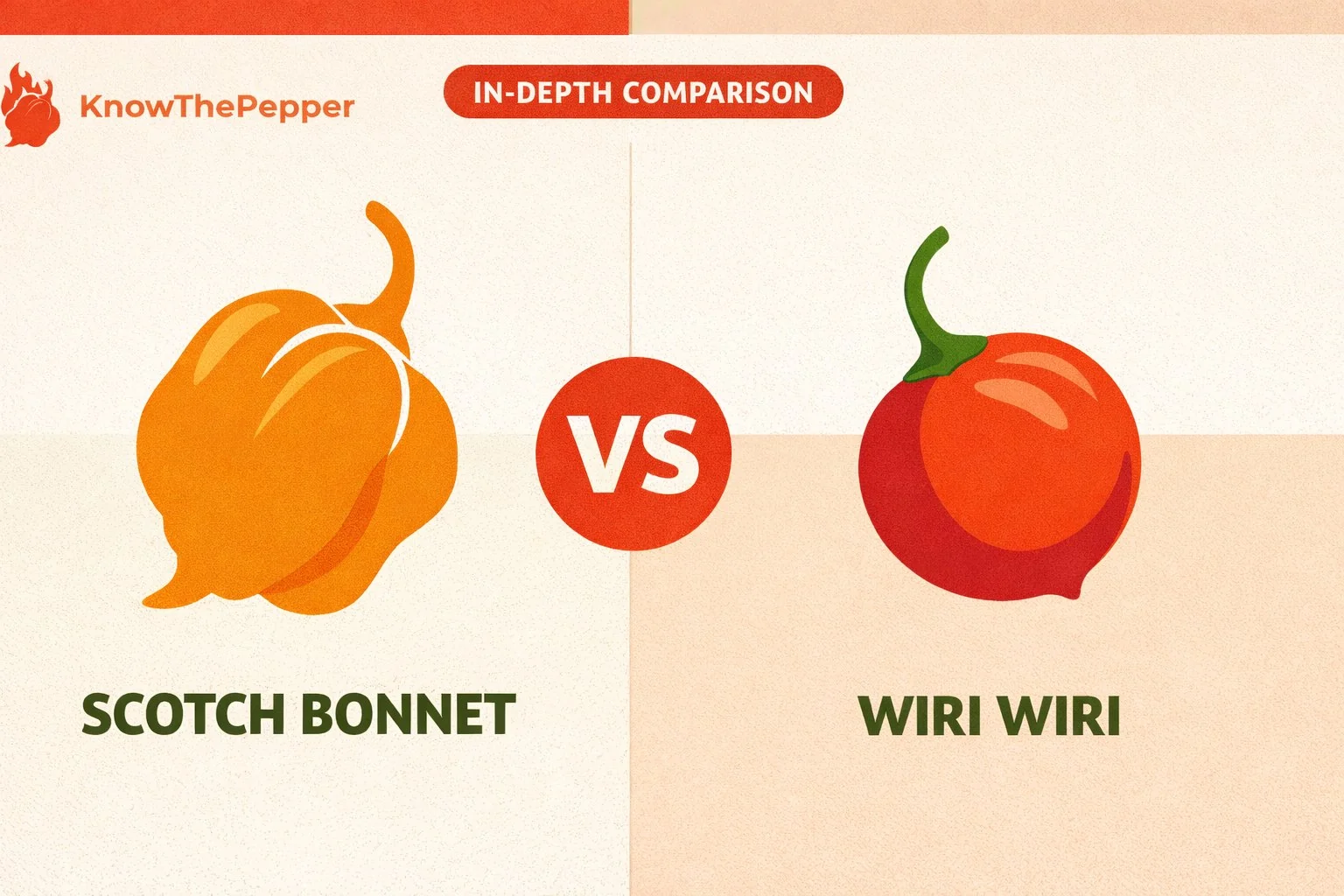
Scotch Bonnet vs Habanero: Heat, Flavor & Key Differences
Scotch Bonnet and Habanero share identical SHU ranges of 100,000-350,000 and the same C. chinense species, yet they taste noticeably different in the kitchen. One carries the soul of Caribbean cooking, the other the citrus-bright heat of the Yucatan. Choosing between them matters more for flavor than for fire.

Scotch bonnet and habanero are different C. chinense peppers with overlapping heat. Scotch bonnet is squat and lobed with a Caribbean identity, while habanero is pointed and bell-shaped with a strong Yucatan identity. Choose by dish and measure prepared pepper when substituting.
- Botanical relationship: C. chinense pod type vs C. chinense pod type
- Typical silhouette: Squat, lobed, flared lower rim vs Bell or lantern shape with pointed tip
- Published heat band: 100,000 to 350,000 SHU vs 100,000 to 350,000 SHU
- Strongest regional cue: Jamaican and Caribbean dishes vs Yucatan dishes
- Best substitution measure: Prepared weight or volume vs Prepared weight or volume
Scotch Bonnet
Extra-HotHabanero
Extra-HotQuick Comparison
| Attribute | Scotch Bonnet | Habanero |
|---|---|---|
| Botanical relationship | C. chinense pod type | C. chinense pod type |
| Typical silhouette | Squat, lobed, flared lower rim | Bell or lantern shape with pointed tip |
| Published heat band | 100,000 to 350,000 SHU | 100,000 to 350,000 SHU |
| Strongest regional cue | Jamaican and Caribbean dishes | Yucatan dishes |
| Best substitution measure | Prepared weight or volume | Prepared weight or volume |
Are Scotch Bonnet and Habanero the Same Pepper?
Scotch bonnet and habanero are different peppers, although both belong to Capsicum chinense. University of Florida IFAS describes Scotch bonnet as a close relative of habanero, not as a second name for the same pod.
That distinction matters because C. chinense contains many pod types. Shared species can explain similar waxy skin, floral fruit aroma, and intense capsaicin heat, but it does not erase differences in shape, regional identity, or cultivar.
Same species does not mean the same market pepper
The Jamaican Ministry of Agriculture gives Scotch bonnet a formal visual standard built around a squat cup-and-saucer shape with three to four lobes. Mexico's official standard for protected Yucatan habanero instead describes a hollow bell-shaped fruit that ends in a point.
Color cannot settle the identity. Scotch bonnets may mature yellow, orange, or red, while habaneros also appear in several ripe colors, so two orange pods can still represent different named types.
Their close appearance also creates a real shopping problem. A grocer may use a loose shelf sign for a mixed group of hot C. chinense peppers, and a pod grown from crossed or poorly documented seed may not match either formal shape cleanly.
Which one is hotter?
Neither name guarantees a hotter pod. UF/IFAS reports Scotch bonnet at 100,000 to 350,000 Scoville heat units, and University of California guidance places standard habanero in the same broad 100,000 to 350,000 range.
The overlap is much more useful than a false winner. Genetics, maturity, plant stress, growing conditions, and variation within one harvest can move an individual fruit around its expected band.
New Mexico State University gives Orange Habanero an average of about 300,000 SHU on a dry-weight basis in its cultivar record. That cultivar figure helps describe one reference pepper, but it cannot predict the exact heat of a fresh pod in your hand.
Most capsaicin concentrates in the pale placental tissue where the seeds attach. The seeds can carry capsaicin from contact, but removing seeds while leaving the placenta in place does not remove the main heat source.
Treat both peppers as seriously hot. Start with a controlled prepared amount, then taste the finished mixture after the pepper has dispersed instead of deciding by color, name, or one bite from an isolated piece.
| Question | Scotch bonnet | Habanero |
|---|---|---|
| Species | C. chinense | C. chinense |
| Published heat band | 100,000 to 350,000 SHU | 100,000 to 350,000 SHU |
| Reliable hotter winner | None by name | None by name |
| Main dose clue | Prepared amount and placenta | Prepared amount and placenta |
How Can You Tell a Scotch Bonnet From a Habanero?
Shape is the most dependable first clue because the two peppers can share color, shine, and size. A true Scotch bonnet spreads outward, while a habanero usually narrows toward a lower point.
Read the pod from the shoulders down
The Jamaican produce standard calls the best Scotch bonnet shape a cup and saucer with three to four lobes. The broad lower brim can look almost flattened beneath the upper body, which creates the bonnet resemblance.
The same standard sets a useful size reference. Grade 1 Scotch bonnets measure at least 4.5 centimeters across, while lower grades may be smaller or less evenly lobed.
That number is a quality grade, not a universal identity test. A small Scotch bonnet can still be genuine, and an unusually broad habanero does not become Scotch bonnet merely because it reaches the same width.
Protected Yucatan habanero has a different official description. Mexico's standard calls it a hollow bell-shaped berry with a pointed end, two to four internal carpels, thin flesh, and a skin that remains fine but resistant.
Follow the silhouette from the stem to the base. Look for a wide lobed skirt on Scotch bonnet and a longer bell body with a clear downward point on habanero, then confirm that the pod is firm and free of shriveling or decay.
The photographic diagram shows whole and cut fruit at the same scale. The cross-sections reveal similar thin walls and central placental tissue, while the outside contours carry the stronger identification signal.
Treat flavor words as tendencies
Both peppers can smell fruity, floral, and bright before their heat dominates. Scotch bonnet often reads rounder or more tropical in a simple sauce, while habanero often reads sharper or more citrus-forward.
Those descriptions are useful tendencies, not fixed ingredient labels. Cultivar, ripeness, soil, harvest handling, and the rest of the recipe can blur or reverse a neat mango-versus-orange story.
The distinction is easiest to notice when the ingredient list is short. A raw pepper sauce, vinegar pickle, or uncooked salsa exposes aroma more clearly than a long stew with browned meat, smoke, allspice, and several herbs.
Supporting seasonings also steer perception. Allspice, thyme, scallion, ginger, and warm spice reinforce Scotch bonnet's Caribbean direction, while sour orange, lime, red onion, and tomato make a habanero's bright edge feel at home.
If the pepper is one note among many, shape and cuisine provide firmer evidence than an aroma adjective. If the pepper is the main flavor, a small side-by-side taste of properly diluted sauce can reveal the difference without asking anyone to bite a raw pod.
Three to four rounded lobes spread across a squat body
A flared lower rim creates the bonnet profile
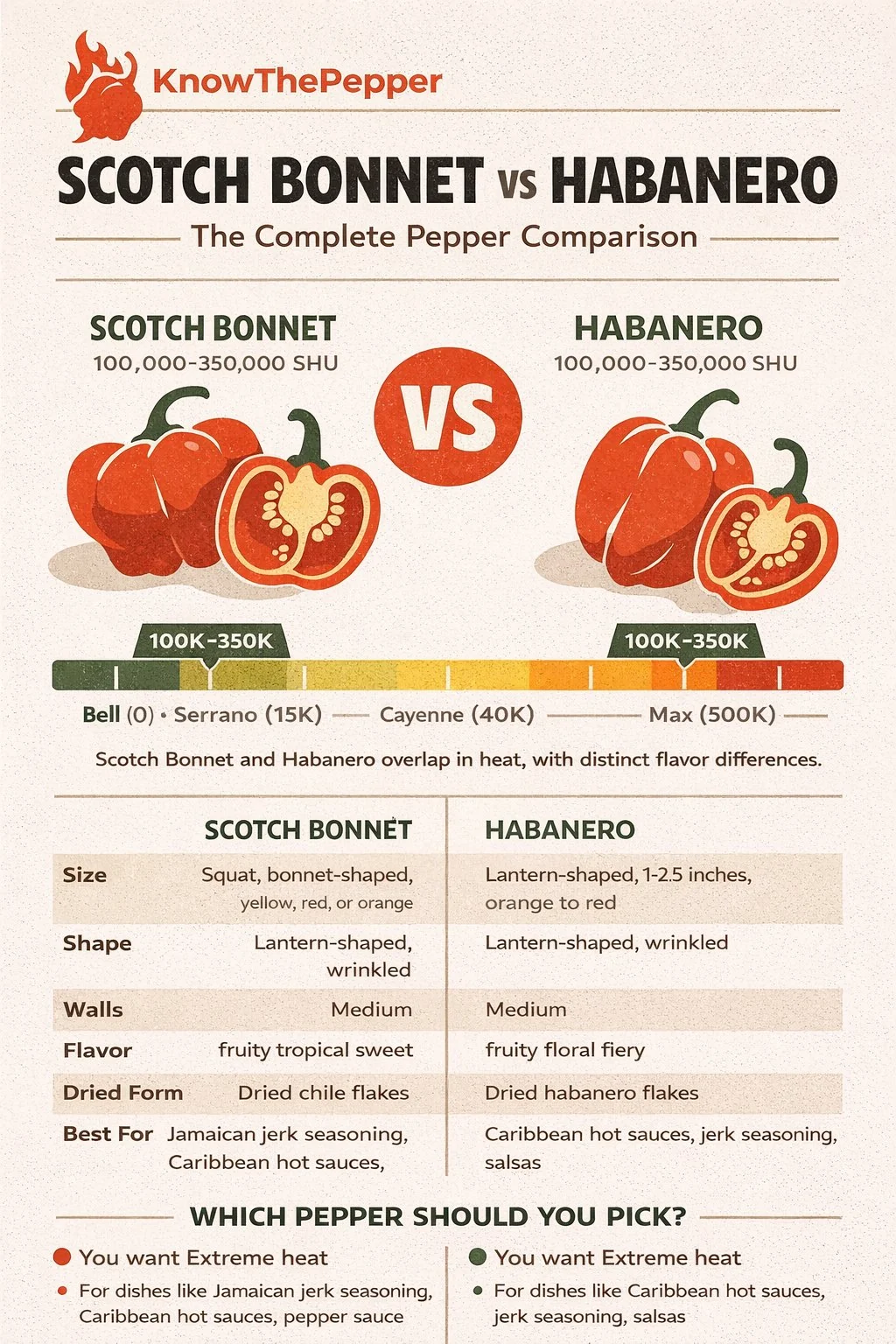
The bell body narrows to a distinct lower point
Thin walls surround central placenta and seed cavities
When Should You Use Scotch Bonnet or Habanero?
Choose by the dish's regional signal first, then by preparation method. Scotch bonnet is the stronger first choice when the recipe names a Caribbean pepper tradition, while habanero is the stronger first choice for a Yucatan preparation or a general fresh hot sauce.
Where Scotch bonnet earns its place
UF/IFAS specifically connects Scotch bonnet with Caribbean cooking, jerk sauce, and marinade. In jerk, the pepper joins allspice, thyme, scallion, ginger, garlic, and acid, so its aroma belongs to the seasoning identity rather than serving as heat alone.
Caribbean pepper sauce exposes the fruit even more directly. Scotch bonnet works with vinegar, citrus, mustard, tropical fruit, or vegetables, but the exact formula changes across islands and households.
Escovitch and pickled vegetable relishes need another kind of control. Thin slices or a small mince distribute heat through acid, while a whole pod can perfume a liquid more gently if it stays intact and is removed before serving.
Long-cooked stews and curries soften the difference between the two peppers because fat, browning, stock, and aromatics share the foreground. Scotch bonnet still carries the clearer regional cue when the recipe names it.
Where habanero is the clearer choice
Mexico's protected designation ties habanero to Campeche, Quintana Roo, and Yucatan. A Yucatan table salsa, xnipec-style fresh salsa, citrus marinade, or pickled red onion preparation therefore has a direct reason to begin with habanero.
Habanero also works well in fermented and cooked hot sauces because it is widely available and easy to pair with carrot, mango, peach, pineapple, tomato, or citrus. Availability makes it a practical production pepper without making it culturally interchangeable in every named dish.
The two finished-food settings make that boundary visible. The Jamaican side places Scotch bonnet beside jerk chicken, allspice, thyme, scallion, and lime, while the Yucatan side places habanero beside fresh tomato salsa, citrus, and pink pickled onions.
When either pepper can work
A mixed-fruit hot sauce, blended marinade, stew, or braise can often use either pepper because other ingredients shape most of the final aroma. The swap becomes less forgiving in a raw three-ingredient sauce where every pepper note remains exposed.
Preparation also changes the decision. Finely minced pepper gives quick, even heat, a blended puree spreads fruit and capsaicin through the whole batch, and a pierced whole pod adds flavor more slowly but can still create a very hot pocket around the fruit.
Do not choose a pepper solely because the dish will cook for a long time. Heat does not simply disappear on schedule, and a sauce can become more concentrated as water evaporates.
Use the named regional pepper when identity is part of the promise. Use the available close relative when function matters more, then adjust acid, sweetness, and aromatics only after the base tastes complete.
Match the pepper to the named dish
| Dish or method | Better first choice | Why |
|---|---|---|
| Jerk marinade | Scotch bonnet | The pepper belongs to the established Caribbean seasoning identity |
| Caribbean pepper sauce | Scotch bonnet | A short ingredient list keeps its regional aroma visible |
| Yucatan fresh salsa | Habanero | The pod belongs with citrus, tomato, and red onion in the regional context |
| Pink pickled onions | Habanero | A small mince brings familiar Yucatan heat |
| Complex cooked hot sauce | Either | Prepared amount and the rest of the formula matter more |
| Simple raw pepper sauce | Original named pepper | The aroma difference remains exposed |
Which Should You Buy, Scotch Bonnet or Habanero?
Buy Scotch bonnet when the recipe names jerk, Caribbean pepper sauce, escovitch, or another dish where the pepper itself signals place. Buy habanero when the recipe points to Yucatan cooking, when a pointed pod fits the expected ingredient, or when reliable availability matters most.
Inspect a Scotch bonnet before buying
Look for a squat fruit with a broad flared base, three to four visible lobes, an intact green stem, and firm waxy skin. Yellow, orange, and red can all be normal mature colors.
The Jamaican grading manual treats cracks, decay, shriveling, pest damage, and misshapen fruit as quality defects. A deeply wrinkled soft pod will be harder to trim cleanly and may have already lost aroma.
Choose a trustworthy Caribbean market or grower when the recipe depends on identity. A handwritten Scotch bonnet sign above smooth pointed orange pods is weaker evidence than the pod's shape and the seller's source information.
Inspect a habanero before buying
Look for a firm bell or lantern body that narrows to a point, with glossy skin and a fresh stem. Avoid wet spots, collapsed walls, deep cuts, or mold around the stem.
A protected Yucatan origin is a separate claim from the generic word habanero. The official designation applies to product from Campeche, Quintana Roo, and Yucatan, so check the package or supplier when that origin matters.
Loose fresh habaneros outside Mexico may be excellent without carrying that designation. The label tells you origin and accountability, while the pod tells you condition and probable type.
Use availability without pretending the peppers are identical
If only one of the two peppers is fresh and sound, buy the sound one for a flexible sauce or stew. Fresh condition matters more than chasing the ideal name through a shriveled or decaying pod.
If the dish is culturally specific and both are available, choose the pepper the dish names. That decision respects the recipe and removes the need to manufacture a flavor correction from guesswork.
When neither identity is clear, treat the pod as an unknown very hot C. chinense pepper. Use a conservative amount, record what the package or grower called it, and judge the cooked result before repeating the batch.
Four checks at the market
- Start with the recipe. Named Caribbean dishes favor Scotch bonnet, while named Yucatan dishes favor habanero.
- Read the silhouette. Look for a flared lobed bonnet or a pointed bell.
- Check condition. Choose firm pods with sound skin and fresh stems.
- Verify origin claims. A loose color label cannot prove Jamaican or protected Yucatan identity.
Orange is not an identity test
Scotch bonnet and habanero can both ripen orange. Shape, source, condition, and the recipe's regional context provide stronger evidence than color alone.
Can Scotch Bonnet and Habanero Replace Each Other?
Scotch bonnet and habanero can replace each other in many sauces, marinades, stews, and relishes, but a blind one-pod-for-one-pod rule is unreliable. The pods can differ enough in trimmed weight, placental tissue, ripeness, and individual heat to change the batch.
Measure the pepper you will actually cook
Trim the stem, remove damaged flesh, and decide how much placenta the recipe needs before comparing amounts. Weigh the prepared pepper or measure its fine mince instead of comparing whole pod counts.
Use the same prepared weight or chopped volume only when the original heat level already suits the table. For an unfamiliar harvest or a raw sauce, begin with roughly half to three quarters of that amount and keep the remainder separate.
- Prepare the base ingredients before handling the chile. Salt, acid, sugar, fruit, and aromatics change how the pepper reads.
- Add the smaller measured portion first. Mince or blend it evenly so one spoonful does not carry most of the capsaicin.
- Let the mixture rest or cook as required. Taste a diluted spoonful after the pepper has dispersed through the batch.
- Scale with the reserved pepper portion. Add small increments and stop when the dish is balanced for the people eating it.
When habanero replaces Scotch bonnet in jerk or Caribbean pepper sauce, do not add random fruit merely because a generic flavor chart says Scotch bonnet is sweeter. First complete the recipe's allspice, thyme, scallion, ginger, salt, and acid, then correct sweetness only if the finished marinade needs it.
When Scotch bonnet replaces habanero in a Yucatan-style salsa, preserve the tomato, red onion, sour orange or lime, and salt balance. The pepper can provide comparable intensity, but it does not change the dish into a Jamaican sauce.
Protect your hands and prevent hot spots
University of California guidance recommends gloves when cutting very hot peppers because capsaicin can irritate skin and eyes. Use food-safe gloves, keep gloved hands away from your face, and wash hands and tools thoroughly after the task.
The pale placenta is the main capsaicin reservoir. Removing loose seeds improves texture, but meaningful heat reduction requires removing some placental tissue too.
The prep image shows the practical rule. Separate trimmed pieces, measured amounts, placental tissue, and fine mince make dose and distribution visible in a way that whole pod count cannot.
Use the substitution freely when pepper identity is secondary to a complex sauce. Keep the original pepper when a simple sauce, market claim, or named regional dish depends on its specific aroma and shape.
What to correct after the measured swap
| Direction | Preserve first | Correct only after tasting |
|---|---|---|
| Habanero for Scotch bonnet | Allspice, thyme, scallion, ginger, and acid | Sweetness or roundness |
| Scotch bonnet for habanero | Tomato, red onion, citrus, and salt | Brightness or acidity |
| Either in a complex cooked sauce | Prepared weight and even distribution | Final heat after reduction |
| Either in a simple raw sauce | The original named pepper when possible | Do not hide a weak match with extra sugar |