
Madame Jeanette vs Scotch Bonnet: Which Fits Your Dish?
Choose Madame Jeanette when a Surinamese dish or bright yellow pepper sauce calls for that named pepper. Choose Scotch Bonnet when Jamaican jerk, a Caribbean marinade, or the lobed bonnet form is part of the expected result. Neither name predicts the exact heat of an untested pod.

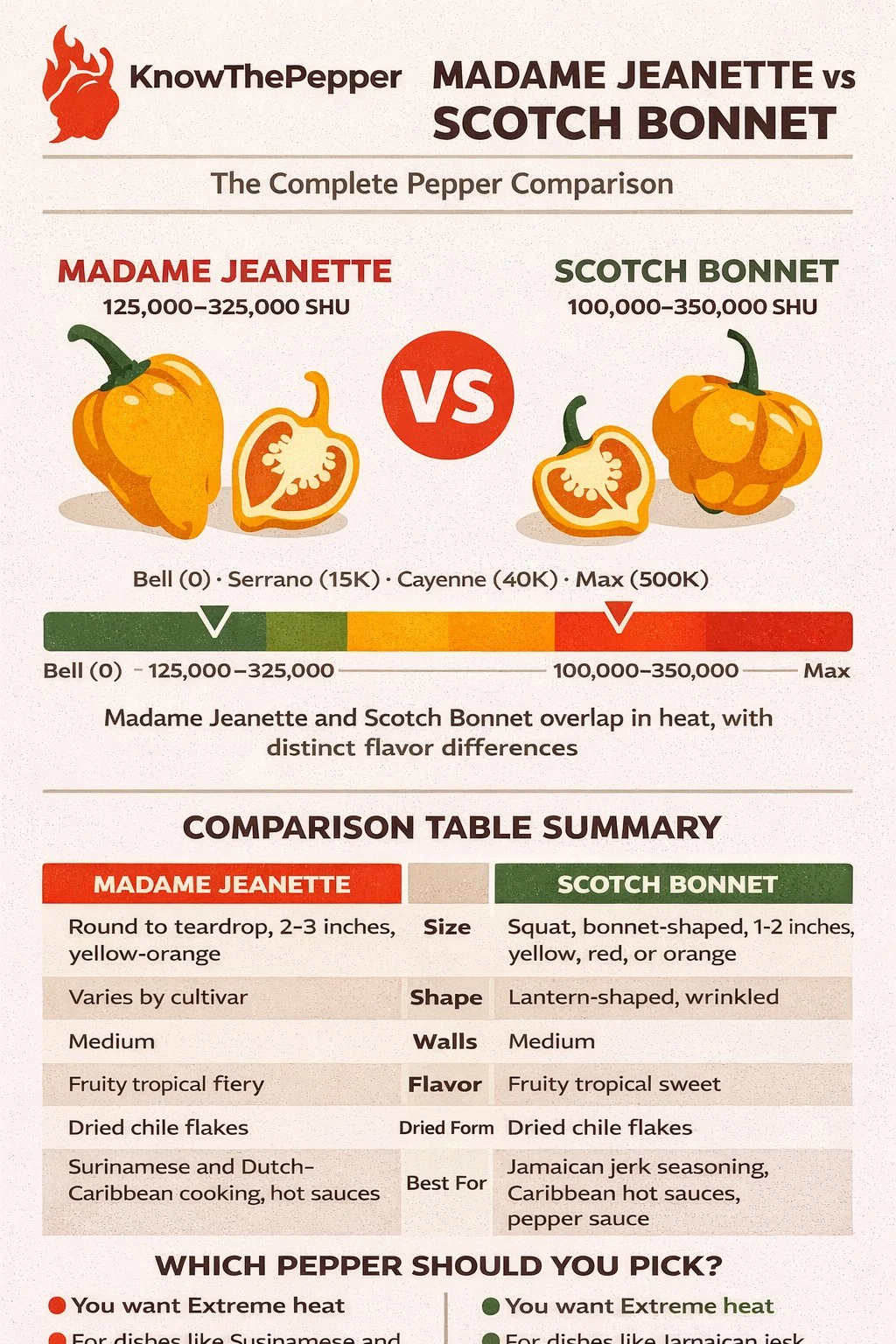
Madame Jeanette and Scotch Bonnet are distinct very-hot Capsicum chinense peppers. Choose by regional dish, pod form, and cooking technique because their heat bands overlap and real pods vary.
- Named identity: Surinamese pepper type vs Jamaican and Caribbean pepper type
- Heat decision: Very-hot working band vs 100,000 to 350,000 SHU published band
- Common visual clue: Yellow and elongated vs Squat cup-and-saucer form with lobes
- Strong first use: Surinamese pepper sauce and local dishes vs Jerk sauce, marinade, and Caribbean cooking
- Useful technique: Measured pieces or blended sauce vs Whole infusion or prepared sauce
Madame Jeanette
Extra-HotScotch Bonnet
Extra-HotQuick Comparison
| Attribute | Madame Jeanette | Scotch Bonnet |
|---|---|---|
| Named identity | Surinamese pepper type | Jamaican and Caribbean pepper type |
| Heat decision | Very-hot working band | 100,000 to 350,000 SHU published band |
| Common visual clue | Yellow and elongated | Squat cup-and-saucer form with lobes |
| Strong first use | Surinamese pepper sauce and local dishes | Jerk sauce, marinade, and Caribbean cooking |
| Useful technique | Measured pieces or blended sauce | Whole infusion or prepared sauce |
Which Is Hotter, Madame Jeanette or Scotch Bonnet?
Heat verdict: Neither pepper is a dependable heat winner.
KnowThePepper uses a 100,000 to 350,000 Scoville heat unit working band for both named profiles, while Iowa State University Extension independently places Scotch bonnet in that range. A comparably hot Madame Jeanette may overlap it, but a cultivar name cannot certify the heat of the pod on your board.
USDA Agricultural Research Service studies explain why.
Researchers found substantial pungency variation among Capsicum chinense accessions and even among accessions from the same country of origin. Genetics, fruit maturity, and growing conditions can move the result within a named group.
The overlapping bands answer the comparison but do not authorize a one-for-one swap.
One long Madame Jeanette and one squat Scotch bonnet can differ in mass, wall thickness, inner tissue, and capsaicinoid concentration. Pod count hides every one of those variables.
| Heat evidence | What it supports | What it cannot prove |
|---|---|---|
| Iowa State range | Scotch bonnet commonly occupies 100,000 to 350,000 SHU | The heat of one market pod |
| Site working band | Madame Jeanette belongs in the same very-hot decision zone | An independently certified cultivar range |
| USDA variation research | C. chinense pungency varies across and within origins | A fixed winner by name |
How should you test the batch?
Cut only the amount needed for a small sample and use gloves if your skin is sensitive. Iowa State warns that capsaicin transfers easily to skin, eyes, and mouth, so keep the knife, board, and tasting spoon away from bare-face contact.
Mix a measured fragment into the same liquid, oil, or food base used by the recipe, then wait before increasing it. A bite from the raw pod measures a different experience from heat dispersed through a pot.
The useful conclusion is shared danger, uncertain rank. Treat either pepper as very hot, and let the actual prepared sample decide the dose.
Are Madame Jeanette and Scotch Bonnet the Same Pepper?
Madame Jeanette and Scotch Bonnet are distinct named peppers, even though both belong to Capsicum chinense. Shared species explains why both can carry an intense fruity aroma, but it does not make their names interchangeable.
USDA Agricultural Research Service measured wide variation in sugars and organic acids across 216 C. chinense varieties. A separate USDA morphology study found eightfold to more than one-hundredfold variation in fruit dimensions, weight, and color across the collection.
Those findings place a boundary around sensory shorthand.
Madame Jeanette is commonly chosen for a brighter, perfumed yellow-pepper character, while Scotch bonnet is commonly chosen for a rounder tropical-fruit character. The actual cultivar and harvest can blur that contrast, so smell and taste the available batch instead of treating an adjective as a laboratory result.
What does pod shape change in the kitchen?
A long pod produces narrower strips and a different chopped yield than a squat, deeply lobed pod. Scotch bonnet lobes create folds where sauce and inner tissue can remain, while an elongated Madame Jeanette is easier to divide lengthwise into measured sections.
Neither form guarantees a specific wall thickness. Use trimmed weight or chopped volume when pepper flesh matters, and use a small measured piece when heat is the main job.
Color is also supporting evidence rather than proof.
Suriname's Ministry of Agriculture describes Madame Jeanette as yellow and elongated, while Jamaica's grading manual accepts Scotch bonnet colors including green, yellow, orange, and red. A yellow pod can therefore belong to either side of the comparison.
The distinction that survives a topic swap is simple. Regional identity plus pod form is more useful than shared species alone.
Suriname identity, an elongated yellow market clue, and a bright aromatic role in sauces or cooked dishes.
Jamaican and wider Caribbean identity, a squat lobed form, and a familiar role in jerk sauce and marinade.
Which Dishes Call for Madame Jeanette or Scotch Bonnet?
Choose from the named dish first.
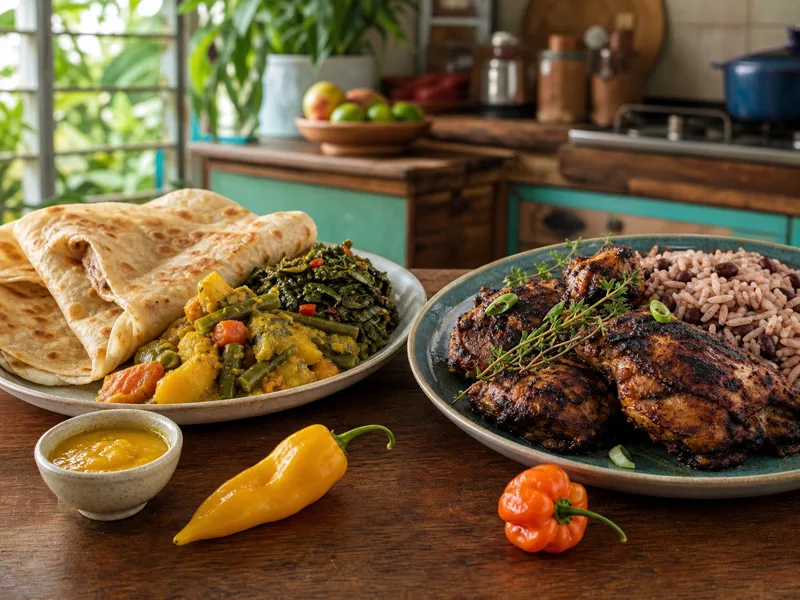
Madame Jeanette carries a Surinamese identity, while Scotch bonnet carries a Jamaican and wider Caribbean pepper identity. When a recipe names one pepper because the dish belongs to that tradition, the name is part of the expected flavor rather than a decorative preference.
Suriname government materials place Madame Jeanette directly in local food. One published recipe uses a green pod with stuffed sopropo, and a primary-school text describes pepper being sliced, crushed, infused, and steamed across Surinamese preparations.
University of Florida IFAS connects Scotch bonnet with Caribbean jerk sauce and marinade. Jamaica's Ministry of Agriculture also treats Scotch bonnet as one of the country's commercially important hot peppers, which reinforces the ingredient's identity beyond a generic heat source.
When does a whole pepper make sense?
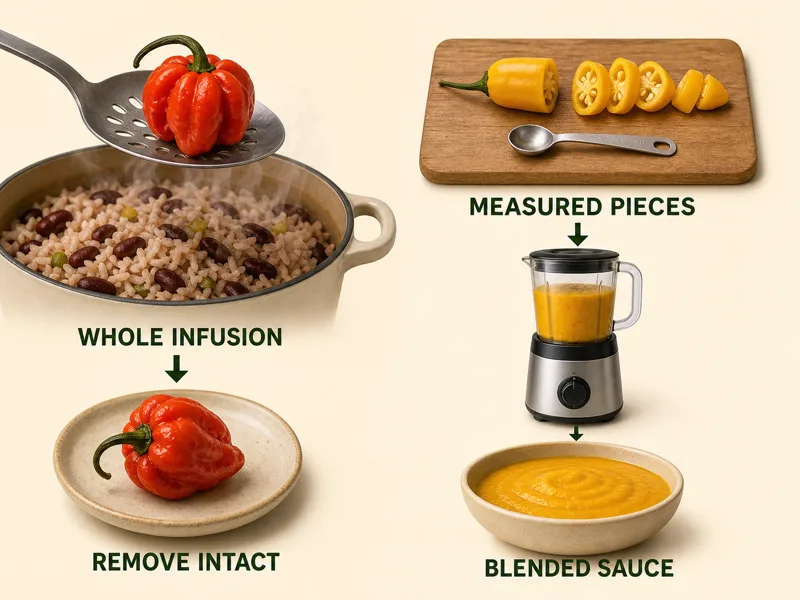
An intact pod can perfume rice, beans, soup, or stew while keeping most pepper flesh out of the finished servings. The method stays controllable only while the skin remains intact and the cook can retrieve the pod before serving.
Do not stir aggressively against the pepper or let a serving spoon crush it. Once the pod breaks, the dish changes from an infusion into direct distribution of very hot tissue.
When should the pepper become part of the sauce?
A blended table sauce deliberately distributes pepper through the batch. This treatment suits Madame Jeanette when the yellow sauce itself is the condiment, but it also suits Scotch bonnet sauces where every spoonful is meant to carry fruit and heat.
Measure trimmed pepper before blending and reserve part of the unheated base. The reserved portion lets you correct a sauce that becomes hotter than intended without adding random sugar or acid.
| Cooking job | Better first choice | Why |
|---|---|---|
| Named Surinamese pepper sauce | Madame Jeanette | The cultivar identity is part of the condiment |
| Jamaican jerk marinade | Scotch bonnet | The pepper belongs with the expected Jamaican flavor set |
| Whole removable infusion | Either intact pod | Condition and removability matter more than shape |
| Neutral very-hot sauce | Either tested batch | The recipe can accept a change in regional signal |
| Visible raw garnish | The pepper named by the dish | Shape, color, and aroma remain exposed |
No rule says Madame Jeanette must always be blended or Scotch bonnet must always stay whole. The technique diagram separates removable aroma from distributed pepper, which is the decision the cook actually controls.
Can Madame Jeanette Replace Scotch Bonnet?
Yes, the peppers can replace each other in some sauces, soups, stews, and marinades. The swap is strongest when the recipe needs fruity C. chinense heat and can accept a different regional signal, color, and pod yield.
Reject the swap when the recipe promises a named traditional pepper, when the visible pod is part of the presentation, or when a commercial batch must repeat a documented formula. A Scotch bonnet jerk sauce and a Madame Jeanette table sauce may both be excellent, but changing the named pepper changes what the label or menu promises.
How do you substitute without a fake pod ratio?
Use a prepared unit that matches the dish. Trimmed weight suits a blended sauce, chopped volume suits visible pepper pieces, and a measured fragment suits an infusion or a tasting sample.
- Name the original job. Decide whether the pepper provides regional identity, aroma, heat, color, flesh, or removability.
- Prepare one controlled sample. Move a spoonful of the actual sauce, stew, or marinade into a separate bowl.
- Add a measured fragment. Mix it through the same liquid or fat that carries heat in the full recipe.
- Wait before judging. Check aroma, heat, texture, color, and the amount of visible pepper material.
- Scale only the successful sample. Stop if heat arrives before the dish has enough pepper body, or if extra flesh changes the intended texture.
If the replacement tastes less aromatic but is already hot enough, do not add more pepper only to chase perfume. Use the intended herbs, aromatics, and recipe acid as written, then accept that the named cultivar has a flavor that another pod may not reproduce.
If neither pepper is available, use Scotch bonnet substitutes for candidates ranked by cooking job. That route is more useful than forcing a mild pepper to reach this heat band through excessive volume.
The verdict depends on the promise of the dish. Swap for function in flexible food, but retain the named pepper when regional identity is the reason the recipe chose it.
The pepper disappears into a general hot sauce, stew, marinade, or soup and the cook can test the batch before scaling.
The dish is sold or served as a specific Surinamese or Jamaican preparation, or the pod's visible form matters.
How Can You Tell Madame Jeanette From Scotch Bonnet?
Read the label and source market before identifying by silhouette. Suriname's Ministry of Agriculture describes Madame Jeanette as yellow and elongated, but the same government material notes that local pepper varieties show substantial crossing and variation.
Jamaica's produce grading manual gives Scotch bonnet a stronger commercial morphology. Its top grade calls for a distinct cup-and-saucer shape with three to four lobes, firm fresh fruit, typical color, an intact green stem, and freedom from decay or pest damage.
Use the clues in this order.
- Name and origin: prefer a seller or seed packet that names Madame Jeanette or Scotch Bonnet and gives a credible source.
- Overall form: look for a longer yellow Madame Jeanette type or a squat lobed Scotch bonnet type without treating shape as proof.
- Condition: choose firm fruit with intact skin and no soft decay, deep shriveling, or split tissue.
- Aroma: a fresh cut sample should smell clearly fruity, but aroma alone cannot establish cultivar.
- Intended use: buy enough prepared weight for sauce, or intact sound pods for removable infusion.
Safety note: Unknown very-hot peppers deserve extra caution.
An unlabeled yellow or orange C. chinense pod may be a related cultivar or hybrid. Handle it as very hot until a controlled sample shows otherwise, and do not sell or serve it under a cultivar name that the source cannot support.
Can seed listings settle the identity?
A reliable seed listing helps only when the supplier maintains the named line and explains its source. Wageningen University research on Suriname seed systems reports that finding seed of the correct Madame Jeanette type can itself be difficult, which makes a generic marketplace photograph weak evidence.
For Scotch bonnet, compare the supplier's mature fruit against the Jamaican lobed standard rather than accepting any squat C. chinense labeled with the name. Also check whether the listing states a ripe color, because official Scotch bonnet grades allow several.
Choose seed for the specific pepper you intend to cook with, then use the individual profile for cultivation details. This page focuses on identification and cooking choice rather than repeating a generic growing schedule.
Madame Jeanette vs Scotch Bonnet FAQ
- Suriname Ministry of Agriculture - Paprika en peper
- Suriname Ministry of Agriculture - Groente- en peulgewassen
- Jamaica Ministry of Agriculture - Produce Grading Manual
- University of Florida IFAS - Pepper Production in Miami-Dade County
- Iowa State University Extension - Growing Peppers in the Home Garden
- USDA ARS - Pungency in Capsicum Chinense: Variation Among Countries of Origin
- USDA ARS - Variability for Free Sugars and Organic Acids in Capsicum Chinense
- USDA ARS - Variation for Fruit Morphological Characteristics within Capsicum Chinense
- Wageningen University - Seed Systems of Local Vegetables and Fruit