Bird's Eye Chili vs Cayenne Pepper: What's the Difference?
Bird's eye chili and cayenne pepper both land in the upper heat registers, but they're distinct in character, origin, and kitchen application. Bird's eye brings a sharp, almost electric brightness common to Southeast Asian cooking, while cayenne delivers a drier, more linear heat that's become a global pantry staple. Understanding their differences helps you choose the right one — or substitute confidently when needed.

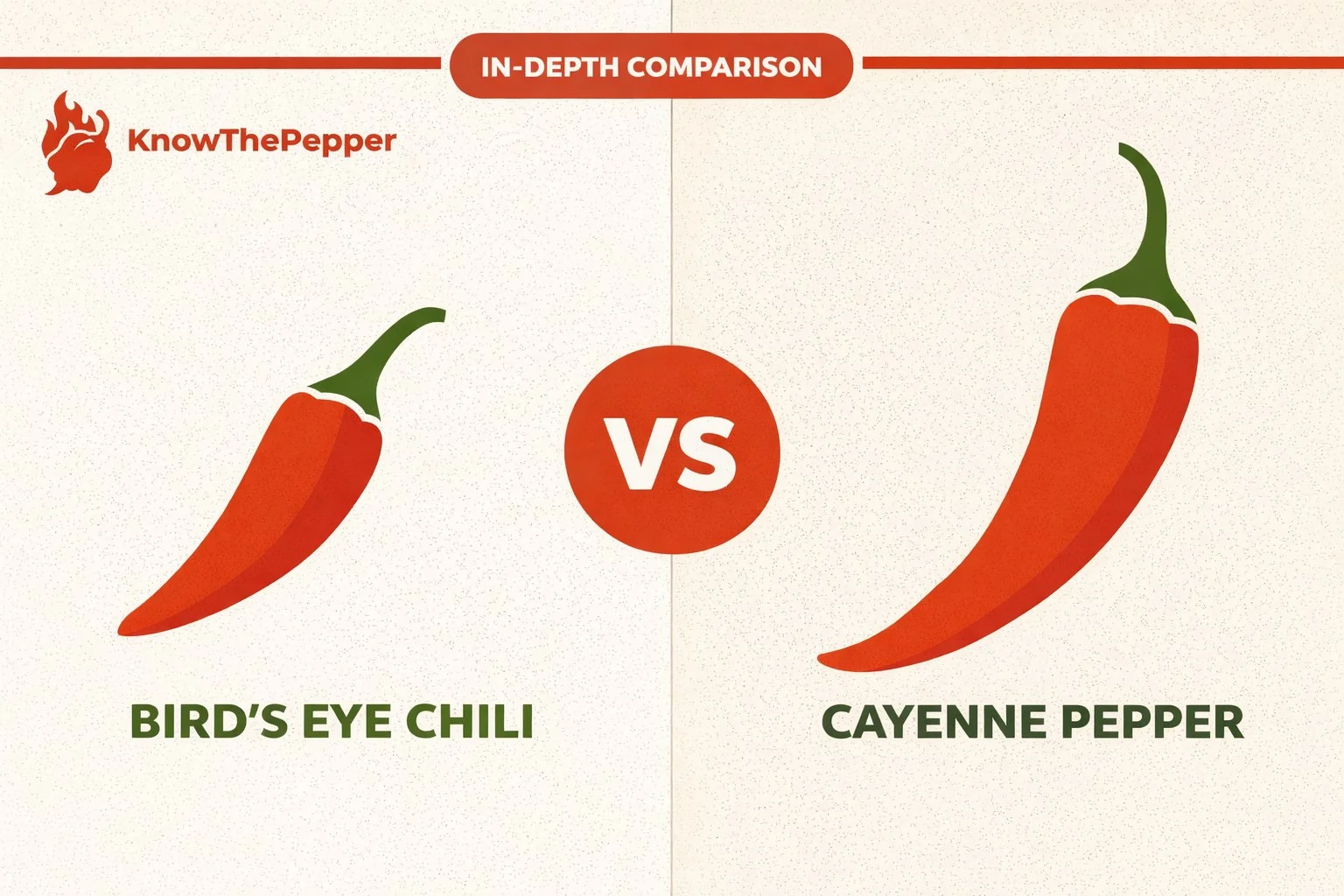
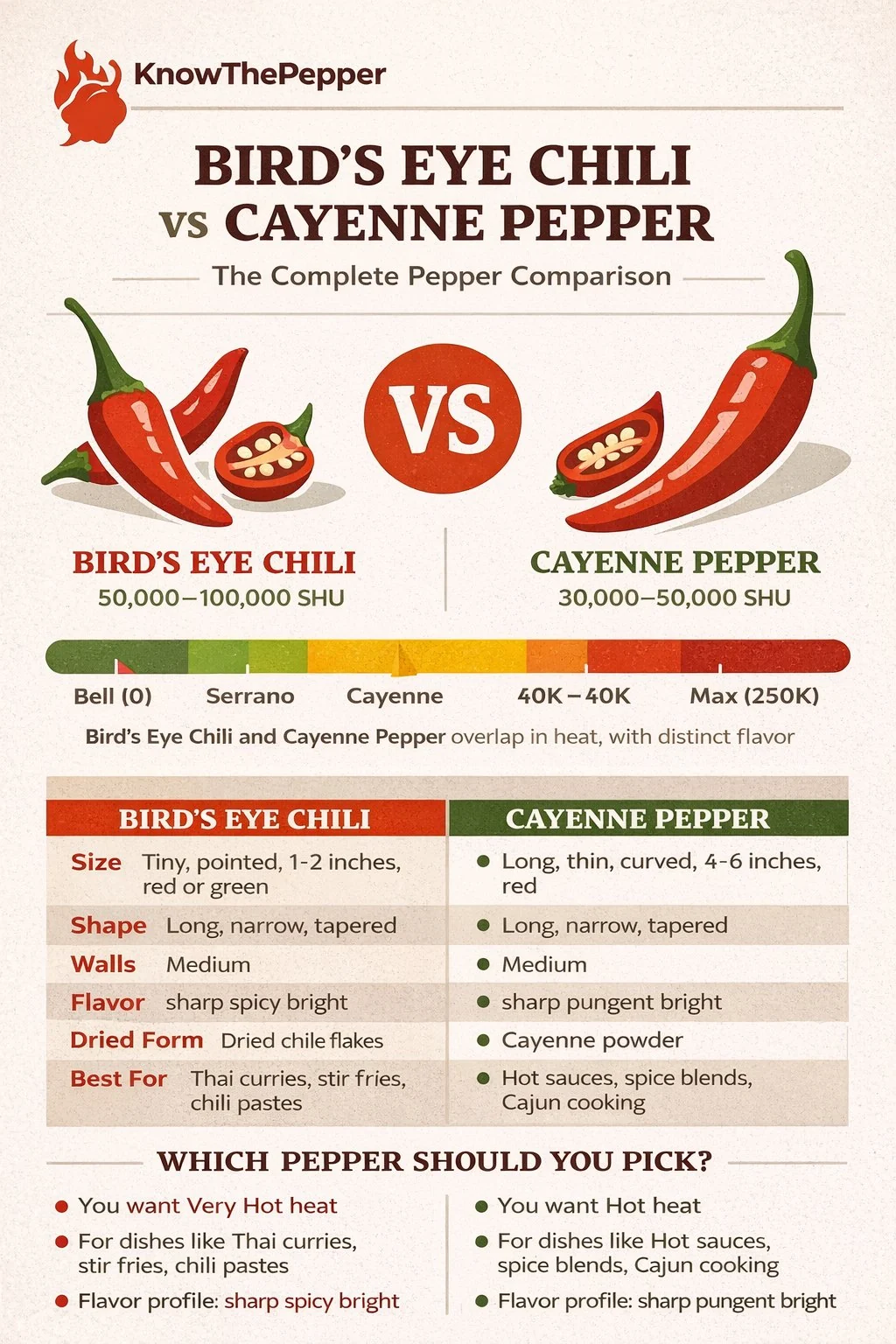
Bird's Eye Chili measures 50K–100K SHU while Cayenne Pepper registers 30K–50K SHU — making Bird's Eye Chili 2× hotter. Bird's Eye Chili is known for its peppery and bright flavor (C. annuum), while Cayenne Pepper offers neutral and peppery notes (C. annuum).
- Heat difference: Bird's Eye Chili is 2× hotter
- Species: Both are C. annuum
- Best for: Bird's Eye Chili excels in hot sauces and extreme dishes, Cayenne Pepper in fresh salsas and mild recipes
Bird's Eye Chili
Extra-HotCayenne Pepper
HotBird's Eye Chili vs Cayenne Pepper Comparison
Bird's Eye Chili vs Cayenne Pepper Heat Levels
The first thing you notice with bird's eye chili is how fast the burn arrives — it's immediate, almost aggressive, hitting the front of your palate before spreading back. That intensity reflects its 50,000–100,000 SHU range, placing it firmly in the hot pepper intensity bracket. Cayenne typically runs 30,000–50,000 SHU, though commercial powders can vary widely depending on processing and source.
To put that in perspective: a Fresno pepper sits around 2,500–10,000 SHU, which means bird's eye can hit roughly 10–40 times that heat, and cayenne lands at 3–20 times Fresno's ceiling. At their peaks, bird's eye runs about twice as hot as cayenne — a meaningful gap when you're building dishes where heat balance matters.
The burn character differs too. Cayenne's capsaicin delivers a slow-building, sustained warmth that spreads evenly. Bird's eye hits sharper and dissipates faster, with less of that lingering throat heat. Both activate TRPV1 receptors — the receptor science behind capsaicin's effect explains why the sensation reads as "heat" despite no actual temperature change — but the specific capsaicinoid profiles create noticeably different experiences. Bird's eye contains higher concentrations of dihydrocapsaicin alongside capsaicin, which contributes to that sharper initial spike.
Flavor Profile Comparison
Size is genuinely deceptive here.
Few peppers have traveled as far or worked as hard as cayenne.
Cayenne's flavor profile, stripped of heat, is relatively neutral — slightly earthy, faintly smoky when dried, with a thin vegetal note that makes it easy to blend into spice mixes without dominating. That neutrality is precisely why it became the backbone of so many spice blends, hot sauces, and restaurant-table shakers worldwide.
Bird's eye chili plays a different game entirely. Raw, it carries a bright, almost citrusy sharpness alongside the peppery punch — there's a grassy freshness that survives even brief cooking. Thai pepper traditions built entire flavor systems around this quality: the chili doesn't just add heat, it adds a top note that lifts the dish. Fish sauce, lime, and bird's eye form a flavor triad precisely because each element needs the others' contrast.
Dried bird's eye loses some of that brightness but retains more fruity complexity than dried cayenne. Cayenne powder tends toward one-dimensional heat delivery; dried bird's eye still carries faint berry-like undertones. Aroma matters here too — fresh bird's eye has a noticeably pungent, almost floral scent when cut, while cayenne's aroma is more muted and dusty.
For dishes where the chili is a background element — chili oil, spice rubs, dry brines — cayenne integrates more cleanly. When the pepper needs to assert its own identity in the dish, bird's eye earns its place. The side-by-side contrast between cayenne and tabasco shows a similar pattern: peppers bred for heat delivery versus those with distinct flavor personalities.
Culinary Uses for Bird's Eye Chili and Cayenne Pepper
Cayenne is the utility player of the spice world. It shows up in Cajun seasoning, curry powders, buffalo wing sauce, and dry rubs because it adds heat without redirecting a dish's flavor identity. A pinch in chocolate desserts amplifies richness; a dusting on roasted vegetables deepens their char notes. Most commercial hot sauces list cayenne as a primary ingredient for exactly this reason — it's heat that cooperates.
Bird's eye chili is more of a lead character. In Thai larb, Vietnamese dipping sauces, and Indonesian sambal, the chili's brightness is part of the dish's signature. Sliced thin and added raw at the end of cooking, it delivers maximum flavor impact. Whole dried bird's eye pods are standard in Sichuan-style chili oils, where they contribute both heat and a subtle fruitiness to infused oil.
Substitution works in both directions with some adjustment. Swapping cayenne for bird's eye in a recipe: use roughly 1.5–2x the cayenne volume to approximate bird's eye heat, and accept that you'll lose some of that sharp brightness. Going the other direction — bird's eye for cayenne — start at half the volume and taste as you go, since bird's eye can easily overpower.
For reference, the heat and flavor differences between cayenne and Thai chili covers more ground on this substitution dynamic. Both peppers belong to C. annuum botanical lineage, which means their heat compounds are structurally similar — making cross-substitution more reliable than swapping between species.
Cayenne powder works where fresh bird's eye won't — spice rubs, dry seasoning blends, anything where moisture is the enemy. Fresh bird's eye has no real powdered equivalent that captures its full profile, though dried and ground bird's eye comes close. Both make excellent chili oils; bird's eye produces a more complex, slightly fruity oil while cayenne yields cleaner, straighter heat.
Which Should You Choose?
If your cooking skews toward Southeast Asian flavors — Thai, Vietnamese, Indonesian — bird's eye chili is the more authentic and flavorful choice. Its brightness and sharp heat are structural to those cuisines, not just a heat source. The full growing guide for starting from seed is worth reading if you want a steady supply, since fresh bird's eye is harder to source than dried cayenne in most Western markets.
For general-purpose heat across cuisines — Cajun, Mexican, American barbecue, European spice blends — cayenne is the more versatile tool. It integrates without demanding attention, and its dried powder form stores well for months.
Heat tolerance is the other factor. Bird's eye at its peak hits twice the intensity of mid-range cayenne. If you're cooking for mixed heat tolerances, cayenne gives you finer control. Bird's eye rewards confident cooks who know their audience. Neither pepper is universally superior — they solve different problems.
Can You Substitute One for the Other?
Proceed with caution. Bird's Eye Chili is 2× hotter than Cayenne Pepper.
Need a different option altogether? Search for peppers that match your target heat and flavor with precise swap ratios.
Growing Bird's Eye Chili vs Cayenne Pepper
If you’re deciding which pepper to grow at home, consider your climate and patience level. Bird's Eye Chili and Cayenne Pepper have different maturation times and temperature preferences. Hotter varieties generally need a longer, warmer growing season to develop their full capsaicin content. Our zone-based planting date tool can pinpoint the best sowing window for your area.
Bird's eye chili is among the more forgiving hot peppers to grow, provided you give it heat and full sun. Start seeds indoors 8-10 weeks before last frost - these need soil temperatures above 75°F to germinate reliably.
The plant stays compact, typically 18-24 inches tall, which makes it suitable for containers. A 3-gallon pot works fine for a single plant.
For pest and disease management, see the practical guidance on common pepper pests and diseases - aphids and spider mites are the main threats, particularly in dry conditions. Good airflow around plants prevents fungal issues.
Cayenne is one of the more forgiving hot peppers to grow, which explains its global reach. Start seeds indoors 8-10 weeks before last frost.
For practical guidance on growing cayenne from transplant to harvest, the key variables are consistent heat and full sun. Cayenne wants at least 6-8 hours of direct light daily and struggles in cool, wet summers.
Transplant outdoors once nighttime temps stay above 55°F. Space plants 18-24 inches apart.
History & Origin of Bird's Eye Chili and Cayenne Pepper
Both peppers carry centuries of culinary heritage. Bird's Eye Chili traces its roots to Thailand, while Cayenne Pepper originates from French Guiana. Understanding their backstory helps explain why each pepper developed its distinctive traits.
Buying & Storage
Whether you’re shopping for Bird's Eye Chili or Cayenne Pepper, the same quality indicators apply. Fresh peppers should feel firm and heavy for their size, with taut, glossy skin and no soft or wet spots. Minor stem cracks known as “corking” are perfectly normal and often indicate a mature, flavorful pod.
- Firm pods with taut skin and consistent color
- Should feel heavy relative to size
- Minor stem cracks (“corking”) are normal
- Avoid anything soft, shriveled, or with dark wet spots
- Fresh: Paper bag, crisper drawer — 1–2 weeks
- Frozen: Wash, dry, freeze on sheet pan — 6+ months
- Dried: Airtight, away from light — up to 1 year
The Verdict: Bird's Eye Chili vs Cayenne Pepper
Bird's Eye Chili and Cayenne Pepper occupy very different positions on the heat spectrum. Bird's Eye Chili delivers 2× more heat with its distinctive peppery and bright character. Cayenne Pepper, with its neutral and peppery profile, excels in everyday cooking.
Frequently Asked Questions
Related Comparisons
Sources pending verification.