

KnowThePepper
Guntur Chili: Andhra Pradesh's Earthy, Pungent Heat at 35,000–40,000 SHU
The Guntur Chili is one of India's most commercially significant peppers, grown primarily in Andhra Pradesh and registering 35,000-40,000 SHU. Its heat lands roughly about 3-4x hotter than a serrano, paired with a deep earthy pungency that defines South Indian cooking.
Whether you're growing it or cooking with it, this pepper rewards patience and attention.
- Species: C. annuum
- Heat tier: Hot (10K-100K SHU)
- Comparison: 4-16x hotter than a jalapeño, depending on where the jalapeño falls in its 2,500-8,000 SHU range
What Is Guntur Chili?
Pull a dried Guntur Chili from a bag and you'll notice the heat before you even break the skin, that sharp, almost smoky pungency that hits the back of the throat before the burn follows. This is a pepper that announces itself.
Botanically classified as Capsicum annuum in species terms, the Guntur Chili produces elongated, thin-walled pods that start green and ripen to a vivid deep red. At 35,000-40,000 SHU, it sits firmly in the hot-tier pepper range - comparable in raw numbers to a cayenne, but with a distinctly earthier, more pungent character that sets it apart.
Guntur, the district in Andhra Pradesh where this variety originates, is one of the world's largest chili-producing regions. The pepper's flavor profile, earthy, slightly smoky, intensely pungent, is inseparable from the volcanic red soils and semi-arid climate of that region.
It's not just a heat source.
It's a flavor backbone.
Dried Guntur Chilies are the workhorse of Indian pepper cultivation traditions and appear in everything from spice blends to commercial hot sauce production. The pods dry exceptionally well, concentrating flavor and heat simultaneously.
For home growers, this is a pepper that produces heavily and stores beautifully.
What Is the Origin of Guntur Chili?
Guntur's chili story begins with the Portuguese introduction of Capsicum to India in the 16th century, but the specific Guntur variety evolved over centuries through selection in Andhra Pradesh's distinct growing conditions.
By the 20th century, Guntur had become the epicenter of India's chili trade. The Guntur Chili Yard, once the largest chili market in Asia, processed hundreds of thousands of tons annually, supplying domestic spice manufacturers and international exporters alike.
The pepper's commercial importance drove systematic cultivation improvements. Andhra Pradesh agricultural universities developed improved strains, and Guntur chili received a Geographical Indication (GI) tag from the Indian government, formally recognizing its regional identity.
Today it represents a significant portion of India's chili exports, particularly to Southeast Asia and the Middle East.
How Spicy Is Guntur Chili, and How Does It Taste?
The Guntur Chili delivers 35K–40K Scoville Heat Units, placing it in the Hot tier (10K-100K SHU). That makes it roughly 4-16x hotter than a jalapeño, depending on where the jalapeño falls in its 2,500-8,000 SHU range.
Flavor notes: earthy and pungent.
How Nutritious Is Guntur Chili?
Dried Guntur Chilies are nutritionally dense relative to their small serving size.
A 1-tablespoon serving of dried chili powder delivers meaningful amounts of vitamin C, vitamin A (as beta-carotene), and vitamin B6. Iron and potassium are present in useful quantities as well.
Capsaicin, the compound responsible for the heat, has been studied extensively for its potential metabolic and anti-inflammatory effects. The capsaicin is well-documented in food science literature.
Because Guntur is primarily consumed dried and in small amounts, it contributes micronutrients without significant caloric load.
The drying process concentrates nutrients dramatically.
Dried Guntur Chili provides iron, potassium, and B vitamins in a much smaller volume than fresh peppers. Vitamin C decreases with drying, but vitamin A (from carotenoids) remains high.
The 35,000-40,000 SHU capsaicin range means dried pods retain their heat, capsaicin is heat-stable and does not degrade during the drying process.
For the full science, see how capsaicin activates heat receptors.
How Do You Cook With Guntur Chili?
Dried Guntur Chilies are the form you'll encounter most often, and they behave differently than fresh. The drying process deepens the earthiness and concentrates the pungency in a way that fresh pods simply don't replicate.
Toasted briefly in a dry pan before grinding, they produce a spice powder with remarkable depth, the foundation of many Andhra curries, rasams, and chutneys. The heat is sustained and building, not the quick spike you'd get from something like Tabasco Pepper.
For spice blends, Guntur works beautifully alongside cumin, coriander, and turmeric. The earthy pungency doesn't compete with these flavors, it anchors them.
It's also worth noting that Guntur's heat-to-flavor ratio makes it excellent for wing sauces and dry rubs where you need sustained heat without losing the pepper's character under heavy seasoning.
Substitute-wise, Cayenne Pepper is the closest Western equivalent in terms of heat level, though the flavor profiles diverge significantly. Use Guntur powder at roughly a 1:1 ratio when substituting.
Where Can You Buy Guntur Chili, and How Do You Store It?
Dried Guntur Chili pods and ground powder are available at Indian grocery stores and online spice retailers. Look for pods with a deep, uniform red color and no visible mold or excessive breakage, pale, faded pods have lost both heat and flavor.
Store whole dried pods in an airtight container away from light and heat. They'll hold quality for 12 to 18 months.
Ground powder degrades faster, plan to use it within 6 to 8 months for best results.
For growing, seeds are available from specialty Indian seed suppliers and some South Asian grocery stores that stock dried pods (viable seeds can sometimes be extracted from quality dried chilies).
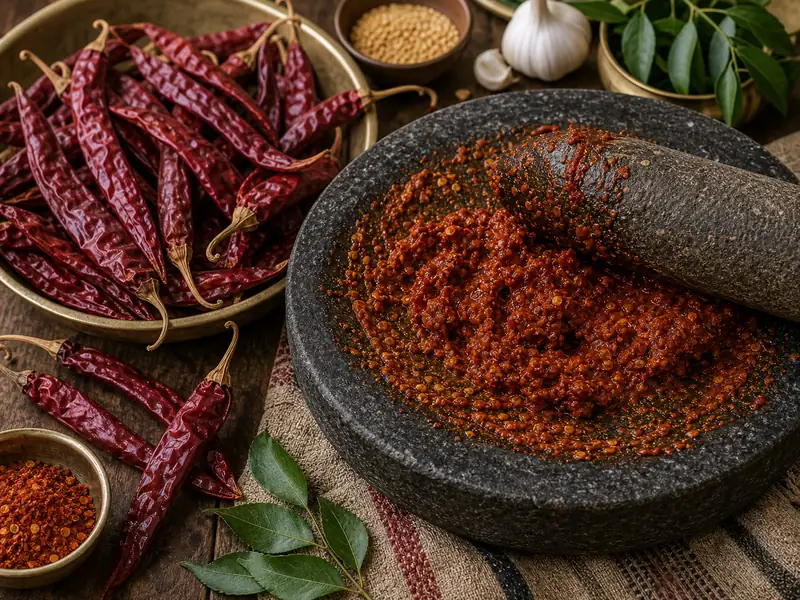
Dried form: The dried pod is the form most cooks will meet, and drying is what gives this chili its character rather than merely preserving it.
Drying deepens the earthiness and concentrates the pungency in a way fresh pods do not replicate. A fresh Guntur is hot.
A dried one is hot and anchored, which is why it works as the base of a spice blend rather than a garnish.
Toast briefly in a dry pan before grinding. The short heat is what turns the pod into a powder with depth, and it is the standard first step for Andhra curries, rasams and chutneys.
Colour is the quality read.
Deep, uniform red means the batch still has both heat and flavour. Pale or faded pods have lost both, and no amount of toasting brings them back.
Whole pods hold twelve to eighteen months in an airtight container away from light and heat.
Ground powder is worth using within six to eight months.
What Can Replace Guntur Chili in a Recipe?
No dedicated substitute guidance is published for Guntur Chili yet.
How Do You Start and Grow Guntur Chili Peppers?
Growing Guntur Chili from seed requires starting early - 8 to 10 weeks before last frost is the standard window.
Germination is reliable at soil temperatures between 75 to 85°F, and using a heat mat significantly speeds things up. Check out the grow peppers from seed before your first season with this variety.
This pepper is adapted to semi-arid conditions, which means it handles heat and moderate drought better than many C. annuum varieties, but it does not tolerate waterlogged soil.
Raised beds with well-draining sandy loam are ideal. In heavier clay soils, amend aggressively with compost and perlite.
Plants typically reach 24 to 36 inches in height and benefit from staking once pods set, the heavy fruit load can stress branches. Space plants 18 to 24 inches apart to allow airflow, which reduces fungal pressure in humid climates.
Fertilize with a phosphorus-heavy blend during flowering, then shift to lower nitrogen once pods begin forming. High nitrogen late in the season pushes vegetative growth at the expense of fruit production.
The Piquin Pepper share some cultivation overlap, but Guntur's larger pods and commercial background mean it's been selected for higher yields per plant. Expect 60 to 75 days to maturity from transplant.
Guntur Chili FAQ


- Cayenne Diane - Guntur Sannam Chile
-
Sourcing note: grower and seed-catalogue documentation only No university, government or research body publishes data on this cultivar. The figures on this page come from grower reports and seed-catalogue listings, which are the only documentation that exists for it.
Species classification: C. annuum - based on published botanical taxonomy.