
Which Peppers Work in Hot Honey, and Should They Be Dried or Fresh?

Dried chiles are the simplest base for hot honey: Oregon State Extension sets no weight limit on them, while fresh chiles need a 140°F hot infusion and no more than 15% of the total weight. Heat ranges come from extension services, and no source measures the heat of a finished hot honey.
Which Peppers Work in Hot Honey?
Dried chiles make the simplest hot honey, so the picks below start there, with fresh Fresno and fresh habanero as the options that need a hot infusion.
The picks rest on three things: heat ranges from extension services, the way Oregon State Extension sorts honey additions by moisture, and flavor notes that are editorial readings. No study has measured how hot or how good a finished hot honey is, so the picks are reasoned from the parts and were not tested as a whole.
Oregon State rates guajillo close to chipotle in heat, and no source read measures Fresno, so its place here is editorial. Fresh Fresno has to follow the hot-infusion rules in the next section.
Cayenne runs 30,000 to 50,000 SHU in Oregon State's guide, and Calabrian varieties differ widely in pungency, so the product matters more than the name.
Colorado State describes chipotles as ripened jalapeños smoked to dry and preserve them, so the heat starts from a jalapeño's 2,500 to 10,000 SHU.
Iowa State lists 100,000 to 350,000 SHU, and Oregon State's own hot honey recipe uses fresh habaneros.
Pizza styles and toppings belong to the guide to peppers for pizza, which already mentions habanero honey as a post-bake drizzle.
Chipotle is one smoked pepper among several, and smoking other chiles at home is covered in the guide to peppers for smoking.
Should Hot Honey Use Dried or Fresh Chiles?
Dried is the lower-risk choice. Oregon State Extension puts brittle, crisp dried chiles in a category with no weight limit and either hot or cold infusion, and it puts fresh chiles in the category it calls the greatest risk in infused honey.
Water is the difference. Honey keeps because of its low water activity, and a fresh chile brings moisture and low acid into the jar.
| Dried chiles | Fresh chiles | |
|---|---|---|
| Oregon State category | 1, dry additions (brittle and crisp) | 3, high-moisture and low-acid |
| Weight limit | None | No more than 15% of the total weight |
| Methods allowed | Hot, cold or dry infusion | Hot infusion only, honey held at 140°F (60°C) or above |
| Steeping time | Hot: 10 minutes to 2 hours. Cold: several days. Dry infusion: several weeks | Hot: 10 minutes to 2 hours (15 minutes in the habanero recipe) |
| After steeping | Not stated | Recipes strain the solids out before bottling |
Oregon State's test for dried chiles is physical: they should be brittle and crisp. A pod that bends and feels leathery does not match that description, which is an editorial reading of the guide, not a statement it makes.
Dried chiles have no weight cap in Oregon State's guidance, while fresh chiles are capped at 15% of the total weight and need a hot infusion.
Fresh chiles steeped in honey at room temperature, with no heating step and no weight limit, fall outside every method in the Oregon State publication. It names botulism among the serious risks of unsafe infusion and reports lab trials in which bacteria grew where a submerged ingredient meets the honey.
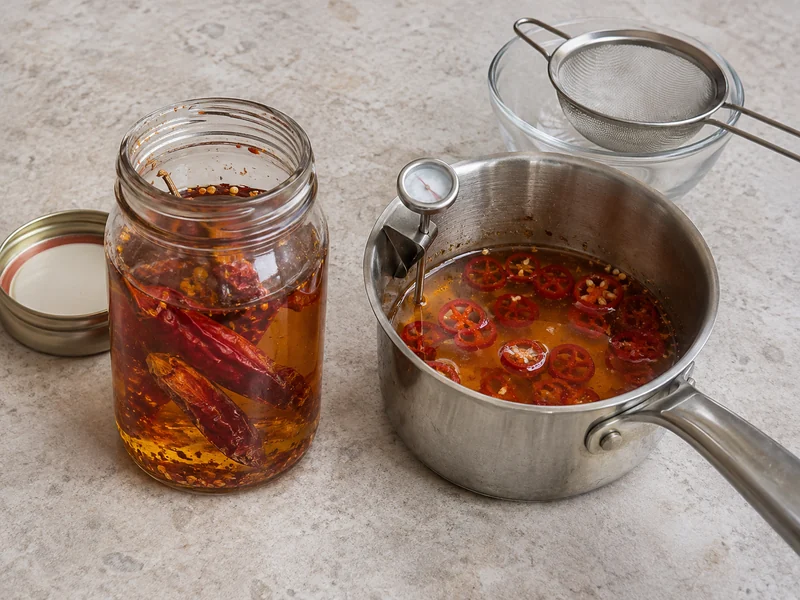
Form also sets the heat ceiling. Dried chile weighs less per pod because the water is gone, so a given weight of dried chile holds more pepper than the same weight of fresh.
Because fresh chile is capped at 15% of the weight and dried chile is not, dried chiles leave more room for strong honey. Both points are editorial inference, since no source measures the heat of the finished honey.
How Do Nine Chiles Compare in Hot Honey?
The table sets nine common choices side by side on the form that works in honey, the heat on record, and the flavor each is usually credited with.
The flavor column is an editorial reading of how these chiles are usually described, because no sensory panel has tasted them in honey. Heat figures and their sources are laid out in the next section.
| Pepper and form | Heat on record | Flavor (editorial reading) | In honey |
|---|---|---|---|
| Calabrian chile, dried flakes | No SHU measurement found. A 2009 study found wide differences in pungency among Calabrian varieties | Fruity and savory, a common pizza chile | Category 1 when dry. Jarred Calabrian pastes and oils are wet products that no source read covers |
| Fresno, fresh or dried | Not measured in the sources read. Colorado State lists 300 to 400 SHU on a page marked pending external review | Fruity | Fresh is Category 3, so hot infusion and the 15% cap. Dried is Category 1 |
| Chile de árbol, dried pods or flakes | Oregon State: much hotter than the guajillo and ancho in its adobo recipe. One 2013 study found about 2 to 10 times guajillo's capsaicinoids | Clean, nutty heat on a thin pod | Category 1 |
| Cayenne, dried flakes or powder | 30,000 to 50,000 SHU (Oregon State). 25,000 to 50,000 (Iowa State, University of Florida) | Bright heat with little flavor of its own | Category 1 |
| Habanero, fresh or dried | 100,000 to 350,000 SHU (Iowa State, University of Florida) | Tropical and fruity, though Oregon State says extreme pungency can mask it | Fresh is the pepper in Oregon State's recipe. Dried is Category 1 |
| Thai or bird's eye, dried or fresh | 50,000 to 100,000 SHU (Iowa State, University of Florida) | Sharp, quick heat | Fresh is Category 3. Dried is Category 1 |
| Chipotle, dried | A smoked ripe jalapeño (Colorado State). Fresh jalapeño is 2,500 to 10,000 SHU (Iowa State). No figure read for the dried pod | Smoky and a little sweet | Category 1 if the pod is brittle and crisp. Canned chipotle in adobo is a wet product that no source read covers |
| Guajillo, dried pods or flakes | Oregon State: heat similar to chipotle. No extension SHU range read | Berry-like | Category 1 |
| Crushed red pepper flakes | Depends on the peppers used, which labels rarely state. If cayenne-type, 25,000 to 50,000 SHU (editorial inference) | Mostly heat, little flavor | Category 1 when dry and brittle |
Fresh chiles gain flavor from a short pre-step in Oregon State's habanero recipe. The sliced pods simmer for 2 minutes in apple cider vinegar, which the guide says helps release their flavor.
The pepper-and-vinegar mixture is what gets weighed against the 15% limit, up to 5.63 ounces for 2 pounds of honey.
Heating the honey speeds the process, since Oregon State notes that it causes more rapid flavor transfer, while its dry infusion method for dried ingredients takes several weeks.
Oregon State also says the extreme pungency of habanero-type peppers masks their fruity aroma. Honey that tastes mostly of heat is a likely result at high doses, which is editorial inference.
How Hot Will the Honey Get?
No source read measures the heat of a finished hot honey, so every number here describes the pepper and not the jar.
The weight of chile per weight of honey and the steeping time set the result, and neither has a measured heat outcome behind it.
Iowa State University Extension lists four of these chiles in one table, so the ranges below come from a single source.
Other extension numbers shift the edges. The University of Florida lists jalapeño at 2,000 to 8,000 SHU, and Oregon State gives 2,500 to 8,000 for jalapeño and 30,000 to 50,000 for cayenne.
Oregon State also groups the Capsicum frutescens cultivars it lists, including African Birdseye, at 30,000 to 50,000 SHU, below the 50,000 to 100,000 that Iowa State and Florida give for Thai chiles.
A pepper's name does not fix its heat. Penn State Extension says peppers from the same plant can differ significantly in heat, and a 2013 laboratory study measured the same guajillo variety at 1.46 mg of capsaicinoids per gram in the field and 4.74 in a greenhouse, more than triple.
That study put chile de árbol at 13.96 in the field and 9.40 in the greenhouse, which works out to about 2 to 10 times guajillo depending on growing conditions (editorial arithmetic). Oregon State's adobo recipe gives the same ordering in plain words, calling árbol and cayenne much hotter than the guajillo and ancho it uses.
Calabrian chiles vary the same way. A 2009 study of fresh Calabrian peppers found the highest capsaicin and dihydrocapsaicin in the 'Vulcan' and 'Corno di capra' varieties.
Four rows in the comparison have no extension or government SHU range: Calabrian, Fresno, guajillo and dried chipotle. Colorado State's 300 to 400 SHU for Fresno sits on a page marked pending external review, and the same page gives jalapeño 2,500 to 10,000, so this page treats Fresno heat as unmeasured.
What Do the Food Safety Sources Say About Chiles in Honey?
Oregon State Extension publication EM 9885, Infusing honey safely, is the one peer-reviewed extension source read that covers fresh chiles in honey. Jared Hibbard-Swanson and Joy Waite-Cusic wrote it, and it is dated July 2026.
Its central claim is that honey stays stable because of low water activity, not acidity or antimicrobial compounds, so added moisture is what can change the jar. It calls honey's pH an unreliable control, because honey ranges from 3.1 to 6.1 and some pathogens grow at a pH as low as 3.7.
Plain honey sits far below the botulinum threshold, and a fresh chile adds water and low acid. No source read measures the water activity of honey mixed with fresh chile, so the point where a given jar crosses the line is unknown.
Oregon State sets a 15% weight cap and a 140°F hot step as its controls, and the page cites no validation data for either number.
| Source | What it covers | What it does not cover |
|---|---|---|
| Oregon State EM 9885 (July 2026) | Fresh chiles, garlic and herbs in honey, dried chiles with no limit, a hot-infusion method, and a habanero recipe | Validation data for the 15% and 140°F numbers, refrigeration of infusions with fresh ingredients, and vinegar or jarred chile products beyond its one recipe |
| CDC botulism prevention (page dated 26 February 2026) | Honey is unsafe for children under 1 year. Homemade oils with garlic or herbs go in the refrigerator and are thrown out after 4 days | Chiles in oil or in honey. The 4-day rule is for oils, not honey |
| Kansas State, Honey Fermented Garlic May Be Risky (2020) | Garlic fermented in honey is risky, botulism has occurred in garlic in oil, and the mixture's water activity depends on the proportions and other factors | Numbers, a rule, or any pepper |
| FDA water activity guide | About 0.93 as the minimum water activity for C. botulinum growth | Honey, chile, or any infused food |
| Lazaridou et al. (2004) | Water activity of 33 plain Greek honeys | Anything added to honey |
Advice on garlic or herbs in oil is the nearest body of guidance, and it does not transfer automatically. CDC's refrigerator rule covers oils, Kansas State's article covers garlic, and neither mentions chiles in honey.
Oil infusions have their own rules, which the jalapeño infused olive oil recipe follows with short refrigerator storage.
What the sources do establish is a mechanism and a set of controls. A fresh chile is moist and low in acid, lab trials found growth where a submerged ingredient meets honey, and Oregon State's controls are heat and a weight cap.
No source read reports a case traced to chile in honey, so the evidence is the mechanism and the extension method and not an outbreak record. That supports using the extension method for fresh chiles and treating dried chiles as the simpler route.
Do not give hot honey, or any honey, to a child younger than 1 year. CDC says honey can contain the bacteria that cause botulism, and Oregon State adds that pasteurization does not kill the spores.
On storage, Oregon State says properly infused honeys keep indefinitely in sealed food-grade containers, may crystallize, and should be thrown out if they bubble or smell sour. The publication does not say whether infusions made with fresh ingredients belong in the refrigerator, so no refrigeration rule is given here.
What Is Still Unmeasured?
These gaps decide how much of the advice above is evidence and how much is judgment.
- No source measures the heat of a finished hot honey, or how much capsaicin moves from chile into honey over time.
- No extension or government SHU range was found for Calabrian chile, Fresno, guajillo, dried chipotle or crushed red pepper flakes.
- No sensory panel compares these chiles in honey, so the flavor column is editorial.
- No source covers jarred Calabrian paste, chipotle in adobo, or chile oil mixed into honey.
- Oregon State's controls come with no cited validation data, and the publication is silent on refrigerating infusions with fresh ingredients.
Where the evidence runs out, dried chiles and the Oregon State method are the choices with a documented basis, and everything else on this page is labeled as judgment.
Which Peppers Work in Hot Honey, and Should They Be Dried or Fresh? FAQ
Yes, but only by Oregon State Extension's hot method: honey held at 140°F (60°C) or above, fresh chiles capped at 15% of the total weight, and the solids strained out. Dried chiles have no weight limit and can steep hot or cold.
No. CDC says not to give honey or products made with it to a child younger than 1 year, because honey can contain the bacteria that cause botulism.
No source read measures it. Dried chile weighs less per pod because the water is gone, so a given weight of dried chile holds more pepper than the same weight of fresh, which is editorial inference.
Oregon State says properly infused honey keeps indefinitely in sealed food-grade containers and does not address refrigeration. CDC's 4-day refrigerator rule covers homemade oils with garlic or herbs, not honey.
- Oregon State University Extension, Infusing honey safely (EM 9885, Jared Hibbard-Swanson and Joy Waite-Cusic, July 2026)
- Centers for Disease Control and Prevention, Preventing botulism (page dated 26 February 2026)
- U.S. Food and Drug Administration, Water Activity (aw) in Foods
- Lazaridou et al. (2004), Composition, thermal and rheological behaviour of selected Greek honeys, Journal of Food Engineering 64(1)
- Kansas State University, Honey Fermented Garlic May Be Risky (Karen Blakeslee, 15 October 2020)
- Iowa State University Extension, Growing Peppers in the Home Garden (Steil, Haynes and Nair, reviewed October 2024)
- University of Florida IFAS Gardening Solutions, Peppers by Scoville Units
- Oregon State University Extension, Grow your own peppers (EC 1227, Edmunds, Myers and Peachey, 2023)
- Oregon State University Extension, Salsa de Adobo Mexicana (Food Hero, December 2023)
- Gonzalez-Zamora et al. (2013), Characterization of Different Capsicum Varieties by Evaluation of Their Capsaicinoids Content by HPLC, Molecules 18(11)
- Ziino et al. (2009), Volatile compounds and capsaicinoid content of fresh hot peppers of different Calabrian varieties, Journal of the Science of Food and Agriculture
- Colorado State University, Jalapeno Peppers, Food Source Information (page marked pending external review)
- Penn State Extension, Growing Hot Peppers: Can You Make Them Hotter? (Susan Marquesen, updated 12 June 2024)
More Guides
 Kitchen Best Peppers for Chili: Build a Dried Chile Base, Then Add the Heat
 Kitchen Dried Mexican Chiles by Flavor and Heat, From Sweet Ancho to Chile de Arbol
 Kitchen Fresh vs Dried Peppers: How Flavor and Heat Change
 Kitchen How to Cut Jalapenos Without Burning Your Hands or Spreading Capsaicin
 Kitchen How to Deseed Peppers and Remove the Pith That Holds Most of the Heat
 Kitchen How to Dry Peppers at Home by Matching the Method to Wall Thickness