
Jalapeño vs Thai Chili: Heat, Flavor & Key Differences
The jalapeño (2,500-8,000 SHU) and Thai chili (50,000-100,000 SHU) are both C. annuum peppers, but they occupy completely different heat territories. One is a mild, grassy workhorse found in nearly every American kitchen; the other is a sharp, fiery staple of Southeast Asian cooking that can hit 12 times hotter. Knowing the difference matters whether you're cooking or substituting.

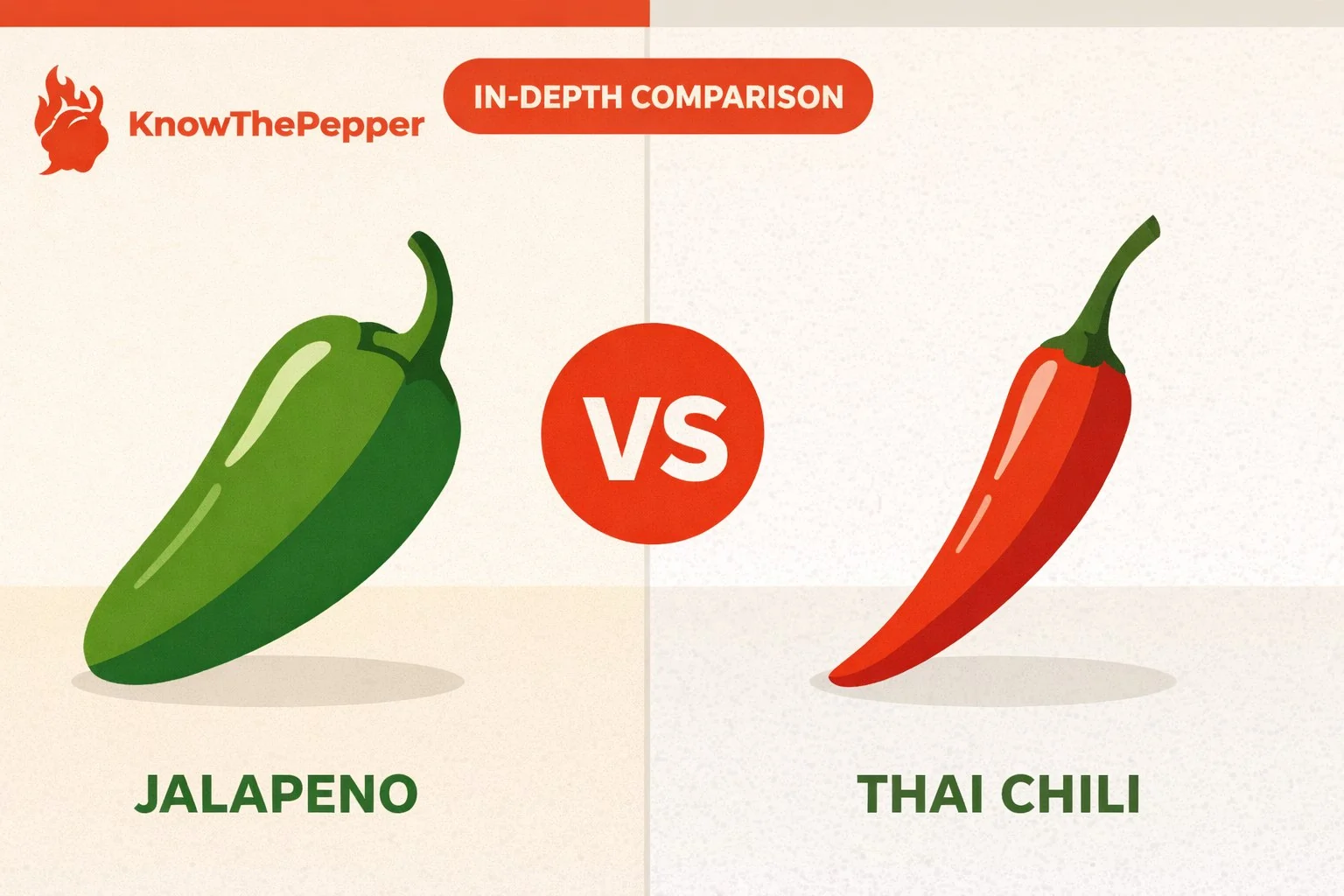
Jalapeño measures 3K–8K SHU while Thai Chili registers 50K–100K SHU — making Thai Chili 13× hotter. Jalapeño is known for its bright and grassy flavor (C. annuum), while Thai Chili offers bright and peppery notes (C. annuum).
- Heat difference: Thai Chili is 13× hotter
- Species: Both are C. annuum
- Best for: Jalapeño excels in everyday cooking and salsas, Thai Chili in hot sauces and spicy dishes
Jalapeño
MediumThai Chili
Extra-HotJalapeño vs Thai Chili Comparison
Jalapeño vs Thai Chili Heat Levels
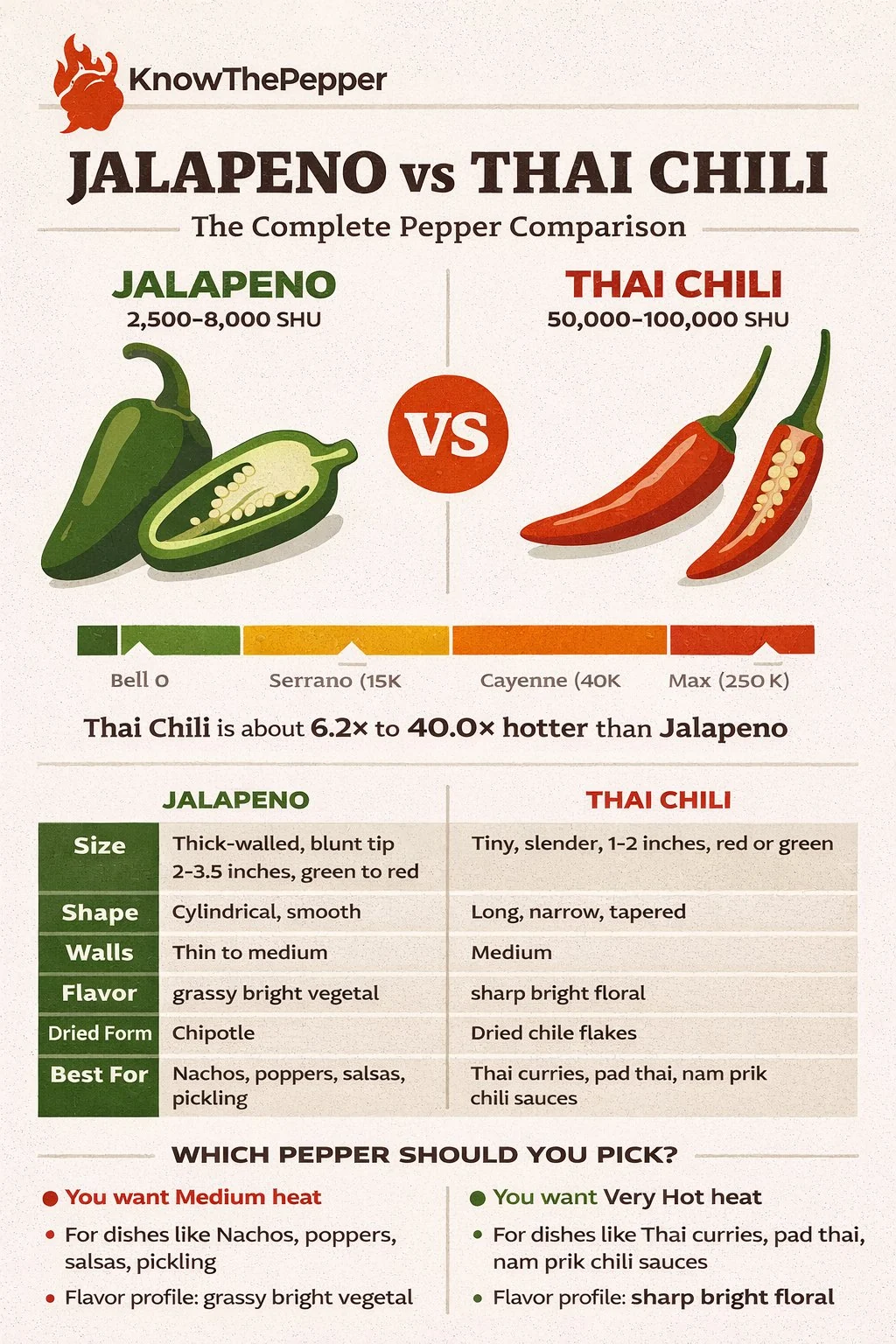
The gap here is not subtle. At 2,500-8,000 SHU, the jalapeño sits comfortably in medium-heat pepper territory — enough warmth to notice, not enough to alarm most eaters. The Thai chili, registering 50,000-100,000 SHU, belongs firmly in the hot pepper range where casual snacking ends and serious heat begins.
To put the multiplier in concrete terms: a Thai chili is roughly 6 to 40 times hotter than a jalapeño depending on where each lands in its range. Compare both against a guajillo (2,500-5,000 SHU) and the picture sharpens further — a guajillo and jalapeño are practically neighbors, while a Thai chili hits 10 to 40 times hotter than that dried Mexican staple.
The character of the burn differs too. Jalapeño heat is front-loaded — you feel it on the tip and sides of the tongue almost immediately, then it fades within a minute or two. Thai chili heat builds. The initial bite may seem manageable, but capsaicin binds aggressively to TRPV1 receptors (for more on why capsaicin triggers that burning sensation, the receptor science is genuinely interesting) and the heat lingers well past the last bite.
Jalapeños also show more heat variability by individual fruit. A stressed, drought-grown jalapeño can push toward 8,000 SHU, while a well-watered greenhouse specimen might barely crack 3,000. Thai chilies are more consistent — their narrow genetics and traditional cultivation keep most fruits clustering in the upper half of their range.
Flavor Profile Comparison
Few peppers have earned their reputation as thoroughly as the jalapeño.
Small enough to overlook, fierce enough to remember — the Thai chili punches well above its size.
Start with aroma, because that's where these two peppers first announce themselves. A fresh jalapeño has a clean, vegetal smell — green bell pepper's sharper cousin, with a faint grassy note that intensifies when you slice through the flesh. Thai chilies smell more assertively peppery even before you bite in, with a thin-skinned intensity that's almost floral at the top note before the heat takes over.
On the palate, the jalapeño's bright, grassy flavor holds up well to heat from cooking. It doesn't disappear into a dish — roast it and you get sweetness; keep it raw and you get that clean green snap. That flavor persistence is why jalapeños work so well in salsas, poppers, and pickled preparations where the pepper is a featured player, not just a heat source.
Thai chilies deliver brightness with a sharper peppery edge and considerably less of the grassy sweetness. The flavor is more one-dimensional in the best possible sense — it punches heat and pepper flavor simultaneously without much background complexity. In Thai cooking, that directness is exactly the point: the chili provides heat and a clean peppery note while aromatics like lemongrass, galangal, and kaffir lime handle the complexity.
Both peppers belong to Capsicum annuum, which partly explains why their base flavor profiles share that bright, fresh quality. The divergence comes from centuries of selective breeding toward different culinary goals — the jalapeño toward moderate heat with flavor, the Thai chili toward maximum heat efficiency in a small package.
Culinary Uses for Jalapeño and Thai Chili
Jalapeños are built for volume. Their thick walls hold up to stuffing, grilling, and long cooking without turning to mush. Classic applications include fresh salsas and pico de gallo, jalapeño poppers, nachos, pickled rings, and smoked chipotles. When a recipe calls for jalapeño, it usually wants both the heat and the pepper's characteristic flavor as part of the dish's identity.
Thai chilies function more like a seasoning than a vegetable. At 50,000-100,000 SHU, you rarely use them in the same quantities — where a recipe might call for two jalapeños, it might call for two Thai chilies and mean a fraction of the volume. They're central to Thai curries, pad kra pao (Thai basil stir-fry), nam prik dipping sauces, and larb. They're also widely used across Vietnamese, Laotian, and Cambodian cooking.
Substitution ratios matter here. Going from jalapeño to Thai chili in a recipe, start with 1 Thai chili for every 8-10 jalapeños called for, then adjust up. Going the other direction — replacing Thai chilies with jalapeños — you'll need significantly more volume and will still miss the top-end heat. For a more workable substitution guide for Thai chili heat, the ratio adjustments depend on the dish format.
For heat-matching without flavor compromise, a serrano sits between these two and can bridge some gaps. For direct jalapeño comparisons at similar heat levels, the Fresno's flavor profile versus jalapeño heat is worth examining — Fresnos run slightly hotter with a fruitier edge.
In practical kitchen terms: use jalapeños when the pepper is a featured ingredient. Use Thai chilies when you need heat that integrates into a sauce or braise without dominating the texture.
Which Should You Choose?
Choose a jalapeño when you want a pepper that contributes flavor and moderate heat in roughly equal measure — it's the right tool for fresh preparations, stuffed applications, and dishes where the pepper itself is part of the character. The habanero vs jalapeño heat gap illustrates how quickly things escalate once you leave jalapeño territory.
Reach for Thai chilies when heat is the primary goal and you're cooking in a Southeast Asian context where that sharp, peppery intensity is the point. They're not interchangeable with jalapeños — the heat difference is too large and the culinary traditions too distinct.
For cooks building a pepper pantry, keeping both makes sense. Jalapeños cover Mexican-American cooking and everyday heat needs. Thai chilies handle Southeast Asian recipes and any dish where concentrated heat in small volume is the goal. Neither replaces the other, and understanding the regional heritage of Thai peppers helps explain why the Thai chili evolved toward such intensity in the first place.
Can You Substitute One for the Other?
Proceed with caution. Thai Chili is 13× hotter than Jalapeño.
Need a different option altogether? Search for peppers that match your target heat and flavor with precise swap ratios.
Growing Jalapeño vs Thai Chili
If you’re deciding which pepper to grow at home, consider your climate and patience level. Jalapeño and Thai Chili have different maturation times and temperature preferences. Hotter varieties generally need a longer, warmer growing season to develop their full capsaicin content. Our zone-based planting date tool can pinpoint the best sowing window for your area.
Jalapeños are among the most forgiving hot peppers to grow, but they do have preferences worth knowing.
Start seeds indoors 8–10 weeks before your last frost date. Soil temperature for germination should stay between 75–85°F — a heat mat under the seed tray makes a real difference in germination speed and uniformity.
Transplant outdoors once nighttime temps stay consistently above 55°F. Jalapeños want full sun — at least 6 hours daily — and well-drained soil with a pH around **6.
The hardest part of growing Thai chilies is not germination — it is managing heat stress during fruiting. These plants originate from a tropical climate and expect warmth, but sustained temperatures above 95°F (35°C) cause flower drop before pods can set.
Germination itself is straightforward at 80–85°F soil temperature, typically within 10–14 days. Start seeds indoors 8–10 weeks before last frost.
They prefer well-draining soil with consistent moisture but will tolerate brief dry spells better than waterlogging. Feed with a low-nitrogen fertilizer once flowering begins; too much nitrogen pushes leaf growth at the expense of pods.
History & Origin of Jalapeño and Thai Chili
Both peppers carry centuries of culinary heritage. Jalapeño traces its roots to Mexico, while Thai Chili originates from Thailand. Understanding their backstory helps explain why each pepper developed its distinctive traits.
Buying & Storage
Whether you’re shopping for Jalapeño or Thai Chili, the same quality indicators apply. Fresh peppers should feel firm and heavy for their size, with taut, glossy skin and no soft or wet spots. Minor stem cracks known as “corking” are perfectly normal and often indicate a mature, flavorful pod.
- Firm pods with taut skin and consistent color
- Should feel heavy relative to size
- Minor stem cracks (“corking”) are normal
- Avoid anything soft, shriveled, or with dark wet spots
- Fresh: Paper bag, crisper drawer — 1–2 weeks
- Frozen: Wash, dry, freeze on sheet pan — 6+ months
- Dried: Airtight, away from light — up to 1 year
The Verdict: Jalapeño vs Thai Chili
Jalapeño and Thai Chili occupy very different positions on the heat spectrum. Thai Chili delivers 13× more heat with its distinctive bright and peppery character. Jalapeño, with its bright and grassy profile, excels in everyday cooking.
Frequently Asked Questions
Related Comparisons
Sources pending verification.
