Jalapeño vs Poblano: Heat, Flavor & Best Uses
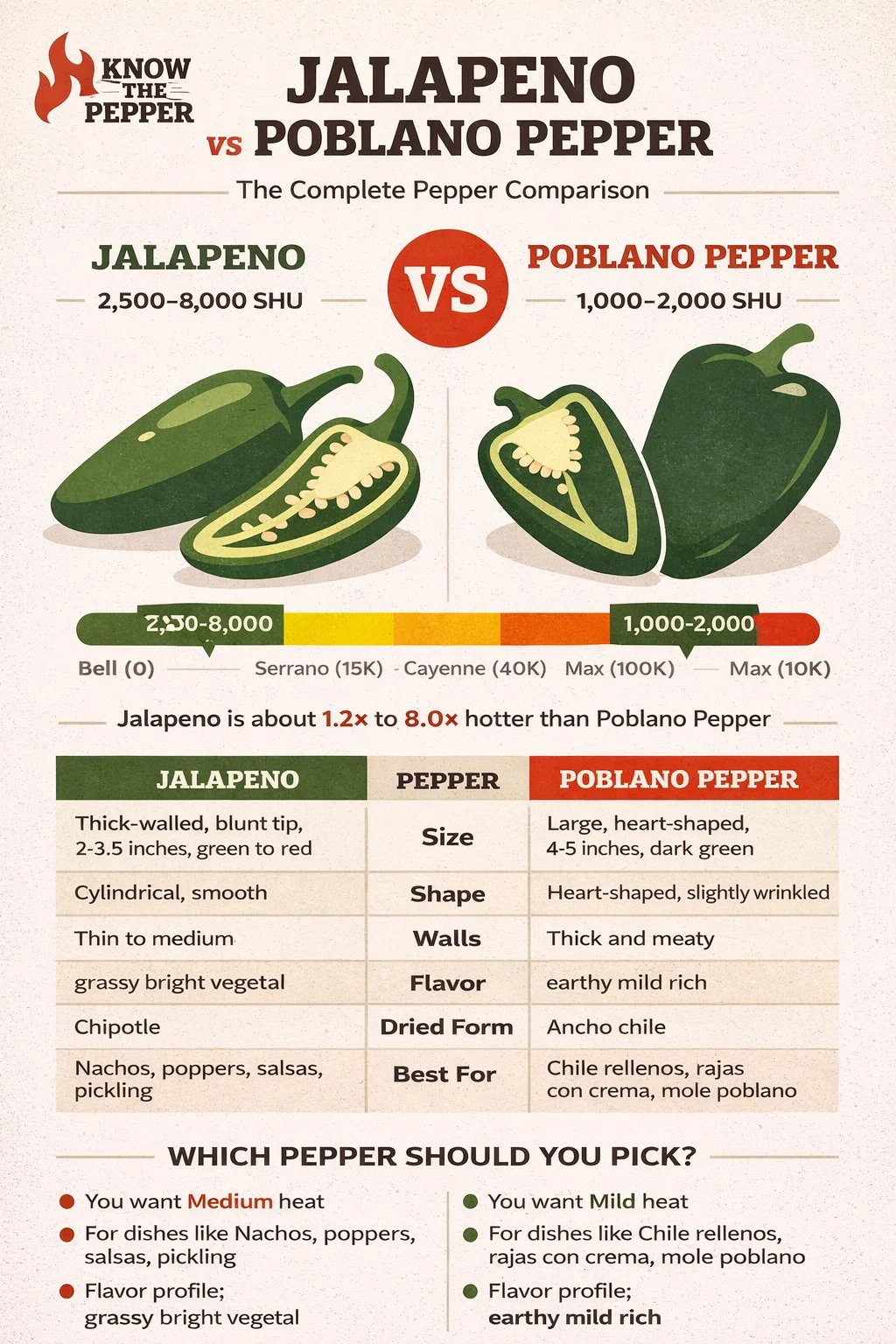
Jalapeño and poblano are both Mexican-born members of C. annuum, but they sit in very different places on the heat scale and serve different roles in the kitchen. The jalapeño runs 2,500–8,000 SHU, while the poblano tops out around 1,000–2,000 SHU — making the jalapeño anywhere from 1.5 to 8 times hotter depending on individual fruit. Flavor-wise, they're almost opposites: jalapeños bring bright, grassy snap while poblanos deliver a deep, earthy richness that transforms completely when dried into ancho chiles.

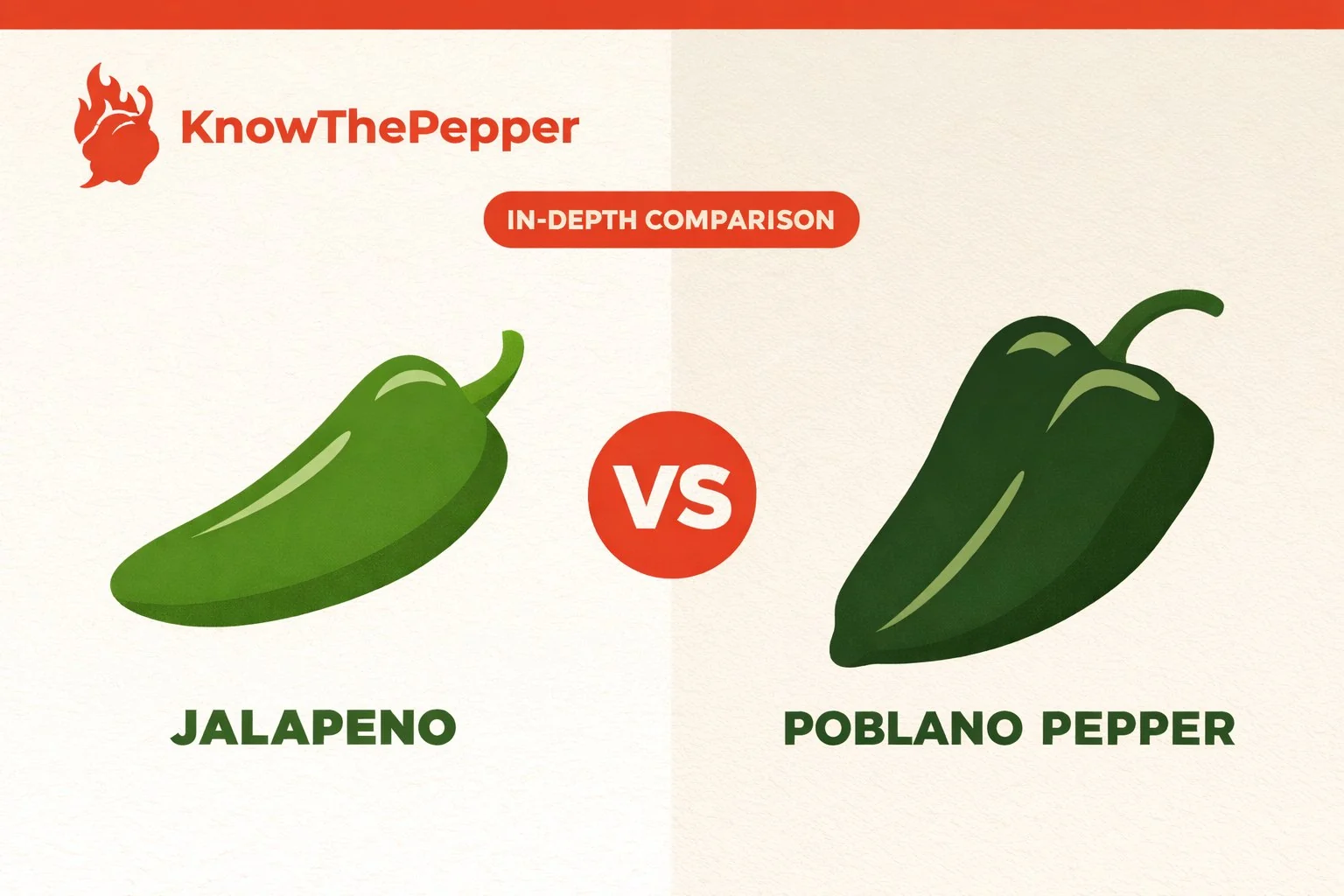
Jalapeño measures 3K–8K SHU while Poblano Pepper registers 1K–2K SHU — making Jalapeño 4× hotter. Jalapeño is known for its bright and grassy flavor (C. annuum), while Poblano Pepper offers earthy and rich notes (C. annuum).
- Heat difference: Jalapeño is 4× hotter
- Species: Both are C. annuum
- Best for: Jalapeño excels in everyday cooking and salsas, Poblano Pepper in fresh salsas and mild recipes
Jalapeño
MediumPoblano Pepper
MediumJalapeño vs Poblano Pepper Comparison
Jalapeño vs Poblano Pepper Heat Levels
The numbers tell the first part of the story. Poblanos land between 1,000 and 2,000 SHU, placing them firmly in what most heat charts call the low end of medium-intensity peppers — noticeable warmth, but nothing that lingers uncomfortably. Jalapeños clock in at 2,500 to 8,000 SHU, meaning even the mildest jalapeño beats the hottest poblano by at least 500 units, and a fully ripe red jalapeño can hit four times the ceiling of a poblano.
For a useful reference point: a Fresno chile averages around 2,500–10,000 SHU, putting it in the same general neighborhood as jalapeños. Poblanos sit measurably below both. If a Fresno is your benchmark for 'moderate heat,' expect a jalapeño to match or slightly exceed that, and a poblano to feel noticeably tamer.
What makes the jalapeño's heat interesting is its variability. Stress factors — drought, high temperatures, soil composition — push capsaicin production upward. A grocery-store jalapeño grown under comfortable conditions might read closer to 2,500–3,500 SHU. One from a hot, dry garden in late summer can approach the upper range. Poblanos are more consistent; their thick walls and lower capsaicin baseline don't swing as dramatically.
The burn character differs too. Jalapeño heat hits the front of the mouth and mid-palate with a clean, quick sharpness. Poblano's mild heat is broader and slower — you feel it as warmth rather than sting. Understanding why capsaicin binds to TRPV1 receptors explains why these two peppers, despite being botanical cousins, produce such different sensations at the table.
Flavor Profile Comparison
Few peppers have earned their reputation as thoroughly as the jalapeño.
Pick up a fresh poblano and the first thing you notice is the weight.
Strip away the heat and you're left with two genuinely distinct flavor profiles. Jalapeños have a brightness that's almost vegetal — grassy, slightly acidic, with a fresh green quality that makes raw slices pop in a salsa or on a nacho. Ripe red jalapeños soften that edge and pick up a subtle fruitiness, but the characteristic snap never fully disappears.
Poblanos operate in a different register entirely. Their flavor is earthy, almost chocolatey in the way a good dark roast coffee is — complex without being sharp. There's a mild bitterness at the skin that roasting converts into something smoky and rich. Raw poblano has a pleasant vegetal depth; roasted and peeled, it becomes almost meaty, with a texture and flavor concentration that few fresh peppers can match.
Aroma is another point of divergence. Fresh jalapeños have a distinct, assertive smell — cut one open and the scent announces itself. Poblanos smell milder raw, but the moment they hit a dry skillet or open flame, they release an aroma that's nutty and complex. This is why they're the standard choice for chiles rellenos and mole negro foundations: the roasted depth can't be replicated with a hotter, sharper pepper.
Both belong to the broader Mexican pepper growing tradition and share the C. annuum species, which also includes bells, cayennes, and serranos. But within that species, jalapeño and poblano represent nearly opposite flavor strategies — one built for bright, punchy contrast, the other for slow-building, layered depth.
Culinary Uses for Jalapeño and Poblano Pepper
Chiles rellenos is where poblanos are irreplaceable. The pepper's size (typically 4–5 inches), thick walls, and earthy flavor make it the structural and culinary foundation of the dish — stuff it with cheese or picadillo, batter it, fry it, and that roasted poblano flavor carries everything. No other fresh pepper handles that role as well. The comparison to bell pepper's milder profile makes clear why bells fall short: not enough flavor complexity.
For mole negro and other long-cooked sauces, dried poblanos — sold as ancho chiles — provide the dark, raisin-like depth that defines the sauce. Fresh poblanos also work sliced into rajas, the cream-braised strips served with corn and onion that pair with almost any protein.
Jalapeños cover more ground. Raw, they go into pico de gallo, guacamole, ceviche, and relishes where their brightness reads as freshness rather than heat. Pickled jalapeños (en escabeche) are a different ingredient entirely — vinegar softens the heat and adds tang. Smoked and dried, they become chipotles, which share some of the poblano's depth but with considerably more fire.
For heat-swapping: replacing a jalapeño with a poblano cuts heat by roughly 60–75% and shifts flavor toward earthiness. Going the other direction — subbing jalapeño for poblano — adds significant heat and loses the structural qualities needed for stuffed preparations. In cooked salsas or stews, the swap works better than in fresh applications.
The cayenne-to-jalapeño heat jump and the bird's eye versus jalapeño intensity gap both illustrate how jalapeños sit in a practical middle zone — hot enough to matter, mild enough for broad audiences. Poblanos occupy a different niche: maximum flavor with minimum heat penalty.
Which Should You Choose?
If your goal is heat with fresh flavor — salsas, pickling, anything where you want the pepper's presence felt — jalapeño is the answer. It's flexible, widely available, and its 2,500–8,000 SHU range gives you room to calibrate by choosing younger green fruit or riper red ones.
If you want depth without fire — stuffed peppers, roasted preparations, slow-cooked sauces — poblano has no real substitute. Its earthy richness at 1,000–2,000 SHU means it adds complexity without overwhelming the dish, and its size and wall thickness open up cooking techniques jalapeños simply can't support.
For everyday cooking, keeping both on hand makes sense. They don't compete — they complement. Jalapeño handles the heat and brightness; poblano handles the body and earthiness. Together, they cover most of what Mexican-inspired cooking demands, and they're among the most approachable peppers for cooks at any experience level.
Can You Substitute One for the Other?
Yes — direct substitution works. Jalapeño and Poblano Pepper are close enough in heat to swap at roughly 1:1. The main difference will be flavor. For more swap options, explore ranked alternatives with conversion ratios.
Growing Jalapeño vs Poblano Pepper
If you’re deciding which pepper to grow at home, consider your climate and patience level. Jalapeño and Poblano Pepper have different maturation times and temperature preferences. Hotter varieties generally need a longer, warmer growing season to develop their full capsaicin content. Our zone-based planting date tool can pinpoint the best sowing window for your area.
Jalapeños are among the most forgiving hot peppers to grow, but they do have preferences worth knowing.
Start seeds indoors 8–10 weeks before your last frost date. Soil temperature for germination should stay between 75–85°F — a heat mat under the seed tray makes a real difference in germination speed and uniformity.
Transplant outdoors once nighttime temps stay consistently above 55°F. Jalapeños want full sun — at least 6 hours daily — and well-drained soil with a pH around **6.
Poblanos are rewarding garden plants, but they need a long season. Start seeds indoors 10-12 weeks before your last frost date — this is one case where rushing transplant time costs you yield.
For a full breakdown of seed-starting methods and timing, the complete pepper growing guide covers everything from soil mix to hardening off. Poblanos specifically want consistent moisture — irregular watering leads to blossom end rot and cracked fruit.
Transplant into full sun once nighttime temps stay above 55°F. Space plants 18-24 inches apart; they can reach 3 feet tall with good conditions.
History & Origin of Jalapeño and Poblano Pepper
Both peppers carry centuries of culinary heritage. Jalapeño traces its roots to Mexico, while Poblano Pepper originates from Mexico. Understanding their backstory helps explain why each pepper developed its distinctive traits.
Buying & Storage
Whether you’re shopping for Jalapeño or Poblano Pepper, the same quality indicators apply. Fresh peppers should feel firm and heavy for their size, with taut, glossy skin and no soft or wet spots. Minor stem cracks known as “corking” are perfectly normal and often indicate a mature, flavorful pod.
- Firm pods with taut skin and consistent color
- Should feel heavy relative to size
- Minor stem cracks (“corking”) are normal
- Avoid anything soft, shriveled, or with dark wet spots
- Fresh: Paper bag, crisper drawer — 1–2 weeks
- Frozen: Wash, dry, freeze on sheet pan — 6+ months
- Dried: Airtight, away from light — up to 1 year
The Verdict: Jalapeño vs Poblano Pepper
Jalapeño and Poblano Pepper sit in the same heat tier but serve different roles. Jalapeño delivers 4× more heat with its distinctive bright and grassy character. Poblano Pepper, with its earthy and rich profile, excels in everyday cooking.
Frequently Asked Questions
Related Comparisons
Sources pending verification.