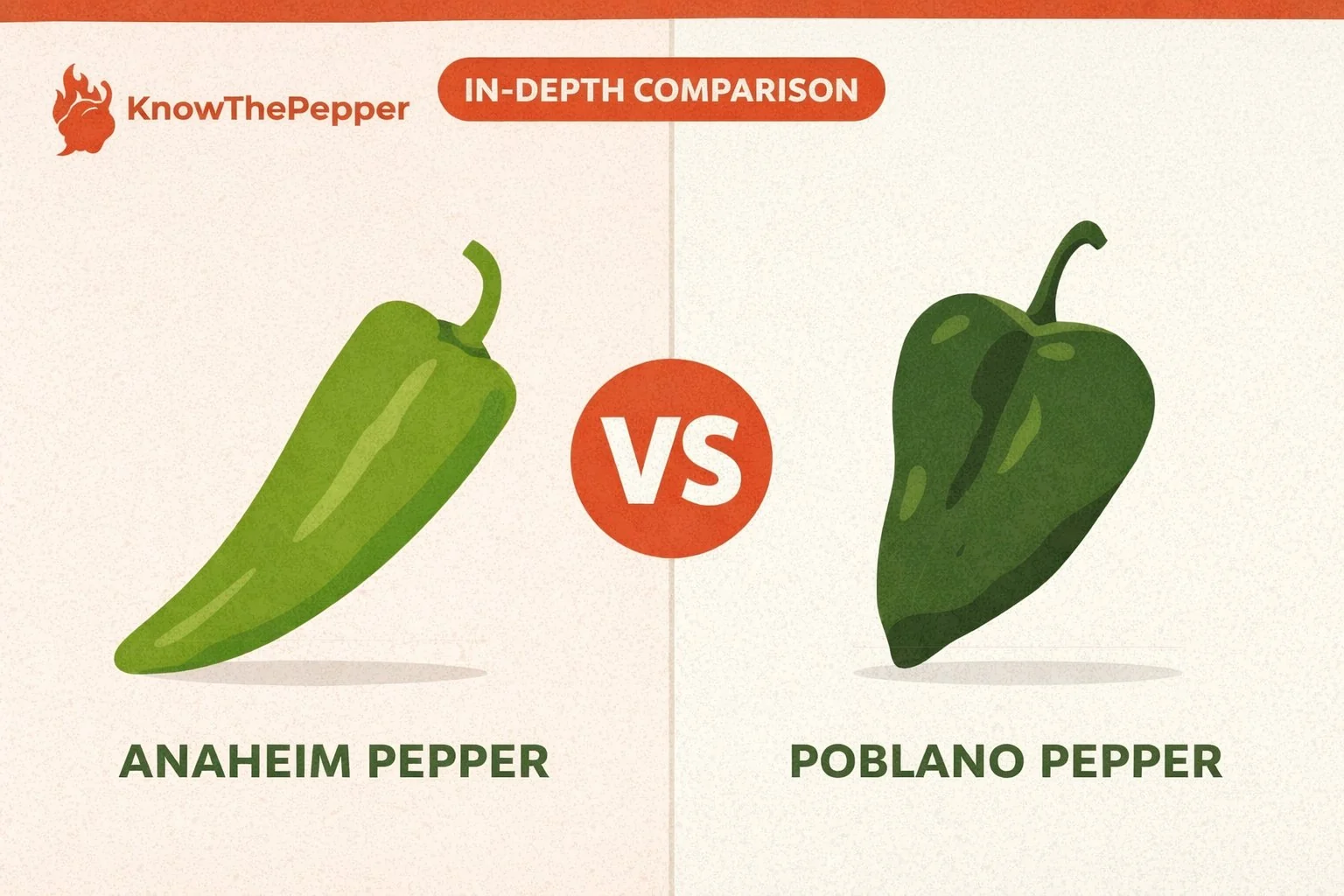
Hatch chiles and poblanos are both mild-to-medium C. annuum peppers beloved in American and Mexican cooking, but they differ sharply in origin, heat range, and culinary identity. Hatch chiles come from a specific valley in New Mexico and carry 1,000-8,000 SHU of earthy, roasted heat. Poblanos are a Mexican staple with a rich, dark-green flavor profile that makes them the go-to pepper for stuffing and sauce.
Comparison Contributor·Updated Jun 29, 2026·
Reviewed by
Karen Liu
Quick Comparison
Hatch Chile measures 1K–8K SHU while Poblano Pepper registers 1K–2K SHU. That makes Hatch Chile about 4x hotter by upper SHU range. Hatch Chile is known for its earthy and sweet flavor (C. annuum), while Poblano Pepper offers earthy and rich notes (C. annuum).
Hatch Chile
1K–8K SHU
Medium · earthy and sweet
Poblano Pepper
1K–2K SHU
Medium · earthy and rich
Heat difference: Hatch Chile is about 4× hotter by upper SHU range
Species: Both are C. annuum
Best for: Hatch Chile excels in everyday cooking and salsas, Poblano Pepper in fresh salsas and mild recipes
Hatch Chile is
about 4× hotter than Poblano Pepper.
Hatch Chile spans 1K–8K SHU, roughly 1× a jalapeño at the upper end.
Poblano Pepper spans 1K–2K SHU.
Use the ranges to decide whether the recipe needs a measured dose, a mild overlap, or a hard substitution limit.
Tools: Scoville chart and SHU calculator.
Few peppers carry the geographic identity that the Hatch Chile does. Grown in the Hatch Valley of southern New Mexico, these elongated C. annuum peppers owe their distinctive character to the region's high desert conditions - intense sun, alkaline soil, and cool nights that concentrate sugars and earthy compounds in ways that flat-land growing simply cannot replicate.
The heat range spans 1,000 to 8,000 SHU, which puts it squarely in the medium heat classification zone - comparable to a moderate smoky-sweet dried pepper with similar SHU on the lower end, but capable of real kick at its upper range. Flavor is the main event here: roasted Hatch chiles develop a complex sweetness layered over an earthy, almost mineral backbone that no other pepper quite matches.
Poblano Pepper
earthyrichC. annuum
The poblano is Mexico's most important large fresh chile - the backbone of chiles rellenos, the base of mole negro, and the fresh pepper that most closely bridges mild bell peppers and the heat of jalapeños. At 1,000–2,000 SHU, most poblanos sit just at or below the lower range of jalapeños, though heat varies by growing conditions.
The pods are heart-shaped to elongated, typically 4–5 inches long, with thick walls that make them ideal for stuffing and roasting. That thick flesh holds up under heat without turning mushy, peels cleanly after charring, and carries a distinctly earthy, slightly fruity flavor that dried versions (anchos) concentrate into one of the most important chile flavors in Mexican cooking.
Both peppers belong to C. annuum, so they share some underlying flavor chemistry. However, Hatch Chile’s earthy and sweet notes contrast with Poblano Pepper’s earthy and rich character.
Hatch Chile brings earthy and sweet notes, so it fits recipes where that flavor should remain visible.
Poblano Pepper leans earthy and rich, which can change the sauce, filling, marinade, or garnish even when the heat range looks close.
Culinary Uses for Hatch Chile and Poblano Pepper
Hatch Chile
Roasting is non-negotiable. Raw Hatch chiles have decent flavor, but fire - whether over a gas burner, under a broiler, or in a commercial roaster - unlocks the earthy sweetness that makes them worth the fuss.
Once roasted and peeled, the applications are broad. Green Hatch chile stew (sometimes called chile verde) is the classic - pork shoulder braised with roasted chiles, garlic, and broth until everything collapses into something deeply savory.
For heat calibration, Hatch chiles sit at roughly the same level as a jalapeño's familiar fresh-pepper bite - sometimes milder, sometimes matching that upper range depending on the specific cultivar and growing season. The flavor profile differs sharply though: where a ripened red pepper with flexible cooking applications brings grassy brightness, Hatch brings earth and sweetness.
Poblano Pepper
Roasting and peeling is the starting point for most poblano applications. Hold the pepper over a gas flame or under a broiler, turning until the skin chars black on all sides - usually 8–12 minutes total.
For chiles rellenos, the roasted, peeled pepper gets a lengthwise slit, the seeds and placenta are removed (reducing heat to near zero), and the cavity is stuffed with cheese or picadillo. The key technique is keeping the stem attached - it holds the stuffed pepper together through battering and frying.
Mole negro uses dried ancho chiles as its primary body - typically 3–4 dried anchos per serving for 4–6 people, soaked in hot water for 20 minutes, then blended with chocolate, spices, and multiple additional ingredients. Fresh poblanos contribute a different flavor than dried anchos; they are not interchangeable in mole recipes.
Start near 1:1 by amount. The heat ranges are close enough that flavor, form, and recipe role matter more than a strict Scoville conversion.
Growing Hatch Chile vs Poblano Pepper
Growing notes
Hatch Chile
Growing Hatch chiles outside New Mexico is possible, but manage expectations - the valley's specific terroir is genuinely difficult to replicate. That said, the cultivars themselves grow well across USDA zones 5-10 with proper care.
Start seeds indoors 8-10 weeks before last frost. Hatch varieties need soil temperatures above 65°F to germinate reliably - bottom heat helps significantly.
These plants prefer well-drained, slightly alkaline soil with pH around 6.5-7.
Growing notes
Poblano Pepper
Poblanos grow well in most North American climates given a full growing season. Start seeds indoors 8–10 weeks before last frost at 75–85°F soil temperature.
Transplant spacing: 18–24 inches apart in full sun with 6–8 hours of direct light daily. Poblanos are slightly more shade-tolerant than most hot peppers, though full sun produces better yield and more developed flavor.
Poblanos take 65–80 days from transplant to green maturity - the standard harvest stage for fresh cooking. Leaving them to ripen to red takes another 2–3 weeks and transforms the flavor toward sweetness.
Where They Come From
Origin & background
Hatch Chile
USA · C. annuum
The Hatch Valley's chile-growing history stretches back centuries, with Indigenous Pueblo peoples cultivating chiles throughout the Rio Grande corridor long before Spanish colonizers arrived in the 16th century. Spanish settlers formalized large-scale cultivation, and by the late 1800s, New Mexico had established itself as a chile-producing region.
New Mexico State University's Chile Pepper Institute played a defining role in the modern Hatch Chile story. Fabian Garcia, a horticulturist at NMSU, spent decades in the early 1900s breeding and standardizing New Mexico chile varieties for consistent flavor and yield.
Origin & background
Poblano Pepper
Mexico · C. annuum
The poblano takes its name from Puebla, the central Mexican state where it has been cultivated for centuries. Puebla is one of Mexico's most culinarily significant regions - home to mole poblano, the complex sauce built around dried anchos (dried poblanos) that represents one of Mexico's most celebrated culinary achievements.
Pre-Columbian cultivation of large C. annuum varieties in Mesoamerica is well-documented archaeologically. The poblano's size, mild heat, and thick flesh suggest it was bred over generations for culinary versatility - the thick walls that survive stuffing and roasting are agricultural decisions, not accidents.
Buying & Storage
Whether you’re shopping for Hatch Chile or Poblano Pepper, the same quality indicators apply. Fresh peppers should feel firm and heavy for their size, with taut, glossy skin and no soft or wet spots. Minor stem cracks known as “corking” are perfectly normal and often indicate a mature, flavorful pod.
Selection
What to look for
Firm pods with taut skin and consistent color
Should feel heavy relative to size
Minor stem cracks (“corking”) are normal
Avoid anything soft, shriveled, or with dark wet spots
Storage
How to store them
Fresh: Paper bag, crisper drawer, 1 to 2 weeks
Frozen: Wash, dry, freeze on sheet pan, 6+ months
Dried: Airtight and away from light, up to 1 year
Mistakes to avoid
Common misses
Hatch Chile
Equating green with unripe. Different products.
Overcooking. Cell walls break down fast.
Sealed plastic storage. Causes rot. Use paper bags.
Common misses
Poblano Pepper
Equating green with unripe. Different products.
Overcooking. Cell walls break down fast.
Sealed plastic storage. Causes rot. Use paper bags.
Final call
Hatch Chile vs Poblano Pepper
Hatch Chile and Poblano Pepper
sit in the same heat tier but serve different roles. Hatch Chile delivers about 4× more upper-range heat with its distinctive earthy and sweet character.
Poblano Pepper, with its earthy and rich profile, excels in everyday cooking.
Heat gap about 4× by upper rangeHatch Chile earthy and sweetPoblano Pepper earthy and rich
Ask what the pepper has to do after roasting. Hatch chile is usually chosen for chopped roasted green chile flavor. Poblano is usually chosen for a mild roasted wall that can hold filling.
So the default is simple: Hatch for green chile sauce, stew, queso, eggs, burgers, and enchiladas; poblano for chile rellenos, rajas, stuffed peppers, and roasted strips where structure matters.
Heat Range And Label Risk
Hatch has the bigger label risk because it can be sold as mild, medium, or hot, while poblano is usually gentler and more predictable for family meals.
Season And Regional Identity
Hatch is seasonal and regional. Fresh roasting events peak in late summer, and many cooks freeze roasted bags because the New Mexico green chile aroma is hard to replace later in the year.
Poblano is steadier at supermarkets. Its identity is less about a harvest event and more about Mexican dishes that use the pod's size, mild heat, and roastable skin.
The dried form points to a different lane: ripe dried poblano becomes ancho. If the recipe needs deep red sauce, you are no longer choosing Hatch versus fresh poblano; you are choosing a dried chile path.
Swap By Dish
For chopped roasted pepper in eggs, queso, burgers, or enchiladas, mild Hatch can replace poblano and will taste brighter. Poblano can replace Hatch only when the recipe does not depend on New Mexico chile aroma.
For stuffed peppers, poblano is the better default because the wall, shoulder, and cavity are built for filling. Hatch can work only if the pods are large and mild enough.
For green sauce, Hatch is the better default because it brings the roasted green chile identity people expect. Poblano can make a good green sauce, but it will taste softer and less regional.
Buy Hatch by heat label and roast status. Fresh pods should feel firm with smooth green skin. Roasted bags should smell clean and smoky, with no sour liquid or gray flesh.
Buy poblanos by shape. Broad shoulders help stuffing; smaller curved pods are fine for strips and sauces. Freeze roasted Hatch in flat portion bags, and refrigerate poblanos only short term because their value is texture as much as flavor.
Fact-Checked & Expert Reviewed
Editorial Standards: Head-to-head comparisons include blind tasting when applicable. Heat levels cross-referenced with multiple sources. All substitution ratios tested side-by-side.
Review Process:
Written by
James Thompson
(Lead Comparison Reviewer)
, reviewed by
Karen Liu
(Lead Fact-Checker & Science Editor)
. Last updated June 29, 2026.
Hatch Chile vs Poblano Pepper FAQ
Yes in mild roasted dishes, but the flavor will be darker and less like New Mexico green chile. For stew or green chile sauce, add another green chile if you need more brightness.
Yes when the Hatch is labeled mild and the dish uses chopped roasted pepper. For stuffed poblanos, use Hatch only if the pods are large enough and not too hot.
Hatch chile has the wider range, about 1,000 to 8,000 SHU. Poblano is usually around 1,000 to 2,000 SHU, so it is more predictable and mild.
Poblano is better for chiles rellenos because its broad walls and mild heat hold filling well. Hatch can work in large mild pods, but it is not the default structure.