

KnowThePepper
Espelette Pepper: A Protected Basque Chile That Seasons at 1,500–2,500 SHU
The Espelette pepper is the only pepper in France with protected origin status, grown in ten communes of the Basque Country.
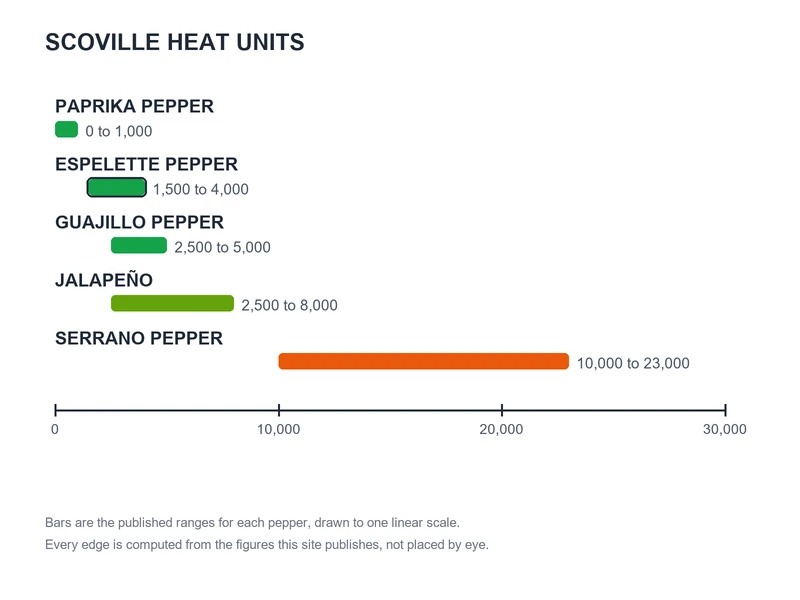
It runs 1,500 to 2,500 SHU in normal use with 4,000 as the ceiling, which puts it at the mild end and lets it work as a seasoning rather than a heat source.
- Species: C. annuum
- Heat tier: Medium (1K-10K SHU)
- Comparison: the same heat range as a jalapeño because their published ranges overlap
What Is Espelette Pepper?
The Espelette has a legal identity. It is a Capsicum annuum grown in ten communes of the French Basque Country, and it took its Appellation d'Origine Controlee in 2000, so authentic Espelette can come from nowhere else.
What that protection does not describe is the flavor, and the flavor is what earns the reputation: sweet at the front, gently smoky once dried, finishing warm rather than sharp.
The appellation is worth reading carefully, because it is often quoted as though it certified the heat. The INAO specification governs the growing area, the communes and the drying and processing standards, and it sets no Scoville figure at all.
The Syndicat du Piment d'Espelette gives 1,500 to 2,500 SHU as the usual band, with 4,000 quoted as the upper limit, which overlaps the bottom of a jalapeno and stays below it everywhere else. Fresh pods are bright red and elongated at 10 to 15 cm, but most Espelette reaches a kitchen as powder.
Drying and grinding concentrate the smoky sweetness while leaving the heat where it was, which is why the powder can be used by the spoon rather than the pinch. That is the pepper's real position: it behaves like a spice, not like a heat source.
Dusted over eggs, stirred into butter or laid on fish, it adds something neither black pepper nor paprika gives, and capsaicin chemistry explains why the warmth reads so clean at this level.
What Is the Origin of Espelette Pepper?
The pepper reached the Basque country in the 16th century, after Spanish voyages brought Capsicum annuum seed back from the Americas. The region took to it quickly, and the town of Espelette became the centre of cultivation.
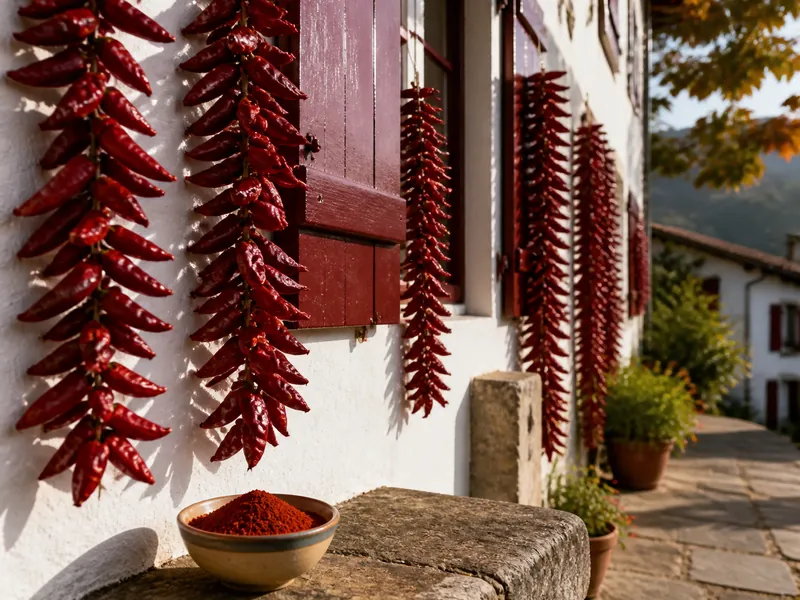
Farmers hung drying pods in strings called cordes from the red-shuttered fronts of Basque houses, and that practice still defines how the town looks in October. The pepper displaced black pepper as the working seasoning of the region, which is how it ended up in axoa and piperade rather than in dishes built around heat.
Espelette received AOC status in 2000 and EU Protected Designation of Origin in 2002. Both restrict production to the ten communes and set drying and processing standards, and the annual harvest festival in late October is the public face of that system.
The pepper sits inside a wider regional cooking tradition rather than standing alone in it.
What Does Espelette Pepper Taste Like, and How Hot Is It?
The Espelette Pepper delivers 1.5K–4K Scoville Heat Units, placing it in the Medium tier (1K-10K SHU). That makes it roughly the same heat range as a jalapeño because their published ranges overlap.
Flavor notes: sweet and smoky.
What Nutrients Does Espelette Pepper Provide?
A tablespoon of dried piment d'Espelette is around 20 calories, carrying vitamin C, vitamin A as beta-carotene and vitamin E in the concentrations drying produces. Those are useful figures for a spice rather than for a vegetable, because nobody eats a tablespoon of it in one sitting the way they eat a fresh pod.
No database publishes a nutrition panel for this cultivar, so class-level entries for dried red chile are the closest available match and should be read that way.
Capsaicin concentrates in the pale placenta the seeds attach to rather than in the seeds themselves. That matters less here than on a hot pepper, since almost all Espelette is bought as powder made from whole dried pods, membrane included.
The Scoville scale is where the 1,500 to 4,000 figures come from.
How Do You Cook With Espelette Pepper?
Espelette's strength in a kitchen is restraint.
Where a bird's eye chili takes over a dish, Espelette adds warmth without asking for the centre, which is what makes it work across eggs, fish and vegetables alike. In Basque cooking it is not optional in piperade, in ttoro, or as the finish on Bayonne ham.
Outside the region cooks use it wherever black pepper would go, which means oysters, scrambled eggs, foie gras and roasted vegetables. The powder is the practical form.
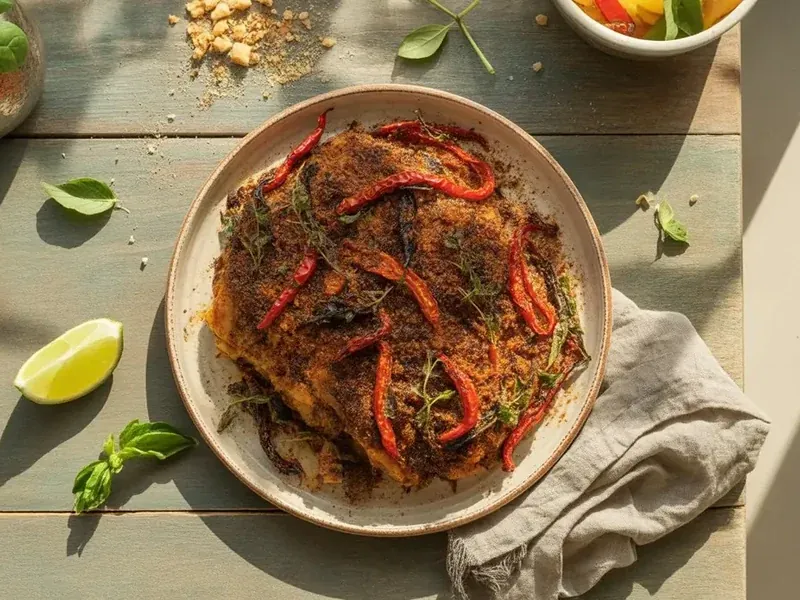
A light dusting over butter-basted fish or into a vinaigrette brings smokiness without burying a delicate flavor, and worked into softened butter with sea salt it becomes a finishing compound for steak or corn.
The heat gap is what changes how freely it can be used. A serrano at 10,000 to 23,000 SHU sits several times above Espelette's ceiling of 4,000, so Espelette goes in by the spoon where a serrano goes in by the slice.
For a swap, smoked paprika with a pinch of cayenne gets close on flavor and heat. What it will not reproduce is the specific character the appellation exists to protect, and the Espelette swaps page works through the trade, including where paprika stands in on its own.
Where Can You Buy Espelette Pepper, and How Do You Store It?
Authentic piment d'Espelette arrives in ceramic jars or sealed pouches carrying the PDO mark, and it costs several times what generic smoked paprika costs. That premium buys the protected origin and the traditional processing rather than extra heat, which is worth knowing before paying it.
The mark says nothing about how long the jar has sat, so judge it by colour and smell: vivid brick red and a clear sweet-smoky aroma on opening. Dull colour or a flat smell means age, and age is the main thing that ruins this product.
Keep powder airtight, away from heat and light, where it holds flavor for 12 to 18 months while fading gradually. Whole dried pods keep longer than powder and can be ground as needed, which is the better buy if you can find them.
Fresh pods, which almost nobody outside the region will meet, hold 1 to 2 weeks refrigerated unwashed in a paper bag. They freeze whole without blanching for about 6 months, losing the raw texture but keeping heat and flavor.
| What a PDO jar guarantees | What it does not |
|---|---|
| Grown in the ten named Basque communes | Any particular Scoville reading |
| Dried and processed to the appellation standard | Freshness, which only colour and aroma can tell you |
| The traditional slow drying that builds the smoke | Protection once the jar is open and exposed to light |
| A traceable producer | Heat comparable to a hot chile, since the ceiling is 4,000 SHU |
What Is a Good Substitute for Espelette Pepper?
Compare substitutes for Espelette Pepper by form, flavor, and heat before choosing a ratio. Measured adjustments must account for the dish and the concentration of the replacement.
Direct comparisons show where flavor, form, and preparation differ in the Aleppo vs Espelette and Espelette vs Paprika matchups.
How Do You Start and Grow Espelette Peppers?
Outside the appellation zone the plant grows well in any warm temperate climate, roughly USDA zones 7 to 11. It wants full sun, soil that drains, moderate fertility and steady moisture without sitting wet.
Start seed indoors 8 to 10 weeks before the last frost, germinating at 75 to 85 F where a heat mat makes a visible difference. Transplant once frost risk has passed, spacing plants 45 to 60 cm apart.
Mature plants reach 60 to 90 cm, and pods set green and ripen deep red over the season. Full colour usually arrives 80 to 90 days after transplant, and for this pepper the wait is not optional, because the sweetness and the colour both arrive late.
Drying is where the character actually forms, not in the field. The Basque method strings whole pods and hangs them in a warm ventilated space for 4 to 6 weeks, while a dehydrator at 135 F does it in days and gives up some of the slow-dried depth.
The plant is not notably disease-resistant, so rotate the bed and keep airflow up. Anthracnose is the risk worth watching in humid weather, and watering at the base rather than overhead is most of the defence.
Espelette Pepper FAQ


- INAO, cahier des charges de l'appellation d'origine Piment d'Espelette
- Syndicat du Piment d'Espelette AOP
- Capsicum annuum L. - USDA GRIN Taxonomy
Species classification: C. annuum - based on published botanical taxonomy.