Jalapeno Planting: When Is It Warm Enough, and What Spacing?
Plant jalapenos after frost danger has passed and nights stay above 50 to 55 F. Space most transplants 18 inches apart in rows 30 to 36 inches apart, or use one strong plant per 5-gallon container. The best planting day is cloudy or late afternoon, with watered roots, warm soil, and no buried peat rim pulling moisture away.
Jalapeno planting should wait until frost danger has passed and nighttime lows stay above 50 to 55°F. A transplant set into cold, wet soil may survive, but it can stop growing, yellow, or shed early flowers.
The job is to move one hardened plant into a warm, draining root zone without changing its soil line. Spacing, pot volume, settling water, and first-week checks decide whether roots restart quickly or spend the next two weeks under stress.
When Is It Warm Enough to Plant Jalapenos Outside?
University of Minnesota Extension recommends moving peppers outdoors only after frost danger has passed and nighttime temperatures stay above 50°F. Illinois Extension uses a 50 to 55°F night range and warns that colder conditions slow growth and can cause flower drop.
One warm afternoon does not satisfy that test.
Read the seven-day forecast and check the bed after several mild days. Air beside a south-facing wall may feel warm while soil two inches down remains cold and saturated from spring rain.
Soil does not need to hit one universal temperature on one clock, but it must be warm enough to drain and support new roots. University of Maryland Extension notes that peppers planted before soil reaches about 65°F may simply sit without useful growth.
| Planting signal | What it means | Decision |
|---|---|---|
| Frost danger has passed and nights remain above 50 to 55°F | Cold injury risk has fallen | Continue to the soil check |
| Soil near root depth crumbles instead of smearing | The bed is workable rather than saturated | Plant if the forecast also stays warm |
| Warm day followed by nights below 50°F | The root zone will cool again | Keep hardened plants protected and wait |
| Muddy soil clings in a dense ribbon | Air space is limited around roots | Let the bed drain before digging |
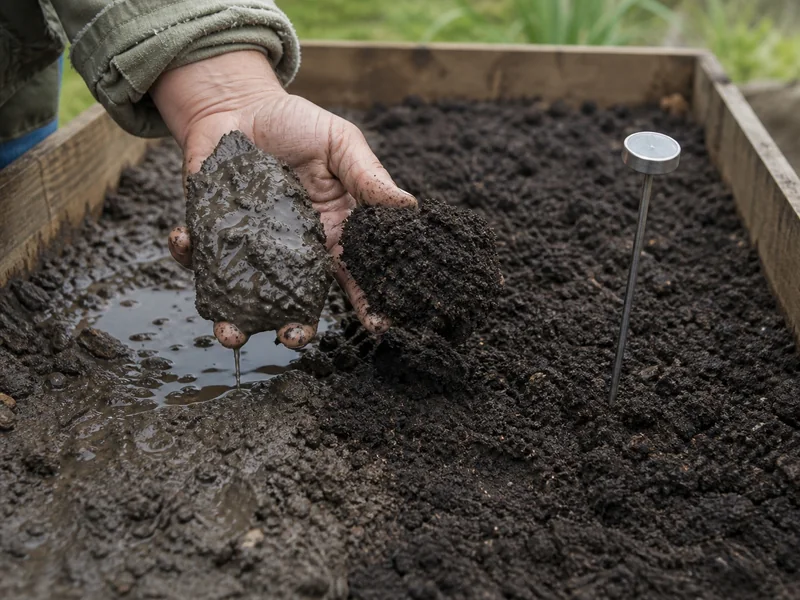
Use a frost-date calendar to estimate the window, then let the current forecast make the final call. A calendar cannot detect a cold rain that leaves one garden bed unready.
Which Jalapeno Transplant Should You Choose?
Most home gardeners get a more reliable start from transplants because jalapenos need a long warm season. Minnesota Extension recommends starting pepper seed about eight weeks before outdoor planting, which explains why direct sowing after the soil warms gives away so much growing time in cooler regions.
Choose a short plant with a firm stem, closely spaced leaves, and green new growth. A leggy pepper seedlings records weak or one-directional light, even when it has more total height.
Slide the root ball partly out of the cell before buying when the nursery allows it. Fine white roots around the outside are workable, while a hard spiral of thick roots means the plant will need careful loosening and more recovery time.
A small transplant covered in flowers is not automatically the strongest choice.
Keep flowers on a sturdy plant with enough root space, but remove a weak bloom from a cramped or wilted plant when it competes with establishment. The useful comparison is root and canopy condition, not whether one specimen reached reproduction first on a crowded sales bench.
- Reject a plant with a cracked main stem or a damaged growing tip.
- Inspect leaf undersides for insects before bringing the tray home.
- Prefer several compact nodes over one long bare stem.
- Water a dry root ball before transplanting rather than flooding the hole afterward.
How Long Should You Harden Off Jalapenos?
Hardening off belongs before permanent planting. An indoor jalapeno has leaves formed under sheltered light and still air, so outdoor sun and wind can damage it even when the soil and forecast are ready.
Minnesota Extension recommends increasing outdoor exposure over one to two weeks. Begin in bright shade or gentle morning sun, then extend the visit as the leaves remain green, upright, and unbleached.
Bring plants back under protection when a hardening night falls below 55°F.
A plant that droops briefly and recovers in shade needs a shorter exposure or a moisture check. Pale bleached patches after sun point to exposure injury, while a stem bent at one point points to wind load.
Delay the permanent move after an unusually hot, cold, or windy hardening day. The plant earns planting readiness by tolerating the actual outdoor setting, not by completing a fixed number of trips.
How Far Apart Should You Plant Jalapenos?
University of Minnesota Extension recommends 18 inches between pepper plants and 30 to 36 inches between rows. That is a useful default because it leaves room for airflow, inspection, and a hand reaching under the canopy at harvest.
University of Maryland Extension gives a wider 12 to 24 inch in-row range with 30 to 36 inches between rows. The range accommodates plant size and bed design, but it does not make every close arrangement equally suitable.
Use 12 to 15 inches only in a wide staggered bed where each plant has open space on several sides. Choose 18 to 24 inches in humid sites, for vigorous cultivars, or where reaching the far side of the canopy would otherwise require brushing wet leaves.
Measure stem to stem, not leaf tip to leaf tip.
| Planting setup | Starting arrangement | Reason to change it |
|---|---|---|
| Single in-ground row | 18 inches between plants and 30 to 36 inches between rows | Move wider if the cultivar or climate produces a dense canopy |
| Wide raised bed | 15 to 18 inches in a staggered pattern | Use the tighter end only when leaves will not seal the canopy |
| Humid or poorly ventilated site | 18 to 24 inches | Extra space helps leaves dry and keeps inspection paths open |
| Container grouping | One plant per normal pot with air between canopies | Move pots apart as branches begin to overlap |
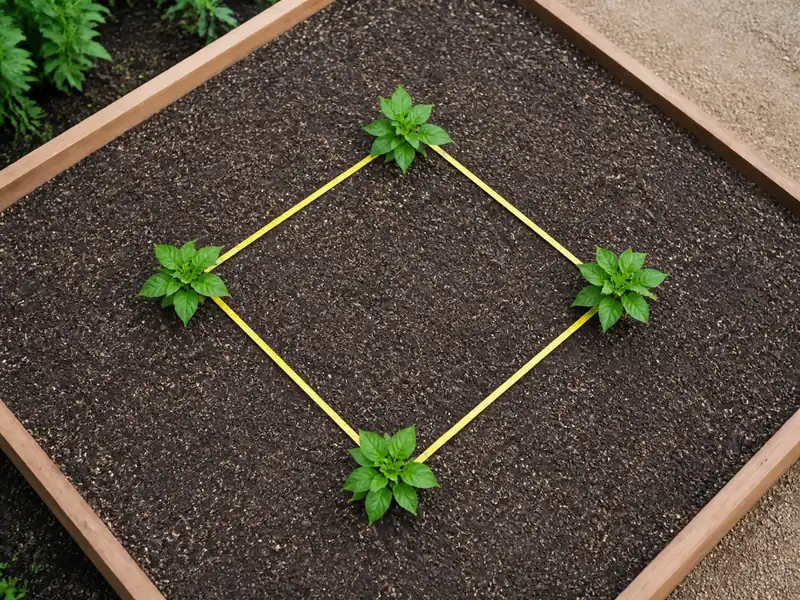
Plan the walking path at the same time as plant spacing. A mathematically open row still fails if you must push through branches to water, inspect the stem base, or pick hidden pods.
What Size Pot Does One Jalapeno Need?
Use one jalapeno per five-gallon container as the working minimum for a normal full-size plant. A larger pot buffers water and root temperature more effectively, which reduces how fast conditions change during hot weather.
Volume alone does not guarantee drainage.
Fill the empty pot once before planting and confirm that water leaves every drain hole. Utah State University Extension emphasizes well-drained soil for peppers, and a blocked container contradicts that requirement from the first watering.
Pot material and placement also change the root environment. A dark container on pavement heats and dries faster than a light container above mulch, so identical five-gallon pots may need different checks.
Do not solve limited patio space by putting two full jalapenos into one five-gallon pot. Use separate containers or select a genuinely compact cultivar, because two normal root systems create faster water swings before their branches reveal the crowding.
What Soil Do Jalapenos Need at Planting?
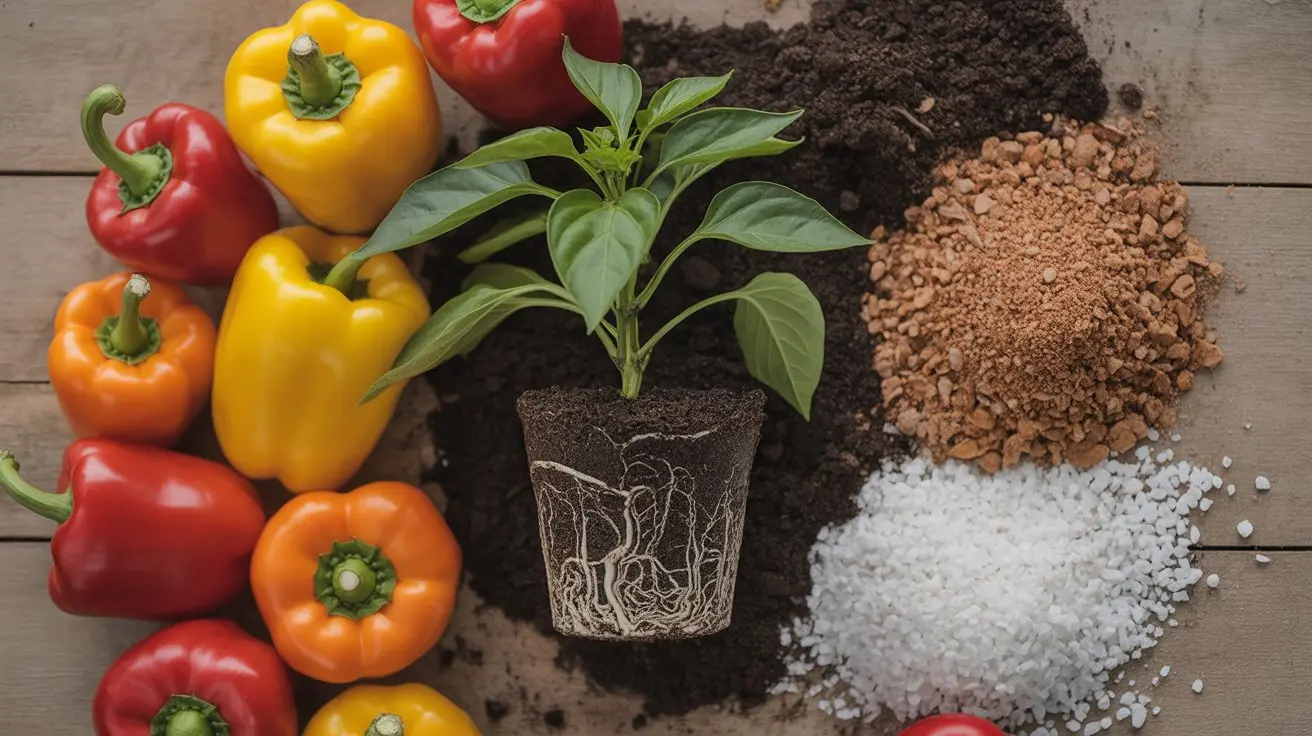
Utah State Extension says peppers need fertile, well-drained soil and perform poorly in heavy wet ground. Correct the bed as a continuous root zone instead of filling one hole with a rich mix that holds water differently from the surrounding soil.
Compost can improve a poor bed when it is blended across the planting area.
A soft amended pocket inside dense clay can act like a bowl after rain, leaving new roots in the wettest part of the bed. Raised rows or a raised bed offer a cleaner correction where spring drainage stays slow.
Minnesota Extension lists pH 6.5 to 7 as a good pepper range. Test the soil before making a large pH or fertility correction, because leaf color from last season cannot identify the exact amendment this bed needs.
Do not put fresh manure or a concentrated fertilizer dose against the root ball. Prepare fertility across the bed according to the soil test, then let new roots enter soil with consistent moisture and salt levels.
In a container, use potting mix rather than garden soil. The container needs pore space after repeated watering, while ordinary bed soil can compact and drain too slowly inside a rigid pot.
How Deep Should You Plant a Jalapeno?
Water transplanting before it leaves the pot, then handle the root ball instead of pulling the stem. Dig a hole slightly wider than the root mass and set the original soil line level with the surrounding bed or potting mix.
Peppers do not need the deep stem burial commonly used for tomatoes.
A weak elongated stem needs better light or a small support, not a deeper wet collar of soil. Keeping the original line visible also makes later moisture and stem checks easier.
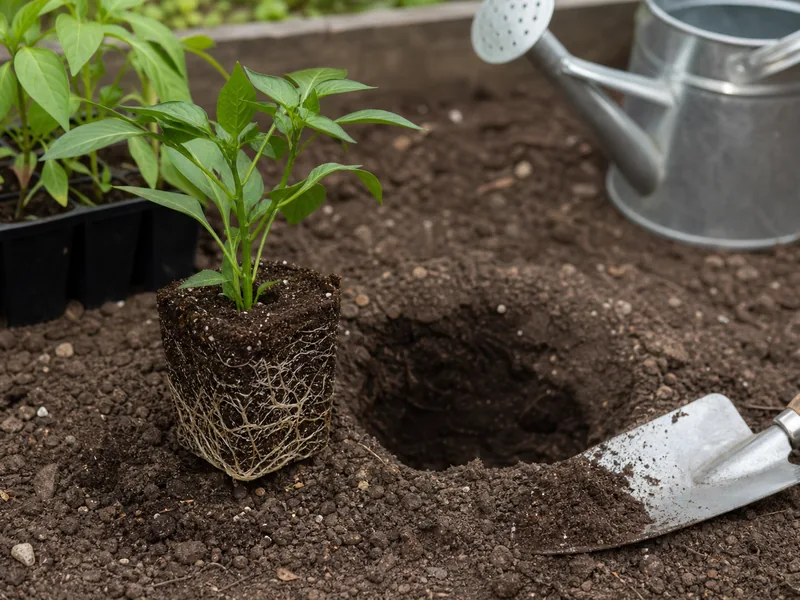
Minnesota Extension warns that an exposed peat-pot rim can wick moisture away from the root ball. Tear away the rim or bury it completely without raising soil against the pepper stem.
- Water the plant until the root ball is evenly moist.
- Dig a hole a little wider than the root ball.
- Slide the plant out while supporting the soil mass.
- Loosen only thick outer roots that circle tightly.
- Set the old soil line level with the new surface.
- Firm soil gently so no large air pocket remains.
A dense root-bound plant may need several outer roots teased loose, but do not split the whole root mass. Heavy tearing combines transplant shock with a sudden loss of water uptake at the moment the plant meets outdoor sun.
How Should You Water Jalapenos After Planting?
Water slowly at soil level immediately after planting. The purpose is to settle soil around the roots and connect the old root ball to the surrounding bed, not to leave the hole saturated for days.
Minnesota Extension recommends soil-level watering and notes that wet foliage is more prone to disease. A hose wand, drip line, or watering can aimed at the base keeps the first irrigation where the recovering roots need it.
Check moisture at root-ball depth before watering again.
The surrounding surface can look dry while the original nursery mix remains wet, especially when a fine potting mix sits inside heavier garden soil. Push a finger beside the root ball or lift a container to read the moisture that roots actually occupy.
A new transplant may sag at midday and stand up again by evening. That pattern can reflect temporary water loss, while overwatering pepper plants calls for a drainage and root-oxygen check rather than another drink.
Wait on heavy fertilizer until a new leaf begins expanding. Fresh growth proves that roots have resumed supply, while fertilizer added to a cold or saturated root zone does not correct the original limit.
Should You Mulch or Stake Jalapenos at Planting?
Add mulch after the soil has warmed, not as an automatic planting-day layer over cold spring ground. A thin layer reduces later moisture swings and soil splash, but keep it away from the stem so the crown remains visible and dry.
Install a small stake at planting where wind exposure or future pod load makes support likely. Placing it beside the root ball now avoids driving it through a larger root system later.
Use a soft tie with enough room for stem expansion.
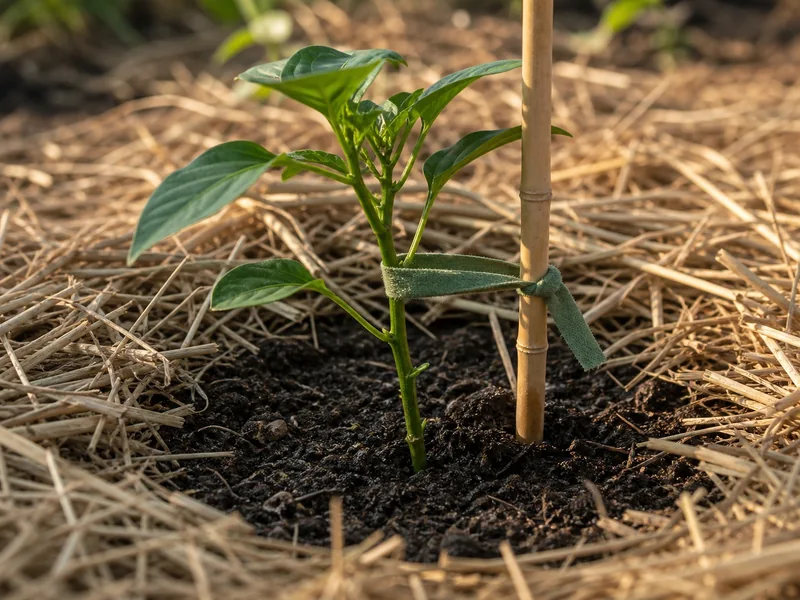
A compact transplant in a sheltered bed may not need immediate support, so the stake should follow the site and plant rather than a quota. Recheck after branches begin carrying pods because fruit load, not height alone, creates many late-season bends.
Why Did Your Jalapeno Stall After Planting?
A planting problem is easier to correct when the symptom is connected to the first failed transition. More water or fertilizer cannot solve every plant that has stopped making leaves.
| Evidence after planting | Likely planting-stage cause | First response |
|---|---|---|
| No new growth during cold nights | Cold soil and slow root activity | Protect the plant and wait for warmer conditions before feeding |
| Pale bleached patches after the move | Incomplete hardening or abrupt sun exposure | Provide temporary shade and resume gradual exposure |
| Root ball dries while nearby soil stays moist | Exposed peat rim or disconnected nursery mix | Remove the rim and water slowly across both soil textures |
| Wilt persists in wet soil | Low root-zone oxygen or blocked drainage | Pause watering and open the drainage path |
| Leaves overlap early in humid weather | Spacing is too tight for the canopy | Move containers or thin the weaker transplant while roots are small |
| Five-gallon pot dries within hours | Exposed hot placement or a root-bound plant | Shade the pot, verify drainage, or move to a larger volume |
Record the night temperatures, planting date, first watering, and first new leaf. Those four observations separate a slow but progressing transplant from one repeating the same stress each day.
Tag each variety at planting time. Jalapeno leaves cannot reliably distinguish the plant from every other Capsicum annuum type before pods form.
How Do You Know a New Jalapeno Has Taken Hold?
Planting is complete when the growing point produces sustained new leaves and the plant remains upright through its normal daily water cycle. Old leaves do not need to look perfect, but the newest structure must show that roots and shoots are working together again.
After that point, shift from establishment checks to ordinary stage care. Long-term feeding, pruning, flower set, pod support, and harvest timing belong to the plant's next visible stage rather than the planting hole.
Keep nearby herbs or flowers far enough away that they do not shade the jalapeno, trap wet leaves, or block access to the stem base. A companion is useful only when the pepper remains easy to water, inspect, and harvest.
If the plant continues making compact new growth, the planting decisions did their work. The next question is what the current jalapeno stage needs, not whether the transplant followed a perfect calendar date.
Jalapeno Planting: When Is It Warm Enough, and What Spacing? FAQ
- University of Minnesota Extension - Growing peppers in home gardens
- Illinois Extension - Peppers
- University of Maryland Extension - Growing peppers in a home garden
- Utah State University Extension - How to grow peppers in your garden