When Should You Plant Pepper Seeds for Your Climate?
Choose the outdoor transplant date first, then count backward by the seed packet's indoor-start interval. Check local freeze probability and wait for soil near the transplant site to reach about 60°F.
Adjust the window for cultivar maturity and the space, light, and containers available indoors. Starting earlier helps only when the setup can hold a compact, healthy transplant until outdoor conditions are ready.
When should you plant pepper seeds indoors?
Choose the outdoor transplant date first, then count backward to get the indoor sowing window. A month such as January or March has no useful meaning until it is tied to local freeze risk, warm soil, and the time your particular seedling needs indoors.
University of Maryland Extension recommends starting pepper seed 8 to 10 weeks before the average frost-free date and notes that some types and cultivars can require 12 weeks. Purdue Extension gives a shorter 7-week reference and lists 7 to 14 days for germination, which shows why an interval is more defensible than one universal date.
Use the seed packet's indoor-start interval when it is available.
That interval normally runs from sowing to transplant, so it already includes germination and much of the hardening period.
- Choose the first outdoor date that meets your acceptable freeze risk and soil-temperature conditions.
- Read the packet for a phrase such as “start indoors 8 to 10 weeks before transplanting.”
- Count backward by both ends of that interval to create an earliest and latest sowing date.
- Mark the final 7 to 14 days before transplanting for gradual hardening rather than adding those days twice.
- Recheck the forecast and soil near the outdoor date, then hold the plant inside if spring is running cold.
| Calendar part | What it represents | How it changes the date | Common mistake |
|---|---|---|---|
| Outdoor anchor | The first date frost risk, soil warmth, and the forecast are acceptable | Everything counts back from here | Using a hardiness zone as a planting date |
| Packet interval | Time from indoor sowing to transplant readiness | Creates the main sowing window | Replacing the packet with a nationwide rule |
| Germination | Time between sowing and emergence | Add it only when the schedule gives post-emergence growth separately | Counting 7 to 14 days twice |
| Hardening | Gradual outdoor exposure before planting | Usually occupies the final part of indoor production | Adding another two weeks to an interval that already includes it |
| Weather delay | A cold spell after the planned date | Moves transplanting later, not sowing retroactively | Planting into cold soil because the calendar says the day arrived |
A packet that says 8 to 10 weeks before transplanting produces a sowing window of roughly March 6 through March 20. Begin hardening near the start of May within that same production window, then delay the actual move if the bed remains cold or the forecast turns risky.
If the packet gives only “6 to 8 weeks from germination to transplant,” add its expected germination interval before counting back.
Utah State University lists 9 to 14 days to germination and 6 to 8 weeks from germination to transplanting for peppers, so that format describes about 7 to 10 weeks from sowing under suitable conditions.
The result is still a planning range.
Seed age, media temperature, light, pot volume, and a cold spring can move emergence or transplant readiness without making the original calculation wrong.
Which frost date should you count back from?
Use a local freeze-probability date that matches your tolerance for risk, then check whether the soil is warm enough for peppers. The average last freeze is a climate statistic, not a guarantee that freezing weather has ended.
USDA hardiness zones describe typical annual minimum winter temperatures.
Two gardens in the same zone can have different last spring freezes, so a zone number cannot supply the outdoor anchor by itself.
National Weather Service tables often show the chance that a threshold temperature will still occur on or after each date. A 50 percent date is the median of the historical record, while a date associated with a 10 percent chance leaves less historical freeze risk but still does not promise safe weather.
Read the table heading carefully because some stations report frost at 36°F, freeze at 32°F, and hard freeze at 28°F. Pepper foliage is tender, so using the wrong threshold can make an apparently precise date misleading.
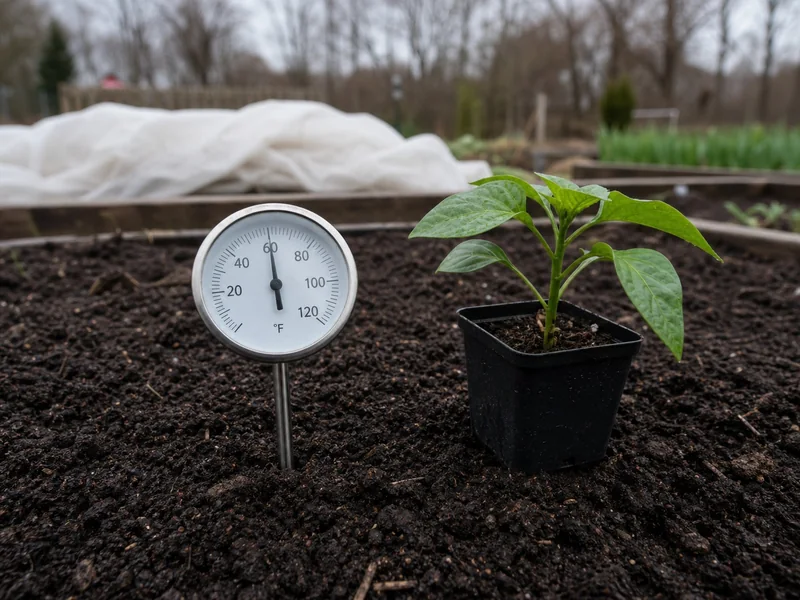
Soil can also lag behind the air. Penn State Extension advises waiting until soil 3 inches below the surface reaches 60°F before transplanting peppers, even when the calendar and air temperature look springlike.
Measure in the actual bed at the depth and time recommended by the thermometer instructions.
A sunny raised bed, a low pocket, a north-facing slope, and a container against a warm wall can reach different temperatures on the same morning.
About a week before the planned move, compare the current forecast with the climate date. Cold rain, several nights near freezing, or soil that remains below the threshold are reasons to delay the transplant while continuing normal indoor care.
Row cover and black plastic can change the protected microclimate, but they do not erase the need to monitor temperature. Protection should be treated as a measured change in conditions rather than permission to ignore the forecast.
Do all pepper varieties need the same start date?
No single heat level, fruit shape, or species name determines the correct sowing date for every pepper.
Begin with the packet or breeder instructions, then adjust for the cultivar's maturity, the germination environment, and how long you can maintain a healthy transplant indoors.
Maryland's guidance allows 12 weeks for some types and cultivars, but it does not say every very hot pepper must be started on that schedule. A labeled cultivar interval is stronger evidence than a social-media rule that groups all peppers by pungency.
| Evidence to check | Why it matters | Reasonable calendar response |
|---|---|---|
| Packet indoor-start interval | It is the closest instruction for that seed lot and cultivar | Use it as the base count-back range |
| Days to harvest or maturity | A long-season cultivar needs enough warm days after transplanting | Choose an earlier cultivar or season protection when the local season is short |
| Expected germination conditions | USU reports 9 to 14 days at an optimum soil range of 65 to 85°F | Fix media temperature rather than moving the calendar earlier to compensate for cold mix |
| Available light | An earlier plant occupies the grow area longer | Start only as early as the light can support compact growth |
| Cell and pot volume | Roots and leaves need more room as indoor time increases | Plan a pot-up or choose a later sowing within the packet window |
| Seed quantity and uncertainty | Old or scarce seed can emerge unevenly | Divide a small batch across two dates instead of risking all seed on one attempt |
Oregon State University Extension recommends comparing the cultivar's days to harvest with the local frost-free season. Check whether the packet counts those days from transplanting or from sowing, because the label convention changes the calculation.
A long maturity figure affects the harvest end of the season more than the germination date.
Starting extremely early cannot create warm outdoor days that the location does not have.
The indoor setup places a second limit on the date. A strong light, enough vertical space, and containers that can accept expanding roots can support a longer runway than a windowsill and a crowded plug tray.
Temperature belongs in the method, not in a nickname for the pepper.
Utah State reports a broad optimum soil-temperature range of 65 to 85°F for pepper germination, while Purdue reports a 7 to 14 day germination interval under suitable indoor production.
For valuable or older seed, a split batch can protect the season without making the whole crop early. Sow part at the early edge of the justified window and the remainder 7 to 14 days later, then keep labels with both batches.
This is risk management, not a claim that the second date will perform better.
Both batches still need the same viable media, warmth, light after emergence, and truthful cultivar label.
Can you start pepper seeds too early or too late?
Yes. “Too early” means the plant will outgrow the light, root volume, or indoor holding time before outdoor conditions are ready, while “too late” means too little warm season remains for the desired harvest.
Calendar age alone does not diagnose an early start.
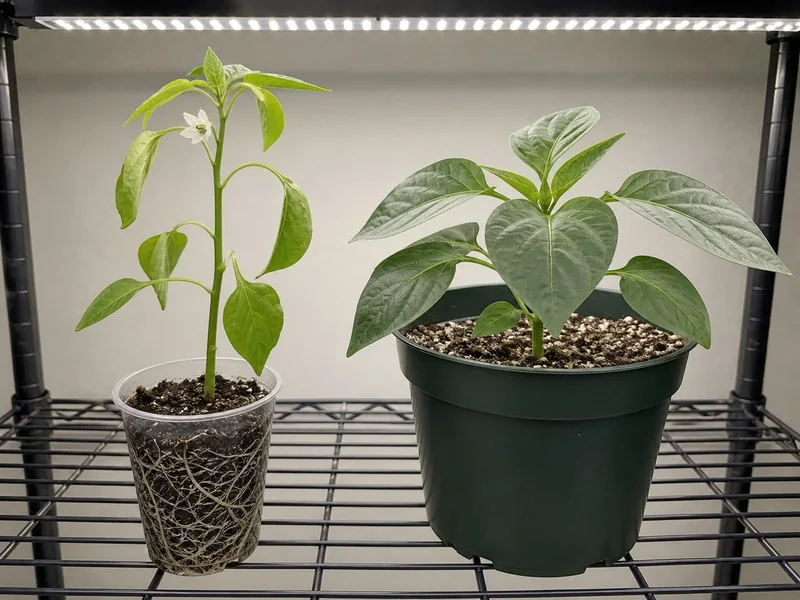
University of Maryland Extension identifies roots visible around the outside of the soil block and overlapping leaves as signals that seedlings have remained crowded too long.
Other practical warnings include a container that dries much faster than before, long weak internodes, leaves touching neighboring plants, and flower buds forming while frost or cold soil will keep the plant inside for weeks.
Utah State describes fast-establishing transplants as stocky, dark green, 5 to 8 inches tall, and carrying 6 to 9 mature leaves. Plants with flowers or fruit establish slowly and yield poorly, so an older and larger plant is not automatically the better transplant.
Give roots more room when crowding is visible, restore adequate light and spacing, and keep checking the outdoor conditions. Do not force the plant into cold soil merely to empty the shelf.
Maintain compact growth and reserve the final 7 to 14 days for hardening. Let forecast and soil readings decide the final outdoor day.
Recalculate from the first fall freeze and the packet's maturity figure. Choose an earlier cultivar, use season protection, accept green fruit, or buy a healthy transplant when ripe fruit no longer fits.
Potting up can protect an early plant from severe root restriction, but it also increases the space, media, water, and light the crop requires. That action buys holding capacity rather than moving the outdoor season forward.
A late sowing needs a different calculation.
Count the days remaining between the realistic transplant date and the local first fall freeze, then compare that runway with establishment plus the packet's harvest interval.
Oregon State notes that some cultivars do not fit frost-free seasons shorter than 120 days without season-extension methods. It also reports that pepper fruit can take at least 45 to 55 days after pollination to become harvestable under good conditions, with cool conditions adding another 15 to 20 days.
A seed can germinate successfully and still be too late for fully colored fruit outdoors.
Green harvest, a container moved into protection, an early-maturing cultivar, or a nursery transplant can still satisfy a different goal.
Buying a transplant is the most reliable rescue when the seedling-production window has closed but the outdoor planting window is opening.
Choose a stocky, disease-free plant without fruit rather than the tallest plant on the bench.
Can you plant pepper seeds directly in the garden?
You can direct sow peppers where soil at seed depth stays warm, freeze risk is acceptably low, and enough warm season remains after the slower field start. In cool or short-season gardens, an indoor or purchased transplant is usually the safer route to a ripe harvest.
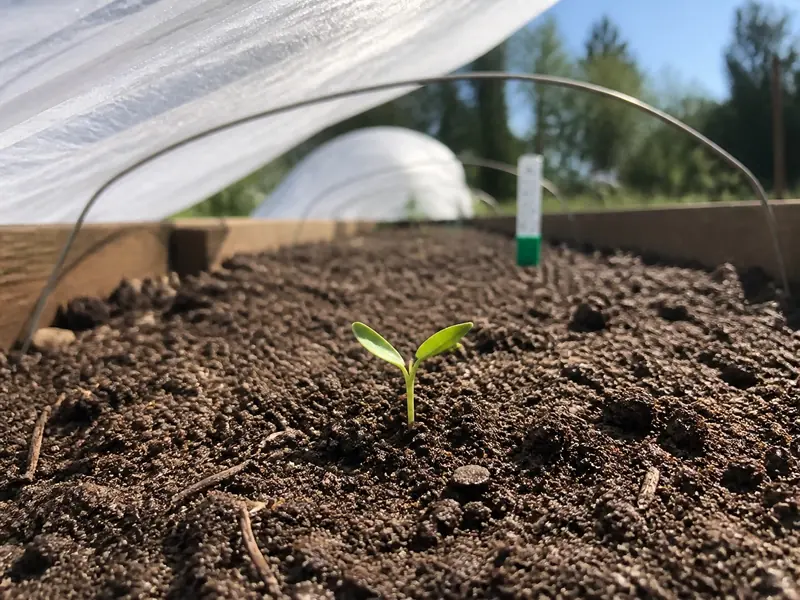
Cornell CALS places pepper among warm-season crops commonly started indoors because protected warmth lets the plant begin before outdoor soil is ready. Missouri Extension adds that field-sown pepper seed can germinate slowly and unevenly, which makes the stand harder to establish.
The 60°F soil threshold from Penn State concerns transplanting. For seed germination, use the warmer range on the packet or local extension guidance and measure at sowing depth rather than assuming one warm afternoon has heated the whole bed.
- Soil at seed depth remains within the recommended germination range across several days.
- The short-range forecast shows no frost event that would kill an emerged seedling.
- The cultivar's harvest interval plus an establishment buffer fits before the first fall freeze.
- The seedbed is fine, drained, and able to stay evenly moist without crusting or flooding.
- Row cover, cloches, or another monitored protection method is ready if nights turn cool.
- Spare seed or a transplant backup remains available if field emergence is poor.
Direct sowing trades indoor equipment for field risk.
The seed faces wider temperature swings, surface drying, heavy rain, soil crusting, insects, and competition before it has a root system.
A low row cover can reduce wind and retain warmth, while black plastic mulch can warm soil around planned openings.
Vent protection on warm days and check the temperature under it, since trapped heat can become a different stress.
Do not use the first visible seedling as proof that the calendar was early enough. The useful test is whether the plant can establish, flower, set fruit, and reach the harvest stage you want before the warm season ends.
If that runway is doubtful, start seed indoors within the calculated window or buy a local transplant near planting time. Those choices move a developed root system into the garden and preserve weeks that direct-sown seed would spend emerging and building its first leaves.
When Should You Plant Pepper Seeds for Your Climate? FAQ
- University of Maryland Extension: Growing Peppers in a Home Garden
- Utah State University Extension: Grow Your Own Transplants at Home
- UMass Amherst Extension: Starting Seeds Indoors
- Purdue Extension: Starting Seeds Indoors
- National Weather Service: Frost and Freeze Probability Dates
- Penn State Extension: Pepper Production
- University of Maryland Extension: Starting Vegetable Seeds Indoors
- Utah State University Extension: How to Grow Peppers in Your Garden
- Oregon State University Extension: Grow Your Own Peppers
- Cornell CALS: Transplants or Direct Seeding
- University of Missouri Extension: Growing Sweet Peppers in Missouri