Which Pepper Companion Plants Help Without Crowding?
The best pepper companion plants earn space through timing, size, or insect habitat. Use basil, chives, sweet alyssum, flowering cilantro, compact marigolds, or temporary lettuce only where they preserve pepper spacing, airflow, watering, inspection, and harvest access.
Pepper companion plants help when the neighboring crop does a clear job without taking the light, water, root space, or access that the pepper needs. Start with pepper spacing, then add herbs, flowers, or short-season greens only where they use otherwise open space.
The strongest choices are basil for compatible height and harvest timing, sweet alyssum or flowering cilantro for insect habitat, chives for narrow edges, and lettuce that leaves before the pepper canopy expands.
Marigolds can supply flowers, but they do not create a pest-free circle around a pepper plant.
What makes a good companion plant for peppers?
A companion earns its place through space use, bloom timing, soil cover, or easier pest monitoring. A plant name alone says nothing about whether the pairing will work in your bed.
University of Maryland Extension recommends comparing maturity time, growth above and below ground, light, nutrients, moisture, and planting arrangement before combining crops. Those checks turn a compatibility chart into a layout decision.
For peppers, useful jobs include filling an edge without shading fruit, flowering when beneficial insects need nectar, and producing an early harvest before pepper branches spread.
The companion should also leave a hand-width route to the stem for watering, inspection, and picking.
| Job | Useful candidates | What to verify |
|---|---|---|
| Use warm-season edge space | Basil, chives, bunching onions | Leaves do not touch the lower pepper canopy |
| Provide small flowers | Sweet alyssum, cilantro, dill | Bloom overlaps the period when peppers are flowering |
| Take an early harvest | Leaf lettuce, spinach | The crop leaves before the pepper canopy closes |
| Mark bed corners | French or signet marigolds | Plants stay outside the pepper root and harvest lane |
Which companions fit beside peppers without crowding?
Basil is a practical warm-season partner because it likes sun and well-drained soil. University of Maryland Extension shows basil interplanted with peppers as a way to use space, but its basil guide still calls for about 12 inches between basil plants, so a solid row can become competition.
Place one or two basil plants along the sunny bed edge and pinch them to keep the canopy compact. Do not wedge basil between every pepper if lower leaves already overlap.
Chives and bunching onions fit narrow borders because their leaves grow upright.
They add a harvest without creating the broad shade produced by squash, cucumber, or a second row of large vegetables.
Sweet alyssum and flowering cilantro have clusters of small flowers that are accessible to many beneficial insects. Maryland Extension specifically recommends small-flowered plants and flowering members of the mint and carrot families for pollinators, predators, and parasitoids.
Leaf lettuce and spinach solve a different problem. University of Minnesota Extension recommends planting these short-season crops before peppers fill the bed, then harvesting them as the long-season canopy begins to close.
- Use basil where it can be harvested without leaning through pepper branches.
- Put chives or bunching onions along a narrow front edge.
- Let only a few cilantro or dill plants flower so their height does not become a screen.
- Harvest lettuce while light still reaches its center and before damp leaves touch pepper stems.
Do marigolds and alyssum protect peppers from pests?
Marigolds and alyssum can add floral resources and plant diversity, but the evidence is not a guarantee against pepper pests.
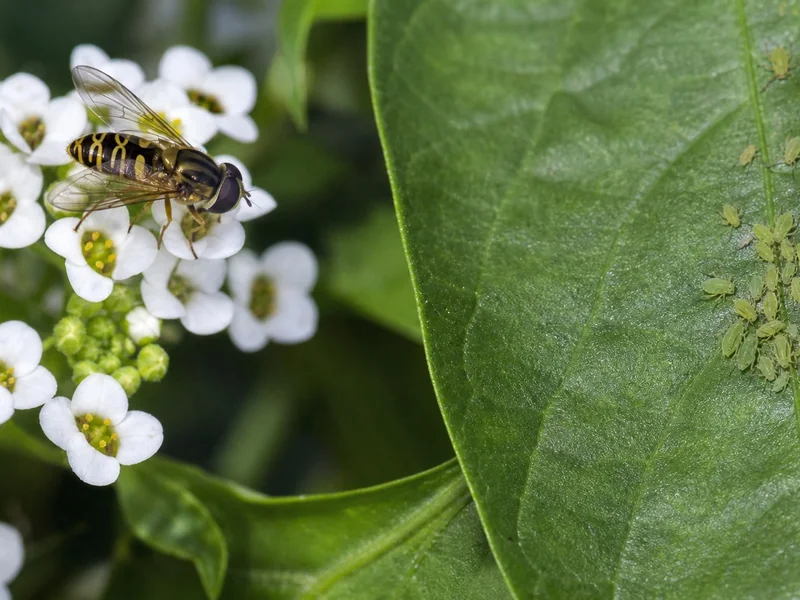
University of Minnesota Extension warns that many companion charts repeat pairings that have little research or contradictory results.
UMN cites a Florida squash study where African marigolds and sweet alyssum increased natural enemies of aphids and produced a slight yield benefit. That result supports a habitat role, but it does not prove that the same border will prevent aphids, thrips, or mites on every pepper bed.
Adult syrphid flies visit flowers, while their larvae consume aphids. A flower strip can help provide that habitat, but you still need to turn over pepper leaves and act when aphid colonies appear.
The root-knot nematode claim needs an even sharper boundary. Penn State Extension says some French and African marigold varieties can suppress nematodes when grown as a dense cover crop for several months, while interplanting a few marigolds does not reduce nematode populations.
Use marigolds as a sunny border, a visual bed marker, and a flower source. Do not treat one plant at each corner as soil treatment or a substitute for pest diagnosis.
What should you not plant near peppers?
The worst neighbor is usually the plant that blocks light, occupies the harvest lane, or keeps foliage wet. Tall corn, okra, sunflowers, pole beans, and trellised cucumbers can shade peppers when they sit on the sunward side.
Sprawling squash creates another conflict because vines and broad leaves cross the pepper root zone. That cover makes it harder to direct water, inspect leaf undersides, and remove fruit without breaking branches.
Tomatoes are not chemically incompatible with peppers, but the two crops demand similar summer resources and share disease risks.
If space is tight or humidity is high, separate rows preserve airflow and make rotation easier.
Fennel often appears on bad-neighbor lists, yet a simple space test is more useful than an allelopathy claim.
Mature fennel is tall and wide, so it rarely earns scarce pepper-bed space unless it stands well outside the pepper row.
Avoid planting by reputation alone. If a proposed neighbor has no defined benefit and makes sun, watering, inspection, or harvest worse, leave it out.
How far apart should peppers be with companion plants?
Utah State University Extension recommends pepper transplants 18 inches apart within a row, with 18 to 24 inches between rows. Preserve that main-crop footprint before drawing any companion strip.
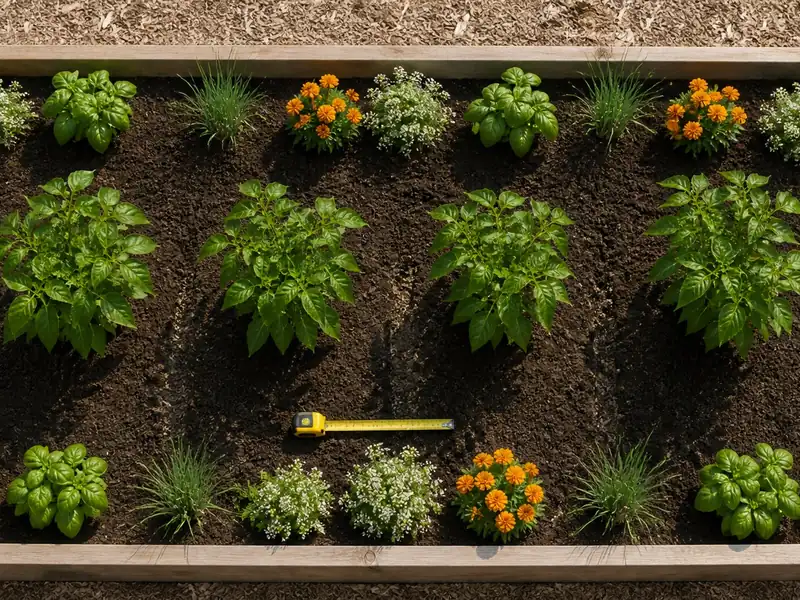
In a four-foot-wide raised bed, one or two pepper rows can occupy the middle according to mature width. Keep low herbs and flowers along the path edge, then leave an open reach lane rather than filling every gap.
Bed orientation matters because a harmless plant on the north edge can become a shade wall on the south edge.
Put the tallest companion where its midday shadow falls away from the peppers in your hemisphere and season.
Water the pepper root zone instead of sprinkling the whole mixed canopy. University of Minnesota Extension recommends airflow and drip or early-day irrigation so foliage dries quickly, which becomes more important as plant diversity increases.
- Mark pepper centers at their mature spacing.
- Reserve a clear watering and harvest path to every stem.
- Place low permanent companions along the accessible edge.
- Put temporary greens only where they can be removed without disturbing pepper roots.
- Check the layout again after the pepper branches begin to touch their supports.
How many companions fit beside a pepper or in a pot?
A compact jalapeno can leave more edge space than a broad bell pepper or poblano. The label spacing and actual branch spread should decide how many companions fit, not the pepper's heat level.
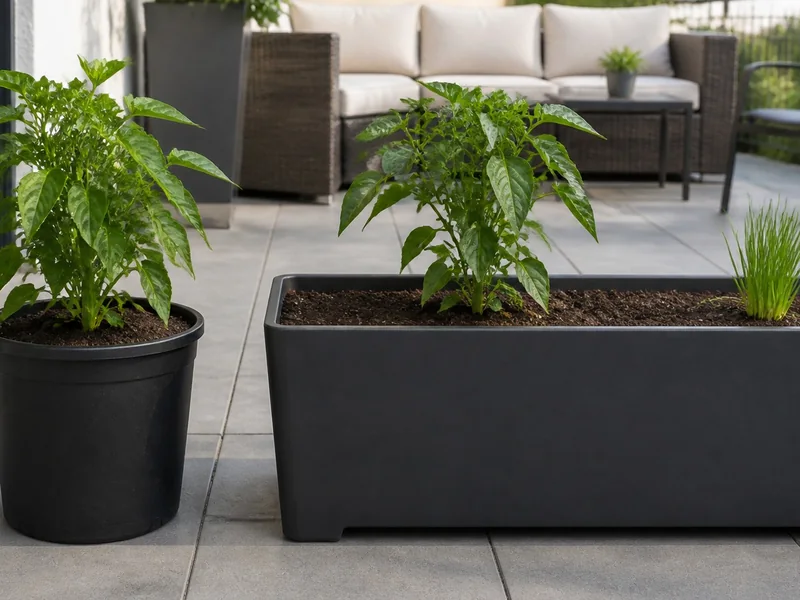
Large-fruited peppers also need a clean picking angle because loaded branches break easily. Keep basil, marigolds, and flower stems away from the side where you will support and harvest the plant.
A five-gallon container should normally hold one pepper without a permanent companion competing for the same limited water reserve. In a much larger planter, one low herb at the rim can work if it has its own soil surface and the pot drains freely.
Two root systems make container moisture change faster.
Check the mix rather than assuming a companion remains small enough to have no effect.
| Pepper setting | Companion pattern | Stop condition |
|---|---|---|
| Compact pepper row | Small herb clusters on the path edge | Herb leaves enter the lower pepper canopy |
| Broad bell or poblano row | Flowers at corners or row ends | Harvesting requires pushing through flowers |
| Five-gallon pepper pot | No permanent companion | The pepper already fills the root volume |
| Oversized planter | One low herb at the outer rim | Water use becomes difficult to predict |
When should you remove short-season crops near peppers?
Companion value changes during the season. Lettuce can cover open spring soil, but the same leaves become a damp obstacle after pepper branches shade the bed.
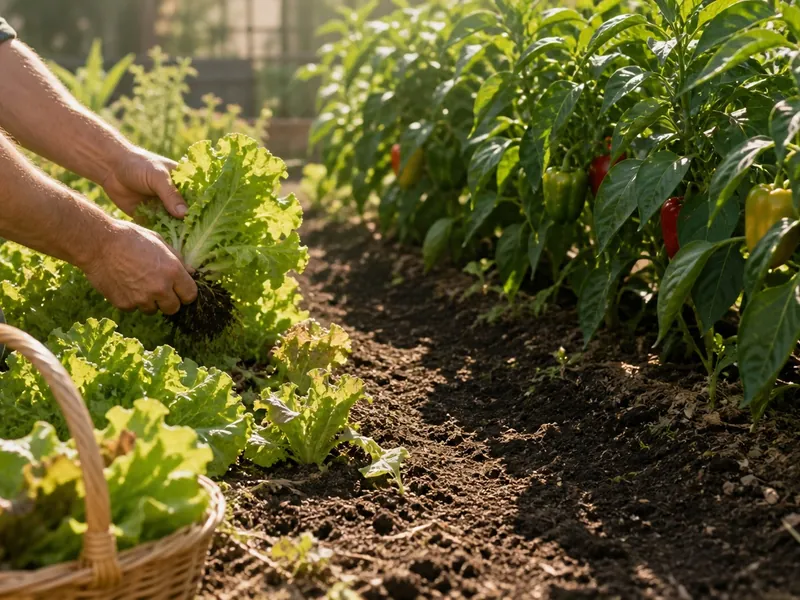
Harvest temporary greens when they begin to touch the pepper canopy or when airflow below the first pepper branch disappears. This timing follows the succession principle described by UMN, where an early crop leaves as the long-season crop claims the space.
Flowering herbs need timing too. Let a limited number of cilantro or dill stems bloom, then remove excess stems before they shade peppers or drop enough seed to create a dense second crop.
Evaluate the bed after rain or irrigation. If foliage remains wet late into the morning, reduce underplanting and restore open air around the stems.
Rotate the whole nightshade group next season
Mixed planting does not cancel crop rotation. University of Minnesota Extension recommends keeping every member of the same plant family out of a location for 2 to 4 years when managing garden disease.
That nightshade group includes chile and sweet peppers, tomatoes, potatoes, eggplants, tomatillos, and ground cherries.
Moving only the pepper while leaving another nightshade in the bed does not create a true family rotation.
Remove diseased plant debris, clean supports, and record where the nightshade row grew. Flowers and herbs can move with the new layout, but they should not hide the identity of the main crop in your rotation notes.
If a bed had severe disease, identify the problem before choosing next year's planting. Companion diversity cannot replace a resistant cultivar, sanitation, or the rotation interval recommended for that pathogen.
Do companion plants increase pepper yield?
Companions can improve conditions that affect yield, but no short list guarantees more peppers.
Utah State University Extension says bees can improve the yield and quality of peppers, while also treating sun, temperature, water, fertility, and disease control as separate requirements.
Count observable changes instead of crediting every fruit to the flower border. Useful measures include pollinator visits during pepper bloom, the time needed to find aphids, soil moisture consistency, leaf-drying time, and whether harvest remains easy.
A full-looking bed can perform worse if lower leaves stay wet or branches break during picking. If the companion layer hides stems or prevents a hand from reaching the plant, reduce it even when every plant looks healthy.
The best result is a pepper canopy with sun and air, an edge that flowers or produces a second harvest, and enough open space to notice a problem early. That is a practical benefit without claiming that basil or marigolds directly caused a yield increase.
How should you plan a raised bed with peppers and companions?
For a four-by-eight-foot bed, place four to six peppers as the main crop, depending on each cultivar's mature width. Mark their centers first, then reserve the accessible long edge for two small basil clusters, a short run of chives, and patches of sweet alyssum or compact marigolds.
Put temporary lettuce between the edge plants only while the pepper canopy is small. Harvest it before the branches close over the space, and never let it block the direct watering route to a pepper stem.
Leave at least one open reach lane from the path into each pepper row. Stand where you will harvest and confirm that your hand can touch every pepper stem without crushing basil, flowers, or greens.
Skip companions entirely when the bed is already shaded, tightly spaced, difficult to irrigate, or recovering from disease.
The pepper remains the main crop, so every neighboring plant must improve a defined job without making basic care harder.
Which Pepper Companion Plants Help Without Crowding? FAQ
- University of Minnesota Extension - Companion planting in home gardens
- University of Maryland Extension - Growing peppers in a home garden
- University of Minnesota Extension - Watering the vegetable garden
- UC IPM - Aphids