Why Is My Pepper Plant Not Flowering or Making Buds?
No buds usually point to growth stage, direct light, root temperature, container limits, or excess nitrogen. Match the newest plant shape to one leading cause, then watch the same branch tips for seven days.
A pepper plant with no buds is usually waiting on light, warmth, root function, or a break from excess nitrogen. Read the newest growth before adding a bloom product because a stretched plant, a dark leafy plant, and a stalled plant need different corrections.
First confirm what is missing.
A plant with no buds is still in vegetative growth, while a plant that opens flowers but never makes peppers has already moved into a fruit-set problem.
Does the plant have no buds, or are flowers dropping?
Look closely at the forks where one stem divides into two.
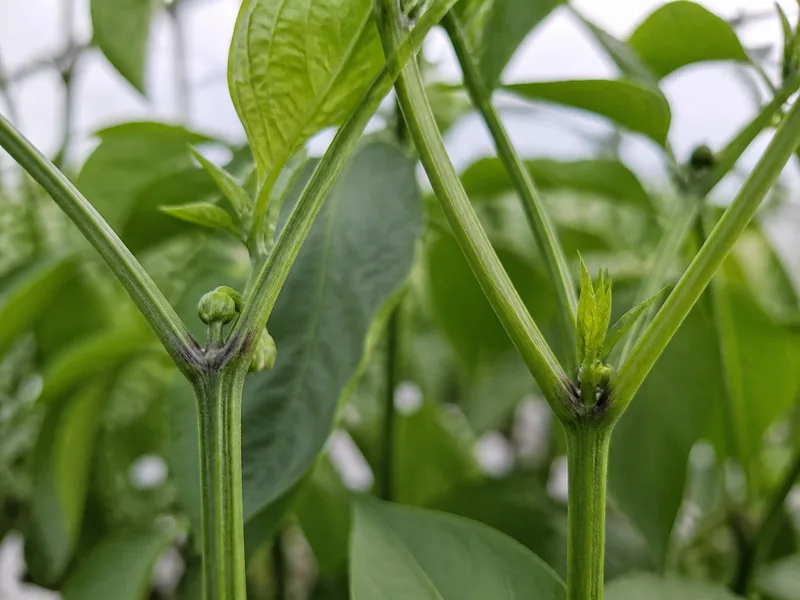
Pepper buds begin as small rounded points near these nodes, so they can hide under new leaves before a white flower opens.
If buds or open flowers are present, stop using a no-flower diagnosis. Temperature during bloom, pollen movement, and flower abortion belong to the next stage, which the pepper plant no fruit guide covers.
A plant with only pointed leaf tips at every new fork has not initiated visible buds. That makes current growth rate, direct light, root-zone temperature, container conditions, and recent fertilizer the useful evidence.
A nursery may also have removed an early bud before sale, or a recent pinch may have removed the tip that would have branched next. In either case, inspect the replacement side shoots for new forks before treating the plant as unable to flower.
When is a pepper plant old enough to flower?
Calendar age alone does not prove readiness because cool growing conditions can slow a seedling for weeks.
Utah State University Extension describes a transplant-ready pepper as having a developed root system and about five to seven mature leaves after roughly eight to ten weeks of nursery growth.
Transplanting resets part of that clock. USU advises hardening peppers before planting, and its vegetable guide says transplants carrying flowers or fruit establish slowly, so a recently moved plant may put energy into roots and new nodes before keeping buds.
Judge the next two or three branch tips instead of counting days since sowing. Compact new nodes and a thickening stem show continued development, while no new nodes means the plant is stalled rather than merely late.
- The plant has several mature leaves and continues to add compact nodes.
- The root ball has resumed using water after transplanting.
- New forks are forming without pale, twisted, or stalled growing tips.
- No recent pinch removed the tip that must now rebuild two side shoots.
Measure progress on the same tips every few days because old leaves cannot show whether the limiting condition has changed. A photo taken from the same angle makes a new fork easier to see than memory does.
How much sun does a pepper need to flower?
A yard can look bright while a pepper receives only scattered light through a railing, tree, or taller crop.
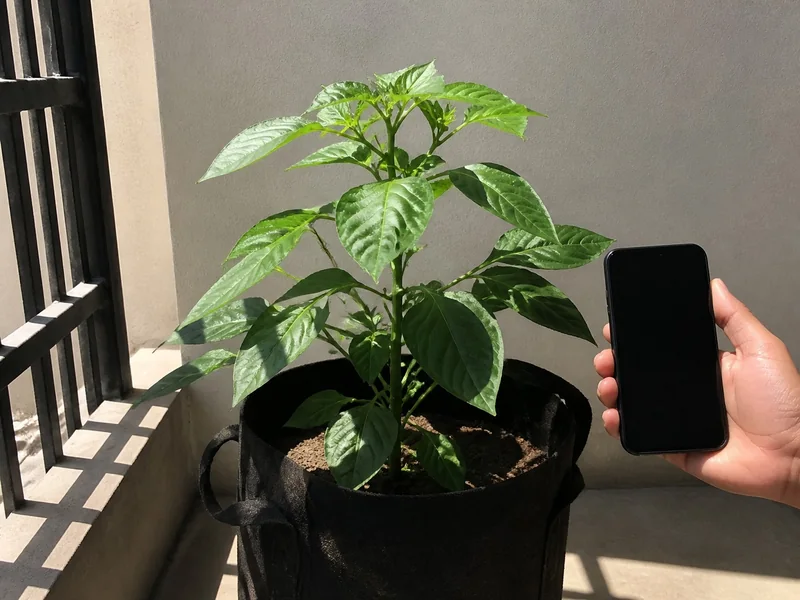
University of Maryland Extension defines full sun as at least six hours of direct light and says peppers prefer eight to ten hours.
Count when sunlight actually touches the pepper leaves for one clear day. Morning sun followed by deep shade at noon may maintain green foliage but provide less light than the plant needs for compact branching and bud formation.
Write down the first and last time direct sun reaches the canopy, then note any long interruption. Bright reflected light from a wall still does not count as direct sun on the leaves.
Indoors, judge plant shape along with lamp time.
USU places fluorescent seedling lights two to three inches above the plants for 14 to 16 hours, while modern fixtures still need the maker's distance and intensity guidance because output and heat vary.
Do not copy the fluorescent distance onto a high-output LED fixture. Use the fixture maker's vegetative setting and canopy distance, then watch for compact growth without bleached or curled top leaves.
Move a shaded plant into stronger sun over several days so tender leaves acclimate. The useful response is tighter new growth at the top, not an immediate open flower.
Can cold soil stop a pepper from flowering?
Pepper leaves can stay green while cold roots slow the whole plant.
Maryland Extension says peppers planted before soil reaches 65°F may simply sit, and Minnesota Extension recommends waiting until nighttime lows stay above 50°F before transplanting outside.
Measure the potting mix or garden soil near root depth in the morning rather than relying on the afternoon air temperature. One warm day does not erase repeated cold nights or a container sitting on cold concrete.
Take readings on several mornings when the diagnosis depends on temperature. Write down both morning and afternoon readings for a dark pot instead of assuming the warmest reading describes the entire day.
| Reading | What it answers | Useful response |
|---|---|---|
| Morning root-zone temperature | Whether roots begin the day cold | Delay feeding and protect the root zone while nights remain cool |
| Afternoon root-zone temperature | Whether a dark pot swings into excess heat | Insulate or relocate the container without reducing morning light |
| Recent overnight lows | Whether one warm afternoon hides repeated cold exposure | Wait for stable nights and judge fresh nodes |
After a cold spell, hold moisture steady and wait for fresh nodes before feeding harder. Fertilizer cannot make chilled roots absorb nutrients on schedule, and extra salts can add another problem to a slow root ball.
Read the plant shape before changing fertilizer
Leaf color by itself is weak evidence because cultivar, light, and leaf age all affect green intensity.
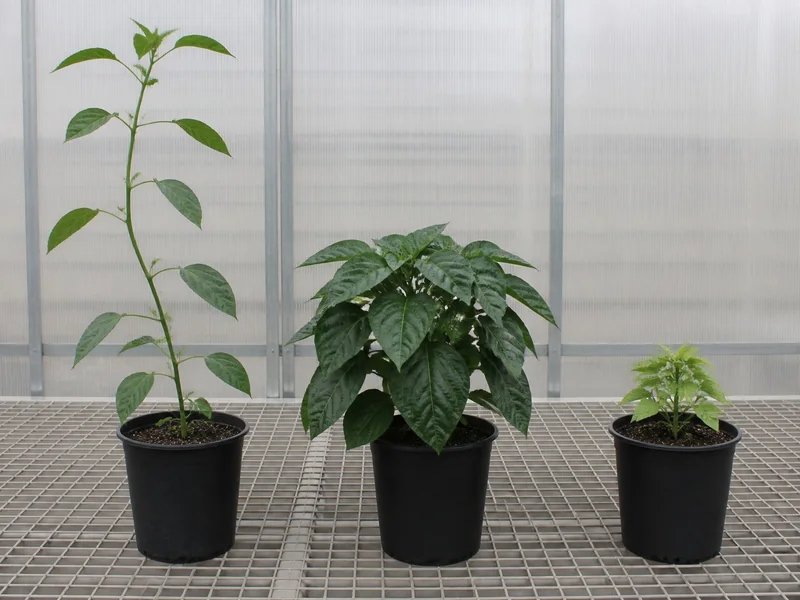
Combine color with internode length, stem strength, and the rate of new leaf production.
| Growth pattern | Leading explanation | First check |
|---|---|---|
| Long gaps between leaves, thin stem, leaning top | Light is too weak or too far from the canopy | Record direct sun or verify grow-light distance |
| Large soft leaves, dark green color, rapid branching, no buds | Nitrogen supply may exceed the plant's current need | Review compost, liquid feed, and fertilizer labels |
| Small plant with firm leaves but almost no new nodes | Cold roots or transplant recovery | Measure root-zone temperature and recent night lows |
| Wilt between waterings, crowded surface roots, pot dries very fast | Container volume or root condition limits steady growth | Compare the pot with the root ball and daily water demand |
Minnesota Extension says too much nitrogen produces bushy, leafy pepper plants that are slow to bear fruit. When that pattern matches, stop adding high-nitrogen fertilizer and let the next growth reveal whether the plant is returning to a balanced pace.
Inventory every nitrogen source before deciding the plant needs another formula. Potting mix with starter fertilizer, compost, granular feed, and a weekly liquid product can overlap even when each one was applied according to its own label.
Minnesota Extension identifies the first number in a fertilizer analysis as the percentage of nitrogen, but a lower first number does not make a product an automatic cure. Use a soil test for an in-ground bed and the potting-mix schedule for a container rather than adding phosphorus on appearance alone.
Do not treat every green plant as overfed.
A stretched plant needs stronger light, and a small stationary plant needs warmth or root recovery, so withholding nutrition from either one may miss the actual limit.
Is the container too small for your pepper to flower?
University of Maryland Extension recommends a five-gallon minimum container for peppers. A smaller pot is not proof of failure, but rapid drying, circling roots at drain holes, and a canopy wider than the available root volume make container restriction more plausible.
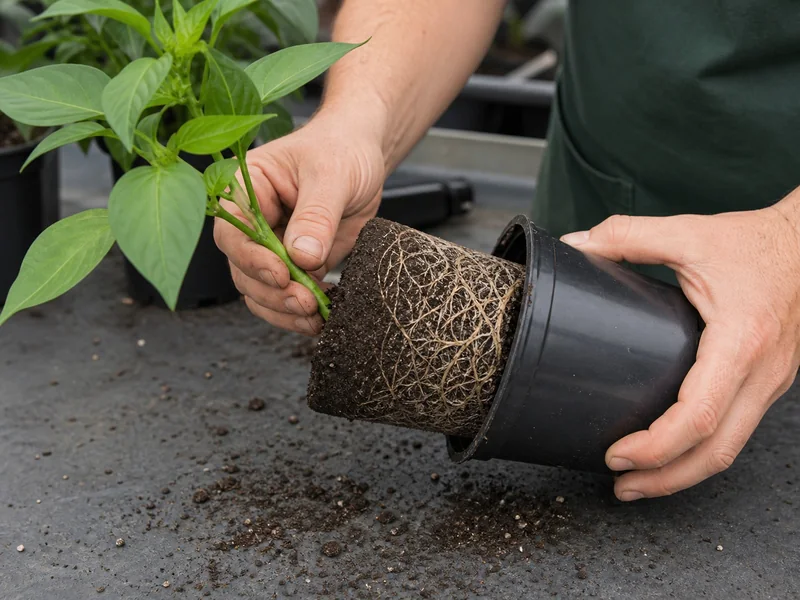
Pot diameter alone can hide the problem because a wide shallow planter may hold less usable root volume than it appears to hold. Check the stated volume, drainage openings, and how quickly the entire root ball dries.
Lift the pot before watering and again after a thorough soak to learn its weight range.
Fast drying, dense roots at drain holes, and a stable plant support a careful move to a larger pot.
Loose mix with few visible roots calls for stable care and more establishment time.
A suitable pot that becomes light every day needs a complete watering pattern before another transplant.
Minnesota Extension notes that container size and temperature can make watering necessary more than once per day, so a dry root ball can interrupt growth even when the surface was watered yesterday.
Slide out the root ball only when it releases without force and the plant is otherwise stable. A dense outer mat of circling roots earns a larger container, while loose mix with few visible roots suggests the plant needs establishment time rather than another move.
Choose a pot with drainage and enough new mix around the root ball, then return to even watering. Repotting and heavy feeding on the same day make it harder to tell which change helped or harmed the new growth.
Following Minnesota Extension's container guidance, avoid leaving a recently repotted root ball surrounded by constantly saturated mix. Increase container size enough to relieve circling roots, then water according to the root ball and current weather rather than the calendar.
Will pruning make a pepper plant flower?
Pruning does not replace light, warm roots, or adequate root space.
Removing healthy leaves from a weak or recently transplanted pepper reduces the leaf area available to support recovery.
Pruning boundary
Removing an early bud from a transplant can protect establishment. Cutting healthy tips from a bloom-free plant does not correct shade, cold roots, root restriction, or excessive nitrogen.
Extension guidance sometimes recommends removing early buds or fruit from transplants so establishment comes first. That is different from cutting a bloom-free plant to force flowers, and it does not support stripping a mature canopy.
A single soft tip may be pinched on a vigorous young plant when branching is the actual goal, but it restarts the tip-growth clock. If the plant is already bushy and dark green, review nitrogen inputs instead of adding pruning stress.
If a tip was pinched recently, wait for the two replacement shoots to extend and form their own forks. Pinching those shoots again repeats the delay instead of proving that pruning works.
Skip a bloom booster during the first diagnosis. Phosphorus cannot correct shade, cold soil, root crowding, or excessive nitrogen, and soil-test guidance should decide whether the garden actually needs more phosphorus.
Do some pepper varieties flower later than others?
Two peppers started on the same day do not have to open flowers together.
USU groups cultivars into early, mid-season, and late maturity classes, while Maryland lists habanero types on a longer ripening schedule than many sweet and hot peppers.
Days to maturity usually describe a harvest milestone under suitable conditions, not a guaranteed date for the first bud. Transplant shock, cool nights, shade, and container limits can extend the interval before flowering.
Read the label first
Check whether the supplier counts from sowing or transplanting and whether the number refers to green or ripe harvest. Neither convention creates a fixed first-flower date.
Check whether the seed supplier counts maturity from sowing or transplanting. Treat that number as a comparison among cultivars under good conditions, not a deadline that overrides the plant's current evidence.
Use another plant of the same cultivar only as supporting evidence when both received comparable light, root volume, and temperature. A jalapeño in a warm raised bed is a poor clock for a large-fruited pepper in a shaded patio pot.
How do you test one change at a time?
Choose the explanation that fits the plant shape and one measured condition.
Change one measured condition, then keep watering and every other input steady enough to read the response at the same branch tips.
- Photograph the top three nodes and record direct sun, recent night lows, pot size, and the last two fertilizer applications.
- Correct one clear limit, such as stronger gradual light, warmer placement, a larger pot, or a pause in high-nitrogen feed.
- Maintain even moisture and avoid pruning, bloom booster, or a second transplant during the observation period.
- Check the same branch tips after seven days, then again after two warm weeks if growth is continuing.
Success begins with compact new nodes or rounded bud points, not necessarily an open flower.
If the plant resumes steady growth, let those tips develop before changing the plan again.
When is a lack of flowers a sign of a bigger problem?
A lack of flowers is more concerning when the newest leaves are pale, mottled, twisted, unusually narrow, or motionless.
Those changes widen the diagnosis to root damage, nutrient availability, mites, viruses, or herbicide exposure.
- The newest leaves are pale, mottled, twisted, or unusually narrow.
- No new nodes form while older leaves remain unchanged.
- The root zone stays wet for days, smells sour, or accompanies wilt in damp soil.
- Several nearby peppers develop the same tip damage after a spray or pest event.
Inspect leaf undersides and the youngest tissue with a hand lens, then compare symptoms across the whole plant. Pepper leaves curling after a spray event or pest outbreak needs a symptom-based diagnosis rather than another flowering treatment.
Check roots when the mix stays wet for days, smells sour, or the plant wilts in damp soil. Overwatering a pepper plant can reduce root oxygen and stop new growth, which must recover before flower timing becomes the main question again.
If compact new nodes continue and the plant otherwise looks healthy, waiting is a real action. Keep the strongest corrected condition stable and let the next forks show whether the plant is ready to switch from leaves to buds.
Why Is My Pepper Plant Not Flowering or Making Buds? FAQ
- University of Maryland Extension - Growing Peppers in a Home Garden
- Utah State University Extension - Transplant Production
- Utah State University Extension - How to Grow Peppers in Your Garden
- University of Minnesota Extension - Growing Peppers
- University of Minnesota Extension - Fertilizing and Watering Container Plants