Hardening Off Pepper Plants Without Sunburn or Transplant Shock
Harden pepper seedlings over 7 to 14 days, starting once daytime temperatures hold above 60 F, and finish with a night outdoors once nights stay above 50 F. A cold frame does the same job without carrying trays, provided you vent it above 85 F. Reduce watering frequency without letting plants wilt, and hold the fertiliser until after transplant.
You started your pepper seeds indoors under grow lights. The seedlings look strong, stocky, and ready for the garden.
You transplant them outside on a warm day and come back the next morning to find them wilted, yellowed, or scorched.
This is transplant shock, and it’s one of the most common mistakes new pepper growers make.
The problem isn’t the seedlings, it’s the transition. Indoor environments are gentle in every direction at once, with consistent temperature, no wind, filtered light and steady humidity.
Outdoor conditions are harsher by every measure.
Direct sunlight is far stronger than any grow light, and wind puts mechanical stress on stems that have never met it.
Humidity drops, and temperatures swing 20-30°F between day and night.
Hardening off bridges this gap by exposing seedlings to outdoor conditions in gradually increasing doses. Over 10-14 days, the plant’s cuticle (waxy leaf coating) thickens, stems stiffen, and the root system adjusts to real soil temperatures.
By the time you transplant, the seedling is physiologically prepared for what’s ahead.
Peppers are slower to forgive stress than tomatoes. A tomato seedling may bounce back from one chilly night, but a pepper can stall for a week after cold soil, harsh wind, or sudden full sun.
Start the clock only when the forecast supports it, which for Capsicum annuum means daytime highs consistently above 60 °F rather than one warm afternoon.
Superhot seedlings need the gentler end of the schedule.
If leaves turn pale, papery, or silver, that is sunscald on young tissue. Move the tray back to bright shade for a day, keep the mix evenly moist, and resume with shorter exposure.
Why do pepper plants need hardening off?
The term “hardening off” dates to traditional agriculture, where growers moved cold-frame seedlings outdoors in stages before final planting. The practice applies to virtually all warm-season crops, tomatoes, peppers, eggplants, and squash, but pepper seedlings are particularly sensitive to the transition because Capsicum species are tropical in origin and tolerate cold poorly.
Cold does the damage before it shows. Ohio State notes that frost and late-night chills damage or kill pepper flowers and leave stunted or deformed fruit, and an unhardened seedling carries that setback for days before anything appears on the leaf.
The hardening process doesn’t make peppers cold-tolerant, but it does make them resilient enough to handle normal spring temperature fluctuations without setback.
Penn State puts the cost in terms worth reading twice. Plants taken straight from the house may brown or turn white from direct sun and wind, and even where they survive, the damage reduces their vigour and adds time before they establish and flower.
In a short pepper season that delay is the whole loss. The plant lives and the harvest arrives late enough to matter.
The schedule, day by day
UC Master Gardeners start the clock 7 to 14 days before the planned transplant date, and only once daytime temperatures are consistently above 60 °F. Ohio State puts seedlings at roughly six to eight weeks old when this begins.
The shape of it is the same everywhere. Shade first, then morning or evening sun, then afternoon sun, then a night outdoors.
| Days | Where | Time outside | Watch for |
|---|---|---|---|
| 1 to 2 | Sheltered shade | About 2 hours | Pots drying faster than they do indoors |
| 3 to 4 | Dappled or morning sun | 3 to 4 hours total | Any bleaching after direct sun, which means cut the next day back |
| 5 to 7 | Partial sun, morning or evening | 4 to 6 hours | Leaves darkening and firming, which is the cuticle thickening |
| 8 to 10 | Most of the day, some afternoon sun | 10 to 12 hours | Light breezes are wanted, strong gusts are not |
| Final 1 to 2 | Outdoors overnight | 24 hours | Nights holding above 50 °F |
Illinois Extension describes the same last step, working plants up to 10 to 12 hours a day for a few days before leaving them out for a full 24 hours.
Do not put tender seedlings out on a windy day, and bring them in if the forecast drops toward frost. UC Master Gardeners are explicit about protecting them from high winds and storms once they are staying out.
Two signals tell you the schedule is working. Leaves darken and feel firmer as the cuticle thickens, and stems stay rigid rather than flopping when you flex them gently.
Light breezes are part of the point. Mechanical stress is what stiffens a stem, so shelter only against gusts strong enough to snap one or tip a small pot.
Check your last frost date on the pepper growing calendar before the overnight stage, because the 50 °F rule assumes frost is already behind you.
Can you harden off peppers in a cold frame?
The schedule above assumes someone is home to move trays out in the morning and back before dusk, for a fortnight. Most people are not.
A cold frame removes the carrying. Iowa State Extension puts it plainly, that when plants are hardened off in a cold frame all you do is close it at night to hold heat and keep them from cold damage when frost threatens.
The hardening still happens, it just happens through the lid. Vent it a little further each day and the plants meet more wind and more cold on the same rising curve the tray-carrying schedule produces.
A board or a dowel props the cover at whatever gap you want. Automatic openers do the same with a wax or gas cylinder that expands as it warms and closes again as it cools.
The trap nobody warns you about
A cold frame in spring sun is a solar oven, and the risk runs the opposite way to everything else on this page.
Iowa State sets the venting threshold at 85 °F inside the frame, measured with a thermometer rather than judged by hand, and says to close the sash before sunset to retain heat.
Check it frequently even on cloudy days, because the temperature inside changes fast and a closed frame can get warm enough to kill what is in it.
Insulating the outside with straw bales or banked soil moderates the swings and cuts how often you have to intervene.
The trade is honest. A cold frame removes two trips a day and adds one check on the thermometer, which is the better deal for most people but not a smaller commitment than it looks.
How should you water and feed peppers while hardening off?
Hardening off is not only about exposure. What you do at the watering can is part of the conditioning, and the page you are reading is the first place most growers meet it.
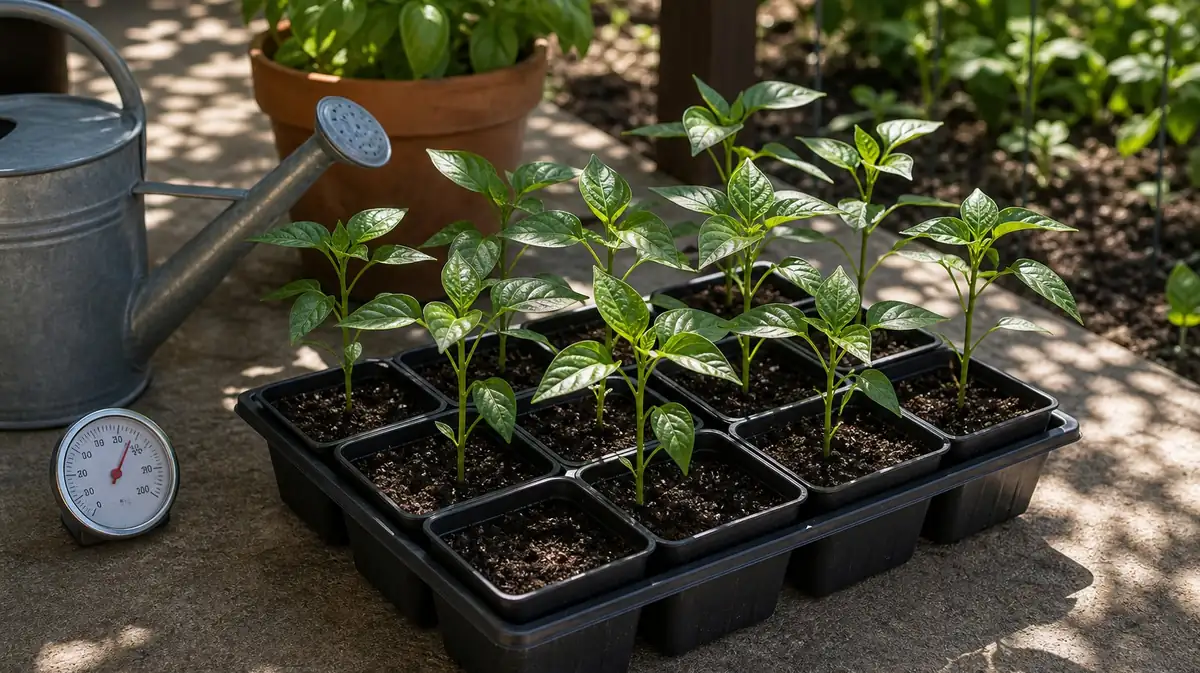
Penn State Extension is direct about it. Reduce the frequency of watering to prevent lush, weak growth, but do not let the plants wilt.
Those two halves are both instructions. Soft, fast growth is what makes a seedling fragile in wind, and a wilted seedling is a stressed one going into a stressful fortnight.
Outdoor pots dry faster than indoor ones, so reducing frequency does not mean forgetting them.
Check by weight or by finger rather than by the calendar.
Hold the fertiliser until after transplant. Penn State applies a high-phosphorus starter solution once the plant is in the ground, which is the point at which you want new root growth rather than new leaf.
Feeding during hardening works against the whole exercise, pushing soft tissue at exactly the moment you are asking the plant to toughen.
What should you do when rain or a cold snap hits?
The schedule assumes a benign fortnight, which is not the fortnight most people get. Three conditions change what you do that day.
- Rain. Light rain is part of the outdoor experience and does no harm. Bring trays under cover for heavy rain or hail, which damages tissue directly and splashes soil onto leaves.
- A cold snap. Bring seedlings in if nights drop toward frost. One cold night undoes several days of progress, and you resume where you left off rather than starting again.
- Extreme heat. Shade unhardened seedlings through the hottest afternoon hours. A tray that has only known a grow light will scorch in full afternoon sun long before a hardened plant would.
None of these resets the clock. They pause it, which is the difference between a delayed transplant and a dead tray.
Which temperatures matter when hardening off peppers?
Most of the confusion around hardening off comes from three different thresholds being quoted as if they were one number.
The 50 and the 55 answer different questions. Fifty is what a hardened seedling can sit through without damage, and fifty-five is the floor below which a planted pepper stops making progress.
Ohio State gives the growing range as 70 to 80 °F by day and above 55 at night, with 60 to 70 as the ideal night band.
A seedling survives the gap between those numbers. It just will not do anything with the time.
Transplant timing and supplies
Once the tray has taken a full day and night outdoors without complaint it is ready to go in, and the hour you pick still matters. Transplant in late afternoon or under overcast skies so the plant is not fighting root disturbance and full sun in the same hour.
You don’t need to buy anything special for hardening off. A shaded porch or north-facing wall works as well as a purchased shade cloth.
If you start many seedlings, a rolling plant caddy or plant tray with wheels makes moving flats in and out significantly easier.
For growers in windy locations, a simple wind screen made from stakes and burlap provides shelter during the first few days without blocking light entirely.
What causes transplant shock in pepper seedlings?
Four failures account for most dead trays, and three of them happen after the hard part is over.
- Rushing the schedule. Moving seedlings from indoors to full outdoor sun in one step. A single day of unhardened full sun can permanently damage the leaf.
- Forgetting the overnight forecast. The day can be perfect and the night still cold enough to shock an unhardened seedling. Check the low, not the high.
- Overwatering. Outdoor pots dry faster and growers overcorrect. Wet roots plus a cold night is how root rot starts.
- Transplanting into bad weather. A finished hardening schedule does not oblige you to plant. Wait for a stretch of warm, calm days.
Zone-specific timing is the one thing this page cannot give you, and when to plant peppers works it out by region.
Hardening Off Pepper Plants Without Sunburn or Transplant Shock FAQ
- Growing Peppers from Seed Part 2: the Hardening Process - UC Master Gardeners, Stanislaus County
- Growing Peppers in the Home Garden - Ohio State University Extension
- Starting a Garden: Hardening Off Indoor Seedlings - Illinois Extension
- All About Cold Frames - Iowa State University Extension
- Transplanting Annuals into the Garden - Penn State Extension