How to Stake Pepper Plants Early, Beside the Crown, with Loose Ties
Stake a pepper plant when its height, branching habit, fruit load, container, or wind exposure makes the root ball or branch forks move under pressure. Install the support early, place it beside rather than through the root crown, and use broad flexible ties that leave room for the stem to thicken.
A single stake suits an upright plant, a cage carries several spreading branches, and a stake-and-weave system supports a row. Recheck ties and upper branches as peppers gain weight because one low attachment cannot protect a loaded canopy.
Do your pepper plants need staking?
Stake a pepper plant when the main stem rocks at soil level, branch forks sag under fruit, or wind repeatedly pushes the canopy out of position.
A compact plant in sheltered ground may stand without help, while a tall pepper in a light container may need support before it flowers.
University of Maryland Extension recommends staking, caging, or otherwise supporting pepper plants because semi-woody branches become brittle late in the season.
Strong wind, driving rain, and heavy fruit make breakage more likely.
- Support the plant if the root ball moves when you press the stem gently from the side.
- Support a branch when its fork opens or the fruit hangs beyond the leaf canopy.
- Plan support early for tall cultivars and exposed beds.
- Anchor a container that can tip even if its plant already has a stake.
- Add support before a forecast storm rather than trying to tie wet broken stems afterward.
Fruit type matters less than the actual plant. A short thick-stemmed habanero can carry a different load from an upright cayenne covered with long pods, so inspect the branch angles instead of assuming every cultivar needs the same hardware.
Install permanent support while the plant is young enough to handle easily and before roots occupy the whole planting area.
A late support can still help, but it should enter the soil farther from the stem and with more care.
Stake, cage, or weave: which support fits your peppers?
The best support carries the expected load without blocking harvest or rubbing foliage.
Choose from the plant's mature shape and the number of plants, then select a height that reaches into the productive canopy rather than stopping below it.
Use one sturdy wood, bamboo, fiberglass, or coated metal stake for an upright plant with a clear main stem. Add separate ties for loaded side forks.
Use a rigid wide cage for a bushy plant whose branches spread in several directions. Openings must be large enough for your hand and mature fruit.
Use strong end posts, intermediate stakes, and horizontal twine for a row. The string supports plants from both sides and shares the load across the planting.
A thin decorative cane may guide a seedling but fail once wet foliage and peppers add weight. Test the support itself by pressing near its top before attaching the plant, and replace anything that shifts in firm soil.
Utah State University Extension describes support as optional for some peppers but useful for cleaner fruit and easier picking. That tradeoff is practical because cages and strings also occupy access space and require inspection through the season.
For one or two plants, an individual stake or cage is faster to maintain.
A row weave becomes efficient when several peppers share a straight bed, but a broken end post can loosen the entire line.
Avoid bare wire against living stems. Thin cord can also cut into bark under load, while soft plant tape, cloth strips, or purpose-made reusable ties spread pressure over a wider area.
Set the stake in firm soil beside the root crown
Place an individual stake a few inches from the stem, outside the dense center of the root crown, and align it with the side that lets the plant rest naturally against the tie.
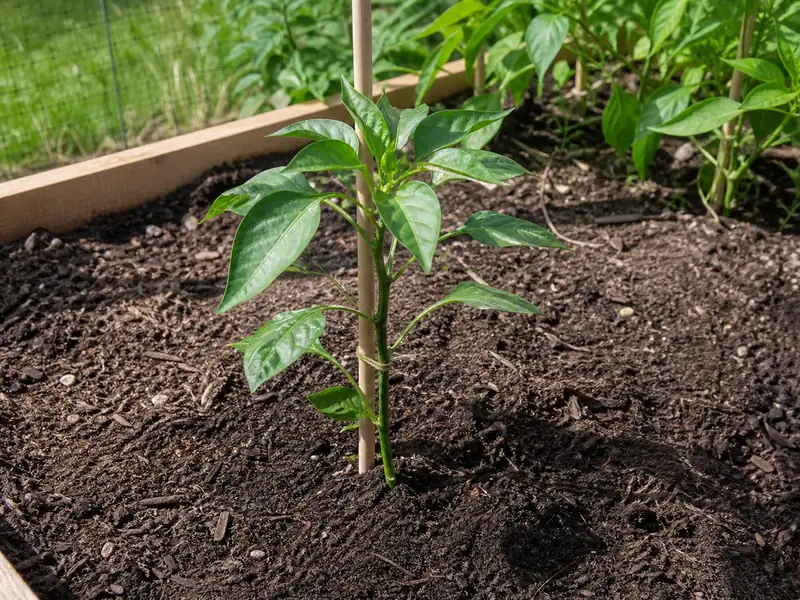
The exact gap changes with stake thickness and plant size, but leaves and branches should not scrape the support.
- Water dry hard soil lightly in advance so the stake can enter without hammering the root ball apart.
- Mark a point beside the plant where the support will not block the main branch forks.
- Drive the stake straight into undisturbed firm soil, using a mallet when needed.
- Stop if a thick root resists rather than forcing the stake through it.
- Press the exposed top from several directions and deepen or reposition a stake that rocks.
- Attach the lowest tie only after the anchor holds on its own.
Penn State's commercial recommendations use stakes driven 6 to 8 inches into the soil for field peppers, while larger home-garden supports may need deeper embedment in loose soil.
The reliable test is resistance to the expected top load, not copying one depth into every bed.
In a raised bed, do not rely on loose fresh mix near the edge where the wall can limit depth. In compacted ground, make a narrow pilot hole only if necessary and firm the soil around the installed stake.
A pot changes the anchor problem because the root system may occupy the entire volume. The safest time to add a stake is at transplanting, placing it near the container wall before filling around the root ball.
For an established potted pepper, slide a blunt support down the inside edge and stop at strong resistance. Stabilize the pot separately with a heavier outer container, a low sheltered position, or a secure attachment to a fixed railing that does not block drainage.
How do you tie a pepper plant to a stake?
A figure-eight tie puts one loop around the stake and a separate loop around the stem.
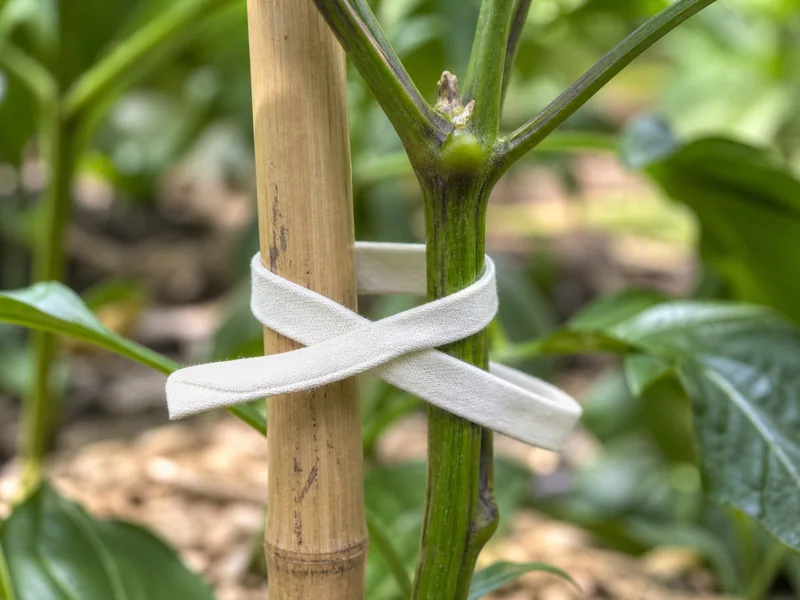
The crossing point keeps the plant from rubbing directly on the support while the loose stem loop allows thickening.
- Choose a broad flexible tie that stays smooth when wet.
- Place the first tie below a sturdy node or branch junction so it cannot slide far.
- Wrap one loop around the stake and cross the tie before looping around the stem.
- Leave enough space to move the tie slightly with a fingertip.
- Secure the knot or fastener on the stake side, away from bark.
- Add a second attachment above the first when the upper canopy can still swing.
Do not pull a leaning mature stem upright in one motion. Reduce the angle gradually, support it at more than one point, and stop if the bark creases or a branch fork begins to split.
The main stem tie controls whole-plant movement, but it does not automatically carry side branches. Put a separate sling or tie below a heavy fork and attach it to the cage or stake so the fruit weight rests on the support.
Penn State production guidance adds another horizontal string 6 to 8 inches above the first before peppers enlarge and fall over the lower line. In a home row weave, use the same principle without treating those field dimensions as a universal plant template.
Ties should guide rather than clamp. A rigid attachment concentrates motion immediately above it, which can turn the unprotected upper stem into a hinge.
Recheck the system as fruit adds weight
Inspect support after rapid growth, irrigation, heavy rain, and each large harvest. Soil can soften, reusable ties can lock, twine can stretch, and a branch that was balanced last week can become overloaded by several expanding pods.
| What you find | Likely support failure | Correction |
|---|---|---|
| A groove or swelling at the tie | The loop is constricting stem growth | Remove it and replace it with a wider looser tie |
| The plant pivots at soil level | The stake is loose or the lowest tie is too high | Firm or replace the anchor and add a low loose tie |
| Upper branches whip above the tie | Support ends below the loaded canopy | Add a higher attachment or a taller support |
| A cage leans with the plant | The cage itself lacks an anchor | Pin the cage to firm soil or connect it to a stable stake |
| A container and stake move together | The pot is too light for the canopy | Anchor or shelter the pot rather than adding more plant ties |
| A fruiting fork begins to open | Fruit weight is outside the supported frame | Harvest mature pods and sling the fork from below |
Harvest with clean scissors or pruners because pulling peppers can break brittle branches. Maryland Extension specifically recommends cutting fruit rather than pulling it from pepper and eggplant plants under load.
Before severe wind, check the stake and pot before tightening every tie. Remove mature heavy fruit, add temporary support to exposed forks, and move portable containers into shelter.
If a branch splits but remains connected, align it gently and support its weight from below.
A fully snapped or crushed branch should be cut back to sound tissue because tape cannot restore a missing vascular connection.
Preserve healthy leaves when possible because upright foliage shades the peppers. Maryland field observations found far less sunscald in staked and tied plants than in unsupported plants, which shows that support protects fruit as well as stems.
Remove or loosen temporary hardware at the end of the crop, clean reusable ties, and store stakes dry.
A support system earns its place when the plant can grow, fruit, and be harvested without the support becoming a new source of injury.