Serrano is the better fresh green pepper for salsa, guacamole, and chopped table heat. Thai chili is the better small-dose pepper for curry paste, stir-fry oil, nam pla prik, and dishes where heat has to spread fast.
Comparison Contributor·Updated Jun 29, 2026·
Reviewed by
Karen Liu
Quick Comparison
Serrano Pepper measures 10K–23K SHU while Thai Chili registers 50K–100K SHU. That makes Thai Chili about 4.3x hotter by upper SHU range. Serrano Pepper is known for its bright and crisp flavor (C. annuum), while Thai Chili offers bright and peppery notes (C. annuum).
Serrano Pepper
10K–23K SHU
Hot · bright and crisp
Thai Chili
50K–100K SHU
Hot · bright and peppery
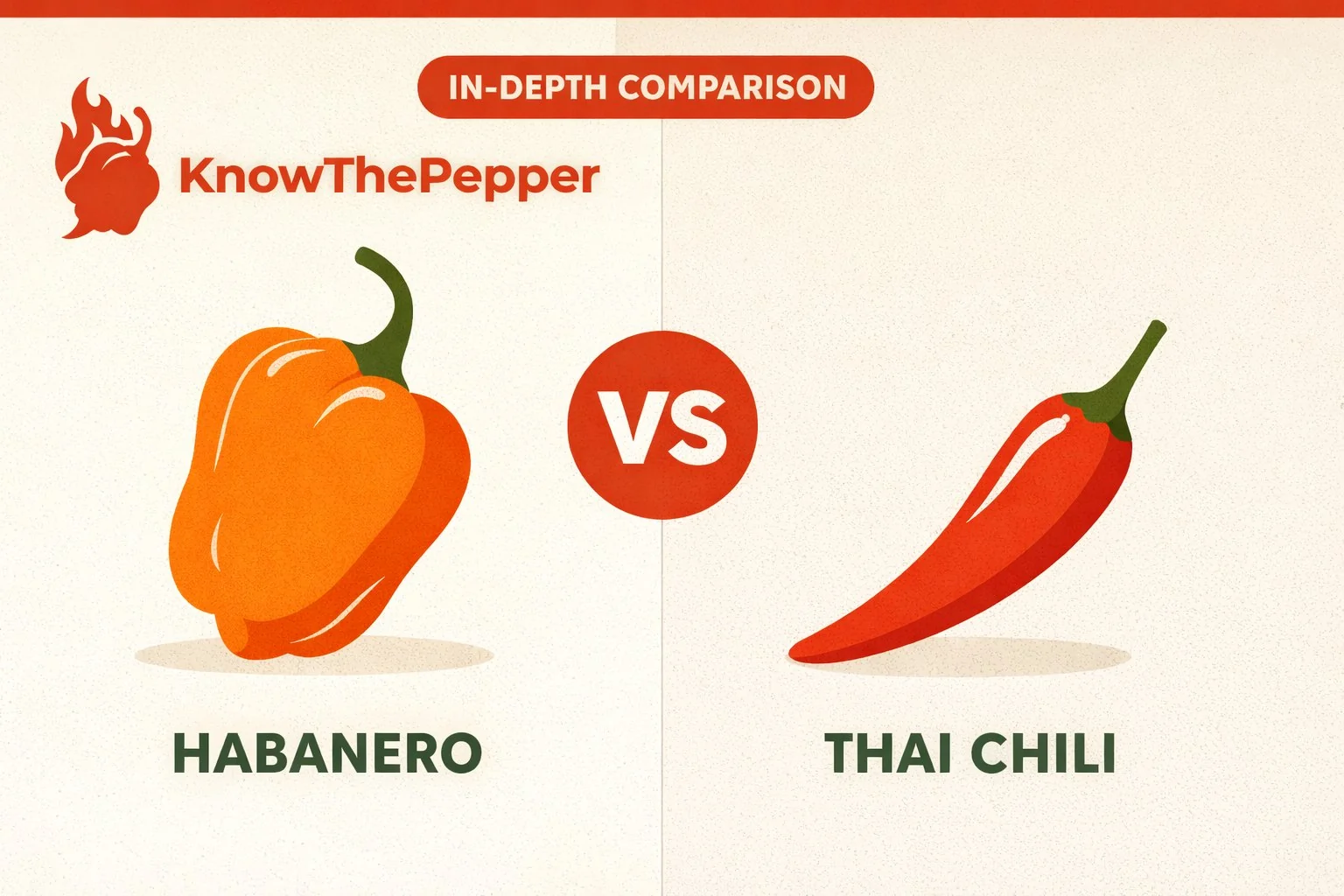
Heat difference: Thai Chili is about 4.3× hotter by upper SHU range
Species: Both are C. annuum
Best for: Serrano Pepper excels in everyday cooking and salsas, Thai Chili in hot sauces and spicy dishes
Thai Chili is
about 4.3× hotter than Serrano Pepper.
Serrano Pepper spans 10K–23K SHU, roughly 3× a jalapeño at the upper end.
Thai Chili spans 50K–100K SHU, about 13× a jalapeño at the upper end.
Use the ranges to decide whether the recipe needs a measured dose, a mild overlap, or a hard substitution limit.
Tools: Scoville chart and SHU calculator.
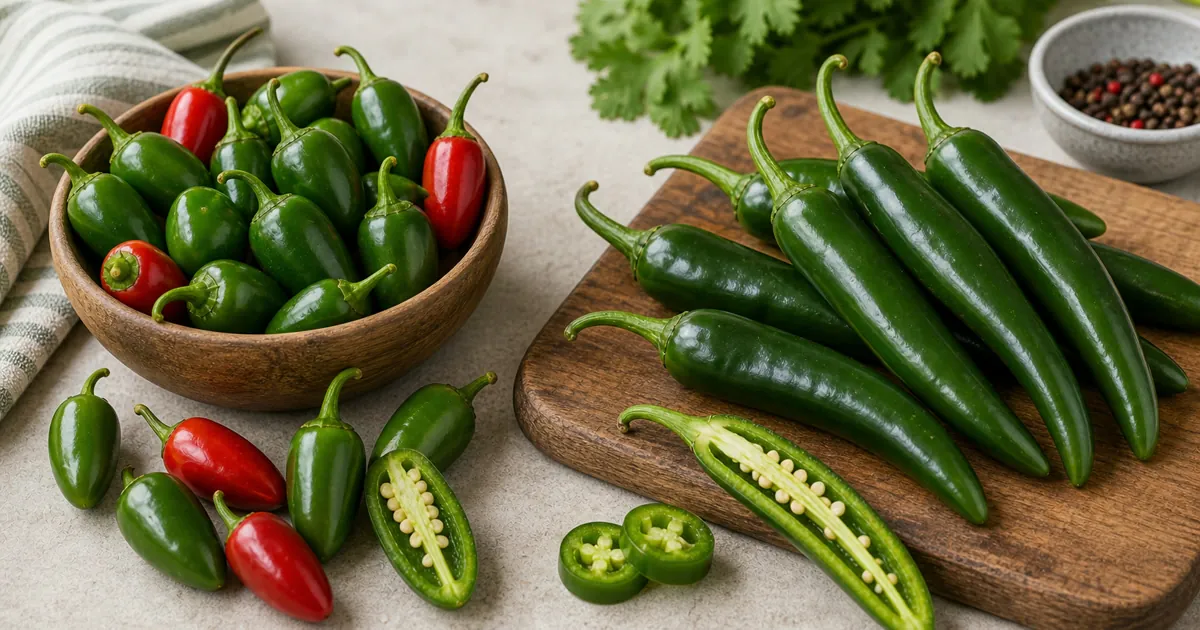
Bite into a raw serrano and the first thing you notice is the aroma - green, grassy, almost herbal, like a jalapeño that decided to be serious. The flavor follows quickly: bright, crisp, slightly vegetal, with a clean heat that builds fast and lingers without the slow creep you get from dried chiles.
At 10,000-23,000 SHU, serranos sit firmly in the hot heat range - hot enough that most people use half a pepper where they'd use a whole jalapeño, but approachable enough for everyday cooking once you calibrate. At peak comparison: a 23,000 SHU serrano is roughly 2.
Thai Chili
brightpepperyC. annuum
Thai chilis are small, thin, fierce, and essential. At 50,000-100,000 SHU, they punch well above their size - roughly 6-40x hotter than a jalapeño - in pods that are typically 1-3 inches long and no wider than a pencil.
The term 'Thai chili' covers a range of related Capsicum annuum varieties used across Thai cuisine and throughout Southeast Asia. Two are most common in Western markets.
Both peppers belong to C. annuum, so they share some underlying flavor chemistry. However, Serrano Pepper’s bright and crisp notes contrast with Thai Chili’s bright and peppery character.
Serrano Pepper brings bright and crisp notes, so it fits recipes where that flavor should remain visible.
Thai Chili leans bright and peppery, which can change the sauce, filling, marinade, or garnish even when the heat range looks close.
Culinary Uses for Serrano Pepper and Thai Chili
Serrano Pepper
Start with aroma when cooking serranos raw: that grassy, sharp scent tells you the heat is intact and the pepper hasn't oxidized. It's your cue that you're working with something alive.
Serranos are the default pepper in pico de gallo across most of Mexico, preferred over jalapeños precisely because the heat is sharper and the flavor cleaner. Dice them fine and the heat distributes evenly.
The capsaicin in serranos follows the same rule as all peppers: it concentrates in the placenta (the white inner membrane), not the seeds. In a serrano, that membrane runs the full length of the thin pod, meaning there's proportionally more heat-concentration surface than in a thicker jalapeño.
Thai Chili
In Thai cooking, chilis function in three distinct modes: fresh in salads and as table condiment, pounded into curry pastes, and dried or fried in stir-fries. Each mode produces a different flavor output from the same pepper.
Fresh Thai chilis sliced thin and added directly to som tam (green papaya salad) contribute their full fresh sharpness. A traditional recipe uses 2-4 prik kee nu per serving - adjustable to taste.
For homemade red or green curry paste, 6-8 dried or fresh Thai chilis per cup of curry paste is a baseline for medium heat in the final dish. Adjust up or down based on preference, then scale by how much paste goes into the dish.
Use approximately 1/5 the amount. Start with less and add gradually.
Milder replacement
Replacing Thai Chili with Serrano Pepper
Use 5× the amount, but you still won’t reach the same heat intensity.
Growing Serrano Pepper vs Thai Chili
Growing notes
Serrano Pepper
Serranos are reliable, high-yield producers that reward patient gardeners. Start seeds indoors 8-10 weeks before last frost - germination takes 10-21 days at soil temperatures around 80-85°F.
Transplant outdoors once nighttime temps stay above 55°F. Space plants 18-24 inches apart for good airflow.
Serranos are notably productive - a healthy plant produces 50-70 pods per season, significantly more than most jalapeño varieties (25-35 per plant). That yield advantage makes them one of the better-value hot peppers for gardeners who want volume.
Growing notes
Thai Chili
Thai chili plants are compact, prolific, and heat-loving - one of the easier ornamental/culinary hot peppers to grow in containers. Plants reach 12-24 inches tall and produce pods that stand upright when young, pointing skyward, then droop as they mature - a natural harvest indicator.
Start seeds indoors 8-10 weeks before last frost at 75-85°F soil temperature. Germination takes 10-21 days.
Transplant spacing: 12-18 inches apart - plants are more compact than jalapeños and can be positioned closer. They want 8+ hours of direct sun for maximum production and heat development.
Where They Come From
Origin & background
Serrano Pepper
Mexico · C. annuum
Serranos originate from the mountainous regions of Puebla and Hidalgo, Mexico - 'serrano' literally means 'from the mountains' in Spanish. They've been cultivated in these highlands for centuries, long before Spanish contact, as part of the complex chile culture that shaped Mexican cuisine.
Unlike many Mexican chiles that found global fame through export, serranos remained largely regional until US immigration patterns in the 20th century brought Mexican culinary traditions northward. The pepper traveled with its cooks rather than through commercial channels.
Origin & background
Thai Chili
Thailand · C. annuum
Capsicum peppers arrived in Southeast Asia via Portuguese traders in the 16th century, moving from the Americas through Portuguese trade routes that connected Goa, Malacca, and the Spice Islands. What happened next was rapid adoption: within a century, chili peppers had replaced or supplemented indigenous heat sources (long pepper, black pepper, galangal) across Thai, Vietnamese, and Indonesian cuisines.
Thai cuisine's integration of chili was particularly thorough. By the 18th century, the pepper had become structurally embedded in Thai cooking - not an addition to existing dishes but a defining element of new flavor combinations that emerged from the integration.
Buying & Storage
Whether you’re shopping for Serrano Pepper or Thai Chili, the same quality indicators apply. Fresh peppers should feel firm and heavy for their size, with taut, glossy skin and no soft or wet spots. Minor stem cracks known as “corking” are perfectly normal and often indicate a mature, flavorful pod.
Selection
What to look for
Firm pods with taut skin and consistent color
Should feel heavy relative to size
Minor stem cracks (“corking”) are normal
Avoid anything soft, shriveled, or with dark wet spots
Storage
How to store them
Fresh: Paper bag, crisper drawer, 1 to 2 weeks
Frozen: Wash, dry, freeze on sheet pan, 6+ months
Dried: Airtight and away from light, up to 1 year
Mistakes to avoid
Common misses
Serrano Pepper
Blaming the seeds. Membranes hold most capsaicin.
Adding heat too early. Capsaicin breaks down with cooking.
Not tasting individual pods. Heat varies 30%+.
Common misses
Thai Chili
Blaming the seeds. Membranes hold most capsaicin.
Adding heat too early. Capsaicin breaks down with cooking.
Not tasting individual pods. Heat varies 30%+.
Final call
Serrano Pepper vs Thai Chili
Serrano Pepper and Thai Chili
sit in the same heat tier but serve different roles. Thai Chili delivers about 4.3× more upper-range heat with its distinctive bright and peppery character.
Serrano Pepper, with its bright and crisp profile, excels in everyday cooking.
Heat gap about 4.3× by upper rangeSerrano Pepper bright and crispThai Chili bright and peppery
Choose by tool first. A molcajete, salsa bowl, or raw garnish usually wants serrano pepper; a mortar paste, wok oil, or fish-sauce condiment usually wants Thai chili.
That answer matters more than the shared Capsicum annuum species. Serrano keeps vegetable crunch in pico de gallo and salsa verde. Thai chili disappears into paste or oil and leaves a sharper burn behind.
Chopping Size Changes Heat
Size changes the burn before the diner even tastes the dish. A Thai chili is small enough that one pod can seed a whole wok, while one serrano usually stays visible as chopped green pieces.
The numbers explain why the same spoonful is not equal: serrano sits at 10,000-23,000 SHU, while Thai chili sits at 50,000-100,000 SHU on the Scoville scale. At the top end, Thai chili can carry more than four times the heat.
The common mistake is counting pods instead of exposed surface. Two minced Thai chilies in curry paste release heat more aggressively than two sliced serranos on tacos because the paste breaks every wall and rib.
For a batch test, mince a quarter of the Thai chili first and wait for the fat, lime, or broth to carry it. With serrano, taste by slice because the walls and membrane stay separated longer.
Raw Green Or Hot Oil
Raw service favors serrano. The crisp wall, grassy aroma, and moderate burn stay readable in salsa cruda, ceviche, guacamole, and quick pickles.
Hot oil changes the winner. Thai chili gives a cleaner sting in pad kra pao, prik nam pla, curry paste, and fried aromatics because the pod is small, thin, and easy to crush. That is why it also overlaps more naturally with bird's eye style Thai chili than with a Mexican salsa pepper.
If the dish has lime, raw onion, cilantro, and tomato, keep serrano. If it has garlic, fish sauce, coconut milk, or a wok stage, Thai chili is the more direct tool.
Substitution Has Two Doors
Replacing serrano with Thai chili is a heat-reduction problem. Start with one quarter to one third as much Thai chili, then add more only after the acid or fat has had time to carry the capsaicin.
Replacing Thai chili with serrano is a distribution problem. Use more pepper by weight, mince it finer, and accept a greener flavor. For a planned swap, keep the dedicated Thai chili substitutes and serrano substitutes separate because the best answer changes by cuisine.
Shopping And Growing Clues
Shopping is one of the quiet separators. Serranos are common in Mexican groceries and many supermarkets, usually green and firm. Thai chilies are easier at Asian markets, where red, green, fresh, frozen, and dried bags may sit beside each other.
Storage also changes use. Serranos keep their snap for chopped fresh dishes after a few days in the crisper. Thai chilies freeze well because their role is usually minced, pounded, or cooked, not eaten for crunch.
For gardens, Thai chili plants reward small harvests over a long window, while serrano plants make larger pods for fresh picking. If you are choosing seed packets, the pepper seed-starting timeline matters more for Thai chili because late fruit still dries or freezes well.
Fact-Checked & Expert Reviewed
Editorial Standards: Head-to-head comparisons include blind tasting when applicable. Heat levels cross-referenced with multiple sources. All substitution ratios tested side-by-side.
Review Process:
Written by
James Thompson
(Lead Comparison Reviewer)
, reviewed by
Karen Liu
(Lead Fact-Checker & Science Editor)
. Last updated June 29, 2026.
Serrano Pepper vs Thai Chili FAQ
Yes, but use more serrano and expect a greener flavor. Start with 3 to 4 serranos for one Thai chili when heat is the main target, then adjust after the sauce, curry paste, or condiment rests.
Thai chili is much hotter by range. Thai chilies run 50,000 to 100,000 SHU, while serranos usually run 10,000 to 23,000 SHU, so the practical dose starts far smaller.
They are closely related in many kitchens, but the names are not perfectly identical. The Thai chili and bird's eye comparison is the better route when the label itself is the question.
Serrano is better for fresh salsa because it stays crisp and green. Thai chili can work in tiny amounts, but its sharp heat usually fits curry paste, fish sauce condiments, and stir-fries more naturally.
Yes, both are generally treated as Capsicum annuum peppers. Species does not make them interchangeable, because pod size, heat range, and cuisine role change how each one behaves.