
Fresno vs Jalapeño: Are They Really Different?
Fresno and jalapeño peppers overlap almost completely on the Scoville scale, share the same species, and even look similar when young. But side by side in the kitchen, they behave differently — one brings fruity smoke, the other a clean grassy snap. Here's where they actually diverge.

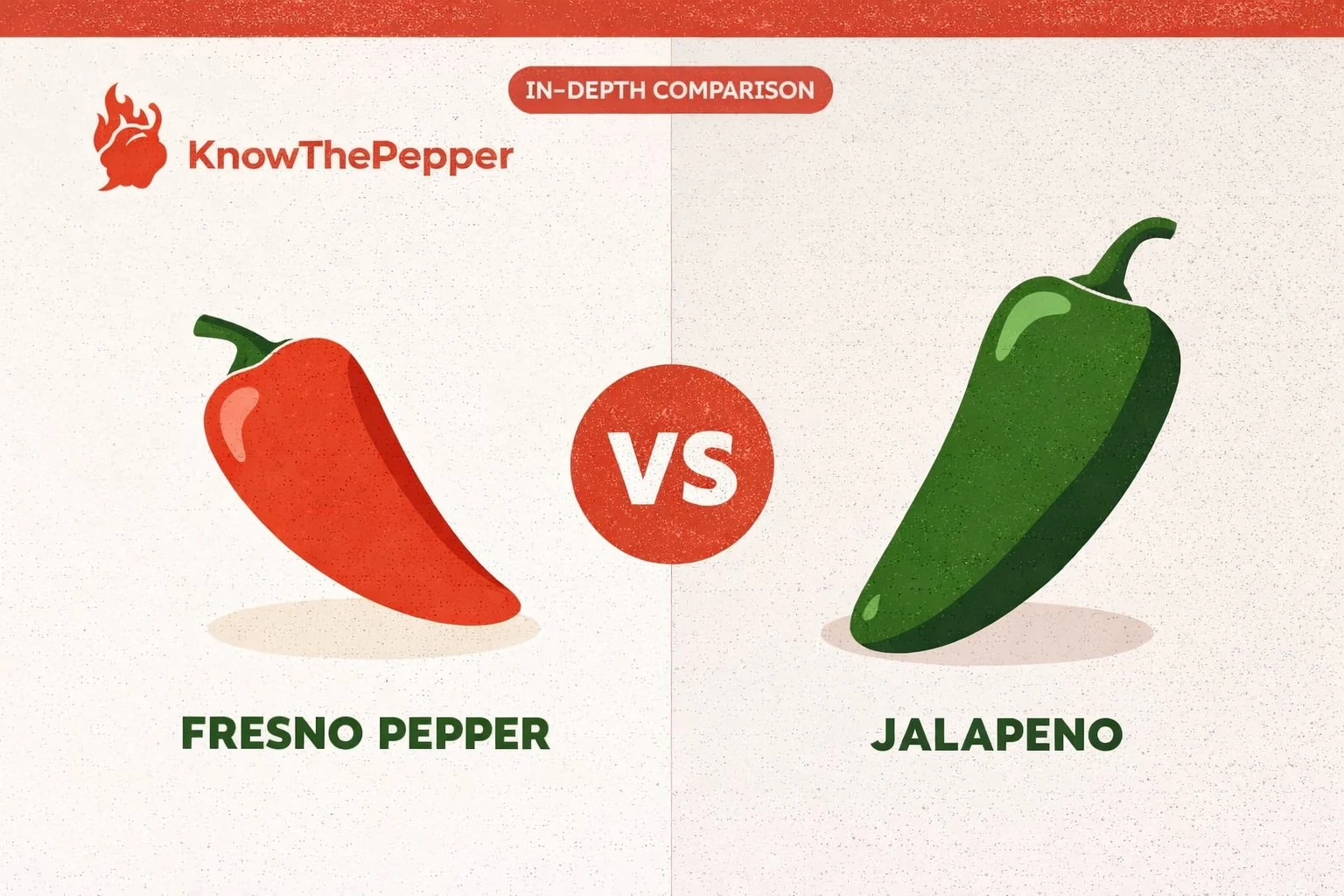
Fresno Pepper measures 3K–10K SHU while Jalapeño registers 3K–8K SHU — roughly equal in heat. Fresno Pepper is known for its fruity and smoky flavor (C. annuum), while Jalapeño offers bright and grassy notes (C. annuum).
- Species: Both are C. annuum
- Best for: Fresno Pepper excels in everyday cooking and salsas, Jalapeño in fresh salsas and mild recipes
Fresno Pepper vs Jalapeño Comparison
Fresno Pepper vs Jalapeño Heat Levels
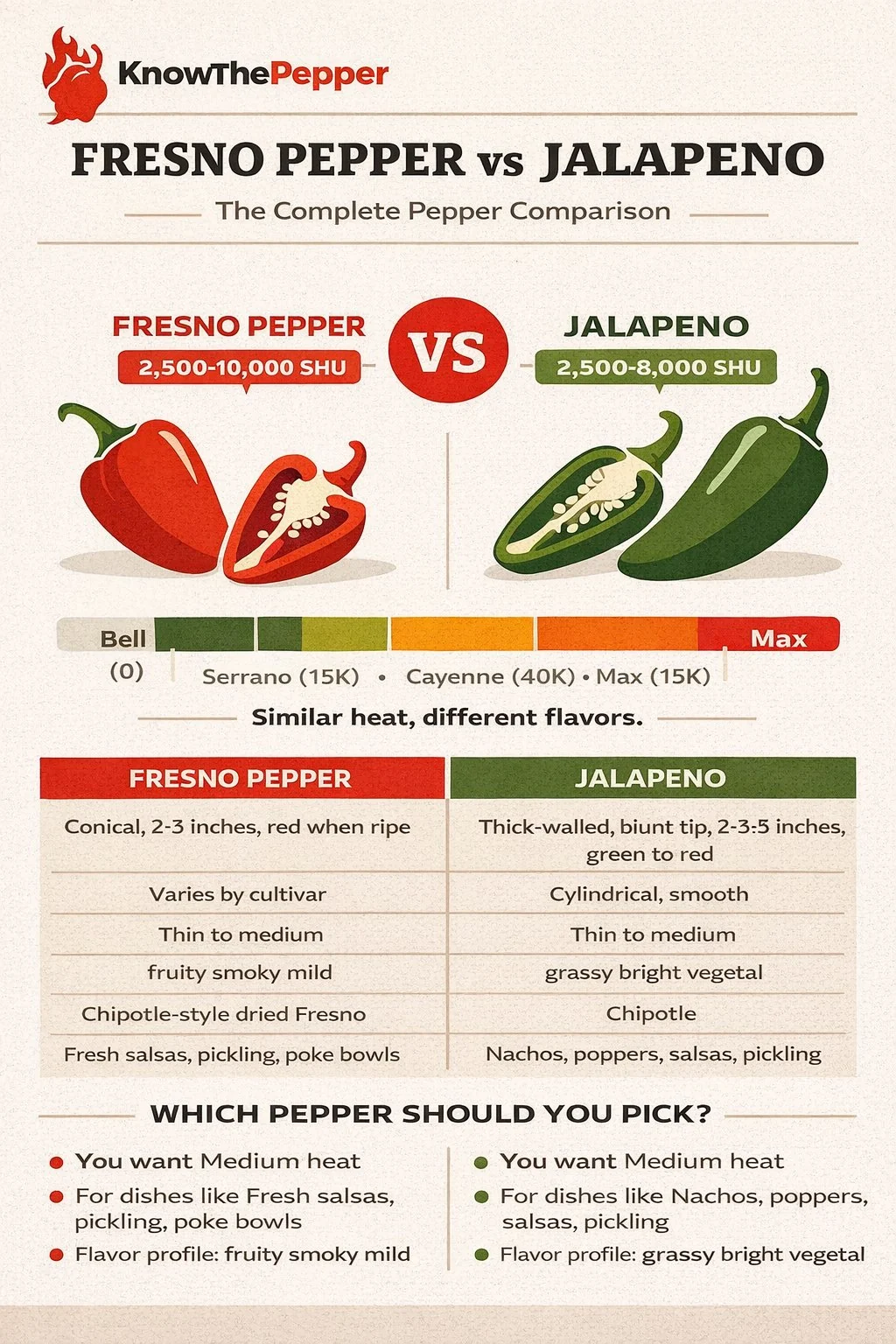
Both peppers sit in the 2,500-10,000 SHU range, which puts them squarely in what most heat reference charts call the medium-intensity SHU bracket — hotter than a banana pepper, cooler than a serrano. The overlap is nearly total: jalapeños top out at 8,000 SHU, while Fresnos can push to 10,000 SHU, giving the Fresno a slight edge at the ceiling.
In practical terms, that difference is rarely noticeable. A hot jalapeño and a mild Fresno are interchangeable in terms of burn. What changes is the character of the heat. Jalapeños tend to build slowly across the tongue and linger near the front of the mouth. Fresno heat hits a bit faster and spreads more broadly across the palate — not dramatically different, but detectable when you eat them back to back.
Both peppers contain capsaicin and dihydrocapsaicin as their primary heat compounds. If you want to understand why those compounds trigger the burn response at the receptor level, the chemistry is the same for both — TRPV1 activation regardless of which pepper you're eating.
Neither pepper approaches serrano territory (10,000-23,000 SHU), so anyone who handles serranos regularly will find both of these quite manageable. The jalapeño's reputation as a benchmark pepper makes it useful for calibration — but the Fresno's upper range does give it a measurable, if modest, heat advantage.
Flavor Profile Comparison
The Fresno pepper gets mistaken for a red jalapeño constantly — same conical shape, similar color, sold side by side at the grocery store.
Few peppers have earned their reputation as thoroughly as the jalapeño.
This is where the real difference lives. Jalapeños have a flavor that's almost universally described as bright and grassy — there's a clean, vegetal quality that makes them taste fresh even when cooked. That character comes through whether they're raw in pico de gallo, pickled in brine, or charred on a grill. It's a reliable, neutral-leaning heat that doesn't compete with other ingredients.
Fresnos are a different animal flavor-wise. They carry a fruitiness that reads almost like a mild red bell pepper crossed with a hint of smoke — especially when fully ripe and red. That smokiness isn't from processing; it's inherent to the pepper's flavor profile. Raw Fresnos taste sweeter and more complex than jalapeños at the same ripeness stage.
Color matters here too. Jalapeños are most commonly eaten green (unripe), which amplifies their grassy character. Fresnos are most often sold red (fully ripe), which concentrates their sugars and deepens that fruity quality. If you compared a green jalapeño to a red Fresno, the flavor gap would feel enormous — but that's partly a ripeness comparison, not just a variety comparison.
For raw applications — salsas, slaws, ceviche — jalapeños bring a sharp brightness that Fresnos don't quite replicate. For cooked applications, especially anything that benefits from a little sweetness or depth, Fresnos often produce a more interesting result. Both belong to the C. annuum botanical species, which also includes bell peppers, poblanos, and cayennes — a remarkably diverse family.
Culinary Uses for Fresno Pepper and Jalapeño
Jalapeños are one of the most versatile peppers in the Mexican pepper tradition — used raw, pickled, smoked (as chipotles), stuffed, and blended into sauces. That flexibility comes from their clean flavor, which adapts to almost any preparation without pulling attention toward itself. Nachos, salsa verde, jalapeño poppers, hot sauce — the applications are nearly endless.
Frenos, rooted in the American pepper-growing tradition, are newer to the mainstream but have carved out a specific niche in restaurant kitchens and specialty markets. Their fruity-smoky depth makes them particularly good in roasted salsas, grain bowls, and anywhere you'd want a pepper to add flavor complexity rather than just heat.
Substitution guidance: In most cooked dishes, Fresnos and jalapeños swap 1:1 without adjustment. The flavor shift is real but subtle enough that most recipes tolerate it. For raw preparations where jalapeño's grassy brightness is the point — think classic pico de gallo — a Fresno substitution will noticeably sweeten and soften the result. That might actually be an improvement depending on your preference.
For the banana pepper vs. jalapeño heat gap, Fresnos land much closer to jalapeños than to banana peppers — don't use them as a mild substitute.
Fresnos shine in: roasted pepper sauces, fermented hot sauces (their sugar content supports fermentation), red salsa, and as a garnish where color matters. Jalapeños dominate in: pickling, stuffing, green salsas, and anywhere you want that signature fresh-pepper punch.
Drying works better for jalapeños (chipotle is proof). Fresnos can be dried but their fruity notes don't survive the process as well. Both can be used at any ripeness stage — green Fresnos taste closer to jalapeños than red ones do.
Which Should You Choose?
If you're shopping for one and the store only has the other, swap freely — they're close enough that most dishes won't suffer. But if you're choosing intentionally, the decision is straightforward.
Reach for a jalapeño when freshness and brightness matter: raw salsas, pickling, anything green and sharp. The clean grassy flavor is a feature, not a limitation.
Reach for a Fresno when you want a pepper that contributes more than heat: roasted sauces, cooked dishes, fermented preparations, or anywhere red color adds visual appeal. The fruity-smoky depth is genuinely distinct.
The bird's eye chili vs. jalapeño heat contrast is far more dramatic than anything between a Fresno and a jalapeño — these two are practically siblings. And compared to the Calabrian chili vs. Fresno flavor profile, the Fresno is the milder, fruitier option.
Both are excellent, accessible peppers. Neither is a compromise.
Can You Substitute One for the Other?
Yes — direct substitution works. Fresno Pepper and Jalapeño are close enough in heat to swap at roughly 1:1. The main difference will be flavor. For more swap options, explore ranked alternatives with conversion ratios.
Growing Fresno Pepper vs Jalapeño
If you’re deciding which pepper to grow at home, consider your climate and patience level. Fresno Pepper and Jalapeño have different maturation times and temperature preferences. Hotter varieties generally need a longer, warmer growing season to develop their full capsaicin content. Our zone-based planting date tool can pinpoint the best sowing window for your area.
Fresnos are straightforward to grow but reward growers who manage water stress deliberately. Start seeds indoors 8–10 weeks before last frost — they germinate well at 80–85°F soil temperature and typically sprout within 10–14 days.
Transplant after all frost risk has passed, spacing plants 18 inches apart in full sun. They need at least 6–8 hours of direct light daily.
For more heat in your harvest, reduce watering by about 30% during the final 2–3 weeks of ripening. This mild drought stress increases capsaicin concentration noticeably — the same technique used commercially to push Fresnos toward the upper end of their 10,000 SHU ceiling.
Jalapeños are among the most forgiving hot peppers to grow, but they do have preferences worth knowing.
Start seeds indoors 8–10 weeks before your last frost date. Soil temperature for germination should stay between 75–85°F — a heat mat under the seed tray makes a real difference in germination speed and uniformity.
Transplant outdoors once nighttime temps stay consistently above 55°F. Jalapeños want full sun — at least 6 hours daily — and well-drained soil with a pH around **6.
History & Origin of Fresno Pepper and Jalapeño
Both peppers carry centuries of culinary heritage. Fresno Pepper traces its roots to USA, while Jalapeño originates from Mexico. Understanding their backstory helps explain why each pepper developed its distinctive traits.
Buying & Storage
Whether you’re shopping for Fresno Pepper or Jalapeño, the same quality indicators apply. Fresh peppers should feel firm and heavy for their size, with taut, glossy skin and no soft or wet spots. Minor stem cracks known as “corking” are perfectly normal and often indicate a mature, flavorful pod.
- Firm pods with taut skin and consistent color
- Should feel heavy relative to size
- Minor stem cracks (“corking”) are normal
- Avoid anything soft, shriveled, or with dark wet spots
- Fresh: Paper bag, crisper drawer — 1–2 weeks
- Frozen: Wash, dry, freeze on sheet pan — 6+ months
- Dried: Airtight, away from light — up to 1 year
The Verdict: Fresno Pepper vs Jalapeño
Fresno Pepper and Jalapeño occupy very different positions on the heat spectrum. Fresno Pepper delivers its distinctive fruity and smoky character. Jalapeño, with its bright and grassy profile, excels in everyday cooking.
Frequently Asked Questions
Related Comparisons
Sources pending verification.
