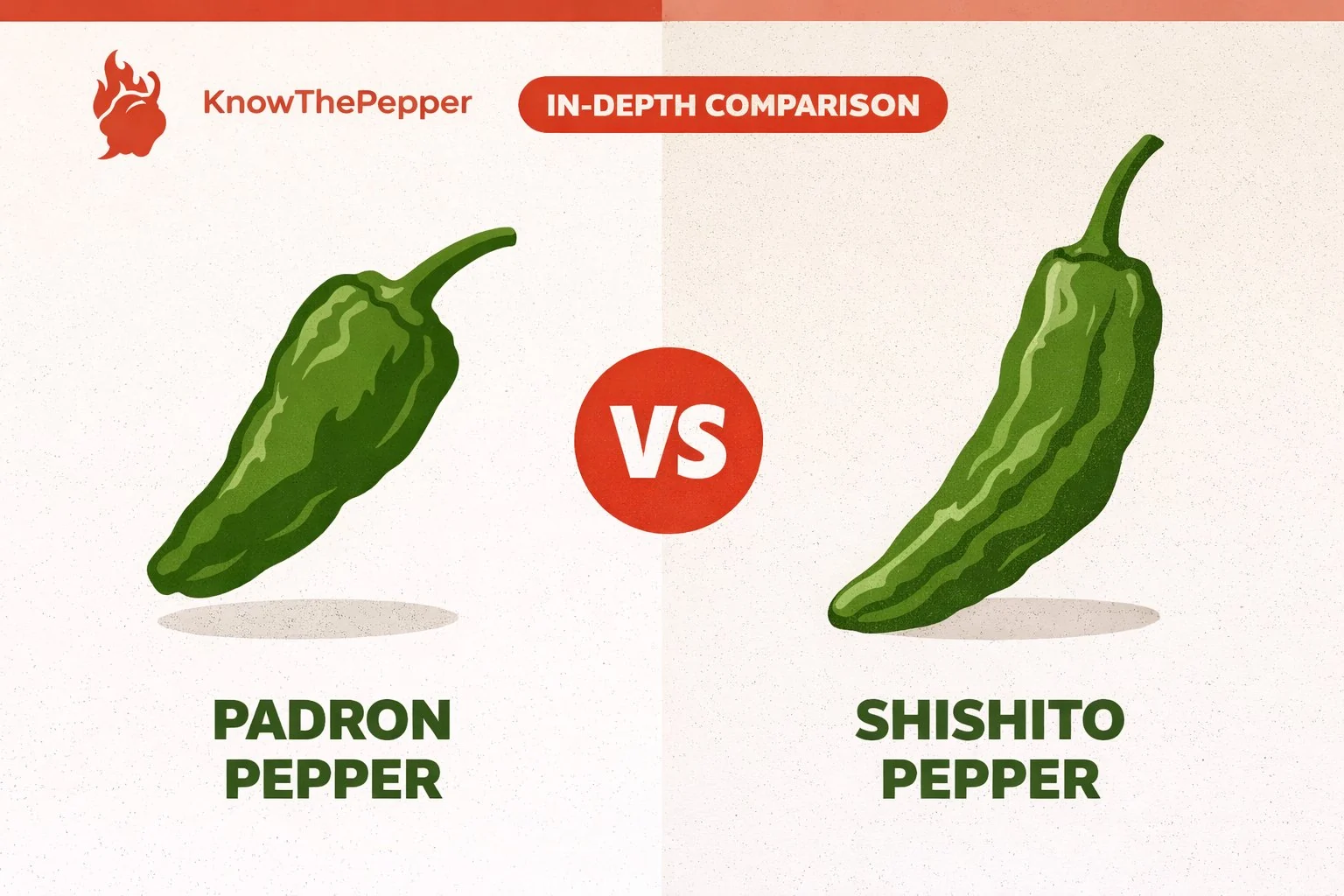
Shishito and Padron are both small green peppers for blistering, but they do not create the same plate. Shishito is usually sweeter, thinner-walled, and almost heatless at 50-200 SHU. Padron is earthier, more tapas-focused, and more variable at 500-2,500 SHU.
Comparison Contributor·Updated Jun 21, 2026·
Reviewed by
Karen Liu
Quick Comparison
Shishito Pepper measures 50–200 SHU while Padrón Pepper registers 500–3K SHU. That makes Padrón Pepper about 13x hotter by upper SHU range. Shishito Pepper is known for its sweet and grassy flavor (C. annuum), while Padrón Pepper offers mild and grassy notes (C. annuum).
Shishito Pepper
50–200 SHU
Mild · sweet and grassy
Padrón Pepper
500–3K SHU
Medium · mild and grassy
Heat difference: Padrón Pepper is about 13× hotter by upper SHU range
Species: Both are C. annuum
Best for: Shishito Pepper excels in everyday cooking and salsas, Padrón Pepper in fresh salsas and mild recipes
Shishito registers 50-200 SHU on the Scoville scale - essentially negligible heat for most palates. That puts it firmly in the heat category for Shishito at the very bottom edge of mild, where most people would call it mild-to-no-heat territory. A guajillo's characteristic dried-chile warmth runs roughly 2,500-5,000 SHU, making even the hottest Shishito about 12 times cooler than a mild guajillo.
Padrón is a different story. Its range of 500-2,500 SHU means the average Padrón is already several times hotter than any Shishito, and the hot ones approach that guajillo baseline. The Scoville rating system for testing pepper heat captures this variability well - Padrón's spread is nearly five times wider than Shishito's, which is exactly what makes eating a plate of them so unpredictable.
Both peppers carry the same genetic quirk: individual fruits on the same plant, from the same harvest, can vary dramatically in capsaicin content. With Shishito, the variation is mostly academic - you might notice a faint tingle on the hot ones. With Padrón, that variation is genuinely felt. The classic Spanish saying roughly translates to 'Padrón peppers, some hot, some not' - and the ones that are hot carry real bite. Neither pepper approaches jalapeño territory at their peaks, but Padrón can deliver a noticeable, lingering warmth that Shishito simply cannot.
Shishitos belong to Capsicum annuum peppers as a species, the same broad botanical family that includes bell peppers, jalapeños, and most of the peppers you'll find at any grocery store.
Padrón Pepper
500–3K SHU
mildgrassy
C. annuum
Crack open a bag of Padrón peppers and you get something unusual: a built-in game of chance.
Start with the nose: both peppers release a grassy, green aroma when they hit a hot pan, almost herbal with a faint sweetness. Shishito's scent is lighter, almost delicate - there's a citrus-adjacent brightness that opens up as the skin chars. Padrón smells a touch earthier, with a more pronounced vegetal depth, closer to green bell pepper territory but with more character.
On the palate, Shishito leads with sweetness. The flesh is thin and tender, with a clean, slightly grassy finish that doesn't linger long. It's the kind of pepper that lets olive oil, flaky salt, and lemon do the talking - the pepper itself is a pleasant, undemanding backdrop.
Padrón has more going on. The flavor is still mild and grassy at its core, but there's a subtle bitterness in the skin and a savory, almost smoky undertone that comes through whether you blister it in a cast iron or roast it whole. When you get a hot one, that capsaicin doesn't just bring heat - it amplifies the other flavors, making the grassiness more intense and the finish longer.
For cooking, Shishito's sweetness makes it the easier crowd-pleaser. Padrón's more complex flavor holds up better alongside bold ingredients - aged cheese, cured meats, full-flavored olive oil. Both benefit enormously from high-heat cooking, which concentrates their sugars and softens the raw grassy edge into something genuinely delicious.
Culinary Uses for Shishito Pepper and Padrón Pepper
Shishito Pepper
Mild
The standard preparation is almost aggressively simple: blister shishitos whole in a dry cast iron skillet or under a broiler until the skins char and blister in spots, then hit them with flaky salt. That's it.
The classic preparation - pimientos de Padrón - is almost aggressively simple: whole peppers blistered in olive oil over high heat until the skins char and blister, then finished with coarse sea salt. No trimming, no seeding, no sauce.
Blistering is the non-negotiable technique for both. Get a cast iron or carbon steel pan screaming hot, add enough oil to coat, and drop the peppers in a single layer. Don't crowd them - steam is the enemy of a good blister. They need 3-5 minutes of mostly undisturbed contact with the pan, turning once, until the skins are deeply charred in spots and the flesh has softened.
Shishito excels as a no-fuss appetizer. Blister, salt with flaky sea salt, add a squeeze of lemon or yuzu, and serve immediately. Japanese izakaya-style preparation is the gold standard - simple, fast, endlessly snackable. They also work sliced raw in salads where you want mild pepper flavor without heat, or skewered and grilled alongside fish. Tempura-battered Shishito is a legitimate revelation if you haven't tried it.
Padrón is the backbone of pimientos de Padrón, the Galician tapa that put this pepper on the international map. Blistered in olive oil, finished with coarse sea salt - that's the whole recipe, and it needs nothing else. The flavor complexity means Padrón also handles more assertive pairings: stuffed with goat cheese and briefly roasted, tucked into a bocadillo with jamón, or scattered over a tortilla española.
For substitution, the ratio depends on what you're after. If you want the blistered pepper experience with zero heat risk, Shishito replaces Padrón 1:1 in any recipe. Going the other direction - swapping Shishito for Padrón - works equally well by volume, though you lose the heat roulette element. The germination and growing guide for both is worth reading if you want to grow your own supply, since both are prolific producers that do well in containers.
Both peppers are at their best eaten immediately after cooking. They do not hold well - the blistered skin turns leathery within an hour.
Choose Shishito when the crowd includes heat-shy guests, when you want a guaranteed mild snack, or when the pepper is playing a supporting role in a dish where you need consistent flavor without surprise. It's the safer, sweeter, more universally crowd-pleasing option.
Choose Padrón when you want more flavor complexity and you're cooking for people who appreciate a little cooking suspense. The heat roulette is genuinely fun at a dinner party, and the earthier, more savory flavor stands up to bolder ingredients. The regional origin for Padrón shapes its natural pairing options - Spanish olive oil, cured meats, aged cheeses - in ways that Shishito, rooted in the regional origin for Shishito, doesn't quite replicate.
For growing, both are beginner-friendly annuals. Neither demands special treatment beyond warmth and sun. The main difference is what lands on the plate - and with Padrón, you genuinely don't know what you're getting until you bite.
Can You Substitute One for the Other?
Start near 1:1 by amount. The heat ranges are close enough that flavor, form, and recipe role matter more than a strict Scoville conversion.
Growing Shishito Pepper vs Padrón Pepper
Growing notes
Shishito Pepper
Shishitos are productive, relatively compact plants that suit both garden beds and large containers. They thrive in the same conditions as most C. annuum varieties - full sun, consistent moisture, and warm soil above 60°F at night before transplanting.
Start seeds indoors 8–10 weeks before your last frost date. Germination is reliable at 75–85°F; a heat mat helps considerably.
The plants are vigorous and branch well without much intervention. Fruit sets prolifically once daytime temperatures settle between 70–85°F.
Growing notes
Padrón Pepper
Padrón peppers follow the same basic calendar as most C. annuum varieties: start seeds indoors 8–10 weeks before last frost, transplant after soil temperatures reach 60°F, and expect first harvest roughly 70–80 days after transplant.
They prefer full sun and consistent moisture - Galicia's cool, humid climate shaped them, so they tolerate cooler summers better than most peppers. That said, they still need warmth to fruit well.
Plant spacing of 18 inches between plants gives enough airflow to reduce fungal issues, which matter more with thin-walled varieties. Unlike the long-season cultivation requirements of large Anaheim-type peppers, Padróns fruit relatively early and keep producing through the season if you harvest consistently.
Where They Come From
Origin & background
Shishito Pepper
Japan · C. annuum
Shishitos trace their roots to the Japanese pepper-growing tradition, where they've been cultivated for centuries. The variety likely descended from peppers introduced to Japan from Portugal in the 16th century, after Portuguese traders brought Capsicum species from South America to East Asia.
In Japan, shishitos became a fixture of izakaya culture - the casual pub-style dining that forms the backbone of Japanese social eating. Blistered and salted, they were a natural bar snack: quick to prepare, easy to share, and forgiving of a little char.
Origin & background
Padrón Pepper
Spain · C. annuum
Padrón peppers take their name from the municipality of Padrón in Galicia, northwestern Spain, where Franciscan monks are believed to have introduced the seeds from the Americas in the 16th century. The variety adapted to Galicia's cool, wet climate over generations, developing the thin-walled, mild character that distinguishes it from hotter American relatives.
By the 20th century, Padróns had become an iconic tapa across Spain, particularly associated with the Galician summer harvest from July through September. The famous Spanish saying - "Os pementos de Padrón, uns pican e outros non" (Padrón peppers: some are hot, some are not) - entered common usage as a proverb about life's unpredictability.
Buying & Storage
Whether you’re shopping for Shishito Pepper or Padrón Pepper, the same quality indicators apply. Fresh peppers should feel firm and heavy for their size, with taut, glossy skin and no soft or wet spots. Minor stem cracks known as “corking” are perfectly normal and often indicate a mature, flavorful pod.
Selection
What to look for
Firm pods with taut skin and consistent color
Should feel heavy relative to size
Minor stem cracks (“corking”) are normal
Avoid anything soft, shriveled, or with dark wet spots
Storage
How to store them
Fresh: Paper bag, crisper drawer, 1 to 2 weeks
Frozen: Wash, dry, freeze on sheet pan, 6+ months
Dried: Airtight and away from light, up to 1 year
Mistakes to avoid
Common misses
Shishito Pepper
Equating green with unripe. Different products.
Overcooking. Cell walls break down fast.
Sealed plastic storage. Causes rot. Use paper bags.
Common misses
Padrón Pepper
Equating green with unripe. Different products.
Overcooking. Cell walls break down fast.
Sealed plastic storage. Causes rot. Use paper bags.
Final call
Shishito Pepper vs Padrón Pepper
Shishito Pepper and Padrón Pepper
occupy very different positions on the heat spectrum. Padrón Pepper delivers about 13× more upper-range heat with its distinctive mild and grassy character.
Shishito Pepper, with its sweet and grassy profile, excels in everyday cooking.
Heat gap about 13× by upper rangeShishito Pepper sweet and grassyPadrón Pepper mild and grassy
Shishito Pepper is listed at 50-200 SHU. Padrón Pepper is listed at 500-2,500 SHU. At midpoint, Padrón Pepper runs about 12.0x hotter than Shishito Pepper. That is only a planning number, but it keeps substitutions from drifting wildly.
For substitution, start by matching the role before matching the number. If the pepper is mainly there for color or body, use volume as the guide. If it is there for heat, start with half the hotter pepper and taste before adding more. If it is a dried chile comparison, match by seeded weight after stems are removed, not by pod count.
Flavor is the second correction. Add a little vinegar or lime when the replacement tastes flat, a pinch of sugar when the replacement tastes bitter, and a small amount of smoked paprika only when the original pepper had smoke. Do not add smoke to a bright fresh-pepper dish unless the recipe already points that way.
Which Should You Choose
Choose shishito when you want a thin-walled, mostly mild Japanese-style blistering pepper for lemon, soy, sesame, miso butter, or bonito flakes. It is the safer choice for a crowd because the occasional hot pod is usually only a small surprise.
Choose Padron when you want the Spanish tapas experience: olive oil, coarse salt, grassy pepper flavor, and a higher chance that one pod on the plate will bite back. Padron also stands up better beside cured meat, aged cheese, and bold olive oil.
The decision is not only heat. It is serving style. Shishito is the easier mild snack; Padron is the classic tapas pepper with more heat roulette.
Best Method Match
Shishito works best as thin, wrinkled, delicate pods that blister quickly. Padron works best as small, firm pods that can be meatier and more heat-variable. This method difference changes timing. Add the pepper early when it needs to bloom into sauce or fat. Add it late when fresh aroma, texture, or table service matters. A pepper that is perfect for a skillet can fail in a stuffing recipe, and a dried powder can fail when the recipe needs visible fresh pieces.
Swap Checkpoint
For substitution, match the role before matching the SHU number. The safest starting point is swap at 1:1 by weight for blistered plates, then season to match the service style. After that, correct the dish around the missing trait: add acid when the swap tastes flat, add mild pepper body when the swap is too thin, and add heat separately only after the sauce or salsa rests for a few minutes. Do not add smoke unless the original pepper had smoke.
Shopping And Prep
Buy shishitos thin, wrinkled, and bright green. Buy Padrons small and firm; larger Padrons can run hotter or tougher. Prep should follow the form: roast fresh thick-walled peppers when skin matters, mince fresh thin peppers for raw bite, toast dried pods before soaking, and bloom powders in fat or liquid so they do not taste dusty.
Reader Scenario Notes
If the plate will carry soy, sesame, bonito, lemon, or miso butter, shishito feels more natural. If the plate is olive oil, salt, and tapas service, Padron is the classic choice. Cook both hot and fast so the skin blisters before the flesh collapses. Do not crowd the pan or the peppers steam instead of blistering. We treat this as the route-owned checkpoint because it survives the swap test: changing the pepper names would break the cooking advice, not merely change the label.
Common Mistake
The common mistake is promising that every pod will be mild. Both peppers can surprise you, but Padron is more famous for the occasional hot one. A second mistake is swapping by pod count when the peppers differ in wall thickness, drying level, or sauce form. Weight, texture, and cooking method are better guides than count.
Final Choice
Final choice: pick shishito for a mostly mild, thin-walled blistered snack. Pick Padron for Spanish tapas flavor with olive oil, flaky salt, and a higher chance of a hot pod.
Fact-Checked & Expert Reviewed
Editorial Standards: Head-to-head comparisons include blind tasting when applicable. Heat levels cross-referenced with multiple sources. All substitution ratios tested side-by-side.
Review Process:
Written by
James Thompson
(Lead Comparison Reviewer)
, reviewed by
Karen Liu
(Lead Fact-Checker & Science Editor)
. Last updated June 21, 2026.
Shishito Pepper vs Padrón Pepper FAQ
Capsaicin production in both varieties is highly variable and influenced by environmental stress - heat, drought, and soil conditions can trigger individual fruits to produce more capsaicin than their neighbors on the same plant. The receptor science behind why peppers burn explains how even small amounts of capsaicin can register differently depending on the person eating them. With Shishito, the variation is minor; with Padrón, it can mean the difference between a mild snack and a genuinely spicy bite.
Yes, at a 1:1 ratio by count or weight - both peppers are similar in size and respond identically to high-heat blistering. The main trade-off is flavor: Shishito is sweeter and lighter, while Padrón has more earthy depth and the occasional heat surprise. For classic pimientos de Padrón, Shishito makes a perfectly acceptable stand-in, though purists will notice the difference.
A typical jalapeño runs 2,500-8,000 SHU, meaning even the hottest Shishito (200 SHU) is at least 12 times milder. Padrón at its hottest (2,500 SHU) just barely touches the bottom of jalapeño territory. For most practical purposes, both blistered pepper varieties are mild enough for people who normally avoid spicy food.
A high-smoke-point oil is essential - the pan needs to be extremely hot for proper blistering, which rules out extra-virgin olive oil for the initial cooking. Use a neutral oil like avocado or refined grapeseed to get the char, then finish with a drizzle of good olive oil off the heat for flavor. For Padrón in particular, a fruity Spanish olive oil as the finishing touch is traditional and genuinely improves the dish.
No - they are distinct cultivars within the botanical family for Shishito, developed independently in Japan and Spain respectively. They look similar and share a grassy flavor base, which has led to frequent confusion, but Padrón's wider heat range and earthier flavor profile set it apart. Genetic studies suggest they share common ancestry through Portuguese trade routes, but centuries of selective cultivation in different climates produced two meaningfully different peppers.