
Which Peppers Make the Best Paprika for Color, Heat and Smoke?

For sweet garden paprika, the best-documented picks are New Mexico State University's low-heat NuMex cultivars, led by NuMex Garnet at 303 ASTA color units and 160 SHU. Hot and smoked paprika follow the Szeged and La Vera cultivar lists, and no source compares Hungarian, Spanish and US cultivars on one color scale.
Which Pepper Should You Pick for Sweet, Hot or Smoked Paprika?
For sweet powder from a home garden, the best-documented picks are the low-heat paprika cultivars bred at New Mexico State University, led by NuMex Garnet at 303 ASTA color units and 160 SHU.
Hot and smoked paprika follow different lists. The Szeged register names Szegedi F-03, 178 and 179 as its hot cultivars, and the Pimentón de la Vera register names Jeromín, Jariza and Jaranda for its hot style, while the smoke in Vera paprika comes from drying over oak, not from one pepper.
The order rests on published measurements, mainly extractable color, capsaicin limits and drying behavior, because no study found grows Hungarian, Spanish and US cultivars side by side. It is a reading of registers and breeder records, not a taste-test ranking.
| Goal | Start with | Published figures | Not established |
|---|---|---|---|
| Sweet powder, US garden | NuMex Garnet, R. Vince Hernandez, R Naky and Sweet | 303, 250, 188 and 157 ASTA, with 160 SHU, under 500 SHU, 260 to 760 SHU and 300 SHU (New Mexico State) | Flavor and sugar content, how the color holds in a home garden, and seed stock for Garnet, Sweet and R. Vince Hernandez |
| Sweet Hungarian-style powder | Szegedi non-hot 57-13, the only Szeged cultivar marked non-hot. Unmarked ones such as Szegedi 80 are not labeled either way | Powder minimum of 120 ASTA in the Szeged register and 85 in the Kalocsa register, with capsaicin up to 100 mg/kg for non-hot Szeged powder | A color figure for each cultivar, whether the unmarked cultivars are sweet, and which seed companies sell them |
| Hot powder | Szegedi F-03, 178 and 179, or Jeromín, Jariza and Jaranda | Szeged calls powder hot above 200 mg/kg capsaicin, and the La Vera register gives its hot style no figure | Capsaicin figures per cultivar, and any hot New Mexico paprika line, since the industry limit for a paprika-type chile is 500 SHU |
| Smoked powder | Jaranda, Jariza and Bola, the cultivars the La Vera register names | At least 90 ASTA, dried over oak or holm oak wood | Which cultivar holds smoke best, and whether these seeds are sold to US gardeners |
ASTA is the unit the registers and breeders use for color, and the next section explains what it measures. Register texts, the New Mexico State circular and the Chile Pepper Institute listings were read on 11 November 2026.
What Do the Hungarian and Spanish Registers Require?
Four protected-origin registers in the European Union give the only official cultivar lists and color floors found for paprika, and the table sets them side by side.
| Register | Cultivars named | Minimum color | Capsaicin and heat | Drying |
|---|---|---|---|---|
| Szeged (Hungary) | 19, including Szegedi 80, Szegedi 20, Mihályteleki and Rubinvörös. Hot: Szegedi F-03, 178 and 179. Non-hot: Szegedi 57-13 | 120 ASTA at packaging, or 3.9 g/kg total pigment, with a loss of up to 5 ASTA per month allowed | Up to 100 mg/kg tastes non-hot, 100 to 200 moderately hot, above 200 hot | Small sacks under eaves, drying chambers or conveyor driers, taking pods from about 80% water to under 10% |
| Kalocsa (Hungary) | 17, including Kalocsai 50, Kalocsai 801, Kalocsai V-2, Szegedi 80 and Rubinvörös | 85 ASTA at the end of the durability term, or 2.6 g/kg total pigment | 30 to 200 mg/kg moderately hot, 200 to 500 spicy, above 500 hot | Pods post-ripened 10 to 40 days, dried below 10% moisture, surface at most 80 °C |
| Pimentón de la Vera (Spain) | Sweet: Bola and Jaranda. Bittersweet (Ocal): Jaranda and Jariza. Hot: Jeromín, Jariza and Jaranda | 90 ASTA | Sweet, bittersweet and hot styles, with no capsaicin figure in the document | Dried with oak or holm oak wood, moisture at most 14% |
| Pimentón de Murcia (Spain) | Bola or americano | 120 ASTA for Extra and 90 for Primera, at milling | Capsaicin at most 0.003%, or 30 mg/kg, in both categories | Sun-dried or dried in a hot-air dryer, labeled either way, moisture at most 14% |
The minimums are not scores for a single cultivar, and they are not taken at the same moment: Szeged checks powder at packaging, Kalocsa at the end of its durability term, and Murcia at milling.
Several cultivars sit on more than one list, which shows that a register protects a place and a drying process more than one pepper. Szegedi 80, Szegedi 20, Remény and Rubinvörös appear on both Hungarian lists, and Bola is the base of both the smoked La Vera sweet style and the unsmoked Murcia powder.
What ASTA measures. ASTA color is the absorbance at 460 nm of an acetone extract of the ground paprika, scaled by sample weight, so a higher number means more extractable pigment and says nothing about heat. The authors of a 2013 Moroccan study of Niora paprika note that high-quality paprika usually exceeds 100.
How Much Color Do the New Mexico Paprika Cultivars Give?
New Mexico State University lists five releases as paprika-type chiles, and its 2023 cultivar circular gives ASTA color for four of them, from 157 for NuMex Sweet to 303 for NuMex Garnet.
The circular defines paprika in the United States as red pepper powder with undetectable or low heat, and it cites 500 SHU as the most heat the chile industry accepts in a paprika-type chile.
NuMex Garnet is a compact, open-pollinated plant with high yields and high dry matter in the fruit, bred as a natural red colorant for powder or oleoresin. Its pods average about 6.2 inches long and 1.5 inches wide, with walls about 1/4 inch thick.
Next in color is NuMex R. Vince Hernandez, released in 2015, at 250 ASTA and under 500 SHU. NuMex R Naky follows at 188 ASTA against 127 for 'New Mexico 6-4', with heat listed at 260 to 760 SHU.
The Chile Pepper Institute lists R Naky at about 80 days to maturity and Conquistador at about 90. Conquistador has no ASTA figure in the circular, carries capsaicinoids below 10 parts per million, and has thick flesh.
These are measurements of New Mexico pods, so they compare only loosely with the register minimums, which are taken on ground powder.
Seed for most New Mexico State cultivars comes through the Chile Pepper Institute, whose listings on 11 November 2026 showed R Naky and Conquistador in stock but did not confirm Garnet, Sweet or R. Vince Hernandez.
Does a Redder Pepper Make Hotter Paprika?
Redness and heat are separate measurements. The registers set a color floor and a capsaicin limit as two different tests, because the red carotenoids form as the pod ripens while capsaicinoids set the burn.
The registers give heat as capsaicin in milligrams per kilogram, not as SHU. The 2013 Niora study pairs 25 to 60 µg/g of capsaicinoids with 398 to 938 heat units, about 16 SHU per mg/kg, the convention described in the guide to the Scoville scale.
At that ratio the Murcia ceiling of 30 mg/kg is near 480 SHU, close to the US industry limit of 500 SHU. Szeged's 100 mg/kg line for non-hot powder is near 1,600 SHU and its 200 mg/kg hot line near 3,200 SHU, and these conversions are editorial arithmetic, not figures any register prints.
Heat also moves inside one cultivar. The Niora study found 398 to 938 heat units depending on harvest date, and the Hungarian food-safety authority Nébih found that two of 46 retail powders failed the capsaicinoid requirements for their hot labels, while three missed the minimum for natural coloring matter.
Does Wall Thickness Decide How Well a Pepper Dries?
One breeder statement ties wall thickness to drying: New Mexico State says NuMex Sweet has thinner walls than 'NuMex Conquistador' or 'NuMex R Naky', which allows more field drying. The same release gave 7,781 pounds of dry red chile per acre in a single harvest, about 40% more than R Naky.
Water content gives the other clue. The Szeged register describes pods falling from about 80% water to under 10% in drying, and a 2000 study of Jaranda and Jariza dried fruit that started at 85 to 88% moisture and found carotenoid levels in the dried fruit similar to or higher than in the fresh fruit.
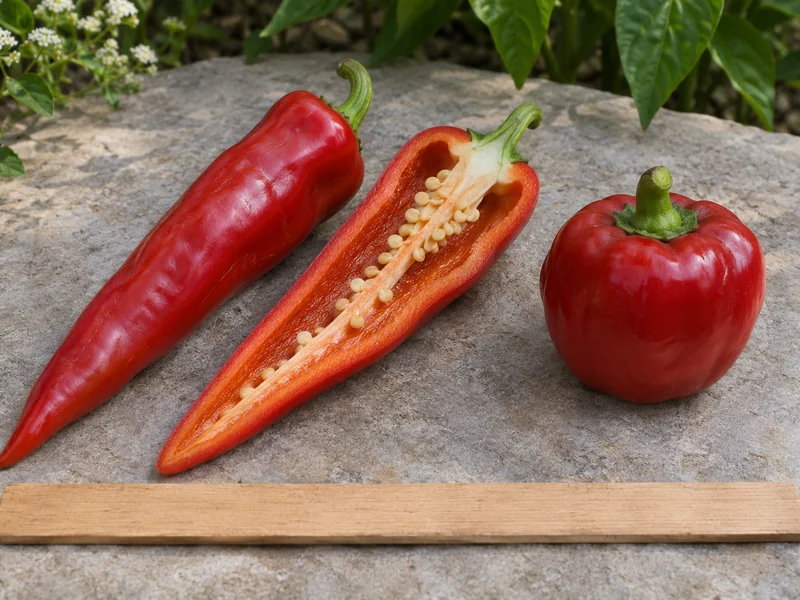
No source read measures drying time or powder yield per kilogram for individual cultivars. The idea that a thin wall dries faster rests on this one breeder statement and on how the registers describe drying.
General drying picks, including peppers that are not paprika types, are compared in the guides to peppers for drying and peppers for dehydrating.
Alma, whose name is the Hungarian word for apple, appears in neither Hungarian register and in none of the breeder records read, so no published color figure exists for it. Bell peppers are a different case, set against paprika peppers in a separate comparison.
What Else Changes Paprika Color Besides the Variety?
A cultivar sets a ceiling for color, and the same plant lands higher or lower depending on ripening, growing cycle, harvest date and storage.
- Ripeness. All five cultivars in a 2000 Spanish study made capsanthin and capsorubin during ripening, so a pod picked early has had less time to build them.
- Growing cycle. Across 12 cultivars bred for paprika, total carotenoids ranged from 4,857 to 12,698 mg/kg dry weight, and shorter cultivation cycles tended to give higher totals.
- Harvest date. Niora peppers in Morocco gave 112 ASTA in September samples and 144 in November.
- Storage. The Szeged register allows powder to lose up to 5 ASTA units per month after packaging, so even a protected powder fades on the shelf.
The Kalocsa text adds one step before drying, with pods post-ripened for 10 to 40 days after picking, and the guide on how to make paprika covers drying and grinding in full.
Which Pepper Makes Smoked Paprika?
The cultivar does not decide whether paprika is smoked, because the same Bola pepper appears in both a smoked and an unsmoked register. La Vera names Bola and Jaranda for its sweet style and Jaranda and Jariza for its bittersweet style and requires drying with oak or holm oak wood, while Murcia names bola or americano and allows sun or hot-air drying.
For a home batch, that points to choosing the pepper from the sweet or hot picks above and adding the smoke at the drying stage. Cooking with the result is covered in smoked paprika uses, and the differences between finished Hungarian paprika and Spanish paprika have their own comparison.
No source read says which cultivar holds smoke best, and no US seed listing for Jaranda or Jariza was confirmed, so a home smoked batch rests on cultivars chosen for color.
What Does the Evidence Not Settle?
Several questions a buyer or grower would ask have no published answer in the registers, the breeder circular or the studies read for this guide.
- No study read puts Hungarian, Spanish and New Mexico cultivars on one ASTA scale, and the figures here come from different methods, years and sites.
- Sugar content and flavor per cultivar were not found. The registers describe Szeged powder as sweet and reminiscent of ripe, baked butternut squash, and La Vera's bittersweet style as intense, entirely sweet or slightly sharp.
- Capsaicin per cultivar for the Szeged, Kalocsa and La Vera hot lines was not found, only the thresholds for finished powder.
- Whether register cultivars such as Szegedi 80 or Jaranda can be bought as seed, and how they perform outside Hungary and Spain, was not established.
- Alma has no published ASTA color, and no source read compares bell pepper powder with paprika-cultivar powder.
Which Peppers Make the Best Paprika for Color, Heat and Smoke? FAQ
Paprika is the ground dried pod of Capsicum annuum, and the registers name specific cultivars, with 19 on the Szeged list, 17 on the Kalocsa list, Bola, Jaranda, Jariza and Jeromín for La Vera, and bola or americano for Murcia. New Mexico State defines paprika in the United States as red pepper powder with undetectable or low heat.
None of the four registers lists a bell pepper cultivar, and the Kalocsa register specifies pods of the Longum variety of Capsicum annuum. No source read compares bell pepper powder with paprika-cultivar powder, so its color and flavor against a paprika cultivar are not established.
The registers say yes, with Szeged listing Szegedi F-03, 178 and 179 as hot cultivars and La Vera listing Jeromín, Jariza and Jaranda for its hot style. Heat is measured separately from color, and Szeged calls powder hot above 200 mg/kg capsaicin.
The registers set powder minimums between 85 and 120 ASTA, and a 2013 Moroccan study of Niora notes that high-quality paprika usually exceeds 100. New Mexico State measured 157 to 303 ASTA for its paprika-type cultivars.
- Szegedi fűszerpaprika-őrlemény / Szegedi paprika, EU product specification (OJ C 44, 2010)
- Kalocsai fűszerpaprika-őrlemény, EU single document (OJ C 303, 2011)
- Pimentón de la Vera PDO, specification amendment (2025)
- Pimentón de Murcia PDO, specification amendment (C/2025/4074)
- The Chile Cultivars of New Mexico State University, 1913 to 2022 (Circular 706)
- Chile Pepper Institute store, NuMex R Naky
- Chile Pepper Institute store, NuMex Conquistador
- Zaki et al. 2013, Quality characteristics of Moroccan sweet paprika, Food Science and Technology
- Hornero-Méndez et al. 2000, Carotenoid biosynthesis changes in five red pepper cultivars during ripening (PubMed 10995282)
- Hornero-Méndez et al. 2002, Carotenoid high-producing Capsicum annuum cultivars selected for paprika (PubMed 12236703)
- Mínguez-Mosquera et al. 2000, Carotenoid content of Jaranda and Jariza and slow industrial drying (PubMed 10898651)
- Nébih, Hungarian retail paprika test (46 products)
More Guides
 Kitchen Best Peppers for Chili: Build a Dried Chile Base, Then Add the Heat
 Kitchen Dried Mexican Chiles by Flavor and Heat, From Sweet Ancho to Chile de Arbol
 Kitchen Fresh vs Dried Peppers: How Flavor and Heat Change
 Kitchen How to Cut Jalapenos Without Burning Your Hands or Spreading Capsaicin
 Kitchen How to Deseed Peppers and Remove the Pith That Holds Most of the Heat
 Kitchen How to Dry Peppers at Home by Matching the Method to Wall Thickness